1
Preamble
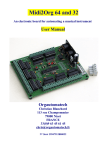
The Midi2Org_16 board isn't a musical instrument by itself. It is intended to be the
interface between an automated musical instrument and a MIDI data stream.
The MIDI data stream can originate from a computer, an iPhone (or similar), or a
dedicated reader (card SD like MIDILECTOR , or diskette).
It is also possible to drive lights, within the limits of the 35 volts DC, or even 220 AC
but with adapted relays.
The purpose of this user manual is not to explain the MIDI protocol. It is assumed the
user already has a basic knowledge of this.
Main features:
• 16 outputs, 35 volt , 500 ma max. On request this last value can be doubled by
coupling outputs.
• size: 85 * 70 mm
• The MIDI channel can be changed on the card by a push button and LED or by
Midi. This simple procedure is explained later in this document.
Responds to note-on, note-off, all sound off (CC120), all note off (CC123)
Considers note-on with velocity 0 as note-off
Supports MIDI running status
On demand, an output can be configured to respond to sustain (cc64) or
another control change of your choice
• Easy mapping of outputs by «self-learning» or by the freeware “Parametor”.
This simple procedure is explained later in this document.
• Chips are not soldered on the board. In case of an accident (for example a short
circuit in a solenoid) they are very easily replaced.
•
•
•
•
• Protection against bad polarity
• Compatible with every midi files player in respect to MIDI standard
• The MIDI OUT socket acts as a MIDI THRU. That means that every message
that arrived via MIDI IN goes out via MIDI OUT except active sensing
messages.
• For safety, there is a limit on the number of notes that may be played at once
on each Uln. The default setting is 4, and can be changed very easily by the
user with Orgautomatech freeware “Parametor”.
• Pushing any button will stop all notes
• Extra output with different functions to choose and program very easily by the
user himself.
• Solenoids test with just one button. This is explained later.