1
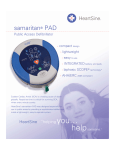
samaritan® PAD unit
System Status Ready
Indicator flashes, to show
that complete system is
operational
Feature:
Benefit:
Result:
System weighs 2.4 lbs (1.1 kg)
Lightweight
Easy to carry and transport
Only 2 buttons–ON & SHOCKaccessible even in storage case
Straightforward to
operate
Easy to use
Clear, easy to understand
visual and oral prompts
Guides rescuer through
each step in the process
Easy to understand
SCOPE® Biphasic escalating
energy waveform
(150/150/200J) & automatic
impedance compensation
Defibrillator automatically
optimizes energy output,
minimizing excess current
- no adjustments required
Provides significantly better
performance in removing ventricular
fibrillation (VF) by the third shock**
Visual cues prompt
pad placement
Press to deliver shock
when prompted. Button
illuminates.
Pad-Pak™
On/Off button
Stand clear of the patient
The samaritan® PAD system senses when pads are applied to
the patient, and automatically analyzes heart rhythm, advises
Feature:
Benefit:
Result:
One Pad-Pak cartridge contains
all system disposables – battery
AND electrode pads
One Pad-Pak updates ALL expired
components at once, quickly
restoring system readiness
Easy to maintain, with minimal
replacement parts
One expiry date – pads and
integrated battery together
Provides assurance that all
disposables are fresh with a
new Pad-Pak
No multiple dates or multiple
components to check
Pre-attached sensors provided
in an easily accessible drawer
No wires to connect, and pads are
accessible while in carry-case
Designed for emergency response
and quick system access
whether or not therapy should be applied, and delivers
carefully defined electrical shock designed to return the heart
*Self Compensating Output Pulse Envelope technology automatically compensates energy, slope and pulse envelope for the patient.
**Efficacy of Distinct Energy Delivery Protocols Comparing Two Biphasic Defibrillators for Cardiac Arrest,”Walsh, McClelland, Owens, Anderson, Turner, Adgey;
The American Journal of Cardiology, Vol. 94, Aug.1, 2004
to a normal rhythm.
It is safe to touch the patient