1
OPERATING INSTRUCTIONS
Before using this battery charger, make sure it is compatible with your battery.
Refer to the ratings on the battery charger, the specifications in this manual, and
your battery documentation. Charge only nickel cadmium type rechargeable
batteries. Attempting to charge other types of batteries may result in battery
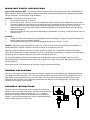
damage. This unit is provided with a polarized barrel plug connector. Make sure
your battery connector is wired to match the output connector.
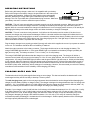
CAUTION: This unit is not reverse battery protected except by use of the polarized connector. Make sure your battery
connector is wired to match the charger connector or damage to the battery and charger may result when power is
applied. While in a reversed condition the charger will indicate that it is in the charging mode. However, it will actually be
discharging the battery at the rated charge current until either the battery or charger is damaged.
CAUTION: This unit is not short circuit protected - it will deliver the full rated current into a short. If the short is not
removed, the charger may overheat and be damaged. While in a shorted condition the charger will indicate that it is in
the charging mode. If the charging light is on while not connected to a battery then there is probably a short in the output
cable or connector. Remove the output cable to see if the charge light goes out. If the light stays on without an output
cable connected then there is a problem with the charger.
Plug the battery charger into a properly grounded (3-prong) wall outlet which supplies the correct input power as marked
on the unit. The indicators should be dark until a battery is attached.
Attach the output connector to the battery connector. The charger should now be on and charging the battery. The
orange CHARGING light should be on. If the green READY light is on instead then the battery voltage is probably too
high (too many cells). The battery must be a 1.2 to 14.4 volts (1 to 12 cells) battery.
The orange CHARGING light indicates that the charger is on and in the charging mode. The charger will deliver a
constant current (rated output current) to the battery for 13 to 15 hours. After this time, the unit will switch into the float
charge mode - the orange CHARGING light will darken and the green READY light will come on. At this point the battery
is fully charged. When the charger is in the float charge mode a constant current (1/4 that of the rated output current) is
delivered to the battery to keep it fully charged. Most nickel cadmium batteries may be left connected to the charger in
the READY (float) mode, indefinitely, without a danger of overcharging. However, we recommend you refer to the battery
manufacturers documentation for the suitability of float charging your battery.
CHARGING NOTES AND TIPS
The batteries should be fully discharged before being put onto charge. This has two benefits: the batteries will not be
overcharged and they will be less likely to develop a “memory effect”.
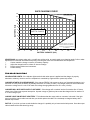
The safe charging curve graph on the next page represents what size batteries can be charged without damaging the
charger (for each battery capacity or charge current). The charger is designed to charge batteries at the C/10 charge rate
(capacity ÷ 10). If your battery capacity is 2.8 AHr (2800 mAHr) then the charger should be rated for 280 mA (2800 ÷10).
Refer to your battery documentation to see if the charger will charge your battery properly.
Example: If your charger is rated for 400 mA then it will recharge 4 AHr batteries between 4.8 to 13.2 volts (4 to 11 cells).
It will safely charge a 14.4 volt (12 cells) battery as long as the charger receives a full 115 volts ac input. If the input
voltage is below 115 volts, at that charge voltage, the maximum current will begin to drop and the battery may not be
fully charged. Attempting to charge 4 AHr batteries between 1.2 to 3.6 volts (1 to 3 cells) will cause the charger to
overheat and possibly be damaged - the batteries will not be damaged. Smaller capacity batteries will be overcharged
and larger capacity batteries will be undercharged.