1
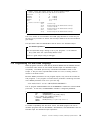
Note
For more detailed information regarding specific AS/400 model Web serving
capacity, see your IBM Representative.
8.5.1 CISC versus RISC
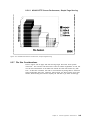
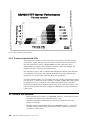
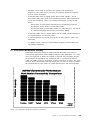
The HTTP serving environment on RISC AS/400 models provides better
performance (per CPW) than on CISC AS/400 models. The hits/sec/CPW factor
for RISC models is almost twice that of the CISC models. This is due to the
better RISC technology for C-language environments and to recent performance
improvements to TCP/IP and IC/400.
Note
Note that CPWs (relative system performance metrics) are derived from a
commercial workload′s capacity. Therefore, relative capacity ratios for Web
serving may not track accordingly. However, they should be adequate for a
high-level capacity planning exercise.
8.5.2 Response Time (General)
User response time is made up of Web browser (client work station) time,
network time, and server time. The response times in measurements taken on
the AS/400 system do not include Web browser time; they typically contribute 0.5
seconds to 2 seconds to response time. A problem in any one of these areas
may cause a significant performance problem for an end user. To an end user,
it may seem apparent that any performance problem is attributed to the server,
even though the problem is elsewhere.
It is common for pages that are being served to have imbedded images (gifs).
Each of these separate Internet transactions adds to the response time as they
are serially retrieved from various servers (some browsers can concurrently
retrieve two URLs).
8.5.3 HTTP and TCP/IP Configuration Tips
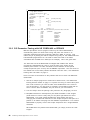
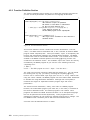
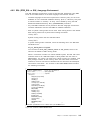
1. The number of HTTP server jobs (CHGHTTPA command) controls the
minimum and maximum number of HTTP server jobs handling HTTP
requests. The reason for having multiple server jobs is that when one server
is waiting for a disk or communications I/O to complete, a different server
job can process another user′s request. Also, for N-way systems, each CPU
may simultaneously process server jobs. The system adjusts the number of
servers that are needed automatically (within the bounds of the minimum
and maximum parameters).
The smallest minimum allowed is two (one parent and one child server).
Typically three to five servers are adequate for smaller systems (50 CPWs or
less). For larger systems (more than 50 CPWs) dedicated to HTTP serving,
increasing the number of servers to 10 or more may provide better
performance. Also, if CGI or Net.Data is used (which are more disk I/O
intensive), configuring more servers may provide better performance. Try
not to have more than what is needed as this may cause unnecessary
system activity.
Chapter 8. Internet Application Performance
243