1
−
−
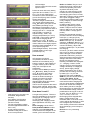
Pic. 5
Pic. 6
Pic. 7
Pic. 8
LCD backlight
internal cooling fan with smooth
speed control
Pulsar can work with many battery
types like: Ni-Cd, Ni-MH, Li-Ion, LiPol, Li-Ta, Pb-bar, RAM (at the
moment this review was written, I've
got info from Elprog, that Li-FePO4
support was added).
Just after charger is switched on,
you can set general parameters
using „M” button (Pic.5) like sound
alert, Tmax (controlling of max.
temperature of the battery), T-on –
max. battery temperature for start of
charging (30-45°C – charger will
wait for battery cool down to
adjusted temp.), T-off – stop
charging temperature (50 - 65°C)
and V-off – power supply voltage
below which charging will be
stopped (10-11.5V). „E” button
starts a work modes, +/- buttons are
used to select one of eight program
memories (freely adjustable) or one
of two special programs
(Format/Regeneration). There's also
possible display of last, eight
processes (Pic. 6).
User manual
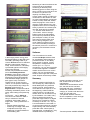
Pic. 9
Pic.10
Pic. 11
−
−
−
−
−
cells format up to 4A (with user
switchable „Regeneration”
function)
Car's battery overcharging
protection (when Reverse
function is used)
Too low car's battery voltage
threshold (adjusted between 10
and 11.5V)
wrong polarity protection
external cooling fan socket is
short circuit protected
At first glance it looks bit
complicated, because so many
features are controlled by only 4
buttons. However, after reading of
12 page manual you'll be able to
freely use of all options and
parameters.
In short: Choose what you want to
do („M” button), how you want to
do it („E” button) and change
values using +/- buttons. The
manual is divided according to
charger's functions (charging,
discharging etc.). There are
diagrams describing all functions
and possible parameters.
There's a nice surprise at the end of
this tiny book: sample, step by step
description of programming process.
How does it work?
Let's get to the practice. There are
few tools available for the user like:
charging Ni-Xx, charging Li-Xx, LiTa, Pb, RAM, discharging,
discharging and charging, format
(with regeneration function), cells
test.
Ni-Xx charging can be done in
Delta peak/Inflex/Reflex modes.
Although you'll find Delta peak
mode in almost all chargers on the
market, you'll not find the last two:
Reflex and Inflex. They're not so
frequently found in chargers (the
second one probably isn't used
anywhere else at all). Inflex
charging is a fast charging mode,
however, there's no possibility of
overcharging (as it exist in normal,
ΔP mode). Charging will be stopped
at the point of biggest voltage
increment (just before battery pack
is fully charged). It avoids too high
battery warming.
In Reflex mode, there's a short
discharging (balancing) impulse
added. It helps to avoid so called
memory effect (you can say after
manual „Reflex – always gives a
profits”).
Here's how the sample charging
process looks like: Choose charging
mode (Pic.7), cell type (Pic.8),
switch Inflex mode on (Pic.9), add
Reflex mode (Pic.10), as manual
suggests, set Delta to low (Pic. 11)
and charging current (Pic.12). Now,
connect the battery, adjust cells
number if needed (Pic. 13) and start
the charging.
Of course, you don't need to do that
every time you want to charge the
same cells type or with the same
parameters. Next time, you'll just
select that program with all previous
settings and connect the battery.
During the charging process,
following information are displayed:
„C” - charging, number of cells,
charging current, actual charging
voltage, raise/drop of voltage (an
arrow), power supply voltage,
battery temperature (Pic.14) and
process time and energy received
by battery (Pic. 15). For the
remaining cell types (Li-Xx, Pb,
RAM etc.) we can choose following
model: Fast, Reflex, V-end.
The Fast mode is a pulse charge
mode which makes charging time
over two times shorter. V-end mode
let the user set the final voltage to
which battery has to be charged.
Discharging let's you discharge cells
to their threshold voltage, which is
predefined for each type of cell: NiXx 0.9V, Pb 1.8V, RAM 1V, Li-Ion
2.7V, Li-Pol 3V, Li-Ta 2.4V.
Discharging will be stopped after
battery voltage drops to the
threshold value. In the Auto mode,
current will be decreased by ¼ each
time voltage drops to threshold
value. Entire process will be finished
when discharging current drops to
200mA.
Reverse is a very interesting
function