1
UV-Visual Echelle SpectrographUser manual
VLT-MAN-ESO-13200-1825
43
frames have been proven to correct well for fringing up to S/N ratios of at least 300. To the
FF calibrations applies the same note of caution regarding stability depending on air pressure
and temperature mentioned for the wavelength calibration in Chapter 4.2. FF exposures can
also be attached to science OBs.
4.5
Flux standard star observations
Spectrophotometric standard stars can be used to obtain response curves of the instrument
to allow a relative flux calibration of the spectra and at the same time to correct for the blaze
function of the different orders before merging. Such calibrations are only obtained on the
request of PIs, with usually a 10 arcsec wide slit, i.e. with negligible slit losses.
For an absolute flux calibration both, the science spectrum and the standard star spectrum
have to be obtained under photometric conditions at similar airmasses and preferably with
the same slit width. In this case, dedicated OBs have also to be provided by the observer or
service mode PI. Recently for QC purposes, daily monitoring of spectrophotometric standard
stars using three Dichroic settings (346+580, 390+564, 437+860) and 1 × 1 binning has been
introduced during twilight.
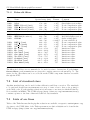
A table of flux standard stars suitable for observations with UVES is given in the Appendix.
For flux standards only, the “std” Observing Templates have to be used.
The response curves of the UVES spectrograph are found to be very stable with time. Therefore, master response curves for all standard instrument settings are provided through
the quality control webpages under http://www.eso.org/observing/dfo/quality/UVES/qc
/std qc1.html which can be used to correct for the relative response of the instrument. A
correction of the science spectra by the master response curves does allow to recover to a
certain extent the shape of the source continuum or to measure relative line strengths across
the complete UVES spectral range.
4.6
Quality Control
All calibrations taken in one of the standard settings are pipeline-processed and qualitycontrolled by the Quality Control group at ESO Garching. The calibration products are delivered with the corresponding Service Mode data. More information about the UVES quality
control can be found under http://www.eso.org/observing/dfo/quality/index uves.html.
The time evolution of the most important instrument parameters like resolving power, spectral stability, detector characteristics, and others can be followed with the help of continuously
updated trending plots as available on the UVES QC webpages.
4.7
4.7.1
Special calibrations
Use of the iodine cell for accurate radial-velocity measurements
As indicated in Chapter 2, UVES is equipped with an iodine absorption cell which can
be inserted in the beam and operated remotely to obtain a dense grid of iodine absoprtion
lines superimposed on the target spectrum. The iodine cell currently mounted on UVES has