1
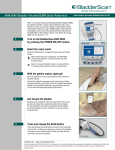
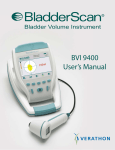
Bladder Scanner Maternal Health Manual Bladder Scan BVI 9400 Original Date Grey Nuns Community Hospital POLICY Revised Date Next Review: Approved by: Director, Maternal, Neonatal & Child Health, Covenant Health, GNH/MHE March 11, 2011 March 2014 Page 1 of 3 Purpose The purpose of this policy is to assist staffs competence in usage of the BVI 9400 Bladder Scan. This policy aims in using non-invasive screening methods for detecting postpartum urinary retention after delivery, thereby reducing the number of unnecessary catheterizations, risk of urinary tract infections, and improving patient satisfaction due to the non-invasive nature. Applicability This policy applies to licensed practical nurses, registered nurses, and students trained in operation of the BVI 9400 Bladder Scan. Responsibility It is any licensed practical nurse, registered nurse, or student’s responsibility to read the entire BV1 9400 BladderScan Manual and have received a clinical inservice or formal training prior to operation of the Bladder Scan. Principles There are two methods for assessing post-void residual (PVR) urine volume: sterile catheterization (direct measurement of urine volume) and bladder ultrasound (indirect estimation of urine volume). Bladder ultrasound scanning offers a non-invasive alternative to catheterization. The scanner is used, primarily as a diagnostic aid, to non-invasively identify incomplete bladder emptying and determine bladder volume in adults with urinary problems of varying aetiologies such as: postoperative patients at risk of urinary retention (UR) patients with urinary tract infections (UTI), neurogenic bladder, and other lower urinary tract dysfunctions postpartum patients with signs and symptoms of suggestive voiding dysfunction (lower abdominal discomfort, dribbling of urine, urgency) See Bladder Scan Algorithm in Appendix A for criteria for use of the bladder scanner. The bladder scan should be used in preference to catheterization in the measurement of PVR volumes, on the grounds of acceptability and reduced rate of adverse events. Procedure 1. Turn on the BladderScan BVI 9400 by pressing the POWER ON/OFF button. 2. Select scanning mode. The BVI 9400 is designed to scan in three patientspecific modes. Select the proper exam mode to ensure the accuracy of your scan. Simply press the button repeatedly until the desired setting appears. Please see the BVI 9400 User’s Quick Reference laminated document located on the bladder scanner. 3. While the patient is supine, apply gel. Have the patient lie in the supine position with abdominal muscles relaxed. Palpate the patient’s symphysis Bladder Scanner 4. 5. 6. 7. 8. Date Approved March 2011 Policy No. Page 2 of 4 pubis (pubic bone). Place an ample quality of gel (with as few air bubbles as possible) midline on the patient’s abdomen, approximately one inch (3 cm) above the symphysis pubis. Aim toward the bladder. Standing at the patient’s right side, place the Probe on the gel and aim toward the expected location of the bladder. For most patients, this means tilting the Probe slightly toward the patient’s coccyx (tailbone) so the scan clears the pubic bone. Press the SCAN button. This is located on the underside of the probe. As the scan progresses, sections of the bladder will appear on the console screen. When you hear the end-scan tone, the scan is complete. Verify the scan. If the scan is ‘on target’ all eight arrows will flash on the Probe screen, and the bladder will be shown in the center of the crosshairs on the Console screen. Since no re-aiming is need, no arrows will appear on the Console screen. If Re-aiming is needed see BVI 9400 User’s Quick Reference located on the bladder scanner. Finish exam. Once you have completed the scan, wipe the ultrasound gel off the patient and the Probe. Clean the Probe. The Probe can be wiped with hospital approved cleaner (i.e. Virox). Thoroughly dry the instrument with a clean, soft cloth. Definitions Urinary Retention- the inability to pass urine despite persistent effort. Urinary Retention is based on post-void residual urine volume. Although there is no clear consensus regarding normal or abnormal residual volume, clinically significant volumes could vary between a lower limit of 50mL and an upper limit of 300mL. Contraindications The BladderScan BVI 9400 is not intended for fetal use or for use on pregnant patients. Risk of Inaccurate Measurements/Results The following conditions which can affect ultrasound transmission and decrease the accuracy of exam results: Patients who have had supra-public of pelvic surgery. Scar tissue, surgical incisions, sutures, and staples. Do NOT use on a patient with open skin or wounds in the suprapubic region. Do NOT use on a patient with ascites. If you scan a patient with a catheter insitu, the catheter may affect measurement accuracy. However, the information obtained from the measurement could still be clinically useful for detecting problems such as a blocked catheter. References BladderScan BVI 9400 Bladder Volume Instrument User’s Manual (2008) Verathon Inc. North Creek Parkway Bothell, WA. Evidence Note (2010). Portable bladder ultrasound scanners. Number 32, p. 1-9. Journal of Wound Ostomy Continence Nursing (2011). The Effect of the Bladder Scanner Policy on the Number of Urinary Catheters Inserted. 38 (1) 71-76. Bladder Scanner Appendix A Date Approved March 2011 Policy No. Criteria for use of the bladder scanner Reference: The Effect of the Bladder Scanner Policy on the Number of Urinary Catheters Inserted. (2011). Journal of Wound Ostomy Continence Nursing, 38 (1) p.72 Page 3 of 4 Bladder Scanner _________________________ GAIL CAMERON DIRECTOR MATERNAL, NEONATAL & CHILD HEALTH PROGRAMS COVENANT HEALTH GREY NUNS & MISERCORDIA HOSPITALS Date Approved March 2011 Policy No. ____________________ DATE Page 4 of 4