1
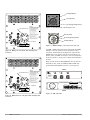
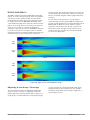
Figure 24. M3D Line Array and M3D-Sub with looped connections
When the two are driven with the same signal but the
M3D-Sub is attenuated by 6 dB, the response is identical
to the M3D Line Array alone but extends to 30 Hz, as
shown in Figure 25.
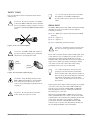
Figure 25. M3D Line Array and M3D-Sub with M3D-Sub attenuated by 6 dB
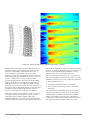
The third option provides optimal headroom to the M3Ds,
while adding an often preferred frequency response
bump centered around 65 Hz. This configuration, shown
in Figure 26 and Figure 27, high passes the M3D
loudspeakers in the array while letting the M3D Subs use
their normal internal crossover frequencies. If the 65 Hz
bump in the spectrum isn’t desired, an equalization filter
can be used to flatten the overall response, while still
optimizing system headroom.
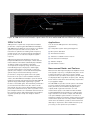
To achieve this, drive the M3D loudspeakers using the
DS-2 (or mid bass) output of the LD-1A line driver, as
shown in Figure 26 or the LD-2 line driver as shown in
Figure 27, with the DS-2 crossover engaged and with no
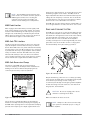
polarity reversal. This provides a crossover function by
rolling off the M3D Loudspeakers below 80 Hz, as shown
in Figure 28. increasing its headroom at very low
frequencies.
Meyer Sound Laboratories Inc
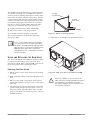
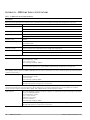
The DS-2 & Sub Crossover network is composed of a
low-pass and an elliptical filter. Pushing the switch in
activates the two-way crossover, sending frequencies
below 80 Hz to the Sub output and above 80 Hz to the
DS-2 output. With the switch out, a full-range signal is
sent to both the DS-2 and Sub outputs. Since this filter
affects the DS-2 out and the SUB out the M3D-Subs need
to be connected to the Mid-Hi output receiving a full
range signal.
NOTE: Full-range signals may be applied to
Meyer self powered subwoofers because they
have built-in active crossovers that filter midhi frequencies; external crossovers are
unnecessary.
M3D™ Line Array • 15