1
672
CHAPTER 16
Acid-Base Equilibria
Relative Strengths of Acids and Bases
Some acids are better proton donors than others; likewise, some bases are better proton acceptors than others. If we arrange acids in order of their ability to
donate a proton, we find that the more easily a substance gives up a proton,
the less easily its conjugate base accepts a proton.
Similarly, the more easily a base accepts a proton, the
ACID
BASE
less easily its conjugate acid gives up a proton. In
ClHCl
~
other words, the stronger an acid, the weaker is its conju~
100%
{
00
HS04H2S04
gate base; the stronger a base, the weaker is its conjugate
ionized in
~
H 20
acid. Thus, if we know something about the strength
No3 HN03
of an acid (its ability to donate protons), we also
H 30+(aq)
H 20
know something about the strength of its conjugate
QJ
HS04solbase (its ability to accept protons).
!U
QJ
The inverse relationship between the strengths of
H2P04H3P04
't.l"'
acids and the strengths of their conjugate bases is
FHF
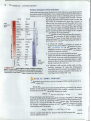
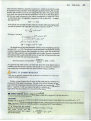
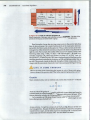
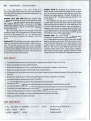
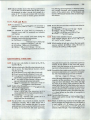
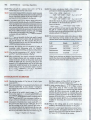
illustrated in Figure 16.4 ~ . Here we have grouped
-s00
CH3COOH CH3COOacids and bases into three broad categories based on
QJ
=
J:j
their
behavior in water.
HC03 H2C03
~
QJ
1. A strong acid completely transfers its protons to
HSH 2S
~ I:Q!U
!U
water, leaving no undissociated molecules in soluQJ
HPOlH 2P04't.l"'
tion. c:x:o (Section 4.3) Its conjugate base has a
NH4+
NH3
negligible
tendency to be protonated (to abstract
-s00
protons) in aqueous solution.
HC03colQJ
=
2. A weak acid only partially dissociates in aqueous so'"'
HP042Pollution and therefore exists in the solution as a mixt.l
OHH 20
ture of acid molecules and their constituent ions.
<,
o2OHThe conjugate base of a weak acid shows a slight
100%
~
ability to remove protons from water. (The conjugate
Hprotonated
-~ H2
bo
base of a weak acid is a weak base.)
in
H
0
}
2
CH3z CH4
3. A substance with negligible acidity, such as CH4,
contains hydrogen but does not demonstrate
..6. Figure 16.4 Relative strengths of some conjugate add-base
any acidic behavior in water. Its conjugate base is
pairs. The two members of each pair are listed opposite each other in
a
strong base, reacting completely with water, abthe two columns. The acids decrease in strength from top to bottom,
whereas their conjugate bases increase in strength from top to bottom.
stracting protons to form OH- ions.
z
(/}
(/}
!ll
.s
(/}
(/}
(/}
.s
j
-·
(/}
:s
Q)
Q)
Using the three categories above, specify the strength of HN03 and the strength of its
conjugate base, N03- .
We can think of proton-transfer reactions as being governed by the relative
abilities of two bases to abstract protons. For example, consider the proton
transfer that occurs when an acid HX dissolves in water:
HX(aq)
+ H20(l)
~ H30+(aq)
+
x - (aq)
[16.9]
If H 20 (the base in the forward reaction) is a stronger base than x- (the conju-
gate base of HX), then H 20 will abstract the proton from HX to produce H 30 +
and x-. As a result, the equilibrium will lie to the right. This describes the
behavior of a strong acid in water. For example, when HCl dissolves in water,
the solution consists almost entirely of H 30 + and Cl- ions with a negligible
concentration of HCl molecules.
HCl(g) + H20(l) ~ H 30 +(aq) + Cl- (aq)
[16.10]
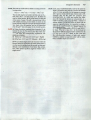
H 20 'is a stronger base than Cl- (Figure 16.4), so H 20 acquires the proton to
become the hydronium ion.















![取扱説明書[SR-HC3/HD3] (18.15 MB/PDF)](http://vs1.manualzilla.com/store/data/006529571_2-3b48fa831230383b69c16cb739499147-150x150.png)