1
N° de document : 99XXC_IM vers01, Nov 2006
INSTRUCTIONS FOR USE
Type and name
Reference
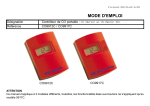
Portable CO detector : CO Metre® and CO Metre® Pro
CO9912C / CO9917C
CO9912C
CO9917C
WARNING
This manual applies to 2 different models, however the instructions dealing with the buttons only apply to the
9917C model.
Information provided by the CO Metre® PRO
Sensor
Alarm and charge
LED
Sound Alarm
Switch
Battery
compartment
LCD screen with
digital information
Control buttons
Carbon Monoxide (CO) is the polluting gas which is the most produced in the world , in far greater volumes
than all other polluting gases put together. Moreover it is particularly treacherous as it is a colourless and
odourless gas and is thus undetectable. Its lethal effects in confined premises are well-known. It is formed
during the combustion of carbonaceous substances (hydrocarbons, coal, wood) and is very toxic when its
concentration reaches a certain threshold (See recommendations of W.H.O.).
CO penetrates the circulatory system via the lungs and is absorbed by the haemoglobin (red corpuscles) 200
times more rapidly than oxygen. As the CO accumulates in the blood, the body is more and more deprived of
oxygen. Long term exposure to a weak concentration of CO may lead to permanent brain or heart damage. A
head ache may be a first symptom (similar to that of influenza).
The contents of these documents may be modifies without prior notice.
The CO Metre® or CO Metre® Pro enable you to control the level of CO to which you are exposed: it is a detector
and analyser of CO, driven by a micro calculator which can measure the concentration of CO in the air with
great accuracy.
The results of the analysis are given in ppm units which account for traces or very small concentrations of gas
in the air.
Ppm stands for: parts per million.Thus when a detector indicates a result of 6 ppm, there is a proportion of 6
volumes of CO in the air or 6 cm3 for 1000 000 volumes of air (1m3), that is to say 6 millionths of CO in the air.
This detector is equipped with the most technologically advanced sensor and guarantees accurate measures
ranging from 0 to 999 ppm. You will be able to use it for many years without having to make any adjustments
to it.
USES OF THE CO Metre® PRO
The CO Metre® or CO Metre® Pro enable you to:
-Identify a heater or boiler which does not draw sufficiently
-Realise that your chimney fire is blowing back
-Realise that there is a leak in your chimney flue
-Identify faulty evacuation of an electric generator
-Identify bad ventilation in a garage
The use of the detector can provide other types of information: tobacco is a major source of CO. In certain
public places such as offices, badly ventilated premises, it is sometimes possible to detect levels of CO
exceeding 30 ppm. Also in heavy traffic (especially in tunnels or underground car parks) you can frequently
come across high levels of CO.
The contents of these documents may be modifies without prior notice.
POSITIONING OF THE BATTERIES
The battery compartment is at the back of the detector.
Press lightly on the grooves of the cover and slide towards the
bottom of the detector.
SWITCHING ON YOUR DETECTOR
Take the detector and slide the switch located on the right hand side of the detector upwards.
When you switch your CO Metre® or CO Metre® Pro on, the following indications will appear during the
first two seconds on the screen:
PPM
These indications and a final 'beep' will inform you that your detector
has successfully carried out an automatic test and is operational.
The contents of these documents may be modifies without prior notice.
Ö
Place the 6 batteries - type AAA- making sure the polarities (+ and -)
are correctly in position.
HOW YOUR CO Metre® OR CO Metre® PRO FUNCTIONS
Once the test has been carried out, the detector gives indications on the amount of time the
batteries can run before they need recharging First of all the message 'CAP' will appear
indicating that the capacity of the batteries is about to be displayed. Then one of the following
diagrams will appear indicating the state of the batteries.
Fully charged
5/6
4/6
3/6
2/6
1/6
Some types of batteries (depending on technology) allow you to estimate remaining capacity.
Next, the detector will indicate ambient temperature:
z First in Celsius degrees:
Ö
Ö
z Then in Fahrenheit degrees:
Ö
Ö
empty
Important: The temperature which is shown on the screen is only an indication as it represents the temperature
inside the casing of your detector. Furthermore if there is a sudden change of temperature from hot to cold or
vice versa, the temperature on the screen might be inaccurate. You should also take into account the
temperature of your hand which might also influence the temperature.
The sensor inside the detector then undergoes a cleaning phase. This phase lasts
approximately 30 seconds. Meanwhile, PPM flashes on the screen and then some activity
on the screen indicates that the process is under way. Then the detector takes a sample
of air from the atmosphere and displays the amount of CO measured.
The contents of these documents may be modifies without prior notice.
Every two seconds, the micro calculator recalculates the concentration of CO and then
displays it on the LCD screen - identical if the figures are unchanged - but different if the
level has been modified.
The length of the cleaning phase corresponds to the length of time needed to clean a normally soiled sensor.
If your detector indicates a few ppm in a sound environment, this means that it might have been soiled
beforehand. A short time later it will give you the correct figures.
HOW TO INTERPRET THE MEASURES
The CO Metre® or CO Metre® Pro enables you to know precisely how much CO there is in the air around you. But
the important thing is to know what the consequences are… The effects of CO are not only due to the level just
detected but also to the dose absorbed. The dose is calculated according to the length of exposure. This dose
is characterized by the level of carboxyhaemoglobin (COHb).
In an industrial environment, French regulations (INRS: ND 1945-153-93) limit the average level of exposure to
50 ppm for a daily work-shift (8 hours). This is the alert threshold of your detector which has been preset
beforehand in our factory.
The density of CO (0.968) being very close to that of air (1.00) explains why it acts almost identically to air.
1000
50% COHB
COHb: Permanent
brain
damage,permanents
deaths
50%
:Dommages
cérébraux
- Décés
900
40%
40%COHb:
COHBFainting
: Evanouissement
800
30%
Headache,
nausea
30%COHb:
COHB
: Somnolence
700
ppm CO
In the event of a higher concentration of CO it is essential
to limit the time of exposure. The graph below shows how
the symptoms evolve according to the length of exposure.
For your safety it is imperative that you should air the
premises as quickly as possible in the event of a high level
of CO. The different 'beeps' are meant to incite you to
react quickly and ensure your safety as well as that of
other people.
20%
COHb:
Sleepiness
20%
COHB
: Mal de crâne, nausées
600
10% COHb:
COHBSlight
: Léger
mal de crâne,
10%
headache,
nauseafatigue
500
400
300
200
100
0
0
20
40
60
80
100
120
140
Time
in minutes
Temps
en minutes
The contents of these documents may be modifies without prior notice.
160
180
200
220
240
LENGTH OF EXPOSURE
As soon as the threshold of 50 ppm is exceeded, precautions must be taken especially with frail people: children,
pregnant women, persons suffering from anaemia, cardiac or respiratory problems, asthma, emphysema, chronic
bronchitis…
As the mass of gas is different to that of air, the formula which will be used to pass from mg/m3 to ppm (at
25°C) takes into account this mass, called molar mass. Thus the following calculation can be done:
Mg/m3 x 24.5/molar mass = ppm
The molar mass of carbon monoxide is 28.01
To calculate the concentration in mg/m3, use the following formula: mg/m3 = p.p.m. x 1,15
MAX Function :
To read the maximum value recorded, press the Max button briefly.
The word MAX will appear with the corresponding concentration
If you press the MAX button again, you will quit the MAX function
When the MAX value is displayed on the screen, press once on the bottom button (MAX
RESET) to reset the Maximum value back to zero.
Ö
MAX
M AX
PPM
CAP Function :
To find out the remaining capacity of your battery, press the bottom
button for more than one second.
MAX
>1s
Ö
MAX
RESET
Ö
Ö
Ö
PPM
The contents of these documents may be modifies without prior notice.
ALARM
The alert level is preset at 50 ppm (average acceptable level of exposure in compliance with French regulations
INRS: ND 1945-153-93).
Three different sound alarms indicate 3 different levels of alert: 100%, 200% and 300% of the alert threshold, that
is to say: 50 ppm, 100 ppm and 150 ppm.
z From 0 to 50 ppm: no sound alarm
z From50 to 100 ppm: a 'beep every two seconds
z From 100 to 150 ppm: a double 'beep' every second
z Over 150 ppm: a 'beep' every half second
A visual alarm (red LED) is activated at the same time and is particularly useful in a noisy environment.
The display of a bell on your screen indicates that the alarm has been activated.
By briefly pressing the bottom button, you will switch the alarm off until the next alert.
When the CO levels diminish and are below the alert threshold, the alarm signals automatically stop.
HOW TO MAKE THE MOST OF THE CO Metre® or CO Metre® Pro
As gases are slowly diffused in the air, it should not be forgotten that CO must take a certain amount of time to
reach inside the sensor before the levels can be measured. The detector should therefore not be removed too
rapidly from a place generating CO to other places at varying distances, if the levels of CO are to be accurately
measured. The sensor itself has a certain inertia which must be taken into account: It takes 3 minutes (in 90%
of cases) for 50 ppm of CO to reach the sensor whereas it takes 5 minutes for the same level to withdraw from
the sensor.
Apart from the indications which appear on the screen when the detector is switched on and operating, certain
specific messages may also appear:
If the message 'tF' appears, this means that the ambient temperature does not allow
correct use of the detector.
The contents of these documents may be modifies without prior notice.
If the message 'bAt' appears on your screen, this means that your batteries are too
low to guarantee accurate measures. Switch the detector off, replace all the batteries
or recharge them if you have equipped your detector with accumulators (see
accessories).
During the last hours of autonomy of the batteries or accumulators, a 'beep' will be
heard every two minutes and the red LED will be briefly activated. When the tension
of the batteries or accumulators is too low to ensure a basic level of accuracy, a
'beep' will also be heard. The message 'bAt' will appear after three successive
'beeps' in the space of six seconds. The message 'bAt' is displayed for one minute
then the detector produces one long 'beep' before it goes out. This process stops the
accumulators from reaching too low a level and thus extends their life span. However
as a slight level of consumption is maintained, it is better to switch the detector off or
to recharge it very rapidly.
The message 'SF' (sensor failure) means that the sensor has broken down.
The message 'SAt' (saturation) means that the measures recorded by your detector
have exceeded saturation level (over 999 ppm). If you move away from the source
of pollution which has saturated the detector, your detector should be in an
environment below the 999 ppm level and should display measures which gradually
fall until they reach normal levels.
The contents of these documents may be modifies without prior notice.
HOW TO CONTROL YOUR CO Metre® or CO Metre® Pro
Checking the electronic condition of your detector:
An automatic test when the detector is first switched on and during use enables you to check that the electronic
condition of the detector is in good working order. Messages indicating faults are described in the previous
chapter.
Checking the sensor:
To control the accuracy of the sensor, use a carboy of CO containing a known concentration (standard
concentrations are 30 ppm and 100 ppm). Inject the contents in an empty plastic pouch containing a few drops
of water to humidify the gas, wait for the gas to reach ambient temperature and empty slowly the contents of
the pouch onto the sensor. If you pour the contents too abruptly, this may modify the results. In the event of an
abnormal result, see the framed information on contamination on the next page. The manufacturer of the
detector may carry out more accurate controls every one or two years.
RECOMMENDATIONS
The detector guarantees accurate measurements for many years; this is how you should take care of it...
z Your detector should not be situated near alcohol vapours, petrol, fuel, lubricants, paint, or chemical
substances as the sensor might become contaminated.
z Do not spray aerosols such as deodorants, perfumes, paints or lubricants near the sensor.
z Avoid all contact or proximity with substances made of silicone (polymerised or not).
z Do not use detergents or solvents to clean the detector. Chemical substances may cause the break down of the
sensor by contaminating it or damaging it temporarily or permanently.
z Do not pour or spray any liquid in the openings. It could permanently damage your detector.
z Do not keep your detector near a significant source of pollution of air, the cleaning phase would be prolonged.
z Let your alarm function several hours after storage of a few weeks or months before it reaches a normal degree of
sensitivity.
z Do not try to take accurate measures of weak concentrations immediately after a measure exceeding 300 ppm.
The contents of these documents may be modifies without prior notice.
In the event of contamination of the sensor, place your alarm in hot environment (between 40 and 60°C) for a
few days. Test it once it has cooled down.
GUARANTEE
The guarantee is strictly limited to the exchange or repair of parts which have been found faulty after
examination and control in our factory, to the exclusion of any other form of indemnity.
z The period of guarantee given by the manufacturer is of one year starting on the date of purchase.
z The guarantee is valid on the condition that the detector has been used correctly and in compliance with the
instructions given by the manufacturer .
z The following are not covered by the guarantee:
¾ Deteriorations due to abnormal conditions of use or due to a faulty positioning or leaking of a battery.
¾ Damage caused by a fall
¾ Deteriorations or accidents due to negligence or modifications or attempts to modify the detector in any
way.
¾ Deteriorations due to opening or attempts to open the detectors
z The guarantee only covers detectors which have been sent back to the address on the guarantee card.
z Time spent repairing the detector while under guarantee does not prolong period of guarantee.
z The terms of the present guarantee do not prevent the buyer from benefiting from the advantages of the legal
guarantee afforded in the event of hidden faults and defects.
The contents of these documents may be modifies without prior notice.
TECHNICAL FEATURES
z SnO2 semiconductor sensor (no ageing)
z Microprocessor
z High resolution analog to digital converter: 10 bits
z Individual calibration during manufacture.
z Automatic test each time detector is switched on with display of remaining autonomy
z Automatic cleaning of the sensor each time the detector is switched on (this takes about 30 seconds).
z Measurement units: one part per million (1 ppm)
z Accuracy of calculations (up to 2%)
z Accuracy of sensor (up to 10%)
z Rated conditions: 25°C and 60% relative humidity (RH).
z Relative humidity span: from 30% to 90% RH.
z Temperature compensation from -10°C to +60°C.
z Operational temperature span: from -10°C to 45°C
z Visual (LED) alarm and sound alarm thresholds at 50, 100 and 150ppm.
- Visual alarm: red LED
- Sound alarm: 'beeps' of different intensity. Sound level: 110 dB at 30 cm. (80 dB at 1m)
z Range of pressure: from -100m to +2000M.
z Measurement cycle: every 2 seconds.
z Display of ambient temperature on switching on of detector in °C and °F with accuracy of more or less 1.5°C.
z Light weight (less than 60 grams without the batteries).
z Compact (6 x 8.5 x 2.9 cm)
z Operates with 6 AAA batteries: autonomy of 150 hours (with 6 alkaline batteries)
z Also operates with accumulators (Ni-Mh) with an autonomy of 80 hours (C> 600mA/h)
z Connector for recharging system. (The 9912C and 9916C models are slow (15 hours). The 9917C
model is fast (about 1h30).
Copyright Nano Sense 2006
The contents of these documents may be modifies without prior notice.
OPTIONS
CHARGING KIT
Contents
z Charger for cigar lighter (12/15V),
z Mains charger
z Six NiMH rechargeable batteries (600 mA/h).
Belt cover
Contents
z Leather cover
z Rotating belt clip
The contents of these documents may be modifies without prior notice.