1
N° of document : NS COACH2017IM
INSTRUCTIONS FOR USE
CO Alarm for heaters COACH®
COACH PRO 2017
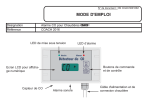
Name
Reference
Under power LED
Alarm signal LED
Digital LCD screen
CO Sensor
Command and control
buttons
Sound alarm signal
Main connection and heater
cable
THE COACH SYSTEM
The COACH CO alarm enables you to check the level of carbon monoxide in the air with ease : it is
a CO alarm which is controlled by a micro calculator which can both calculate the level of theoretical
carboxyhaemoglobin (COHb) of persons living in the vicinity of an appliance likely to produce CO and
can ensure that your heater is safe.
The COACH ® alarm is equipped with the latest sensors and microprocessors and guarantees accurate COHb and concentrations of CO (from 0 to 999 ppm) measurements. You will be able to use it
for many years without having to make any adjustments.
With the COACH ® alarm it is possible to make your heater or boiler safe thanks to a powerful relay
which will be activated if the accepted theoretical level of COHb has been exceeded.
Thanks to its LCD screen, the Coach ® alarm will provide information on the state of the appliance at
any time (number of times the alarm signal has been triggered, fault messages) and on the maximum
level of exposure.
CARBON MONOXIDE
CO is particularly treacherous as it is a colourless and odourless gas which cannot be detected by our
senses. Its deadly consequences in confined spaces, flats and houses are well known. It is formed
when there is incomplete combustion of coal, wood and hydrocarbons. It is extremely toxic when
levels of concentration reach a certain threshold.
The content of this document can be changed without previous notice
CO penetrates the circulatory system through the lungs and combines with haemoglobin 240 times
more readily than oxygen. CO combined with haemoglobin is called carboxyhaemoglobin (COHb). As
the CO is accumulated in the blood, the body is more and more deprived of oxygen. When carboxyhaemoglobin levels reach 10 to 30%, symptoms of intoxication may become apparent : they consist
of headaches, nausea, confusion, dizziness and problems with eye-sight.
In the case of chronic exposure amounting to levels of carboxyhaemoglobin of 30 to 50%, the following symptoms are apparent : dyspnoea when making an effort, increase in respiratory and cardiac
frequency and fainting. When the level of carboxyhaemoglobin exceeds 50% a coma, convulsions and
finally cardiac and respiratory arrest may ensue.
Intoxication is a frequent source of medical complications (immediate death, damage to the myocardium, hypotension, arrhythmia, pulmonary oedema. The most insidious consequence may be the
delayed appearance of neuropsychiatric after-effects with neurological consequences especially for
children. Intoxication during pregnancy entails high risks for the mother as it increases the risk of short
term complications. The foetus risks death, abnormal development and brain damage due to lack of
oxygen.
Carbon monoxide intoxications are frequent and their consequences are very serious. They can cause
immediate death but may also entail complications and after effects which are often left untreated. It
is therefore essential to avoid them by installing alarm and safety systems inside the home.
The content of this document can be changed without previous notice
MEASUREMENTS AND NORMS
The result of the analysis is given in volume units called ppm . Ppm means: part per million.
When the COACH ® alarm indicates a result of 60 ppm as a measurement of maximum level of exposure, this means that there has been a proportion of 60 volumes of CO - (60 cm3) - for 1000 000 volumes - (1m3) - of air or 60 millionths of CO in the air.
Starting from this level of concentration the calculator takes into account exposure under a given
amount of time in order to calculate the theoretical level of COHb. If this level exceeds the threshold
stipulated by the norm, this alarm is triggered off.
The corresponding European norm EN50291 imposes the theoretical COHb limit by giving the following standard levels of exposure :
Level of exposure
30ppm
50ppm
100ppm
300ppm
The content of this document can be changed without previous notice
No alarm before
120 minutes
60 minutes
10 minutes
Alarm before
90 minutes
40minutes
3 minutes
Graph showing the
limitsconcentration
of CO concentration
according
to EN50291
Limites
CO selon
CENELEC
50291 with curve showing corresponding
of time
before
the correspondante
COACH alarm is activated
et courbe delapse
réponse
Alarme
COwhich
COACH
300,00
Réponse COACH
Response
COACH
Pas avant
selon
CENELEC
Not
before
(EN50291)
Pas après
CENELEC
Not
after selon
(EN50291)
250,00
% COHB
0.3 à
to0,7
0.7
0,3
0,7
0.7 à
to2,9
3
3 toà44,5
2,9
4 àto66
76 àto10
10
to20
20
10 à
to30
30
20 à
Time
(minutes)
en mn
Temps
200,00
150,00
30 à
to40
40
120
100,00
90
to50
50
40 à
50 à
to70
70
60
Effects
Effets
Normal concentration
level
forles
non-smokers
Concentration
normale
chez
non fumeurs
No identifiable
physical
changes
Pas
de changement
physiologique
identifié
Cardiovascular
for chez
cardiac
Troubles
cardioproblems
vasculaires
lespatients
cardiaques
Higherrelevé
levelschez
for smokers,
psychomotor
Taux
les fumeurs,
troubles problems
psychomoteurs
Cardiovascular
for non
Troubles
cardioproblems
vasculaires
chezcardiacs
les non cardiaques
Slight head
ache,
fatigue,
potential
danger
for foetuses
Léger
mal de
crâne,
fatigue,
danger
potentiel
pour le fœtus
Mal
de crâne
important,
nausée,
troubles
de coordination
Serious
headache,
nausea,
problems
of coordination
des membres
Violent
irritability,
confusion,
problems
visual
Mal
de head
crâneache,
violent,
irritabilité,
confusion,
troublewith
de l'acuité
acuity, nausea,
muscular
weakness,
lossvertiges
of balance
visuelle,
nausée,
faiblesse
musculaire,
Convulsions and
loss of consciousness
Convulsions
et inconscience
death
Coma, fainting,
évanouissement,
décés
60
50,00
40
10
0,00
0
50
100
150
200
250
300
350
en ppm
(ppm)
CO CO
The content of this document can be changed without previous notice
In an industrial environment, French regulations (Institut National de Recherche et de Sécurité : INRS
: ND 1945-153-93) stipulates that the maximum level of concentration for an 8 hour shift should not
exceed 50 ppm. The figures used for the home alarms indicated above are thus stricter and the
COACH ® alarm can therefore be used in an industrial environment.
INSTUCTIONS FOR USE
To switch the COACH ® alarm on, first connect the device to the mains supply (230 V).
When switching the COACH ® alarm on, the segments of the screen are activated during the first two
seconds and then a 'beep' will be heard. This signal indicates that the device has carried out a test
and that it is now operational. Once this testing phase is over, the sensor undergoes a cleaning phase.
This phase lasts about 30 seconds. During this lapse of time the message CO and a bell symbolising
an alert flash on the screen. Finally when the flashing stops, the device collects a sample of air in the
atmosphere every minute and calculates the corresponding level of COHb.
MAX FUNCTION :
To read the maximum level recorded, briefly press the top button on the right of the screen.
The word MAX will appear together with the corresponding concentration of CO expressed in ppm
units. Press on the button a second time in order to quit the MAX function. If you press the bottom button for more than one second when the MAX value is displayed on the screen, the MAX value will be
reset to 0.
MAX
PPM
The content of this document can be changed without previous notice
ALARM FUNCTION
The alarm is automatically triggered off if the level of COHb exceeds the threshold indicated on the
curve above.
When the alarm is triggered, the message ALR 1, 2 or 3 can be read on the screen, the sound alarm
is activated and the red LED flashes.
Press the top button on the right hand side of the screen for more than 3 seconds to acknowledge
the alarm signal and switch the sound alarm off. Once you have acknowledged the alarm, the red
LED will stay red, the relay is open as long as the concentration level exceeds 50 ppm.
The fact of acknowledging the alarm implies that the occupants have taken into account the alarm
and will take the necessary precautions : air the premises, evacuate in order to get fresh air.
Once the alarm has been acknowledged, the device simulates a level which is just under the alarm
threshold. Thus, if any CO reappears, the lapse of time necessary for the alarm to be triggered off
again will be very short because the occupants are supposed to have already had a significant intake of CO.
This level will diminish with time. Indeed the device calculates the amount of time needed for the
natural elimination (via the lungs) of CO accumulated in the blood when the concentration is less
than 50 ppm.
If the alarm is not acknowledged, the calculation of the level of CO in the blood continues. The level
of CO should however drop if the source of CO has been cut off by the relay. The level of COHb
should therefore diminish (much more slowly than when the alarm has been acknowledged).
The content of this document can be changed without previous notice
In order to avoid continual triggering off of the alarm, the screen indicates the number of times it has
been triggered during the last four hours.
If there has been no triggering of the alarm, the screen will indicate :
After the first triggering the screen will indicate:
After two triggerings the screen will indicate:
After three triggerings the screen will indicate AL3 and SEC (for security) alternately:
Once the alarm has been triggered a third time, you will have to restart the device in order to reconnect your heater to the mains supply. The professionals who deal with the maintenance of your heater will tell you how to proceed.
The content of this document can be changed without previous notice
To contact your local dealer or installation service :
The content of this document can be changed without previous notice
WARNING
z A CO alarm is not a substitute for a smoke detector or a combustible gas detector.
z The use of a CO alarm does not mean that you can do without proper maintenance of your chimney flue, heater and boiler
z The CO COACH® alarm is in conformity with standards which apply to normally healthy persons.
This system might not ensure adequate safety if you or your family are particularly vulnerable to
CO: elderly people, pregnant women or people with a particular medical condition. If in doubt,
please consult your doctor.
WHAT SHOULD YOU DO IN CASE OF AN ALARM ?
1. Stay calm and open all the doors and windows to ventilate. Switch off whenever possible all
appliances likely to produce CO and stop using them (gas cookers etc…)
2. Evacuate the premises leaving the doors and windows open. In a multi storey building make sure
that other occupants have been warned of a risk of CO intoxication.
3. Do not return to the premises as long as the alarm is activated (red LED if the alarm has been
acknowledged).
4. Call a doctor immediately if any symptoms associated with CO appear (headache, nausea, vomiting) and indicate that there is suspected CO intoxication (see the symptoms described in the
chapter 'measurements and norms')
5. If the alarm is triggered off, the relay automatically cuts off the heater or boiler. When the alarm
stops, the relay is reactivated and the appliance can be started up again. If you are present and
The content of this document can be changed without previous notice
if the appliance has to be restarted manually, first you must make sure that the source of CO has
been identified and that the fault has been corrected. Call the maintenance service for your heater
or boiler and inform them about the incident. Do not switch on the appliance which has produced
the CO which triggered off the alarm before it has been checked by a professional.
The following points may modify the measures recommended above and might have to be taken into
account when your boiler or heater is installed:
A. It may be the case that excessive ventilation increases the level of CO in the premises: when for
example traffic is particularly heavy outside, especially when it is cold. In this instance the air which
comes from outside is likely to trigger off the alarm.
B. Once the alarm has been triggered off, you can check the level of CO thanks to the MAX function
: consult the MAX value and reset it to 0. One minute later you will be able to recheck it. In order to
do this you must re-enter the premises. Make sure you limit risks of intoxication.
C.Other sources of CO may trigger off the alarm such as :
- A large quantity of cigarette smoke
- A gas leak (this may contain a large amount of CO)
- CO emission from combustion without a flame.
- Other substances may trigger off the alarm : the sensor is sensitive to certain domestic products such as vapours of alcohol, ammonium, certain solvents like trichloroethylene, acetone….
D.Frequently CO comes from neighbouring premises especially when the block of flats is equipped
with shafts (ventilation shafts, garbage chutes, water pipes) or with defective ventilation systems. In
this case the source of CO may originate from several floors below, or even an under ground car
The content of this document can be changed without previous notice
park. This situation must be taken into account when the CO alarm is installed.
MAINTENANCE
The alarm continuously checks a certain number of fundamental functions and warns the user via the
LCD screen and the buzzer in the event of a fault. However we recommend that you regularly check
that the alarm is operational by briefly pressing one of the buttons. A 'beep' will be heard and the red
LED will be activated.
Check and clean the outlets of the alarm once a month to avoid accumulation of dust which could
block them up. Use a vacuum cleaner if necessary.
MESSAGES
Faults :
Since the alarm is meant to ensure your safety, its essential functions are continuously checked. If a
fault should occur, a message will appear on the screen. In the event of a fault, the alarm will remain
under fault mode and can no longer be relied upon as a CO alarm. A regular 'beep' will be heard and
the red LED will be activated to warn the occupants of the fault.
If one of the following three messages persists contact your maintenance service indicated (page 3).
The content of this document can be changed without previous notice
The message “PS” (power supply) on your screen indicates that the voltage of
your mains supply is at too low a level to guarantee an accurate measurement.
A variation in the mains voltage may cause this fault. If the voltage returns to
its initial level, the alarm will start up again within 30 seconds.
The voltage is checked every 2 seconds. A 'beep' will be heard if it shows signs
of weakness. The PS message will appear after three successive 'beeps'.
If the message “PSF” (Power supply failure) appears, the alarm is suffering
from a breakdown of the electrical mains supply system or the voltage is too
high. If the voltage returns to its initial level, the alarm will start up again automatically within 30 seconds.
If the message “tF” (temperature failure) appears, the alarm is in an environment where the ambient temperature does not allow the alarm to function
normally or the temperature sensor is faulty. In this event, the estimated temperature is of 20°C and the alarm continues to function (the fault is not crucial). However, beware if the real temperature is very different from 20°C as
an error in the measurements will be made and the danger level of the CO
could be underestimated.
If the message “SF” (sensor failure) appears, the sensor has broken down
(crucial fault).
The content of this document can be changed without previous notice
OTHER MESSAGES :
MAX
The message “SAt” (saturation) means that the measurement taken by the
alarm was at saturation level (over 999ppm). This message may appear when
consulting the maximum value.
RECOMMENDATIONS
The CO COACH ® alarm guarantees accurate measurements for many years; this is how you
should take care of it…
z Install the alarm following the recommendations of the installation instructions.
z Your alarm should not be situated near alcohol vapours, petrol, fuel, lubricants, paint, or chemical
substances as the sensor might become contaminated.
z Do not spray aerosols such as deodorants, perfumes, paints or lubricants near the sensor.
z Avoid all contact with substances made of silicone.
z Do not use detergents or solvents to clean the alarm. Chemical substances may cause the break
down of the sensor by contaminating it or damaging it temporarily or permanently.
z Do not pour or spray any liquid in the openings. It could permanently damage your alarm.
z Do not paint the alarm.
z Watch out for the life span of the alarm (approximately 10 years). The month and year of manufacture are indicated under the smallest bar code on the sticker situated on the top of the alarm :
the two first numbers stand for the month of manufacture, the three other numbers stand for the
year e.g: 05001 stands for May 2001..
The content of this document can be changed without previous notice
TECHNICAL FEATURES OF THE COACH ® ALARM :
SnO2 semiconductor sensor (no ageing)
Life span estimated at 10 years for rated use
Alarm complies with European regulation EN50291
Visual (LED) alarm and sound alarm of 85 decibels (A) at one meter.
Memorisation of the maximum value detected.
Supply of 230 V alternating current +10% -15%.
Consumption ‹ 2 watts.
Remote control by relay.
Individual calibration during manufacture.
Continuous check of sensor, temperature and mains supply.
Automatic cleaning of the sensor each time the device is switched on (this takes about 30 seconds).
Optimum sensitivity of the sensor after 24 hours of use.
High degree of accuracy in the measurements (up to one part per million).
Accuracy of calculations (up to 2%)
Accuracy of sensor (up to 10%)
Rated conditions : 25°C and 60% relative humidity (RH).
Temperature compensation from -10°C to +60°C.
Operational temperature span : from -10°C to 45°C
Relative humidity span: from 30% to 90% RH.
Pressure span: from -100m to +2000M.
Measurement cycle: every 30 seconds.
IP 42 casing (resistant to rain at angle of 15°)
The content of this document can be changed without previous notice
GUARANTEE
The CO COACH® alarm has been manufactured in compliance with norms of the highest standards. However,
despite the numerous tests it has undergone, a fault or break down may occur.
It is guaranteed against all manufacturing faults and material defects within the limits of the following terms :
z The guarantee is strictly limited to the exchange or repair of parts which have been found faulty after examination and control in our factory, to the exclusion of any other form of indemnity.
z The period of guarantee given by the manufacturer is of one year starting on the date of purchase.
z The guarantee is valid on the condition that the alarm has been used correctly and in compliance with the
instructions given by the manufacturer .
z The following are not covered by the guarantee:
- Deteriorations due to abnormal conditions of use or due to a faulty connection with incorrect voltage.
- Damage caused by a fall
- Deteriorations or accidents due to negligence or modifications or attempts to modify the alarm in any
way.
- Deteriorations due to liquids penetrating the alarm.
- Deteriorations due to contamination of alarm by chemical substances..
z The guarantee only covers alarms which have been sent back to the address on the guarantee card.
z Time spent repairing the alarm while under guarantee does not prolong period of guarantee.
z The terms of the present guarantee do not prevent the buyer from benefiting from the advantages of the legal
guarantee afforded in the event of hidden faults and defects.
This document together with the installation instructions complies with the European regulation
EN50292
The content of this document can be changed without previous notice