1
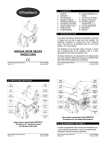
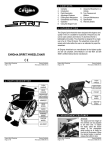
parts description The backrest has an in-built half folding back which has been designed so that the wheelchair will fit into small spaces by reducing the push handle height. In order to fold down the backrest, push the black paddle with your thumb (see photo below) whilst pulling the handle down. This operation should be repeated for the other handle.To put the backrest back into position, lift both handles together and the folding mechanism will lock back automatically. Warning: Do not push down on the handles to raise the front of the wheelchair, as this could result in damage to the wheelchair. Use the stepper tube as described legrest adjustment For optimum comfort it is important to attain the correct leg position. The footrests have been designed so that they can be extended into a number of fixed positions by releasing the bolt at the base of the legrest. This lengthens the legrest into a number of different positions. folding the wheelchair The wheelchair has been designed with an easy fold mechanism. To fold the chair, ensure that the footrests are in the forward position and that the plastic footplates are flipped up. Holding the front and rear edge of the seat sling, pull the seat in an upward motion. The wheelchair will naturally fold up. using the stepper tube operating the backrest Use the stepper tube to raise the front castors (when mounting a kerb for example). To mount a kerb. Approach the kerb head on. Then the attendant uses the stepper tube to raise the front castors, and lowers the front castors on the raised kerb. Finally the attendant should push the wheelchair forward, lifting it up slightly to mount the kerb if required. To go down a kerb. Line up the front castors with the edge of the kerb. The attendant uses the stepper tube to raise the front castors and tip the user slightly back. Keeping the castors raised, slowly lower the wheelchair down the kerb. ! This will help keep the user's hips and pelvis towards the back of the wheelchair. Use the tri-glides (shown) to adjust the length of the lap belt. The length of the lap belt should be checked each time the belt is used. There is a risk of suffocation from users 'submarining' (where they slide down the chair until the lap belt is around the neck area). To reduce the risk of this, ensure that the lap belt is used under supervision and is used as instructed. The lap belt may not be suitable for all users of wheelchairs. Seek professional medical advice before using the lap belt. Warning: Do not raise the front castors by pushing down on the push handles as this could result in damage to the wheelchair. using the lap belt operation and propulsion transporting the wheelchair To transport the wheelchair, first fold up the wheelchair and fold down the back as previously described. Then remove the legrests by pushing the chrome lever on the legrests whilst pulling the legrest away from the chair. This operation should unlock the legrest and allow it to be removed by lifting up on the legrest. The Travel Chair comes with an optional easyto-carry bag. Put the wheelchair and two legrests in the bag. Ensure that the latest health and safety practice is used for carrying and lifting items. The lap belt is to restrain the wheelchair occupant during normal use. The lap belt can not be used as a seat belt in a motor vehicle. Under no circumstances should the Travel Chair be used as a seat in a motor vehicle (e.g. cars, buses, trains, etc) as it is not suitable for this application. The lap belt should be adjusted to suit each user. The length of the belt can be adjusted by the tri-glides (as shown in the diagram overleaf). The lap belt has a luggage-style large locking clip to fasten and unfasten the lap belt. To fasten the lap belt, push the clip in to the receiver until it locks in the position (which can be heard by an audible click). The wheelchair should not be used as a seat in a motor vehicle. When fastened, the lap belt should be tight around the user's pelvis without causing discomfort or undue pressure. The Travel Chair can only be propelled by an attendant using the push handles. Use slow speeds on gradients. Do not use on gradients larger than 10º The wheelchair is only suitable for single occupancy. Keep your feet on the footplates when moving. Do not stand on the footplates. Do not use escalators. Do not reverse down a gradient Maintain proper balance at all times. Users should not move their centre of gravity out of the seating area. Do not reach for items further than your arm will extend. Be aware of hazards in your environment, such as narrow doorways, steps, household appliances, children's toys, etc. We recommend you consult your healthcare professional for advice about transferring to and from the wheelchair. The parking brakes should always be applied when transferring.