1
SOFTWARE IV1ANUAL
AIphaPASCAL
USEWS GUOE
ov/rA 00100 08
REV 801
alpha micro
ALPHA PASCAL USERS MANUAL
Page ii
This printing of the manual, contains the contents of
Change Page Packet ill for the AIphaPASCAL Users Manual',
NOTE:
(OSS"1OOO01O),
which
Micro,
First Print mg:
Second Printing:
may be orff7Tsepa7tetyfrALpa
1
August 1981)
30 April 1981
Alpha Micro', 'AMOS', 'ALohaBASIC,
AM'1OO'
'AIphaPASCAL', 'AlphaLlSP', and 'ALphaSERV'
are trademarks of
ALPHA MICROSYSTEMS
Irvine, CA
This
92714
book refLects AIphaPASCAL Versions 2,1) and later,
©1981 " ALPHA MICROSYSTEMS
ALPHA MICROSYSTEMS
17881 Sky Park North
Irvine, CA
C'2.M 10/81
92714
0.
0
Page iii
ALPHA PASCAL USER'S MANUAL
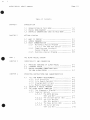
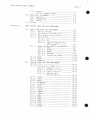
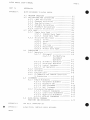
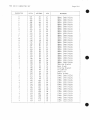
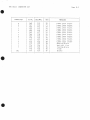
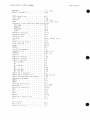
Table of Contents
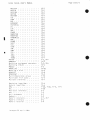
CHAPTER 1
INTRODUCTION
1.1
1.2
1.3
CHAPTER 2
ORGANIZATION OF THIS BOOK
PASCAL BIBLIOGRAPHY
GRAPHICS CONVENTIONS USED IN THIS BOOK
GETTING STARTED
2.1
2.2
2.3
WHAT IS PASCAL'
SAMPLE PROGRAM
BRIEF DEMONSTRATION
2.3.1
Building a Pascal Program
2.3.1.1
The VUE Text Editor
2.3.2 Compiling and Linking a
Pascal Program
2.3.3 Running a Pascal Program
PART I
THE ALPHA PASCAL SYSTEM
CHAPTER 3
COMPATIBILITY AND CONVERSION
3.1
3.2
3.3
CHAPTER 4
1—2
1—3
1—3
PREVIOUS VERSIONS OF ALPHA PASCAL
STANDARD PASCAL
MAKING PROGRAMS COMPATIBLE WITH
THE NEW ALPHA PASCAL
2—1
2—3
2—4
2—4
2—4
2—7
2—8
3—1
3—6
3—7
OPERATING INSTRUCTIONS AND CHARACTERISTICS
4.1
FILE AND MEMORY REQUIREMENTS
File Extensions
File Search Pattern
4.1.3 Program Restrictions •0•S
4.1.4 Memory Requirements
CREATING A PASCAL PROGRAM.
THE ALPHA PASCAL COMPItER,
4.3.1
The Diagnostic Display
4.3.2 Compiter Options
4.3.2.1
The IGTO Options
($G+ and $G—)
4.3.2.2 The Include Option (SI)
4.3.2.3 The List Options
(SL, SL+ and SL—)
4.3.2.4 The Page Option (SP)
4.3.2.5 The Quiet Options
($Q+ and SO—)
4.1.1
4.1.2
4.2
4,3
4—2
4—2
4—3
4—4
4—4
4—5
4—5
4—6
4—7
4—7
4—7
4—8
4—10
4—10
4
1
v Iv
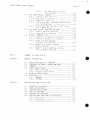
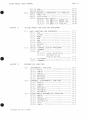
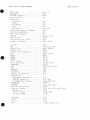
ALPHA PASCAL USER'S MANUAL
4..
4.3.2.6
The Range Check Options
($R— and $R+)
4.4 'THE ALPHA PASCAL LINKER
4.4.1
Linking a New .PCF File
4.4.2 Replacing a .PCF File
4.4.3 Updating a .PCF File
4.4.4 Linking Assembly Language Subroutines
(the /LINK Option)
4.4.5 Preventing Backtracing of .PCF Files
(the /SMASH Option)
4.5 THE ALPHA PASCAL RUN—TIME PACKAGE
4.5.1
Library Version Checking
4.5.2 Interrupting a Program
4.6 HELPFUL COMMAND FILES
4.6.1
CompiLing a Single File (PC.DO)
4.6.2 Linking a Single File (PL.DO)
4.6.3 Compiling and Linking
a Single File (PCL.DO)
4.6.4 Updatinq a Single Program
Module (PU.DO)
4.6.5 CompiLing and Updating a Single
Program Module (PCU.DO)
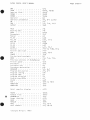
PART II
SUMMARY OF ALPHA PASCAL
CHAPTER 5
GENERAL INFORMATION
5.1
5.2
5.3
5.4
5.5
5.6
CHAPTER 6
BASIC STRUCTURE OF A PROGRAM
COMPOUND STATEMENTS (BEGIN AND. END)
COMMENTS
LEGAL IDENTIFIERS
5.4.1
Reserved Words
5.4.2 Standard Identifiers
SCOPE OF IDENTIFIERS
NOTATION
5.6.1
NUMBERS
5.6.2 STRINGS
4—10
4—11
4—12
4—13
4—14
4—15
4—16
4—17
4—17
4—10
4—20
4—20
4—21
4—21
4—21
4—22
s_i
5—3
5—4
5—5
5—6
5—6
5—?
5—9
5—9
5—10
DECLARATIONS AND DEFINITIONS
6.1
6.2
6.3
6.4
6.5
6.6
PROGRAM DECLARATIONS
LABEL DECLARATIONS
CONSTANT DEFINITIONS
TYPE DECLARATIONS
VARIABLE DECLARATIONS
FUNCTION AND PROCEDURE DECLARATIONS
6.6.1
Functions
6.6.2 Procedures
6.6.3 Forward Declarations
6—1
6—2
6—4
6—4
6—5
6—6
6—6
6—8
6—9
.
.-.
V
Page v
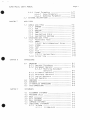
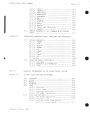
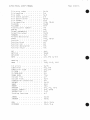
ALPHA PASCAL USER'S MANUAL
Formal Parameters
Value Parameters
6.6.4.1
6.6.4.2 Reference Parameters
EXTERNAL DECLARATIONS
6.6.4
6.7
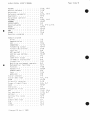
CHAPTER 7
SIMPLE DATA TYPES
INTEGER
7 .1..1
t.i.z
7.2
6—12
6—12
REAL
7.1.3 BOOLEAN
7.1.4 CHAR
7.1.5 User—Defined Scatar
7.1.6 User—DefIned Subrange
STRUCTURED DATA TYPES
7.2.1
Packed Data Types
7.2.2 ARRAY
Multi—dimensionat Arrays
7.2.2.1
7.2.3 STRING
7.2.4 TEXT
7.2.5 SET
7.2.6 FILE
7.2.7 RECORD
7.2.7.1
variant Parts
7.2.8 PoInter Type
7—2
7—2
7—3
7—3
7—4
7—5
7—6
7—6
7—7
7—8
7—10
7—10
7—11
7—12
7—15
7—16
7—1 8
7—19
EXPRESSIONS
8.1
8.2
8.3
8.4
8.5
CHAPTER 9
6—1,1
DATA TYPES
7.1
CHAPTER 8
6—11
OPERATORS
8.1.1 Operator Precedence
8.1.2 Assignment Operator
8.1.2.1 ModIfying Assignment
Operators
8.1.3 Arithmetic Operators
8.1.4 Retational Operators
8.1.5 Logical Operators
8.1.6 Set Operators
CSTANTS
VARIABLES
IF—THEN—ELSE EXPRESSIONS
CASE EXPRESSIONS
8—1
8—1
8—3
8—4
8—5
8—6
8—6
8—7
8—7
8—8
8—8
8—9
STATEMENTS
9.2
ASSIGNMENT STATEMENT
PROCEDURE CALLS
9.3
EXIT
9.4
9.5
9.6
9.7
GOTO STATEMENT
NULL STATEMENT
COMPOUND STATEMENT
CONDITIONAL STATEMENTS
9.7.1
IF—THEN
9.7.1.1
IF—THEN—ELSE
—
9—2
9—2
9—3
9—4
9—4
9—4
9—5
I
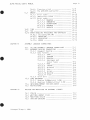
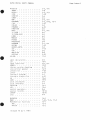
ALPHA PASCAL USER'S MANUAL
9.7.2
9.8
9.9
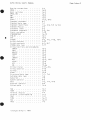
CHAPTER 10
Page vi
CASE—OF
9.7.2.1
CASE—OF—ELSE
REPETITIVE STATEMENTS
9.8.1
WHILE—DO
9.8.2 REPEAT—UNTIL
9.8.3 FOR—DO
WITH—DO
9—6
9—7
9—8
9—8
9—8
9—9.
9—10
INPUT/OUTPUT FUNCTIONS AND PROCEDURES
10.1
BASIC FUNCTIONS AND PROCEDURES
10.1.1
The File Window
10.1.2 EOF (End—of—file Funotion)
10.1.3 EOLN (End—of—line Furktion)
10.1.4 GET and PUT
10.1.4.1
GET
10.1.4.2
10.1.4.3
PUT
10—1
10—3
10—3
10—4
10—5
la—s
10—6
Sample Program Using
GET and PUT
10—6
10.1.5 READ, READLN, WRITE, and WRITELN .... 10—7
10.1.5.1 READ
10—7
10.1.5.2 READLN
10—8
10.1.5.3 WRITE
10—9
10.1.5.4 WRITELN
10—9
10.1.5.5 Formatting Output
10—10
10.1.6 PAGE
10—13
10.1.7 RESET
10—13
10.1.8 REWRITE
10—13
10.2 SPECIAL FUNCTIONS AND PROCEDURES
FOR FILE I/O
10—14
10.2.1
Information on AMOS Files
10—14
10.2.1.1
Random Files
10—15
10.2.1.2 Sequential Files
10—15
10.2.1.3 Logical Records
10—16
10.2.1.4 Opening and
Setting Up Files
10—16
10.2.2 CLOSE
10—17
10.2.3 CREATE
10—18
10.2.4 ERASE
10—19
10.2.5 EXTENSION
10—19
10.2.6 FILESIZE
10—20
10.2.? ESPEC
10—21
10.2.8 GETFILE
10—22
10.2.9 JOBDEV
10—23
10.2.10 JOBUSER
10—24
10.2.11 LOOKUP
10—24
10.2.12 OPEN
10—25
10.2.13 OPENI
10—25
10.2.14 OPENO
10—25
10.2.15 OPENR
10—26
10.2.16 PFILE
10—26
10.2.17 RADSO
10—26
10.2.18 RENAME
10—2?
ALPHA PASCAL USER'S MANUAL
•
'
,
10.2.19 SEEK .
10.2.20 SETFILE
10.3
SAMPLE PROQRAM TO DEMONSJRATE FILE HANDLING,
10.3.1
Sample'Run
10.3.2 The Program ....,.,
10.3.3 Program Organization
10.3.3.1 The, AMOS file NAMREC.INC
10.3.3.2 The AMOS file EMPREC.INC
10.3.3.3 The AMoS file FIND.PAS
CHAPTER 11
10—27
10—27
10—29
10—29
10—31
10—38
10—38
10—38
10—39
MISCELLANEOUS FUNCTIONS AND PROCEDURES
11.1
BASIC FUNCTIONS' AND
111.1
11.1.2
11.1.3
11.1.4
11.1.5
11.1.6
11.1.7
11.1.8
11.2
CHR
11.2.3
11.2.4
11—1
11—1
11—2
11—2
KILCMD
MARK
NEW
ORD
PRED
RELEASE
SUCC
SPECIAL TERMINAL DISPLAY PROCEDURES
11.2.1
11.2.2
CHAPTER 12
Page vii
CHARMODE
CRT
11.2.2.1
11.2.2.2
Cursor Positioning
11—3
11—4
11—5
11—5
11—6
11—6
11—7
11—7
Extended Screen
Display Options
INCHARMODE
LtNEMODE
11—7
11—8
11—9
MATHEMATICAL FUNCTIONS
12.1
12.2
TRIGONOMETRIC FUNCTIONS
12.1.1 COS(X)
12—1
12—1
12.1.2
12.1.3
12.1.4
12.1.5
12.1.6
12—1
12—1
SLN(X)
TAN(X)
ARCtOS(X)
ARCSIN(X)
ARCTAN(X)
HYPERBOL IC TRIGONQMETRIC FUNCTIONS
12.2.1
12.2.2
12.2.3
12.2.4
12.2.5
COSH(X)
SINH(X)
TANH(X)
ARCCOSH(X)
ARC5INHçX)
12.2.6
12.3
ARC'TANH(X)
MISCELLANEOUS MATHEMATICAL FUNCTIONS
12.3.1
12.3.2
12.3.3
12.3.4
1?.3.5
12.3.6
(Changed 30 April 1981)
ABS(X)
EXP(X)
EXPONENT(X)
FACTORIAL(X)
LN(X)
LOG(X)
12—2
12—2
12—2
12—2
12—2
12—2
12—2
12—3
12—3
12—3
12—3
12—3
12—3
12—4
12—4
12—4
12—4
ALPHA PASCAL USER'S MANUAL
12.3.7
12.3.8
12.3.9
12.3.10
12.3.11
12.3.12
12.3.13
12.3.14
12.3.15
12.3.16
12.3.17
12.4
CHAPTER 13
Paee viii
POWER(X,Y) .
000(X)
•
PWROFTEN(X)
PWROFTWO(X)
RANDOMIZE
RND
ROUND(X)
SHIFT(X,Y)
SQR(X)
SQRT(X)
STR(X) and STR(X,a,b)
12—4
12—4
12.3.1 TRUNC(X)
12—5
12—s
12—S
12—5
12—6
12—6
12—6
12—6
12—6
12—6
SAMPLE PROGRAM TO PAD A I'SJMBER WITH LEADING
ZEROS
12—6
STRING AND CHARACTER ARRAY FUNCTIONS AND PROCEDURES
13.1
STRING INTRINSICS
CONCAT
COPY
DELETE
INSERT
13.1.1
13.1.2
13.1.3
13.1.4
13.1.5
•
13.2
LCS
13.1.6 LENGTH
13.1.7 P05
13.1.R STRIP
13.1.9 UCS
13.1.10 VAL
CHARACTER ARRAY INSTRINSICS
13.2.1
FILLCHAR
13.2.2 MOVELEFT and MOVERIGHT
13.2.3 SCAN
PART III
ADVANCED PROGRAMMING ON THE ALPHA PASCAL SYSTEM
CHAPTER 14
SYSTEMS FUNCTIONS AND PROCEDURES
14.1
14.2
14.3
14.4
14.5
14.6
LOCATION
SIZEOF
MEMAVAIL
MAINPROG
SPOOL
14.5.1
Switches
14.5.2 Error codes
14.5.3 Function definition
14.5.4 The SPOOL subroutine
XLOCI( AND GETLOCKS
14.6.1
The XLOCI( subroutine
14.6.2 Setting a lock
14.6.3 Setting a lock (and waiting
until it is available) .
(Changed 30 April 1981)
11—2
13—2
13—2
13—3
13—4
13—4
13—5
13—5
13—6
13—6
13—6a
13—7
13 7
13—7
13—9
14—1
14—1
14—2
14—2
14—3
14—3
14—4
14—4
14—4
14—5
14—6
14—7
14—7
Page ix
ALPHA PASCAL USER'S MANUAL
14.7
14.6.4
14.6.5
XMOUNT
14.7.1
14.7.2
14.7.3
Clearing a lock
The GETLOCKS subroutine
Error codes
Unmounting a disk
Error codes
14.7.3.1 MOUNTED
14.7.3.2 UNMOUNTED
14.7.3.3 DEVNOTFOUND
14.7.3.4 BADHASH
14.7.3.5 NOVOLID
14.8 TIME
14.9 TOD
14.10 ERROR HANDLING PROCEDURES AND VARIABLES
Including ERT.INC
14.10.1
14.10.2 ERRORTRAP
14.10.3 XERRORTRAP
14.10.4 ERROR
CHAPTER 15
14—1 5
14—16
ASSEMBLY LANGUAGE SUBROUTINES
15.1
15.?
15.3
15.4
15.5
CHAPTER 16
14—8
14—9
14—9
14—10
14—10
14—10
14—10
14—10
14—10
14—10
14—10
14—11
14—11
14—12
14—12
14—12
CALLING ASSEMBLY LANGUAGE SUBROUTINES
ARGUMENT PASSING CONVENTIONS
Argument Passing
15.2.1
15.2.2 Data Formats
CHAR
15.2.2.1
15.2.2.2 INTEGER
15.2.2.3 BOOLEAN
15.2.2.4 Subranqes and
Scalar Tyoes
15.2.2.5 REAL
15.2.2.6 STRING
15.2.2.7 Pointers
15.2.2.8 Sets
15.2.2.9 Arrays
15.2.2.10 Records
15.2.2.11 FiLes
15.2.3 Error Exit
CODE RESIDENCY
Routine, PLINKed with /LINK
15.3.1
15.3.2 Routines PLINKed without ILINK
OBTAINING MEMORY FOR DATA AREAS
RESTRICTIONS
15—1
15—2
15—3
15—4
15—4
15—4
15—4
15—4
15—4
15—4
15—4
15—4
15—5
15—5
15—5
15—5
15—S
15—5
15—6
15—6
15—6
WRITING AND MODIFYING AN EXTERNAL LIBRARY
16.1
STDLIB
16.2
16.3
WRITING LIBRARY FILES
16—2
16—3
MODIFYING S'TDLIB
16—4
16.4
VERSION CHECKING
16—5
(Changed 30 April 1981)
ALPHA PASCAL USER'S MANUAL
Page ,
PART IV
APPENDICES
APPENDIX A
QUICK REFERENCE TO ALPHA PASCAL
A.1
PROGRAM STRUCTURE
A.2
A—i
DECLARATIONS AND DEFINITIONS
A—2
A.3
4.2.1
A.2.2
4.2.1
4.2.4
A.2.5
4.2.6
Constant Definitions
Type Definitions
Variable DecLarations
Procedure Declarations
Function Declarations
DATA TYPES
A.3.l
A.3.2
A.4
LabeL Declarations
Simple Data Types
A.3.l.l Standard Data Types
A.3.l.2 Scatar Data Types
Structured Data Types
A.3.2.l String
4.3.2.2 Arrays
A.3.2.3 Sets
A.3.2.4 File Type
A.3.2.5 Record Type
A.3.2.6 Pointer Data Types
EXPRESSIONS
A.4.l
4—2
A—3
A—6
4—4
4—4
A—4
A—4
A—S
A—S
A—s
A—S
A—5
A—6
4—6
4—6
Operators
A.4.1.l
4—2
Assignment
A.4.1.i.1
4—6
The Modifying
Assignment
Operators
A.4,.l.2 Arithmetic nperators•
A.4.1.3 Relational Operators
A.4.l.4 Logical Operators
4.4.1.5 Set Operators
A4.2 Constants
4.4.3
4.4.4
4.4.5
A.5
in Expressions
GOTO Statement
Null Statement
Structured Statements
A.5..1.4
A.5.2.l
4—8
A—9
A—9
A—9
A—9
4—10
A—iC
4—10
Compound Statements
A—1O
WITH—DO Statements
A—li
A—li
Conditional Statements
Repetitive Statements
ALPHA PASCAL STANDARD
FUNCTIONS AND PROCEDURES
APPENDIX 8
THE ASCII CHARACTER SET
APPENDIX C
ALPHA PASCAL COMPILER ERROR MESSAGES
INDEX
A—S
4—9
Simple Statements
A.S.l.l Assignment Statement
4.5.1.2 Procedure CML
A.5.2.2
A.5.2.3
4.5.2.4
A.6
A—i
IF—THEN—ELSE and CASE—OF Constructs
A.5.i.3
4.5.2
4—7
A—S
Variables
Function Calls
STATEMENTS
A.5.l
A—i
A—i
A—i
4—12
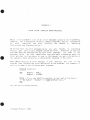
CHAPTER
1
INTRODUCTION
book is a reference manual for the AlphaPascal programming system, We
realize that some of you may be experienced PascaL programmers, whiLe others
may never have seen a Pascal program before, Therefore, to suit the wide
range of interests and backgrounds our readers are LikeLy to have, we have
This
tried to organize this book so that you can easily find the information that
you
need
without
that
spending
unnecessary
time
on
chapters
that
contain
know or that is not important to you
information on the organization of this book, see Section Li, below,)
information
you
already
(For
Because there are so many exceLLent books available that teach you how to
program in Pascal, we have not attempted to do so in this book. (For a list
of some of the books that we found heLpfuL, see Section 1,2, "Pascal
BibLiography,") However, our intention is to provide a detailed enough
description of AlphaPascal that an experienced computer programmer who is
unfamiliar with Pascal can get some idea of how to write PascaL programs
The major purpose of the book is threefoLd:
1,
To describe this impLementation of ALphaPascaL;
2,
To discuss how this impLementation differs from
previous versions
of AlphaPascal and from the standard Pascal as set forth in the
PascaL User Manual and Report by Jensen and Wirth (and to give
hints on converting programs written in these versions of Pascal to
the current AlphaPascal format); and
3.
give operating instructions for the various components of the
ALphaPascai programming system: the compiler, the Linker, and the
runtime package.
To
This book aLso gives information to systems programmers on writing their own
assembLy Language subroutines caLlabLe by Pascal programs, and on writing
and modifying an externaL procedure library
INTRODUCTION
1.1
Page 1—2
ORGANIZATION OF THIS BOOK
of the chapters in
programmers, while others
this book are aimed at experienced Pascal
are specifically for new Pascal users.
you find the information that you are particularly interested in, weTo help
have
divided this book into four
Some
general parts:
PART I
—
THE ALPHA PASCAL SYSTEM
PART II
—
SUMMARY OF ALPHA PASCAL
PART III —
ADVANCED PROGRAMMING ON THE ALPHA PASCAL SYSTEM
PART IV
APPENDICES
rest
—
this section discusses
interest to specific readers.
The
of
which chapters may be of particular
IF YOU ARE AN EXPERIENCED PASCAL PROGRAMMER:
You wilt probably want to skip Chapter 2, "Getting Started," and go
directly to Chapter 3, "Compatibility and Conversion," which tells you
how
this version of Pascal differs from earlier versions of
AlphaPascal and from the Jensen and Wirth standard.
Chapter 4
discusses how to operate the various components of the AlphaPascat
programming system. Rather than read through Chapters 5 through 13,
which give detailed discussions of the AiphaPascat statements and
procedures, you may want merely to turn to Appendix A, "A Quick
Reference to AlphaPascal," to get an idea of the functions and
procedures included in this implementation of Pascal.
After you are somewhat familiar with the AlphaPascal system, you may
want to read Chapter 15, "Writing and Modifying an External Library
File." If you are a systems programmer, you may want to
16, "Assembly Language Subroutines."
read
Chapter
IF YOU ARE NEW TO PASCAL:
You will
probably want to read Chapter 2, "Getting Started," which
gives a brief discussion of Pascal, and goes through a quick
demonstration of building, compiling, andt running a small, simple
Pascal program. Next, you will probably want to start reading Part
II, "Summary of AlphaPascal," for information about this version of
the Pascal language.
When you are ready to begin writing Pascal programs, turn back to
Chapter
4,
"Operating
Instructions
and Characteristics,'
for
information on using the AlphaPascal compiler and run—time package.
NOTE: We would appreciate any comments or
Comments Form in the back of this book.
suggestions;
note
the
Reader's
.
Page 13
INTRODUCTION
1,2
PASCAL BIBLIOGRAPHY
The
most
important
source
book
definition of standard Pascal) is:
for
programmers (containing the
Pascal
Jensen, K, and Wirth, N,
PascaL User Manual and Report (Second Edition)
Springer'Verlag, 1976
If you are interested, in Learning to program in Pascal,
you
might
want
to
take a Look at one or more of the foLLowing textbooks:
Conway, R,, Gries, 0, and Zimmerman, E,C,
A Primer on Pascal
Winthrop, 1976
Grogono, P
Programming in Pascal
Addison"Wesley, 1978
Kieburtz, R,B,
Structured Programmi ngand ProbleirSolving with Pascal
Prentice"Hall, mc,, 1978
Schneider, G,M,, Weingart, S,W,, and Perlman, D,M,
An Introduction to Programming and Problem Solving
with Pascal
John Wiley g Sons,. 1978
Wilson, hR. and Addyman, A,M,
A Practical Approach to Pascal
Springer"Verlag, 1978
1,3
GRAPHICS CONVENTIONS USED IN THIS BOOK
symbol
indicates the place in an example where you would press the
terminal carriage return key if you were entering the example into the
computer.
(The
carriage return key on the terminal keyboard is usually
The
labeled RET or RETURN, and tells the computer
current line,)
to
accept
and
process
the
INTRODUCTION
Page 14
It is
often confusing when Looking at a program in a new computer Language
to determine which elements are an inherent part of the Language
(for
example, program statements) and which elements
are to be supplied by the
programmer,
To help eliminate some of this confusion, our
follow these conventions:
sample
programs
Reserved words are all upper case and underlined,
Standard identifiers are all upper case, but not underlined,
All user identifiers (for example, variable names, constants, etc.)
are in a combination of upper and lower case, and are not underlined,
(Note that reserved words are underlined, For claritys sake, therefore,
manua I
deviates from the usual Alpha Micro documentation practice of
underlining all output the computer displays on your terminal display,
We
will try to clearly indicate which portions of our examples are entered by
you and whi
this
ch portions are printed by the computer,)
-
CHAPTER 2
SETTING STARTED
This chapter
is
primarily for the benefit of the programmer who is
interested in learning Pascal, but who has not yet had the chance to become
If you are already familiar with Pascal, you
familiar with the language.
wilt probably want to skip to Part I of this book, "The AlphaPascal System,'
information on Alpha Micro's specific implementation of Pascal, and for
for
operating instructions for the AlphaPascal compiler. (You may be interested
a
brief
contains
in
SectIon 2.3 of this chapter, however, which
compiling,
linking,
and
running
a
small
Pascal
demonstration of creating,
program.)
The rest of this chapter gives a brief discussion of Pascal and walks you
through a quick demønstration of building, compiling, linking, and running a
program under the AlphaPascal system.
We also show you a small Pascal program and discuss its component parts.
2.1
WHAT IS PASCAL?
Pascal
language is based on the 1970 work of Jensen and Wirth, and is
related to the ALGOL—family of languages.
The
Pascal is a fairly new programming language, and is considered by many to be
"cleaner" and more powerful in design than many older languages as welt as
more
reflective of current trends in the philosophy of program design and
structure.
However, this does not mean that programs written In Pascal will
necessarily be clearer or more powerful than programs written in other
The major claim made for
languages—— that wiLl depend on thi programmer.
Pascal is that the language makes it easier to write programs
that may be
easily understood and maintained.
It was developed in response to increasing concerns that current programming
languages were not encouraging good programming "style," and is based on the
idea
that
an effective programming language should help the programmer to
result
should be
apply design techniques in a natural and simple way. The
that
are
easy to read and easy to
well—made, welt—structured programs
GETTING STARTED
Page 2—2
maintain. Because most of a program's life cycle is spent
in
design and
maintenance, the creators of Pascal tried to develop
a language that helps
programmers In these areas.
Pascal's use, acceptance, and availability have become widespread in recent
years.
An increasingly large number of students are being taught Pascal as
their first programming language. Pascal's use in Industry is also becoming
more prevalent as project planners become more aware of its usefulness in
implementing large programming projects.
Some of Pascal's advantages stem from these characteristics:
*
Pascal
*
One
*
Pascal was designed to be a general—purpose language.
encourages welt—structured programming by requiring that
programs be built in a block structure in which the beginning and
end of each procedure is clearly marked. Because program structure
is
hierarcHal in nature, programming in Pascal lends itself
naturally to top—down design.
of
the most
important
features
of
Pascal
is
its
extensibility.
It
is very simple to add your own functions and
procedures if the routines provided by Pascal do not exactly match
your needs.
In addition, on the AlpitaPascal system, you can add
these user—defined
routines to an external
library where all
Pascal programmers can make use of them.
Since it is
specifically aimed at
scientific
or
data
processing
applications, it can be used to solve a wide range of problems.
not
*
An
*
Any variable used in a program must be declared within that
program.
That is, Pascal requires that the type of values that a
variable may assume (e.g., integer or boolean) be clearly stated
by
the programmer.
This helps
both
in program design and
maintenance, since the
readability and organization of your
program are enhanced.
Variables may be global or local in scope,
depending on where they are declared.
*
Most implementations of Pascal, while they may include extensions
to
the
language,
also contain a subset of Pascal which adheres
firmly to the standards for the language as set forth by Jensen
and
Wirth.
This means that programs wrttten in standard Pascal
are transportable between computer systems on which Pascal is
important
feature of Pascal is its powerful data structures
(arrays, sets, records, pointers,
user—defined, etc.), and the
sophisticated structures you can build from those primitives
(e.g., linked lists).
implemented.
.
Page 2—3
GETTING STARTED
2.2
SAMPLE PROGRAM
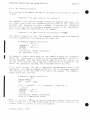
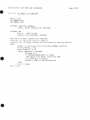
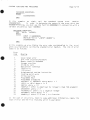
never •before seen a PascaL program, you may be interested in
taking a look at the small, simpLe program below:
If
you
have
(Determine what % is deducted from your gross salary)
PROGRAM Salary;
REAL;
Gross, Takehome, Deductions, Percentage
VAR
BEGIN (Begin Program Salary)
(Print ques.t1ons and read answers from terminal)
WRITE ('What is your•gross salary? ');
READLN
(Gross);
WRITE ('What is your takehome salary? ');
READLN
(Takehorne);
Deductions : Gross — Takehome;
1OO*theductio,s/Grpss);
Percentage
percent of your salary!')
WRITELN ('They keep', Percentage,
END (End Program Salary).
:
'
eLements of
NOTE: To help you keeç track of which words in the program are
language:and which are variab{e names and data supplied by you,
the Pascal
we have written in upper case and underlined those words (calLed "keywords")
you do not
course,
(Of
that are actually part of the Pascal language.
underline such keywords when you write your own Pascal programs.) Those
are called
not underlined,
but
that are
words that are in upper case,
they are elements of the Pascal language which can
"standard identifiers";
are
be re—defined by you. The words that are upper and lower case and that
and
string
not underLined in the example above are variable names, comments,
data supplied by the writer of the program.
line of our sample program is catted a "comment." It Is ignored
Its
by the computer, and has no effect on the execution of the program.
(Comments in
the program easier to read for humans.
purpose
Is
to make
Pascal are denoted by enclosing text either with the symbols "(*" and "*)"
The
first
or with the symbols "C" and ")".)
The second line "declares" the program name, "Salary."
tine "declares" the variables "Gross," "Takehome," "Deductions,"
The third
and "Percentage," and tells Pascal that they can only assume the values of
information on declaring programs and variables, see
real
numbers.
(For
Chapter 6, "Declarations and Definitions.")
marks the
The fourth line
contains a BEGIN statement; this statement
beginning of a program block. The end of. this block (and in this case, the
end of the program) is marked by the END statement on line 13. Within this
block, we send questions to the terminal display (sixth and eighth lines)
and read data from the terminal keyboard (seventh and ninth tines). On the
tenth
and eleventh lines we compute the answer we need based on the data we
The twelfth line sends the computed
received from the user of the program.
(For
information on Pascal program
answer to the terminal display.
statements and procedures, see Part II, "Summary of AlphaPascat.")
GETTING STARTED
Page 2—4
(NOTE: So that we could identify specific tines
of the program to you, we
mentioned identifiers such as "first line"
or
"fourth
line." This was for
our convenience only; the tines in Pascal programs do not ordinarily
start
with numbers.)
2.3
BRIEF DEMONSTRATION
Now
that you've taken a look at a small Pascal program,
we would like to
walk you through a brief demonstration of building, compiling,
linking, and
running the program.
We'll
assume that the computer and your terminal are on, and that you have
been assigned an account in which to work.
Make sure that you are at AMOS
command
level (that is, that you see the prompt symbol, ".", that indicates
that you are communicating with the operating system).
First, log into the system
contains
the
by
typing
LOG
followed by
the
device
that
account you want to log into and then entering the number of
Then press the RETURN key on your terminal. For example,
that account.
you want to work in account [20,33 on device DSKI:, enter:
if
LOG DSK1:[20,33 t!D
Now you see something like:
Logged into DSK1:[20,33
You can now begin to create your Pascal program.
2.3.1
Building a Pascal Program
To build a Pascal program, use one of the system text editors to create your
program as a text file. If you are using a video—display terminal, you will
probably want to use the screen—oriented text editor, VUE, rather than the
character—oriented text editor, EDIT.
2.3.1.1 The VUE Text Editor
First, we'll make sure that no earlier
versions exist of the program we're going, to create. So, we'll erase from
—
the disk any file called
SALARY.PA5.
At AMOS command level, enter:
ERASE SALARY.,PAS
If you see:
SALARY.PAS erased
Total of 1 file deleted, 2 disk blocks freed
Page 2—5
GETTING STARTED:
that
it.
means that thefile did exist on the disk, and that we have now erased
If you see:
ZNo files erased
no error occurred, it's just that no file named SALARY.PAS was in the
account
you are logged into, and so we couldn't erase it. tn either case,
you now are free to create a new file of the name SALARY.PAS.
So, enter:
VUE SALARY.PASt
Now VUE looks for the disk tile SALARY.PAS in the account
into.
Since the file does not yet exist, WE says:
SALARY.PAS does not exist —
create
you
are
loqqed
it?
a V followed by a RETURN to tell VUE that you do want to create a new
file named SALARV.PAS.
Enter
see this
you do not
(If
you see one or more tines of asterisks.
display, but
instead see a display whose first line begins: "AlphaVue n.n
Status:" (where n.n is the version number of VUE), simply type an Escape
Now
(sometimes labeled ESC or ALT MODE on your keyboard), and VUE will display
the asterisks.)
The display of asterisks means that you are in editing mode, and
Start typtng the sample
ready for you to type your program in.
Section 2.2 just as you would if xou were using a typewriter.
semicolons, quote
example exactly as shown, inctudln alt
parentheses.
that VUE is
program in
Type in the
marks, and
you make a mistake, you may erase single characters by using the RUB key
To erase the characters on an entire
(sometimes labeled DEL. or DELETE).
(That is, hoLd down the CONTROL key while you
Control—RUB.
line, type
a
press the RUB key.)
If
The cursor (which may appear as a small white rectangle, triangle, tine, or
marks your place on the screen; the next character you type
other symbol)
If more extensive corrections are needed,
appears at the cursor position.
up
in
the
display
by using the arrow—keys to move the cursor
you may back
(If your terminal does not have
back and forth in the text on the screen.
these arrow—keys, you must move the cursor by typing Control—J, Control—H,
For example, to move the cursor to the left, hol4
Control—K, and Control—L.
down the CONTROL key and type an H.)
When the cursor is positioned just to the left of th! error, you can
overwrite the error by typing your new characters over the problem spot.
Or, if you do not want to overwrite the error, type a Control—Q. From this
point
on, the
new characters you type will be Inserted into the current
line, rather than overwriting it.
(To resume overwriting characters, type
another Control—Q.)
(Changed 30 April 1981)
GETTING STARTED
Page 2—6
course, there are many more WE editing commands that we won't discuss
here.
You can, for example, erase characters a word at a time, insert
entire new
lines of
text, search for particular groups of characters, or
move the cçirsQr a word at a time. For more information on usinq VIlE, see the
Of
AIphaVUE User's Manual, (DWM—OO100—15),
When the program is entered correctly, you are ready to leave VIlE. Type an
Escape.
The screen clears, and the cursor is now positioned next to the VIlE
prompt
symbol, >
(You are now in command mode.) Type an F followed by a
RETURN.
This tells VUE that you are finished; it therefore writes your file
SALARY.PAS out to the disk.
Next you see the AMOS prompt
symbol, a dot,
which tells you that you have exited VIlE, and are now back at AMOS command
level.
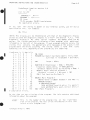
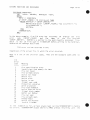
Here is a summary of the keys that
you
will
use
the
most
when
editing
programs with VIlE:
RETURN
ESC
CONTROL
RUB
ARROW—KEY
End each line with a carriage return symbol by pressing the
RETURN key (sometimes labeled RET, CR, or CARRIAGE RETURN).
change from editing mode to command mode (and back
again), type an Escape by pressing the ESC key (sometimes
labeled ALT NODE or ESCAPE).
To
Most of the VUE commands are control—characters.
To type a
control—character, hold down the CONTROL key (sometimes
labeled CTRL), and type
For
the appropriate character.
example, to type a Control—C, hold down the CONTROL key
while you type a C.
To delete a single character, press the RUB key
labeled DELETE or DEL).
(sometimes
To
move the
cursor around on the screen. use the keys
marked with arrows (labeled with a left—arrow, right—arrow,
up—arrow, and down—arrow).
For example, to move up on the
screen, press the up—arrow key.
If your terminal does not
have arrow keys,
you will
control—characters
use these
instead:
Control—H
Control—J
Control—K
Control—L
To
To
To
To
move
move
move
move
left
down
up
right
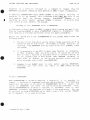
If
VIlE
is
new to you, you may want to ask the System Operator to place into
your account a copy of the VIlE initialization file in which the menu—display
option has been enabled. VUE wilt then display a summary of its commands when
you enter command mode.
You may also want to ask the System operator to modify
the VIlE initialization file so that the default extension is set to .PAS (which
means that VIlE wilt, expect you to edit .PAS files and thus will not require you
to enter a file's extension unless you want to edit a non—.PAS file).
.
(Changed 30 Apri1 1981)
Page 2—7
GETTING STARTED:
2.3.2
CompIling and Linking a Pascal Program
The first step after creatinq your Drogram is to compile it using CMPILR.
After you have compiled it, the program is still not ready to run until you use
(Both PLINK and CMPILR are themselves programs written in
the
linker, PLINK.
Pascal.) Chapter 4, "Operating Instructions and Characteristics," discusses the
Fornow, we'll, simply show you one
operation of PLINK and CMPILR in detail.
way to use them—— t* compile and link a new program made up of only one file.
For this demonstration, we will use one of the command files provided with your
system, PCL.DO. This command f:ite conDains a series of commands and data that
invo CMPILR and PLINK far you, and provide necessary
automatically
NOTE: Remember that the larger your memory
to those programs.
partition
informationis, the faster your programs will compile!
AMOS command level, enter PCL followed by the name of your program
For examplel
Then type a RETURN.
off the .PAS extension).
At
(leaving
PCL SALARYtj
Now the PCL command file runs CMPILR and PLINK for you.
compiled, you see a display something like this:
As
your
program
PRIJN CMPILR
AlphaPascal V2.O
Source file name? SALARY
Diagnostic file name (<return> for terminal)?
AlphaPascal Compiler Version 2.0
0>———
3>
PROGRAM <
12 lines
10.47 seconds, 68.79 lines/minute
No compilation errors.
If CMPILR spots an error while it is comotling your program (for example, if
semicolon off the end of the second line), CMPILR pauses, and
the
we
left
For example:
tells you about the problem.
VAR
Gross, Takehome, Deductions, Percentage
?Line 2: CINISOP]
;' or ')' expected ——
Hit RETURN to continue
:
REAL;
inserting
';
the
of
front
missing in
is
The message above tells us that a semicolon
("(INISOP]" identifies the portion of the compiler that caught
symbol
VAR.
the error—— you can disregard that information.)
Now you may type a RETURN to resume program compilation, or you may type a
the CONTROL key while you type a C) to interrupt the
Control—C
(hold down
the message:
Control—C, CMPILR displays
compilation.
(If
you type
a
If you
"?Compilation
aborted" and then returns you to AMOS command level.
type a RETURN, CMPILR resumes the compilation, and then returns you to AMOS
In either case, because an error has occurred PCL does not
command
level.
go on to link the program and you are returned to AMOS command level.)
If CMPILR reported something other than "No compilation errors," your
You should use VUE on the oroqram and check your copy
program is incorrect.
(Changed 30 April 1Q81)
is
GETTING STARTED
Page 2—8
of the program against the one in this book.
Correct any discrepancieg, and
use the PCI command file again.
(For
full
information
on using CMPILR and
its options, refer to Section 4.3, "The AlphaPascal Compiler."
That section
also discusses the compiler display.)
Let's say that your program has compiled without error.
PCL.DO goes on to
invoke the tinker, PLINK.
At this point, CMPILR has,, created three
intermediate files: SALARY.Po1, SALARY.Po2, and SALARY.p03.
However, your
program still is not completely ready to run.
PLINK
wilt
fully resolve
references within the
intermediate files and will produce the final,
.pcr file.
The second part of the screen display that you see
looks something like this:
executable
.ERASE SALARY.PCF
ZNo files deleted
.PRIJN PLINK
Aiphapascal V2.O
Code file = SALARY
Creating new code file SALARY.PCF
Library code file for SALARY.pCF
= STDLZB
Please specify files to be linked into
one per line, ending in a blank line
File 1
SALARY,
= SALARY
File 2 =
Loading Drogram and library dictionaries
Processing SALARY
Linking in global func/proc PROGRAM
Transferring temporary file to new code file
SALARY completed
The first thing that the command file does before linking your
erase
file
is t
any file SALARY,.PCF that already exists. (This is because PLINK asks
different questions depending on whether or not the specified program
already exists, and we want to make sure that PLINK asks a particular set of
questions.) Now it invokes PLINK.
For more information on linking a file, see Section 4.4, "The ALphaPascal
Linker." That section also discusses the meaning of the display you see
above, and talks about the concept of a "library."
2.3.3
Running a Pascal Program
To run the program you have compiled, use the Pascal run—time package, NUN.
At AMOS command level, enter:
PRUN SALARY.PCF
followed
by
information on
a
RETURN.
executing
(Changed 30 ApriL 1981)
At
last
Pascal
your
programs,
program
is
refer to
running!
Section
(For full
4.5,
"The
Page 2-9
GETTING STARTED
ALphaPascal Runtime Package)
As you run SALARLPAS, you see:
AlphaPascaL V2D
What is your gross salary?
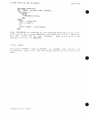
Lets assume that you want to enter 250 as your gross saLary and 175 as your
takehome, Below is a sample run of your program:
AiphaPascal V20
What is your gross salary? 250
What is your takehome salary? 175 tED
They
keep 30 percent of your salary!
ALPHA PASCAL USER'S MANUAL
PART I
THE ALPHA PAScAL SYSTEM
next two chapters introduce you to the Alpha!ascal programming system.
Chapter 3 is aimed at the experienced Pascal programmer; it discusses the
differences between this Implementation of Pascal and previous versions of
The
AlphaPascal. It also discusses the major differences between this Pascal
and the standard Pascal as described in Jensen and Wirth's Pascal User
Manual and Report. The last section of Chapter 3 gives some flints for
converting programs written in earlier versions of AtphaPascal over to the
current AiphaPascal standards.
Chapter 4 gives full, operating instructions for the various
components of
AlphaPascal system; the compiler, the linker, and the run—time package.
Chapter 4 tells you everything you need to know about the actual processes
of creating, compiling, linking, and running an AlphaPascal program.
Chapter 4 also discusses file requirements and memory limitations of the
the
AlphaPascal system.
CHAPTER 3
COMPATIBILITY AND CONVERSION
primariLy at the experienced Pascal programmer who
of Pascal differs from previous
versions of ALphaPascai and from the standard Pascal described by Jensen and
Wirth in the Pascal User Manual and Report
This chapter is
wants to know how
aimed
this
impLementation
have also included a section that provides hints on converting Pascal
programs written under earlier versions of AlphaPascal to the format used by
the current AlphaPascal.
We
If you have never before programmed in Pascal, you will probably want to
skip this chapter and go directly to Part II, "Summary of AiphaPascal," for
information on the Alpha Micro Pascal, or to the next chapter, "Operating
Instructions and Characteristics," for information on using the AlphaPascal
compi Icr and linker,
3,1
PREVIOUS VERSIONS OF ALPHA PASCAL
Previous versions of AlphaPascal were based on the UCSD Pascal programming
system, Version 1.4.
In order to provide a Pascal that is more fully
integrated with the Alpha Micro operating system and file system, we now
offer this new version of AlphaPascal that was expressly developed for the
Alpha Micro computer.
To make life easier for programmers who have written programs using previous
versions of AlphaPascal, we have tried to keep many of the same features and
functions, while adding a number of new extensions and abilities.
Most of
the changes between this version and earlier versions are added features
that do not require that you rewrite your earlier programs.
Several of the most important difference are:
The operating instructions for AlphaPascal have changed. An important
difference is that you will use the Alpha Micro screenoriented text
editor, VUE, to create your programs. You must also use the linker,
COMPATIBILITY AND CONVERSION
Page 3—2
PLINK, to link any compiled program, whether or not it consists of
more
than
one
file.
See
Chapter 4,
"Operating Instructions and
Characteristics," for complete instructions.
—
Expression handling has been considerably
1.
enhanced:
You may now include the assignment operator in an
For example:
5 +
X
:
expression.
7
The
expression above is equivalent to 5 + (X :
7), and means
"Let X assume the value of 7, and then be added to 5."
2.
Wherever an expression is legal, you may
expression of the form:
include
an
IF—THEN
IF condition THEN expression ELSE expression
For example:
Year
If
:
(IF
Feb = Leap THEN 29 ELSE 28)+337;
Feb
equals the value Leap, then Year assumes the value
29+337; otherwise it assumes the value 28+337.
3.
Wherever an expression is
expression of the form:
CASE value OF valuel
value2
legal,
:
:
you
may
include
a
CASE
expression;
expression;
ELSE expression
For example:
WRITE(CA$E Errorcode OF
'Illegal iiiut';
2
'Number too large';
3 : 'Number too small';
ELSE 'undefined error');
:
—
AlphaPascal.
now
recognizes
modifying
assignment
operators are:
—=
1=
Adding assignment operator
Subtracting assignment operator
Multiplying assignment operator
Dividing assignment operator
operators.
These
COMPATIBILITY AND CONVERSION
Page
S
—3
the
These operators teLl the compiler to modify (instead of replace)
value of the variable on the left of the assignment operator with the
value of the expression on the right of the operator.
For example, in the case of the adding assignment operator:
X +=
1
tells the compiler to let X assume the value
Section
information
see
on these operators,
Assignment OperQtors."
—
of
X+1.
8.1.2.1,
For more
"Modifying
Operator precedence has beenchaAqed to make it
more compatible with
Language processors on the Alpha Micro
precedence in other
The relational operators have ,been made of higher precedence
system.
(See Section 8.1.1, "Operator Precedence,"
than the Bootean operators.
for more Information.)
operator
—
AlphaPascal allows you to label BEGIN—END blocks by following the BEGIN
These labels
and END keywords:with a colon followed by an indentifler.
If
you
to
tell
the
compiler
which
BEGINs
and
ENDs
should
match.
allow
they do not match, the
the structure of your program is such that
compiler wilt til you so.
For example:
BEGIN
:
Blocki
BEGIN
:
END
Block2
END
:
:
Btock2
BLocki
The compiler checks these Labels to make sure that the designated pairs
For exampLe, the
BEGIN—END keywords are indeed property matched.
following program would cause an error because the BEGIN—END blocks are
not property nested:.
of
BEGIN
Blocki
BEGIN
END
:
:
Block2
Blockl
END :Block2
(Changed 30 April 181)
COMPATIBILITY AND CONVERSION
—
Page 3—4
Two new keywords have been added to AlphaPascal.
EXTERNAL and MODULE.
These words may no longer be used as identifiers,
If they do appear in
your
programs, you see an error message
(e.g.,,
"(TRYSCAN] VAR,
PROCEPURE, or FUNCTION expected —— scanning") when you compile
the
programs.
EXTERNAL allows you to access variables, procedures, and
functions In
an external library, and aLlows a file in a multiple—file
Program to
access variables, procedures, and functions in
another file.
See
Section 6.7, "External Declarations," for more information.
The MODULE keyword designates a file that does not contain the main
program portion of the program. Modules may contain declaration and
definition statements, but may not contain the final BEGIN—END block.
(That
is, BEGIN—END
blocks may only appear in function or procedure
definitions if they appear in modules.)
See Section 6.1, "Program
Declarations," for more information.
—
—
The SEGMENT keyword and seqment procedures are no Longer supported.
(See the discussions of EXTERNAL and MODULE, above.)
Remove the
SEGMENT keyword from your programs.
Floating
point numbers are now three words in length (i.e., 12 digits).
(They used to be two words, and could only represent six digits.)
—
You may call
assembly language
subroutines from within your Pascal
programs.
For information on writing
assembly language subroutines,
see Chapter 15, "Assembly Language Subroutines."
—
Opening,
closing, and specifying files have changed. You may now
access AMOS files, and make full use of the Alpha Micro fit. system.
Refer to Chapter 10, "input/Output Functions and Procedures," for more
information on the procedures and functions that allow you to search
for, open, and read and write sequential and random files. (NOTE: Those
of
you who have done assembly language programming using monitor calls
on the AMOS system will recognize some of the new procedure names such
as FSPEC, OPEN, OPENI, OPENO, and OPENR.)
—
AlphaPascal
supports an external procedure
Library.
This Library
contains a series of procedures and functions available to your
programs.
You may write your own external libraries that make use of
the library provided.
See Section
16.1, "STDLIB," for
list
of
a
procedures and functions in the library.
If you wish to access these
routines in your programs, your programs may not use these names in
global identifier definitions, since such definitions will override the
standard library definitions.
if
you wish to access these procedures and functions, simply invoke
them in your program.
If they are not
defined within that program,
Alphapascal assumes that they are in the external library.
.
(Changed 30 April 1981)
Page 3—5
COMPATIBILITY AND CONVERSION
procedures and identifiers used by previous
AlphaPascal are not supporte4 by the current version:
Several,
versions
of
BLOCKREAD
BLOCKWRITE
UNITREAD
UNITWRITE
UNITWAIT
UNITBUY
UNILEAR
GOTOXY
(Refer to Section 11.2.2, "CR1," for
information on cursor positioning.)
HALT
IORESULT
INTERACTIVE tiles
(the main program) may not be catted recursively.
—
PROGRAM
—
You should be aware of these changes to the standard procedures:
type
1.
RESET and REWRITE accept only one argument: a variable of
FILE.
You rnèy not specify a filename after that argument.
2.
The file type INTERACTIVE is no longer supported or needed; replace
It with the standard file type TEXT.
3.
In
4.
When you use the EXIT statement to exit a program, you must supply
(That
the PROGRAM keyword as the argument, not the program—name.
is, EXIT(PROGRAMY is valid, but EXIT(NewProgram) is not.) You may,
however, exit a procedure br function by giving the name of that
procedure or function (e.g., EXIT(EvalError)).
5.
argument.
WRITE and WRITELN do not accept a Boaiean variable as an
That is, If NewElte is a Boolean variable which evaluates to TRUE:
CLOSE took an option as an
earlier versions of AlphaPascat,
now accepts
it
argument tn addition to a varlabtt of type VIE;
only a single argument—— a variabtie of type VILE.
WRITELN(NewFl Ic);
does not print TRUE, but instead generates an error.
COMPATIBILITY AND CONVERSION
3.2
Page 3—6
STANDARD PASCAL
The
standard. Pascal is described by
Jensen and Wirth, in the Pascat User's
Manual and Report (Second Edition).
AlphaPascal differs from this standard
in several ways (also, note the extensions discussed In Section 3.1,
above):
The program heading file identifiers are scanned but ignored.
That Is,
if
you have
any information in the program heading after the program
name, that information is ignored. (For example, "PROGRAM MailBox;" is
equivalent to "PROGRAM Mall$ox(INPUT,ouypuT);".)
This
Is
because
Alphapascal uses its own form of file handling that Is
consistertt with
the AMOS file structure.
(Note, however, that the remainder of the
heading after the program name is
scanned, and that therefore the
program heading must be syntactically correct.
For example:
"PROGRAM
NewAccount (;"
generate an error because of the open parenthesis.)
If
you want to use any files other than the predeclared file INPUT and
OUTPUT, you must use VAR statements to declare them.
will
—
Operator precedence has been changed to make it
more compatible with
other
language
processors on the Alpha Micro system.
If It ts
important that your program be able to run under another Pascal that
uses
standard Pascal's rules of operator precedence, you will have to
use parentheses In your expressions to override AlphaPascal's rules
operator precedence.
This
of
will
only become necessary
if your expressions use relational
operators to compare Boolean expressions.
For example, if A, B, C, and
D are Boolean variables, standard Pascal evaluates: IF A = B AND C
D
THEN..,
as:
IF
(A
=
(B AND C)) = D THEN ..., white AlphaPascat
evaluates it in this way: IF (A = B) AND (C = D) THEN...
(See
Section
precedence.)
—
8.1.1,
"Operators,"
for
information
on
operator
Two
new keywords
have
been added to the
list of reserved words:
EXTERNAL and MODULE.
In addition, several identifiers have been added
to the
standard identifier list.
(For a list of AlphaPascal standard
identifiers, see Section 5.4.2, "Standard Identifiers.")
Also, several standard identifiers used by standard Pascal are NOT used
by Alphapascal (DISPOSE, PACK, and UNPACK) since AlphaPascal does not
use these
procedures.
AlphaPascal uses MARK and RELEASE to reclaim
memory alLocated by NEW, and automatically unpacks packed
data
structures for you when necessary.
(See Section 11,1.4, "NEW," for
information on allocating dynamic variables.)
—
Standard
Pascal
supports
AlphaPascal atso supports a
length
fieLd as
well as
"STRING," for a description
the
data
type
CHAR
(single character).
non—standard type, STRING, which contains a
a field of characters.
(See Section 7.2.3,
of this data type.)
.
COMPATIBILITY AND CONVERSION
Page 3—1
33 MAKING PROGRAMS COMPATIBLE thTH THE NEW ALPHA PASCAL
In general, programs written in previous versions of AlphaPascal or standard
Pascal wilt require very little modification before being runnable under the
current AlphaPascal.
For example, the sample progrèm given in Chapter 2
runs
correctly in any of these versions ot Pascal. The largest number of
changes will probably involve fuWttions and proeedures that read and write
disk files, since the new AlphaPascal is fully Integrated into the AMOS file
structure.
your programs were written under previous versions of UCSD/AlphaPascat,
you will need to transfer your programs toAMOS files before you begin to
perform any necessary conversions.
To
do so, use the UCSD/AlphaPascal
programming system (which was provided only in earlier releases
of
AtphaPascal):
If
1.
AMOS command
level,
enter the UCSD/AlphaPascal programming
system by typing PASCAL followed by,a RETURN:.
At
PASCAL €E
When you see the initial prompt:
Command:E(dit,R(un,F(i le,C(ompl le,X)ecute,D(ebug,I(nit,H)alt
Type an F.
2.
You are now communicating with the Filer.
You see this prompt:
Fl ler:G(et,S(ave,W(hat,N(ew,L(dir,R(em,C(hng,T(rans,D(ate,Q(uit
To see what Is in your library, type L.
Now yâu see the question:
What volume?
Enter a colon followed by a RETURN.
took something like this:
Now you see a list that
might
5CR:
ROMAN.TEXT
4
28—Jun—80
POSTFIX.TExT
4
28—Jun—80
2 files, 8 blocks used, 26 unused
This is a list of the files in your library.
3.
You
see
the Filer prompt again.
to an AMOS file, enter T.
a.
To write one of the programs out
The Transfer function asks you:
Transfer what file?
enter one of the files listed in the directory.
For example:
COMPATIBjLjT AND CONVERSION
Page 3—8
Transfer what file? ROMAN.TExT
b.
Now Transfer asks:
To what file?
Enter "REMOTE:' and type a RETURN:
To what file? REMOTE: fEED
c.
Now Transfer asks:
Using what AMOS file?
Enter a valid AMOS file specification.
For example:
DSK1 :CONVRT..PAS
that this file does not
already exist; if it does, the UCSD/AlphaPascal system wilt not
do the transfer, and will make the accessed drive inaccessible
IMPORTANT NOTE: You must make sure
to you (that Is, it wilt declare that drive "off tine') until
you exit or re—enter Pascal.
d.
Now Transfer asks:
CONVRT..PAS mode: T(ext, t(mage:
Enter an upper case T followed by a RETURN.
e.
Now
transfer begins
DSK1:C0NVRT.PA$.
to copy ROMAN.TEXT into the AMOS file
When Transfer is done, you see:
SCR:ROMAN.TEXT transferred to REMOTE:
You may now use the text editor, VUE, to modify the AMOS file that
contains your program. NOTE: If your file is too large, Transfer
may ask for additional AMOS
finally finished,
you
file specifications.
When
you
are
will need to append all such files into a
single file, using the AMOS APPEND command.
Here is list of things to check when converting your old programs to current
AlphaPascal format:
1.
Make sure that you do not use the reserved words EXTERNAL or MODULE
as identifiers.
2.
Check the list of standard Identifiers in Section 5,4.2, "Standard
identifiers, to make sure that you do not redefine any identifiers
that designate functions or procedures you need by including them
in global declarations.
Page 3—9
COMPATIBILITY AND CONVERSION
from
3.
Remove any information concerning input or output files
program heading.
4.
Change any
longer supported.
The INTERACTIVE
file
type is no
occurrences of the INTERACTIVE file type in your programs to TEXT.
might be
easiest to just redefine INTERACTIVE at the fronf of
It
your programs via a type statement:
TYPE
your
INTERACTIVE = TEXT;
S.
Previous versions of AlphaPascal expected a UCSD file specification
Now the SI
for the argument of the compiler include option, SI.
The default
option request
accepts an AMOS file specification.
compiler option, you
extension is
INC.
If you have used the $1
wilt
have to
change your file specifications to valid AMOS file
For more
specifications, and make sure that those files exist.
information on include files,
see Section 4.3.2.2, "The Include
Option (SI)."
6.
If it occurs in your programs, remove the SEGMENT keyword.
7.
Note that the operator precedence used by AlphaPascal is different
from that of standard Pascal and previous versions of AiphaPascat.
are
You may need to check expressions in which Boolean expressions
compared
with
relational
operators to make sure that the
expressions will be evaluated correctly.
See Section 8.1.1,
"Operator Precedence," for more information.
Besides changing your programs so that they will run under AlphaPascal, you
listed in
might also want to add some of the new AlphaPascal features
Section 3.1, above. As an example, instead of the statement:
TOTAL
:
TOTAL + SliM;
*
you might want to say:
TOTAL +=
Or,
SUM
you may want to break your programs up into modules.
(For information
if
on modules, see Section 6.1, "Program Declarations.")
you
Of
course,
want
your programs
written in standard Pascal so that they can run with
other Pascal implementations, you may want to restrict your programs to
using features found only in standard Pascal.
CHAPTER 4
OPERATING INSTRUCTIONS AND CHARACTERISTICS
This
chapter assumes that you are ready to start compiling and running
Pascal programs. If you are not familiar with AiphaPascat, you may want to
skim through Part II, "Summary of AlphaPascal," before 4'ou attempt to start
This chapter gives, you tnfGrmation that you
using the AlphaPascal system.
programs that make up the AlphaPascat
the
will
need
to
know about
sections talk about file and memory
The
first
few
programming system.
Operating instructions begin with Section 4.2, "Creating a
requirements.
Pascal Program."
The AlphaPascal system consists of the compiler, CMPLLR; the tinker, PLINK;.
the run—time package, PRUN; and, the standard external library, STDLIB.
create a Pascal
source program, use the system screen—oriented text
editor, VUE. WE is an easy to use, powerful editor that allows you to see
program on the screen of your terminal, and to make changes to
your
Pascal
that program by moving the cursor around, on the screen display and entering
the new or
replacement characters., For, information pn using VUE, see the
to
brief, introduction
a
(Also,
AIphaVUE User's Manual, (DWM—OO100—15).
VUE is given in Secti'on 2.3.1 of this. book, "Building a Pascal Program.")
To
After
creating your, program, you will exit VUE and use the AtphaPascal
compiler, CMPLLR, which compiles your souroe,,program (a file that has the
Next you will use the
.PAS extension) into a seri:es of intermediate flies.
Alphapascal linker, PUNK, which uses the intermediate fites created by the
to create a fully resolved, runnabte P—code ,fite that has the .PCF
compiler
extension.
The linker also allows you to Link together separate files into
one proqram,
and
allows you te update,one portton of an existing compiled
program without re—compiling all of the modules thit make up that program.
To run your .PCF file, you wilt use the AlphaPascal run—time package, PRUN.
external library contains a set of procedures, variables, and functions
routines
list
of the
For
a
that are available to your Pascal programs.
within the external library, see SectIon 16.1, "STDLIB." For information on
writing and modifyinq your own procedures within this library, see Chapter
16, "Writing and Modifying an External Library rile."
The
(Changed 30 April 1981)
OPERATING INSTRUCTIONS AND CHARACTERISTICS
4.1
Page 4—2
FILE AND MEMORY, REQUIREMENTS
The AlphaPascal system consists of these files:
DSKO:PRLJN. PRG(1 ,4)
DSKO:CMPILR.pCFCT,5]
DSKO:PLINICPCF(7,5)
DSKO: STDLIB.PCF(7,5]
DSK0:DEMO.PASC7,5)
DSKO:DEMO.PCFrT,5)
U
DSKO:
UT. INC(7,5)
OSKO: SPOOL. INCC7,5)
DSKO:XLOCK. INCC7,5)
05KG: XLOCK. SYS(1 ,4]
05KG: XMOUNT. INC(7,5]
DSKO:PC.DO(2,2)
DSKO:PCL.D0E2,2]
DSKO:PL.D0t2,2)
DSKO:PCU.DO(2,2)
DSKO: PU. 00(2,2)
The
first
four of these files must be on your system if you are to use the
AlphaPascat system.
PRUN.PRGC1,4) is
a
re—entrant
assembly
Language
program; you may load it into system memory.
CMPILR[7,5), PLINKC7,5), and
STDLIBCY,5) are Pascal code file programs.
(.PCF files may not be loaded
system memory.)
DEMO,,PAS and
DEMO.PCF are the source and compiled
versions of a samDle Pascal program that demonstrates file handling.
(This
program
also appears at the end of Chapter 10 of this book.)
into
The
.INC files are special files you will include in programs that make use
of several of the subroutines we have provided with the AiphaPascal system.
(The special
routines that make use of the .INC files are described in
Chapter 14, "Systems Functions and Procedures.") (See SectIon 4.3.2.2, "The
Inctude Option (SI)," for information on Include fiLes.)
The
Last
five
files listed above are .00 files: these are special command
files that help you to compile and Link files. They invoke the compiler and
tinker for you, and automatically answer alt of the questions asked by those
programs.
Although these command files are not for use in all cases, you
will
probably be able to use them most of the time when you are compiling,
linking, or updating a single file.
For information on how to use these
files, see Section 4.6, "HeLpful Command Files."
4.1.1
File Extensions
Some of the extensions
programming system are:
recognized
by
various
components of the Pascal
.
(Changed 30 April 1981)
Page 4—3
OPERATING INSTRUCTIONS AND CHARACTERISTICS
.PAS
Pascai. source tile, created by text editor.
.PO1
Pascal intermediate files, crepted by the
Not directLy executabLe.
&ompiler.
.P02
.P03
.PCF
Pascal code file. The executable prqgram file
created by the tinker.
.PSB
.INC
Pascal assembly language subroutine.
Include files
.PSB files have been inctuded with this release, aLthough many of
the routines in the standard library are aàtuauly 'linked—in assembly
you write your own assembly language subroutines,
If
language programs.
they must have the .PSB extension. Theadvantage In using assembly Language
programs in combination with your Pascal functions and procedures is that
some systems functions can best be performed by an assembly language program
because of speed, size, or hardware requirements.
NOTE:
4.1.2
Pascal
needs.
No
File Search Pattern
standard search patter-n in Looking for those files that it
For .PCF and .INC files, this pattern is:
uses
a
The account you are logged into
Your project Library account: [*,O]
The Pascal Library Account, PAS: —— DSKO:17,5]
For PRUN.PRG, this pattern is:
System memory
User memory partition
System Library Account, SYS:—— DSKO:C1,4]
Your project library account: [*,O]
The account you are logged into
For .PSB files, this pattern is:
System memory
User memory partition
The account you are logged into
Your project library account: [*,O]
The PascaL Library Account, PAS: —— DSKO:C7,S]
For example, if you are logged into DSK1:[100,3], and want
program PRIME.PCF, you enter:
PRUN PRIME @E
to
execute
the
OPERATING INSTRUCTIONS AND CHARACTERISTICS.
Page 4—6
(PRUN
assumes a file extension of .PCF,) Pascal first
looks for the file
PRIME.PCF in the account you are logged into
(in this
case, DSK1:C100,3));
next it looks in your project library account, DSK1:C100,0].
Finally It
looks in the Pascal Library Account, DSKQ:C7,5].
If
it
doesn't find the
file in any of these places, you see the error message:
?Cannot OPEN PRIME.PCF —
file
not found
Of
course,
if
you give a
complete file specification (including device
and/or account specification) Paseat will look for the file on the
device
and account
you have specified, without going through its search pattern.
The standard,
complete AMOS file specification
consists of a device
specification, a file name, a file extension, and an account specification.
For example:
PRUN HWK1:PRIME.PCFC200,56] @D
4.1.3
Program Restrictions
AlphaPascal handles your programs via a virtual memory paging system.
This
means that
there
is
no
limit to the size of your programs. (NOTE: Only
programs are paged, not data allocated by NEW.) However, there are minor
limits on the size of components of those programs:
4.1.4
1.
The object code version of any one procedure may not be larger than
2000 bytes.
2.
You may not have more than 255 global procedures and functions in
any one program or library.
3.
Any global procedure or function cannot have more
procedures or functions.
4.
Maximum nesting of program block declarations is 15.
5.
Maximum
nesting
of
descriptions is 12.
procedures,
WITH—Dos,
than
and
255
RECORD
local
type
Memory Requirements
Because AlphaPascal uses a virtual memory paging system, there is no Limit
to the
size of
your programs.
However, a certain amount of memory is
required to use CMPILR, PLINK, and PRUN.
Although the minimum size of your
memory partition depends on the data space
requirements of the Pascal
program you want to use, you should have at Least 16K of memory to run a
small program.
To compile and link a program, you should have at least 24K
of memory.
OPERATING INSTRUCTIONS AND CHARACTERISTICS
Page 4—5
Also, you should
note that even though you may execute a program that Is
larger than your memory partition, the larger that
memory partition is, the
less paging must be done and, in general, the faster your programs will run.
To
help even more
in
speeding up orogram execution and In reducing the
minimum meAiory partition size, remember that you may load PRUN.PRGC1,4) into
system memory. Also, if the assembly language subroutines that
you write
are re—entrant, you may load them into system memory. If you should run out
of room in memory while compiling a program, CMPILR displays the messages:
?Insufficient memory
or:
?Attempt to call ERRORTRAP while in ERRORTRAP
4.2
CREATING A PASCAL PROGRAM
To
create a Pascal source program, use one of the system text editors, VUE
or EDIT.
you are using a video display terminal, you wilt probably want
to use
the screen—oriented text editor WE. Ear a full description of how
to use VIJE and a list of all
of
its
commands, see the AIph3VUE User's
Manual,
(DWM—OO100—15).
Also, Section 2.3.1, "Building a Pascal Program,r
of this book contains a brief introduction to VUE.
If
4.3
THE ALPHA PASCAL COMPILER
The compiler reads the source program that you have created, and compiles it
into three Intermediate files that have the same name as the source
program
file and
the extensions .PO1, .P02, and .PO3. These files are used by the
linker to create the final, executable program file, which has a .PCF
extension.
(If .PO1, .P02, and .PO3 files already exist with the same name
as the program,
CMPILR deletes them before compiling the new source
program.)
To use the compiler, at AMOS command level enter:
PRUN CMPILRtEJ
The compiler now asks you for the name of the source file:
AlphaPascal V2.0
Source file name?
Enter
the name of the file that contains tie program or module you want to
compile followed by a RETURN.
(CMPILR assumes the .PAS extension.)
This
source
file may be in any account, but the .PO1, .PO2, and .PO3 files for
the program will be generated in the device and account you are logged into.
(Changed 30 April 1981)
OPERATING INSTRUCTIONS AND CHARACTERISTICS
Page 4—6
•'
4.3.1
The Diagnostic Display
After you have given CMPILR the name of the source file you want to compile,
it asks:
Diagnostic file name (<return> for terminal)?
The diagnostic file contains information about the, program compilation. You
wilt usually want. to see this information on the screen as
the compilation
proceeds, and therefore will enter a RETURN.
If you want this information
sent to a file so that you can have a permanent record of the compilation,
enter a valid AMOS file specification. For, exampte:
Diagnostic file name (<return> for terminal)? DIAG
The default extension is .LST.
The diagnostic display might took something
Like this, depending on the program you are compilinq:
AlphaPascat Compiler Version, 2.0
<
0>
NEWCHECI( C
4>————
PROGRAM C 10>
16 lines
7.07 seconds, 152.83 lines/minute
No compilation errors.
diagnostic display above shows the line nunbers at which the procedures
within the orogram begin (line #6 for the Drocedure NEWCHECK; line #10 for
The
the main program). 'Each dash indicates the compilation of one program line.
The last three lines tell you a) how many lines were in the program; b)
how
quickly the compilation was done; add'c) how many errors occurred.
error occurs,
an
you see it reported at, the appropriate place In the
compilation.
For example, suppose we had left
off a
statement
separator
(the semicolon) at the end of the firSt line of the program.
The diagnostic
display would look like this:
If
AlphaPascal Compiler Version 2.0
<
PROGRAM MYPROG
VAR
Target
0>—
:
REAL;
?Line 1: CINISOP] ';'
<
1>
NEWCHECI( <
or
'('
expected
——
inserting
';
6>————
PROGRAM < 10>
16 lines
6.97 seconds, 155.02 lines/minutes
?Total of 1 compilation errors.
NOTE:
you
tell
CMPILR to send the diagnostic display to the terminal
screen instead of a file, CMPILR pauses when an error occurs, and gives you
a chance either to continue or quit. For example:
If
(Changed 30 April 1981)
OPERATING INSTRUCTIONS AND CHARACTERISTICS
Page 4—?
AtphaPascal Compiler Version 2.0
.
<
0>—
PROGRAM MYPROG
Target
REAL;
?Line 1: CINISOP) ';
or
Hit RETURN to continue
At
this
('
expected—— inserting ';'
point
you may continue the compilation by typing a RETURN, or
may stop the compilation by typing a Control—C (in which case you see
message:
?Compilation aborted).
If
an error
occurs, CMPILR does
generate the .PO1, .PO2, and .PO3 intermediate files; this is to prevent
from linking a program that contains a comDile—time error.
4.3.2
you
the
not
you
Compiler Options
The AlphaPascal compiler has a nunber of options available to you.
You may
select one or more of these options at
compile—time by including the
appropriate option codes in your program.
Including
You tell the compiler that you want to make an option request
by
the symbol
$
at
the
front of a program comment followed by the specific
option code you want to use.
The compiler acts upon the option requests as
It reaches them in the program.
Option
No space may separate the left
codes may be in upper or lower case.
comment delimiter and the option code. For example, ($6—) is valid, but
'C $6—) is not.
The GOTO Options
($G+ and $6—) — The $G+ code tells the compiler
to allow use of the GOTO statement: the $6— code telLs the compiler to
qenerate an error message if it encounters a GOTO statement.
You may use
(The
these options to turn GOTO recognition on and off within your program.
recognize
compiler uses the $6— option as the default; that is, it does not
GOTO statements unless you use the $G+ option in your program.)
4.3.2.1
4.3.2.2 The
Include Option
(SI) — The SI
code tells
include the contents of the specified file in your program.
AMOS file specification.
For example:
the compiler to
Supply a valid
(SI MACRO.INC)
The default
extension is
.INC.
The SI option code tells the compiler to
physically Insert the contents of the specified file into the file being
compiled. The Insertion takes place at the point of the option request. You
may not
include any other option codes after the file specification.
The
(Changed 30 April 1981)
OPERATING INSTRUCTIONS AND CHARACTERISTICS
Page 4—8
purpose of the SI option is to save you from having to duplicate
used declarations or lines of code.
frequently
The
Include file pan contain any valid program elements, as long as those
elements can Legally be inserted at the olace in the program where the
incLude file option occurs.
(For example, you will not use the SI option
request in a program's variable declaration section to include a file that
contains a program header.)
NOTE:
You cannot nest tnâlude file requests.
not itself contain an include file reqdest.
That is, the include file may
4.3.2.3 The List Options (SL, SL+ and SI.,—) — The SI option request tells
the compiler
to
send a listing to an AMOS file. (You do not see a orogram
listing if you do not use the SI. option.)
Supply a valid AMOS file
specification. For example:
<SI DSK1 : DIA6t33,2]}
listing
will
now be written to the specified file.
The default file
extension is .1ST.
If you do not give a file specification when you use the
SI request, CMPILR creates. a listing file bearing the name of your source
file and a .LST extension in the account you are Logged into.
The
course, you may not create a listing file outside of the project of the
account
you are
logged
into.
For
examDte,
if
you are
logged
into
DSKO:t100,2] and try to create the listing file DSKO:LIST.LSTC200,2J, the
AMOS system wilt respond with a "protection vioLation" error and abort the
compilation because you tried to create the file in an account outside of
the 100 oroject area.
Of
You may use the codes SI— and SL÷ to turn program listing off and back on
again.
For example, suppose you have a long program that contains a large
section of comment that you don't want In your Listing tile.
the front
At
of your source program you might say:
<SI MYPROG)
Directly
in front of the section you do not want in your listinq, you would
place:
(SI—)
At the point where you want the listing turned back on again, place:
C$I+}
The compiler tells you in the
listing file. For example:
diagnostic
display
that
It
is
writing
a
.
(Changed 30 April 1981)
OPERATING INSTRUCTIONS AND CHARACTERISTICS
Page 4—9
AlphaPascal. CompiLer VersIon 2.0
<
0>
List to LIST
ERRCHECK C
9>————
PROGRAM < 13>
20 lines
12.36 seconds, 96.90 tines/minutes
No compilation errors.
you want the listing to appear on your terminal screen, use th device
specification TTY:.
For example:
If
C$L TTY:)
(NOTE: This display will be interminaled with that of the diagnostic display
unless you send the diagnostic display to a file—— see SectIon 4.1.1, "The
Diagnostic Display.')
option requests may appear after the $L
No other
option. The listing consists of a display of your program
with additional
information to the left of the program. If your program contains errors, the
Listing
file contains
the appropriate error messages at the places in the
looks
program where the errors occurred. The listing takes a form that
something like this, depending on the program you are compiling:
line# proc lv il dsp ic/Ic
1—— Dl
2 —
0
3
Dl
1
6—— Dl
5—— Dl
6— Dl
1
1
1
1
0
0
0
1
1
1
1
1
1
0
0
1
1
Target:REAL;
1
40
0
BEGiNCMainProqram>
2
D
2
9 —
0 2
0
0
2
2
10——
C 2
1
2
11 ——
12 ——
C
2
1
2
C
2
0
0
2
1
15
16
17
18
19
VAR
REAL)
BOOLEAN;
FUNCTION ErrCheck(Local
C Function checks entry. If 100<nuiiber<1,
ErrCheck reports error by returning a TRUE.
BEGIN C Begin function ErrCheck 3ErrCheck := Local < I OR Local > 100
END C End function ErrCheck 1;
D
14— Cl
'C$LDIAG}
PROGRAM Validate { Validate nijueric entry; make
sure that it is between 1 and lQO.1;
4
7
7
0
0
12
7 ——
8 ——
13—— C2
o
0
0
2
2
:
:
C
1
1
1
2
C
1
1
1
45
WRITE('Enter a number between 1 and 100:
READLN(Target);
——
C
1
1
1
63
IF ERRCHECK(Target)
——
C
1
2
1
——
——
C
1
C
1
3
0
——
—
compilation
20
1
1
69
112
157
);
THEN WRITELN('Invalid entry: try again.')
ELSE WRITELN('Very good. Correct entry.')
END 'C Main Program 3-.
errors.
On the right you see a listing of the program.
information about the program:
Line# —
3-
This
The left contains additional
is
the nunber of the program line on the right—hand
side of the display. The rest of the information on this line
refers to this program line.
(Changed 30 April 1981)
___________
OPERATING tNSTRUCTIONS AND CHARACTERIST!CS.
Page 4—10
Proc
You see the name of
CMPILR comes to it,
Cor D
Pascal
tells you if data (0) or code (C)
for the program line,
each
locally
declared
procedure
as
is being generated
lv and
FIT
Internal information used by the compiler,
Indentation
level,
Tells
current program line is at,
is/Ic —
you
what
nesting
level
the
Internal code location counter, This number tells you how
many total bytes have been allocated at
this
ooint
in
the
program
compilation for
the
object
code
of
the current
orocedure or function,
The ic/Ic number can come
in
handy
later
when
you
debug
programs.
If you interrupt program
execution and hacktrace that program, the backtrace gives you
the 'IPC' number—" the
Interpreter Program Counter,"
The
IPC is the number designated by ic/Ic in the program listing,
you can
thus compare
your
backtrace with your
program
listing, and see exactly where the problem occurs,
Also, if a run—time error occurs, the error message gives the
IPC in the procedure at
which the
occurred
error
(e,g,,
?Vaiue
range error in PROGRAM at IPC = 64 within FILL,PAS),
(For
information on
backtracing,
Section
4,5,2,
see
"Interrupting a Program,)
4,3,2,4 The Page Option
($P)
The $P option allows you to start a new
page in the listing by telling the compiler to insert a
form—feed
at
that
point
in
the
program
listing,
($P is ignored if the $L option is not in
effect,
4,3,2,5
The Quiet
flptions
($Q+
$Q+
and
$0")
designates
the
quiet—compile ootio
This option request tells the compiler to give you a
brief diagnostic disp lay, leaving off procedure names and line numbers,
To
turn
full—display m ode back on (the default condition), use the $Q— option
code,
4,3,2,6
The Range Check OQtions (SR— and SR4)
The $R— option tells the
to
turn off range checking; that is, the compiler does not output
additiona
code to perform checking on array subscripts and
assignments to
sub range
type
variables,
Programs
compiled with range checking off run
slightly faster; however, since the
compiler
is
checking
for
not
range
errors,
if
an
•invalid
index
or
assignment is made by your proqram, the
run—time package will not stop the program when
error occurs,
that
You
compi Icr
I
(Changed 30 April 1981)
,
OPERATING INSTRUCTIONS AND CHARACTERISTICS
Page
4—11
should not turn off range checking until your program has been tested
and
you are absolutely sure that your program runs without error. To turn range
checking back on (the default condition), use the $R+ option.
4.4
THE ALPHA PASCAL LINKER
The
tinker,
PLINK,
reads
the
.PO1,
.P02, and .P03 files created by the
compiler and resolves the files into a single executable program.
You may
use PLINK to link multiple files together into one program.
However, even
if your complete program consists of only one file, you must use PLINK on
that file to generate an executable program file. The final file created by
PLINK has the .PCF (Pascal Code File) extension. Although the use of PLINK
may at first look complicated, once you begin to use It, you will find that
its questions are rather self—explanatory.
The paragraphs below discuss the
different
ways in which you can use PLINK.
The last few paragraphs of this
section (Sections 4.4.4 and 4.4.5) dIscuss the PLINK options.
To use PLINK, at AMOS commmand level enter:
PRUN PLINK @iD
Now PLINK asks:
Code file:
Enter the specification you want given to your final
.PCF
file.
This
specification may be that of an existing file, or it may designate a new
file.
It may be the same as or different than the specification of
one of
the files you are
going to link. Make èure that you supply a valid AMOS
file specification that cpntains a filename of no more than six characters
(for
example,
DSK4:VALIDC1IO,4D.
For
the purposes of our discussions,
let's say that you enter VALID
*
Code file: VALID@!fl
(PLINK will automatically assign the file a .PCF extension.) If you do not
include a device and account specification, PLINK assumes that you want to
Link a file that is in the device and account you are logged into. At this
point PLINK asks you different questions, depending on whether or not the
specified .PCF file already exists. In the next sections we will step
through the three situations which can occur: 1) you are creating a new
file; 2) you are replacing an existing .PCF file; 3) you are updating a
single module in the .PCF file.
For now, let's assume that PLINK has asked its next few questions, and knows
what files to link together and what external library to use. You see:
Loading program and library dictionaries
OPERATING INSTAUCTIONS AND CHARACTERISTICS
tells
This
file
file.
you that PLINK is getting ready to process your file.
you are linking, PLINK. tells you when it begins working
that
For example:
Page 4—12
For each
on
that
A
Processing NEWNOD
Next
PLINK
tells
you
what globally declared f%,nctions and procedures are
(These routines are in your program and
being linked into your .PCF file.
the external library.)
For example:
Linking 1v4 global func/proc
Linking in global func/proc
last,
At
PLINK
.PCF file:
ERRCHECI(
PROGRAM
is finished, and begins to copy the resolved code into the
Transferring temporary file to new code fi I.e
PLINK's final message tells you that it is finished:
VALID completed
Now, let's get back to the questions PLINK asks when It is determining which
files to link together. NOTE: Keep in mind when answering PLINK'S questions
that PLINK converts all of your input to upper case.
4.4.1
Linking a New .PCF File
.
If you use PLINK to create a .PCF file, and that fiLe does not already
PLINK knows that you are linking a new program, and not trying to
replace or update an existing program. For example, suppose you have told
exist,
it
that
you want to create VALID.PCF.
It tells you:
Creating new code file VALID.PCF
Now it
which external library you want to use for the new program:
Library code file for VALID.PCF =
asks
the file specification of the library you want to use. In almost
every case, this will be the standard library file, STDLIB.PCF.
The
external library contains routines used by your program and the compiler.
You must specify a library (except in the very rire case where you are
linking a "root" Library—— that is, a library that has no library of its
own—— such as SIDLIB itself). For information on the external library, see
Chapter 16, "Writing and Modifying an External Library File." Now PLINK asks
which files you want to link together:
Enter
.
OPERATING INSTRUCTIONS AND CHARACTERISTICS
Page 4—13
Please specify files to be Linked into VALID,
one per tine, ending in a blank tine
File 1 =
Enter
the
specification
asks for another file:
of the first file; then type a RETURN.
Now PLINK
File 2
Remember that a single .PCF file may be made up of several
separately
compiled modules.
If you are linking only one file, enter a RETURN here;
otherwise enter the file specification of the next module.
If
you are
linking together more than one file, the file
specifications do not have to
be entered in any special order, but at least one of these files must be a
main program file (rather than a module), or you see the message: ?Attempt
to create new code file without main program block.
(For
information on
module files,
see Section 6.1, "Program Declarations.") Remember that you
are entering AMOS file specifications, and not the internal
names of your
programs or modules; each specification must contain a six—character or less
file name that designates an AMOS disk file.
NOTE:
Although you will usually be linking together compiled Pascal files,
you may also want to use .PSB (Pascal assembly Language subroutine)
files.
To
tell Alphapascal
that a file is an assembly language subroutine rather
than a Pascal program file,
you will
specify the
.PSB extension.
For
example:
File 1 = MODUL1 @!D
FiLe 2 = MAINPRtTh
File 2 = INPUT.PSB
File 3
ANYCN.PSB/LINKEff
File 4
The
example above shows us linking together a main Drogram file, MAINPR, a
module file, MODUL1,
an assembly
language subroutine file reference,
INPUT.PSB, and an assembly language subroutine, ANYCN.PSB.
For a discussion
of
how these .PSB files are linked in, see Section 4.4.4, "Linking Assembly
Language Subroutines
(the
/LINK Option)." For
information on assembly
language subroutines, see Chapter 15, "Assembly Language Subroutines."
4.4.2
Replacing a .PCF File
If the VALID.PCF file that we specified as "code file" already exists, PLINK
knows that we want to either update or replace the file. Therefore, after it
asks for the code file, PLINK asks:
Do you wish to 1) replace or 2) update VALID.PCF?
To replace the file, enter a 1.
PLINK now says:
OPERATING INSTRUCTIONS AND CHARACTERISTICS
Page 4—14
Creating new code file VALID.PCF
It asks which external library to use:
Library code file for VALID.PCF =
Once
again,
you
wilt probably want to answer "STDLIB." Now PLINK asks for
the names of the files you want to link together:
Please spqify files to be linked into VALID,
one per line, ending in a blank line
File I =
Enter the specification of the first file; then type
a
RETURN.
Now
PLINK
asks for another file:
File 2 =
Type a RETURN if you are only linking one file; otherwise, supply the file
specification of the next module.
When you have finished entering all
module specifications, enter a single RETURN.
(See Section 4.4.4 for
information on linking assembly language subroutines.)
4.4.3
Updating a .PCF File
It would be extremely inconvenient to re—compile and re—link a huge Pascal
program every time you wanted to èIlange a tiny portion of it.
AlphaPascal
allows you to split one program up into a number of files called "modules,"
which are
linked together with one main program tile.
You can change a
module file, re—compile just that file, and then re—link the changed module
into the main .PCF file.
To update a single module, make. your changes and then re—compile that
module, Now, use PLINK to re—link the modu4e into the program. When
PLINK
says:
Do you wish to 1) replace or 2) update VALID.PCF?
enter a 2 followed by a RETURN.
was used to link that .PCF file.
Now It will tell you what external library
For example:
The standard library code file for VALID.PCF is STDLIB.PCF
Do you wish to change this?
Answer V or N.
You will probably want to answer N, to instruct PLINK to use
the same library the file was originally linked with.
If
you answer V,
PLINK asks for the new library:
New standard library
OPERATING INSTRUCTIONS AND CHARACTERISTICS
Page 4—15
Enter the specification of the external library you want to use.
PLINK asks what files you want to link together.
Just enter the
specifications of the module or modules you have re—compiled. The rest of
the modules in the .PCF file wilt be left alone.,
If you do change to
a new tibrary, you wilt have to re—link alt modulesNOTE;
used
in
the program and
the main program file, since the old modules wilt be incompatible
with •the
new library. (See Section 4.5.1, "Library Version Checking,' for more
information on program—library
Now
compatibility.)
PLINK wilt tell you what new procedures or functions have been linked in,
and what old procedures or functions have been kept. For example:
Keeping global func/proc ERRCHECK
Keeping global func/proc PROGRAM
Linking global func/proc NEWPROC
4.4.4
Linking Assembly Language Subroutines (the fUNK Option)
We mentioned briefly above in Section 4.4.1, "Linking a New .PCF File," that
you can tink assembly language subroutine (.PSB) files into your .PCF file
by specifying the .PSB extension when you use PLINK to link the subroutine
files into the program. (For information on such routines, see Chapter 15,
"Assembly Language Subroutines.")
What
actually happens is this: when you specify a .PSS file to PLINK, PLINK
then inserts a reference to that file In your final
execute
file,
.PCF
file.
When
you
searches for the specified .PSB file
(using the standard file search pattern we discussed at the front of this
chapter), and then loads that file into memory from the disk (if the file Is
not already in system or user memory); next, it executes the routine when
catled by the program. When PRUN finishes executing the .PSB. file, it
detetes it from memory.
(You can force PRUN to leave the .PSB file in
memory by explicitly loading the file into memory via the monitor LOAD
command before
using PRUN to run the program that calls the .PSB file. If
the .PSB file has been placed into memory via the LOAD command, the file
remains in memory until you use the DEL command to remove it.)
the
.PCF
AlphaPascal
If you want the contents of the .PSB file to be physically part of your .PCF
file
(so that this search—and—load procedure does not take place), you may
specify the /LINK option after the name of the .PSB file when you link that
file in.
For example:
File 1
MODUL1 lEE
File 2 = MAINPRJ
File 3 =
XPUT.PSS/LINKj
fUNK option refers only to the single file specification on the same
line as the option request.
If you are going to physically link a .PSB file
into your .PCF file, the .PSB file cannot be larger than one disk block.
The
OPERATING INSTRUCTIONS AND CHARACTERISTICS.
Page 4—16
NOTE: UsuaUy if you modify a module or .PSB file, you only need to re—link
the modified file into the linked .PC.F file of which It is apart.. (For
example, If you changed the file XPUT.PSB in our example above, you would
not need to re—link MAINPR and MODUL1; only XPUT.PSB.) However, if you
decide to replace a .PSB file with a Pascal file of the same name or vice
versa, you wilt need to re—link all modules that form the .PCF file of which
that file Is a part. For example, looking at our example above again, if
you decide that the tile MODUL1 would be better as an assembly language
file,
MODUL1.PsB,
you
wilt need tore—link all of the files that form the
complete .PCF fite—.MODUL1.pSB, MAINPR, and XPUT.PS8.
4.4.5
Preventing Backtricing of .PCF Files (the /STIA$H Option)
AtphaPascal allows you to trace the functions and procedures called by a
program.
This is a useful debugging feature when you are developing a
program, since you can interrupt the program at a trouble spot and see what
function or procedure it is in. (For more iMormation on backtraclng, see
Section 4.5.2, "Interrupting a Program.")
However, once a program has been finistied, and tested, you may not want users
of that program to be able to find out the names of the program functions
and
procedures
(which they can ordinariiy do by interrupting the execution
Therefore, AlphaPascal provides the linker
of the program and backtracing).
/SMASH option.
When you link a program using the /SMA$H option, users of that program are
prevented from seeing the names pf the program!s procedures and functions
when they backtrace the program; instead, the names are replaced with
asterisks. For example, instead of the backtrace dispLay:
Interrupt (?Help): 8j
In STDLIB.PCF
RDR
at IPC = 33
In VALID,PCF
PROGRAM
at IPC = 43
In STDLIB.PCF
PROGRAM
at IPC = 423
Exit to AMOS
they see:
.
OPERATING INSTRUCTIONS AND CHARACTERISTICS
Page 4—17
Interrupt (?Help): 8
th STDLIB.PCp
RDR
at 1PC33
in VALID.PCF
at
IPC
In STDLIB.PCF
PROGRAM at IPC
Exit to AMOS
43
423
Note that in the smashed version above, the name of the function in
your own
program, VALID.PCE, is blanked out with a tine of asterisks.
To
use the
/SMASH option, pLace the option request after the name of the
code file you want to smash,.
For exampLe:
Code file = VALID/SMASH tED
When PLINK finishes linking the specified fiLes, it t.eLLs
you that the names
of the functions and procedures in the code file have successfulLy been
hidden
from the backtrace option.
In the case of the file discussed above,
VALID.PCF, you see:
SMASHed VALID/SMASH Completed
NOTE: CMPILR and PLINK have both been linked using the /SPIASH option.
4.5
THE ALPHA PASCAL RUN—TIME PACKAGE
The AtphaPascal run—time package, PRUN, is the program that executes your
program by interpreting the .PCF fiLe created by the tinker. To use PRUN, at
AMOS command level enter PRUN followed by the specification of the fiLe that
contains the program you want to execute.
Then type a RETURN.
For exampte:
PRUN LSTSQRC200,1] @D
4.5.1
Library Version Checking
Because you
can
add routines
to the external library, the situation can
arise where an old program was linked with an external Library that is
different
from the
current external
library.
PRUN wiLl not execute a
program that is not compatible with the library it Is being run with.
By
'compatible," we mean that a program that was Linked with a certain external
library
cannot be run with an older version of that Library, or with a
completeLy different library.
OPERATING INSTRUCTIONS AND CHARACTERISTICS
Page 4—18
You wiLl rarely have to worry about library version numbers; if you modify a
Library, you can run programs linked with earlier versions of that library
without re—Linking the programs (unless you changed functions and procedures
used by those programs, in which case you might have to change your programs
to be compatible with the new procedures and functions).
AlphaPascal
uses
a
system
of
version numbers and version stamps to keep
track of program and Library versions. (These numbers are for Internal use,
only—— they are not accessibLe to your programs.) Whenever a library is
created or modified, AlphaPascat writS a unique identifying number caLled
the "version stamp" to that Library. It, also keeps track of the number of
version stamps generated for a. Library; this number is called the "version
number."
you link a program, AlphaPascal writes the version stamp and
version number of the external library you are using to the .PCF file being
linked.
Whenever you execute a program, PRUN: checks to make sure that the
version stamp for that program matches one of the program stamps in the
current external library. This makes sure that the current Library is not a
compLetely different Library than the one the program was linked with. If
the ltbrary Is a modified version of the Library the program was linked
with, checking to see that the version stamp in the program exists In the
list of version stamps in the library makes sure that the Library is not an
earlier version than the library with which the program was Linked.
Whenever
,
If the library and program are not compatible, you cannot run the program
with that version of the Library; instead, you must re—link your program
with the current Library.
PRUN
displays the following message if the program version stamp and number
of the Library are older than those of the program:
?Wrong version of xxxx for use with yyyy
where xxxx is the external library, and yyyy is your .PCF file.
If you update an external library, check to see if your oLd .PAS files have
to change because of the revisions.
For example, if a hypothetical
procedure REVERSE now expects three arguments, while a previous version
expected two, your programs will have to change to accommodate the changes
in the procedure. (For more information on, the external Library, see
Chapter 16, "Writing and Modifying an ExternaL Library File.")
OPERATING INSTRUCTIONS AND CHARACTERISTICS
4.5.2
Interrupting
Page 4—19
a Program
Whenever you use PRUN,
you can tell it to interrupt program execution by
typing a Control—C. PRUN stops the
program being executed and displays:
Interrupt (?Jlelp):
You may enter one of four responses: Q, R, B, or ?, followed by
a RETURN:
Q
—
Tells
R
—
Tells
B
—
Tells
PRUN that you want to terminate
returns you to AMOS command Level.
PRUN
interruption.
to
resume
program
program
execution
execution.
at
the
PRUN
point
PRUN to print
a
backtrace of all the procedures and
functions
invoked during the program execution to this point.
These procedures and functions are listed
in order,
with the
last—called procedure or function
listed first.
The display
might look something like this, depending on the program you are
executing:
Interrupt (?=Help): BI!
In STDLIB.PCF
RDR
at IPC
33
In VALID.PCF
PROGRAM at IPC = 43
In STDLIB.PCF
PROGRAM
at IPC = 423
Exit to AMOS
Interrupt (?Help): QD
(For information on keeping program users from using the
backtrace function to see the names of the functions and
procedures in your programs, see Section 4.4.5, "Preventing
Backtracing of .PCF Files (the /SMA$H Option).")
—
of
Tells
PRUN that you need help.
the responses you can enter:
Interrupt (?Help): ? €!fl
Q = Quit
B = Backtrace
R = Resume
Interrupt (?Help):
PRUN now displays
a
menu
of
OPERATING INSTRUCTIONS AND CHARACTERISTICS
4.6
Page 4—20
HELPFUL COMMAND FILES
Although our discussions above on the compiler and linker discussed several
special uses of thost programs, in general the iaformation that you give to
the programs will be fairly standard.
For example, you will rarely want to
use an external library other than SIDLIB. To make CMPILR and PLINK easier
to use, we have provided a number of special command files that you can use
for most cases of compilation and linking; these files automaticalLy supply
much of the information needed by CMPILR and PLINK.
These command files are in the Command File Library Account, DSKO:C2,2). (A
command file is a text file that contains a series of AMOS commands and
input for those command programs.
Such a file allows you to execute a
string of commands and provide a stream of input by simply entering the name
of that file.)
You will use these command files at AMOS command level.
To invoke one of
the files, enter the
name of the file followed by one or more file
specifications.
For example, suppose you want to use the command file named
PC
(for
Pascal—compile) to compile your program file SMALL.PAS,. At AMOS
command level, enter:
PC SMALL @D
The PC command file now invokes the Pascal compiler, and tells it that you
want
to compile
the file SMALL.
Then it tells CMPILR that you want the
diagnostic file to be displayed on the screen.
If
an error occurs
NOTE:
while you are using one of these command files (for example, if your program
contains an error or if AMOS cannot find the specified file), AlphaPascal
stops execution of the command file., After you clear up the problem, you
can then use the command file again.
The command files we have provided are:
DSKO:PC.DOCZ,2)
DSKO:PL.D0C2,2]
DSKO:PCL.D0t2,2]
DSKO:PCU.D0C2,2]
DSKO: PU.D012,2]
Remember that
linking files.
Pascal—compile
Pascal—Link
Pascal—compite and —link
Pascal—compile and —update
Pascal—update
command files do not cGver all cases of compiling and
If after you read these descriptions you realize that the
file will
not
do exactly what you need, you will have to run CMPILR and
PLINK yourself to perform the actions you want.
4.6.1
these
Compiling a Single File (PC.DO)
To use the PC file, enter PC followed by the name of the file that contains
the program you want to compile. Then type a RETURN.
For example:
PC DRWLIN E
OPERATING INSTRUCTIONS AND CHARACTERISTICS
CMPILR
compiles
and DRWLIN.p03.
Page 4—21
the file DRWLIN.PAS into the files DRWLIN.PO1, DRWLIN.P02,
4.6.2 Linking a Single File (PL.DO)
To use the PL file, enter RI foltowed by the name of the file that
to link. For example:
you
want
P1 DRWLIN fj
links the files DRWLIN.PO1, DRWLIN.P02, and DRWLIN.P03 together
Before you try to link a file, make sure that
has
already been compiled; that is, that the .PO1, .P02, and .P03 files it
exist.
PLINK
now
into DRWLIN.PCF.
P1 assumes that you want
to link a single file, and that you want to use the
standard external library, SIDLIB.
4.6.3
Compiling and Linking a Single File (PCL.DO)
To use the PCI file, enter PCI followed by the name of the file you went to
compile and link. For example:
PCI TRSRCH
The
compiler
compiles
the
TRSRCH.P02, and TRSRCH.P03.
TRSRCH.PCF.
file TRSRCH..PAS into the files TRSRCH.PO1,
Next, PLINK links these intermediate files into
The command file assumes that you want to link a single program
file, and that you want to use the standard external library, STDLIB.
4.6.4
Updating a Single Program Module (PU.DO)
To use the PU file, enter PU followed by the name of the module you want to
update, followed by the name of the .PCF file you want to Link the module
into.
For example:
Pu MODUL1 TRSRCH @23
PLINK now links the module into TRSRCH.PCF. This file assumes that MODUL1
has already been compiled, and that you want to use whatever external
library TRSRCH was originally linked under.
OPERATING INSTRUCTIONS AND CHARACTERISTICS
Page 422
465 Compiling and Updating a Single Program Module (PCUDO)
To use the PCU file/enter PCU followed by the name of the module you want
to compile and update, followed by the name of the PCF file you want to
link the module into, For example:
PCU MODUL1 TRSRCH
it
CMPILR now compiles MODUL1; PLINK then links
assumes that you want to use the external library
linked under,
into TRSRCH,PCF,
PCU
TRSRCH was originally
ALPHA PASCAL USER'S MANUAL
PART II
SUMMARY OF ALPHA PASCAL
The next nine chapters discuss the elements of the Pascal Language as it has
been implemented by Alpha Micro. If you are interested in a quick summary,
refer to Appendix A, "A Quick Reference to AlphaPascat."
CHAPTER 5
GENERAL INFORMATION
This
chapter contains very general information about AtphaPascat program
concepts such as: basic program structure, statement separation and spacing,
legal identifiers, compound statements, scope of identifiers, etc.
For
detailed Information on specific elements of a Pascal program, see the Index
and Appendix A, "Quick Reference to AlphaPascal."
5.1
BASIC STRUCTURE OF A PROGRAM
This
section lists the major elements of a Pascal program. We'll talk more
about each element in the following paragraphs, but this will give you a
general
idea of what goes where.
Every Pascal program follows the general
form:
Heading
block.
The heading follows this form:
PROGRAM program—name;
PROGRAM;
NOTE: Standard Pascal requires that you follow the program—name with a set
of names
that
are concerned with program input and output (for example:
PROGRAM Schedule(INPUT,OUTPUT);).
AlphaPascal,
however, ignores
these
names,
and you may omit them altogether.
However, make sure that the
program heading is syntactically correct. (For example, "PROGRAM NewAccount
C;" generates an error message because of the open parenthesis.)
The
program block which appears under the heading consists of a dectaration
section that defines the names and properties of various data objects (such
as
variables and constants)
and subprograms
(such as procedures and
functions) that will be used In the program, and a statement section, which
Page 5—2
GENERAL INFORMATION
lists
to be taken upon the declared items. (The names of the
data objects, as weLt as the names of the procedures and functions of a
Pascal program are called "identifiers.')
The program block takes this
actions
the
form:
Label—declaration part
Constant—definition part
Type—declaration part
Variable—declaration part
External—declaration part
Procedure—and—function—declaration part
Statement part.
(For information on the definition and declaration sections of the
program
block, see Chapter 6, "Declarations and Definitions." For information on
the statement section of the program block, see Chapters 9—13.
Any number of spaces and/or blank tines may appear between words and symbols
in a Pascal program. Because program statements may be broken up by blank
lines and spaces, Pascal requires that you identify where one statement ends
and another begins by separating them with a semicolon. For example:
PROGRAM Newlest;
VAR Counter
:
REAL;
last element of a Pascal program must be the END keyword followed by a
period. (The period indicates that the end of the program has been reached,
rather than just the end of a group of Statements within the program.)
The
As a final word on program structure, we would like to mention that your
can consist of more than one file. The advantage of splitting your
program up Into multiple files is that when a change needs to b! made to one
of the files, you only have to re—compile the one file and then re—link the
program
files, rather than re—compile all of the files.
If your program does consist of multiple fiLes, only one of those files will
follow the
main
program format we discussed above; the rest wilt follow a
slightly different format. (This is because only one main program file may
be linked
together with other files.) These non—program files follow this
format:
MODULE module—name;
block.
or:
MODULE;
block.
This heading tells the Pascal compiler that the file is not a
file,
main
program
that it is part of a multiple—file program. The module—name
identifies this non—program file, and does not necessarily have to be the
and
GENERAL INFORMATION
Page 5—3
same name as that assigned to the actual file or to the main program.
The btock takes this form:
Label—decLaration part
Constant—definition part
Type—dectaration part
Variable—declaration part
External—declaration part
Procedure—and_function..dectarat ion Dart
I
you can see, the file does not contain a statement part.
of
course, the procedure and function declarations can contain (Although,
a
statement
section.)
The file ends with a period (even though it cannot end with an
As
END keyword fottowed by a period).
Below is a small sample of a module and the main program with
linked:
which
It
is
A MODULE
MODULE;
FUNCTION MAX(Argl,Arg2
BEGIN C MAX )
:
REAL)
:
REAL;
IF Argl>Arg2 THEN MAX:Argi ELSE MAX:Arq2
ENV{ End of MAX };
U
A
MAIN PROGRAM
PROGRAM Main;
VAR
NumI, Num2
:
REAL;
EXTERNAL FUNCTION MAX(Arql,ArgZ : REAL)
REAL;
BEGIN { Main Program )
WRITE('Enter two numbers: '); READLN(Numl,Num2);
WRITELN;
WRITELN('The larger number is: ',MAX(Numl,Num2))
END C Main Program ).
5.2
COMPOUND STATEMENTS (BEGIN AND END)
The
statement
section of the program block starts with a BEGIN keyword and
ends with an END keyword.
The elements
within these two
keywords may
consist of one statement or many, and comprise the executable section of the
program.
(Changed 30 April 1981)
Page 5-'4
GENERAL INFORMATION
one
statement may be replaced by a combination of statements called a
"compound statement," A compound statement is a series of statements, and
starts with the BEGIN keyword and finishes with the END keyword. By
Any
convention, the programmer usually indents each compound statement one level
within the program (see the example below) so that he or she can visually
keep track of how compound statements are nested,
The individual statements within the compound statement must be separated by
a semicolon, For example:
PROGRAM Average;
C This program computes the average of a series of numbers 1
Count
:
Answer, Total, Num
:
VAR
INTEGER;
REAL;
10;
CONST Maxval
BEGIN C Average }
Total
0
FOR Count
TO Maxval DO
1
BEGIN
WRITE CEnter number, please: ) C Prompt user for number it;
READLN(Num) C Get number from user it;
Total := Total ± Num C Sum numbers it
END;
Answer := Total/Maxval C Compute average it;
WRITELN CAverage is: , Answer)
END C Average it,
In the example above, the statement section of the program block cortains
two nested BEGIN'END compound statements, Note that the BEGIN keyword does
that you do not precede the END
and
not require a semicolon after
keyword with a semicolon, This is because BEGIN and END are keywords, but
it,
are
not statements,
Therefore, there is no need to separate BEGIN from the
WRITE statement •in fact, doing so causes an error,
For the same reason, do
not place a semicolon between the END keyword and the statement before it,
5,3
COMMENTS
Sometimes the function of a section of a program is not immediately obvious
To help the reader of a program understand what
to the casual observer,
that program is doing, Pascal allows you to enter comments" in your
program,
Comments
program,
are ignored by the compiler, and serve only to document the source
AlphaPascal accepts as comments any text enclosed either by a pair
of "Ct" or "(* *)" symbols,
READ(PianeRoute)
For example:
(* This variable is accessed by FLIGHT procedure *);
A comment may appear between any two symbols in a program, cover
(Chanqed 30 April 1981)
more
than
GENERAL INFORMATION
Page 5—5
line, and may appear in the middle of a statement.
Comments may not be
nested, but 'C) symbols. may appear within the symbols (* *),
and vice versa;
this allows you to "comment out" areas of programs that contain
comments.
For example:
one
(* WRITELN(RecCount)
READLN;
'C Report # of records sorted )
IF Error THEN ErrorFix 'C Error condition ); *)
5.4
LEGAL IDENTIFIERS
Identifiers are groups of characters that
constants, procedures, functions, programs,
tagfields. As one example of an
identifier,
denote
record
variables,
fields, and
consider
types,
record
variable that
assumes the values of a range of school test
scores;
it
might
appear In a
program as the Identifier Scores.
a
Identifiers in AlphaPascal may consist of combinations of upper and lower
letters and numbers, but must begin with a letter. Identifiers may be
as many characters as you wish, but only the first eight characters are used
by Pascal in recognizing the identifier. (That means that the Identifiers
case
STANDARDBUFFER
and STANDARDBUFFOON will be recognized by Pascal as the same
identifier—— STANDARD.)
IMPORTANT NOTE: AlphaPascal "folds" lower case identifiers to upper case.
This means that It translates all lower case letters to
upper case when
considering identifiers. In other words,
AlphaPascal
considers
the
identifiers Evalauote, Evalquote, EVALQUOTE, and CvaIQUOTE
to be the same
identifier.
You may choose any combinations of letters and numb!rs for identifiers
the following exceptions.
Certain words (called "keywords"
with
or "reserved
and structures
words") have been reserved by Pascal to identify statements
inherent to Pascal, and may not be used as Identifiers. (These keywords are
listed in the section below.)
Other identifiers (called "standard
identifiers") have been pre—declared by AlphaPascal. This means that
AlphaPascal recognizes these standard identifiers as denoting procedures,
functions, and types already defined to AlphaPascal. The difference between
standard identifiers and keywords is that you MAY redefine standard
identifiers so that they no longer represent predefined Pascal types,
functions, and procedures. In other words, if you attach a new meaning to a
standard identifier, no error message is generated; but, the procedure,
function or type previously associated with that identifier is no longer
available to the procedure or function in which you redefined the
identifier.
(Of course, a re—definition only applies to the program in
which it appears.)
For this reason, you must be very careful when assigning identifiers not to
inadvertently redefine a standard Identifier whose procedure, type, or
function you may have need for later on in the program.
Page 5—6
GENERAL INFORMATION
5.4,1
Reserved Words
Below is a list of the
Pascal
reserved words as identifiers.
reserved
words.
You
may
AND
ARRAY
BEGIN
CASE
DIV
DO
EXTERNAL
FILE
IN
DOWNTO
FOR
ELSE
FUNCTION
LABEL
MOD
OF
OR
RECORD
REPEAT
TYPE
UNTIL
iF
NIL
PROCEDURE
THEN
NOT
PROGRAM
TO
WHILE
WITH
5.4.2
not
use
these
CONST
END
GOTO
MODULE
PACKED
SET
VAR
Standard Identifiers
is a list of all AlphaPascal standard identifiers. You may redefine
these identifiers. However, be careful not to unintentionally redefine
Below
them.
Constants:
FALSE
TRUE
MAXINT
BOOLEAN
REAL
OUTPUT
KEYBOARD
Types:
INTEGER
TEXT
CHAR
STRING
Predectared files:
INPUT
Procedures,
variables
and
functions.
(NOTE: Several of these procedures,
variables, and functions are for internal use of the compiler and standard
library. For a list of all functions and procedures available for your use,
refer to Appendix A, "Quick Reference to A1*haPascat," or to the Table of
Contents.)
.
GENERAL INFORMATION
ABS
ARCS INN
CHR
COS
•
5.5
ARCCO$
ARCTAN
CLOSE
•-COSH
DELETE
EOF
ERROR
EXP
ERRORINFO
EXPONENT
FILLCHAR
GETFILE
INSERT
FILESIZE
LCS
GETLOCK$
JOBDEV
I,ENGTH
LOCATION
LOG
MARK
MEMAVAIL
ARCCOSH
ARCTANH
CONCAT
CREATE
EOLN
ERRORTRAP
ARCSIN
CHARMODE
COPY
CR1
ERASE
EXIT
EXTENSION
FACTORIAL
F$PEC
IDSEARCH
GET
INCHARMODE
.JQBUSER
KILCMD
LINEMODE
LOOKUP
MOVELEFT
LN
MAINPROG
MOVER IGIIT
NEW
ODD
OPEN
OPENO
OPENI
OPENR
PUS
ORD
POWER
PAGE
PRED
PUT
RAD5O
PVIRT
PWROFTEN
PWROFTWO
RANDOMIZE
RDC
PD!
RDR
RDS
RELEASE
RENAME
READLN
REWRITE
RLN
SEEK
RND
READ
RESET
ROUND
SETFILE
SHIFT
SIN
SINH
SIZEOF
SPOOL
SQR
STRIP
TIME
SQRT
SUCC
TOD
SPL
STDERRORTRAP
TAN
TREESEARCH
tiCS
VAL
WLN
WRB
WRC
WRI
WRITE
WRITELN
WRR
WRS
XERRORTRAP
XLOCK
XMNT
XMOUNT
PFILE
•
Page 5—7
SCAN
TANH
TRUNC
SCOPE OF IDENTIFIERS
Because Pascal is a
block structured
language,
a
Pascal program falls
naturally into a nested structure.
(See Figure 5—1, below.
Each Block in
the diagram represents some procedure or function within the program.) What
happens if, for example, a variable is declared in the main program, and
then re—declared
in
a
procedure catted by the main program?
Which
declaration
is
valid? This problem is resolved by defining the "scope' of
the identifier; that is, by defining the area of a program for which the
declaration of an identifier is valid.
The
scope of an identifier is the program, procedure, or function in which
it is defined and any enclosed btockswhich do not redefine it.
(The use of
an identifier in the same block as its declaration is called a "tocal
reference;
the use of an identifier declared in an outer block is called a
"non—local" reference.)
(Changed 30 April 1981)
Page 58
GENERAL INFORMATION
Main Program
BlockA
BLockA
A2
kB2
Figure 5—1
Nested Structure of Program BLocks
Lets say that a constant is defined both in the main
itself
program
and
B1ockA
the blocks enclosed in BlockA (BiockAl and BlockA2) use
the definition made in BiockA,
BlockA, BlockBl, and
The main program,
BLockB2 use the constant definition made in the main program.
BlockA
and
foLLowing small program demonstrates identifier scoping The variable
Counter is declared both within the main program and within the procedure
The
InnerB Lock:
(Changed 30 prit. 1981)
GENERAL INFORMATION
Page 5—9
PROGRAM Scope 'C Tjiis
Counter
VAR
:
program tests identifier scoping };
INTEGER;
T "Counter' declared for main program >
PROCEDURE Inrtere lock;
Counter
VAR
INTEGER;
T "Counter" declared for Procedure Innerelock 3
BEGIN
Counter
:
FOR Counter
1;
:
1 1010 DO
BEGIN
WRITELN('Procedure InnerBlock—— Counter = ',Counter);
END
END tind Procedure InnerOtock 3;
BEGIN C Main Program 3
Counter : 20;
WRITELN('Main Program—— Counter = ',Counter);
InnerBlock C Invoke Procedure InnerBl.ock 3;
WRITELN('Main Program again—— Counter = ',Counter)
END C End Main Program 3.
If
our
description of
statement:
Identifier scoping is correct, we would expect the
WRITELN('Majn Program again—— Counter= ',Counter)
to produce the value 20, regardless of the value assumed by Counter
the procedure InnerBlock. That is exactly what happens.
5.6
within
NOTATION
AlphaPascal
and strings.
5.6.1
uses
several
conventions in handling and representing numbers
NUMBERS
Pascal recognizes two types of
numbers: integer and real.
The integer
the "whole numbers"; that is, they cannot contain a fractional
part. Real numbers are numbers that contain a decimal point, and which
therefore contain a fractional part (even if that fractional part Is zero).
numbers
are
For example, these numbers are integers:
—231
7
8098
GENERAL INFORMATION
Page 5—1,0
These are real numbers:
567.8
—25.00
4.318
(For
information on the REAL and INTEGER data types see Chapter 7, "Data
Types.') Pascal has two methods of displaying numbers: decimal noitatton and
scientific notation.
Decimal notation allows us to represent a number with
an optional sign, a whole number part, a decimal point, and an optional
fractional part.
If the fractional part exists, there must be at least one
digit on each side of the decimal point.
For example:
—2405.3
Scientific notation is handy for representing very small or very large
numbers.
A
number represented in scientific notation is shown as a value
multiplied by the appropriate power of 10.
To indicate the exponent, Pascal
uses the symbol "E".
For example:
—2.4053E+3
represents "negative 2.4053 times 10 to the third"; that
is,
In decimal
notation, the number would be —2405.3.
A positive number after the E tells
you how many places to shift the decimal point to the right, in order to
read the
number in decimal notation; a negative number tells you how many
places to shift the decimal point to the left.
For
example,
to
represent
the number:
5.678E—2
in decimal notation, shift the decimal point to the left two places: 0.0567.
Alphapascal generally uses decimal notation to display real and integer
numbers.
(Of course, if the number is integer,
no fractional
part
Is
shown.)
However,
If a number is too large or too small to represent easily
in decimal notation, AlphaPascal displays it in scientific notation.
You may use either scientific or decimal notation when entering numbers to a
Pascal program, or within the program itself.
(For information on using the WRITE and WRITELN procedures to format numeric
and character output, see Section 10.1.5.5, "Formatting Output.")
5.6.2
STRINGS
A string is a
group of
characters.
These
characters may be numbers,
any combination of characters, including the delimiters for a
comment—— 0 or (*
A string is identified to Pascal by enclosing it
in
single quotation marks.
For example:
letters,
or
*)
GENERAL INFORMATION
Page 5—11
'This is a string.'
'Data: 123'
'The END itnear'
The characters in a string represent themselves, rather than numeric values,
reserved words, etc. For example, the third example contains the characters
"123", but does not represent the number 123.
The fourth example contains
the characters "END", but does not represent the keyword
END.
If you wish a string to contain a quotation mark, place two quotation
marks
where you want the single quotation mark to appear. For example:
'You don''t say.'
A string may be defined in a constant definition.
CONST Message
(We
then
For example:
'Error — Type CR to recover'
say that Message is a string constant.)
as a string literal.
For example:
WRITELN('Do not forget to write—enable
Or, a string may be used
the disk.')
NOTE: Alphapascal includes the data type SIRING as a standard data type.
Data of type STRING consists of a
group of characters (data of type CHAR)
rather than a single character.
Chapter 7, "Data Types.'
For information on
CHAR
and
STRING,
see
.
CHAPTER, 6
DECLARATIONS AND DEFINITIONS
One
of the important features of Pascal is that it requires that you define
and name the data objects you are going to, use in a program before you
reference those objects.
For example, if you are going to be using a
variable named 'Cost', you must 'dectare" that variable at the start of the
program or procedure in which that variable appears. Besides declaring
variables, you must also declare the program name, labels, functions and
procedures, and modules. Zn addition, you must define any numeric or string
constants you are going to use, as well as any data types. All declarations
and definitions appear at the front of the main program or the procedure or
function containing the declared data objects.
centralized declarations and definitions
and organization of your program,
performing error detection.
These
legibility
greatly
and
aid
enhance
the
the compiler in
You'll remember from Chapter 5 that the declaration and definition
the program block takes the form:
part
of
Label declarations
Constant definitions
Type declarations
Variable declarations
External declarations
Procedure and function definitions
6.1
PROGRAM DECLARATIONS
consists of the PROGRAM. keyword. It may also
This program declaration assigns the name of the
main program, and marks the start of the main program file. A program name
may be any legal identifier (see Section 5.4, "Legal Identifiers"). The
program declaration statement takes the form:
The
program
declaration
contain a program name.
PROGRAM prog ram—name;
Page 6—2
DECLARATIONS AND DEFINITIONS
or:
PR PG RAM;
other versions of Pascal, AlphaPascal does not require or recognize
any information about external input or output files after the program name
in the program declaration, Neither does AlphaPascal attach any significance
That is, the program name serves only as a type of
to the program name.
comment, and does not actually identify the file,
Unlike
End the program declaration with a semicolon to separate it from the rest of
the program statements, For example:
PROGRAM BubbleSort;
An AlphaPascal program may consist of more than one file. You can compile
these files separately; then, using PLINK, you can link them together into
Of the files that you are going to link together, only one may
You tell the linker which files are not the main
program file by including an external program declaration at the front of
those files, This declaration tells the linker that the file is not the
main program (that it is, in effect, an external file to the main program),
The declaration takes the form:
one program,
be a main program file,
MODULE module"name;
(where module"name identifies the non"program file, and does not need to
the same as the name of the main program) or:
be
MODULE;
If
a file does not contain the main program, there are some restrictions on
the elements that it can contain,
For information on the format of a
non"program file, see Section 51, "Program Structure,'
6,2
If
LABEL DECLARATIONS
you
want
to transfer control to a particular section of a program, you
Labels are unsigned
a
"statement label,"
must label that section with
integers from 0 to 32767, and must be declared in a label declaration
statement, The label declaration statement takes this form:
LABEL one or more numbers, separated by commas;
For example, if we want to use the labels 25
declaration looks like:
LABEL 25,
and
100
in
a
program,
the
100;
Labels
appear
in the program in front of the statement they designate, and
end with a colon,
For example:
DECLARATIONS AND DEFINITIONS
Page 6—3
'
IF EOF THEN WRITELN('End of file.');
25:
To reference a labeled statement, use the GOlD statement.
on GOTO, see Section,9.4, "GOb.")
(For
information
addition to the standard labels we talked about above, AlphaPascal also
recognizes another type of label which appears after the BEGIN and END
keywords.
The purpose of these labels Is to enlist the compiler's help in
If
determining whether or not you are properly nesting BEGIN—END blocks.
the same Label appears after two BEGIN, and. END keywords, the compiler checks
to
make
sure that,,, the keywords do Indeed, mark the beginning and end of a
if they do not, the compiler
("CSTMBID) Wronq
reports an error
BEGIN—END Identifier —— XXX expected,"
where XXX is the block label
block;
expected).
This helps you to make sure that the structure of your program
is
correct. An example may help to clarify.
Look at the following program
diagram:
In
BEGIN
:
Labell
BEGIN
:
END
Label2
:
LabetZ
*
END
:
Labell
The example above shows a program in which the bLocks are properly nested.
By including the labels "Labell" and "Label?", we have asked the compiler to
check the program
structure and Sake sure that the BEGIN and END keywords
The program below wilt cause the compiler to
are Indeed nested properly.
report an error:
BEGIN : Blocki
BEGIN : Block2
•
END
:
0
END
:
Block?.
since the END keyword for Blocki appears before the END keyword of Block2.
The BEGIN—END label may take the form of any Legal identifier, and must be
separated from the keyword by a colon.
(Changed 30 AprIl 1981)
Page 6—4
DECLARATIONS AND DEFINITIONS
6.3
CONSTANT DEFINITIONS
wilt be helpful whenever: you have a string or ntrerlc
Defining constants
to
literal that is used frequently within a program; a literal is important
understandjng the logic of the program; or a literal may possibly be changed
(For irformat1on on constants, see
of
the program.
in
future versions
Section 8.2, "Constants.")
Th! constant definition takes the form:
identifierl = nunber or string;
ldentifler2 S ntsnber or string;
CONST
S
.
S
identifierN
=
nunber or string;
For example, Instead of repeating the expression "Radius *
throughout a program, you might want to define the constant Pi:
CONST
P1
3.1415927"
3.1415927
Then, wherever your program used to say "Radius * 3.1415927", you can now
a
at
Also, If
say: "Radius * RI". This keeps your program easy to read.
simpte
future date you have to change a literal in your program, it Is now a
since you have only to change one constant definition statement
matter
instead of every occurrence of that literal in the program.
As an example of a string literal, consider the statement:
WRITELN('You have entered an invalid ntsiber—— try again');
If you use this string more than once, you might want to replace it
constant:
with
a
CONST Error = 'You have entered an invalid ntsnber—— try again');
Now your statements can read:
WRITELN(Error);
6.4
TYPE DECLARATIONS
its use and definition of the
important
feature of Pascal Is
The most
A
data
type
is
a
set
of
data (for example, whole
concept of "data types."
For
more
information on data types,
alike
in
some
way.
that
are
nunbers)
For
now,
let's
just
say
that Pascal gives you
see Chapter 7, "Data Types."
representing different kinds of data types.
of
some very powerful ways
Besides the standard types that Pascal recognizes (for example, the type
INTEGER, that
represents whole nunbers), Pascal also allows you to define
your own data types. You must declare a user—defined data type at the front
(Changed 30 April 1981)
5
DECLARATIONS AND DEFINITIONS
Page 6—5
of the main program or procedure inwhich you are going to access that data
type.
The type deálar.ation takes this form:
TYPE
identifierl = typel;
ldentifier2 = type2;
.
idectitierN = typeN;
For example, suppose you want to define a new data type that is a simple
scatar type whose elements are: MON, TUES, and WEDS. You can do so by
simply enumerating the elements of that type:
TYPE
Days = (MON,TUES,WEDS);
On the other hand, suppose you want to declare a more complicated data type,
such as a type of array:
TYPE
NewArray = ARRAY t1..1O) OF INTEGER;
The declaration above declares an array named NewArray which contains 10
The
indexed by the tiumbers 1 through 10).
elements (which are to be
elements are of type INTEGER.
6.5
VARIABLE DECLARATIONS
This means that you
Pascal requires that all variables be "declared.'
to
a
variable
and
permanently
associate
a data type to that
name
assign a
Since you tell Pascal the data type of each variable, Pascal
variable.
knows what operations can be performed on that variable, and which functions
and procedures can be used on It.
does not assume an initial value (e.g., zero) for a
Pascal.
aware that
declared variable; you must explicitLy assign a value to a variable. If you
try to assign a value that is not consistent with the data type associated
with that variable, the Pascal compiLer generates an error message.
Be
The variable declaration statement takes the form:
VAR
identifier.. .,identifier : data—type;
identifier...,identlfier : datátype;
S
identifier...,identifier
For example:
:
data—type;
Page 6—6
DECLARATIONS AND DEFINITIONS
TestScores, Variance, Mean :
StudentlD, ClassName,
VAR
StudentName, Teacher
Passed
:
REAL;
STRING;
BOOLEAN;
variable name may be any legal identifier. The data types yoz can
assign to a variable are discussed in Chapter 7, "Data Types."
The
6.6
FUNCTION AND PROCEDURE DECLARATIONS
You may often need to perform the same sort of actions on a body of data
throughout your program. Rather than forcing you tb tediously duplicate one
piece of code every place It IS needed, Pascat gives you two ways to
generate "subprograms' which may be call!d upon wherever neded in a
These subprograms are cat led"functions" and "procedures." Such
program.
subprograms atso help you to maintain your programs since, if a change must
be made, it only needs to be made once.
functions and procedures any place in the
(or within the declarations of other
statement part of
functions and procedures), you must first define the functions and
procedures within the declaration part of your program before you invoke
for referencing funflions and procedures
them.
(A special case exists
within other functions and procedures before they have been defined; see
Section 6.6.3, "Forward Declarations.")
Although
you
may
invoke these
your program
and procedures can be thought of as prpgrarns within a program.
They can declare variables, define and invoke procedures and functions of
their own (known as "local" procedures and functions), and input and output
data.
Functions
6.6.1
Functions
A function is a subprogram that performs some computation and returns a
(For example, the standard funçtioñ ABS takes a number and returns
value.
the absolute value of it..) Pascal allows you to define your own functions
by including function declarations at the front of the program or procedure
that will call that function. Function declarations must appear after any
variable declarations.
The function declaration takes this form:
FUNCTION function—name (format parameters)
:
data—type of result;
function—block;
where the format parameters are identifiers that describe the variables (and
their data types) which will be used within the function. These variables
do not have to appear in a variable declaration statement, since they are
being declared within the function heading.
DECLARATIONS AND DEFINITIONS
Fol towing
function.
Page 6—7
-
the
format parameters
For example:
is
the
data
type of the result of the
FUNCTION SufficientFunds(Request : REAL)
BOOLEAN;
BEGIN
SufficientFunds
Request <= AmountAvaitable
:
:
The heading above might identify a function that returns TRUE if a checking
account has
enough funds to cash a spectfled check. The function block
starts with the BEGIN keyword and finishes with the END keyword.
The
statements in between perform the action on the input data when the function
is executed.
The function block takes this form:
Labet declarations
Constant declarations
Type declarations
Variable declarations
Procedure/function declarations
BEGIN—END block
As
you can see, the block of the function follows much the same form as the
program block itself, except that a function definition ends with a
semicoton,
rather than a period. At some point withtn the BEGIN—END block,
a value must be assigned to the function name ttself. This is the way that
the
result
of
the function
is returned to the program or procedure that
invoked it.
To invoke a function, Include the name of the function within the program
block along with
the names of the variables that are going to supply that
function with data.
For example, to invoke the function SufficientFunds,
you might include a statement line like thts:
IF SufficientFunds (100.50)
THEN WRITELN('Good check')
ELSE WRITELN('Sorry, overdrawn');
The statement above prints 'Good Check' if SufficientFunds returns TRUE, and
'Sorry,
overdrawn'
if
it
returns FALSE.
You may supply variables,
expressions, or constants as the arguments of the function.
Note that the
names of the variables you pass to the function do not have to have the same
names as those variables listed in the function heading. The first variable
(or
constant)
mentioned in the function invocation is substituted into the
function for the first variable
mentioned in the function heading, the
second variable (or constant) in the invocation replaces the second variable
in
the function heading, and so
on.
(Of course, the data types of the
variables must be consistent.
For example, if you supply the variable Check
to the function SuffictentFunds, it must contain a number of type REAL.)
Remember that a function Invocation is always part of an expression.
For
example, given the function NaxNum, these are valid function invocations:
Page 6—8
DECLARATIONS AND DEFINITIONS
WRITELNYThe Largest number is: ,MaxNum(Number1,Number2fl;
or:
IF MaxNum(VaLuel,Value2) C 0 THEN WRITELN(Numbers are
negative);
at an exampLe of a function and function invocationS Suppose
Look
your program frequently needs to check the range of input numbers A simple
Look
100 might
and
function to make sure that a number is between
something Like this:
Lets
1
PROGRAM Validate; C Validate a numeric entry; make sure
that it is between 1 and 1OO }
VAR
Target
:
REAL;
FUNCTION ErrCheck(LocaL
:
REAL)
:
BOOLEAN;
C Function does error checking on entry If 100 C number < 1,
ErrCheck reports error by returning a TRUE )
BEGIN C Begin function ErrCheck }
OR LocaL > 100
ErrCheck : Local C
END C End function ErrCheck J-;
1
BEGIN C Main Program }
WRITEYEnter a number between
1
and 100: );
READLN(Target);
IF ERRCHECK(Target)
THEN WRITELNYInvaLid entry: try again)
ELSE WRITELN(9Very good Correct entry')
END C Main Program )
Note
that
untiL
the
program begins executing the main program, where the
function is actuaLLy invoked, the function is not executed, even though
the
function definition appears at the front of the program
662 Procedures
major purpose of a function is to compute and return a vaLue The main
For example,
purpose of a procedure is to perform a set of operations
a
program
that
plays
a
card
gameS At
lets say that you are designing
various times throughout the program you may need to simulate the shuffling
of a deck of cards Rather than include this same piece of code throughout
your program (which would make the program hard to read and maintain), you
may
designate this piece of code as a procedure The procedure declaration
names the procedure, tells what kinds of variables it will use, and gives
the statements that make up the procedure It takes this form:
The
PROCEDURE procedure—name (formal parameters);
procedure—block;
DECLARATIONS AND DEFINITIONS
Page 6—9
S
The
formal
parameters
list the vafiables (and their types) with which the
procedure wilt work. 'for example:
PROCEDURE PrintReport (Title
STRING; PageSize
:
:
INTEGER);
The procedure block takes this form:
Label declarations
Constant dec (.arat ions
Type declarations
Variable dectarations
Procedure/function declarations
BEGIN—END block
F
To invoke the procedure, include the name of the procedure within your
program.
Unlike a function invocation, a procedure invocation Is a program
statement, not an expression.
For example, say that you have a procedure
named Shuffle that simulates the shuffle of a deck of cards:
BEGIN
IF Dealer = New OR Deck = Empty
THEN Shuffle
END;
Although a procedure may take a form very much like that of a function, it
does not necessarily return a value.
Notice that it also does not have to
accept
any
arguments.
(For
information on using procedures to return
several results, see Section 6.6.4.2, "Reference Parameters.')
6.6.3
Forward Declarations
What happens when a procedure or function declaration invokes a procedure or
function whose declaration has not yet appeared In the program?
There are
times when for aesthetic or practical reasons (or because the two routines
call each other)
you must
invoke a procedure or function before Its
definition appears in the, declaration part of the program. Pascal provides
a way to do this.
The forward declaration tells the Pascal compiler, "We'll define this later;
don't worry that
you haven't
seen
its
The forward
declaration yet.'
declaration takes the same form as the heading of a procedure or function
declaration, except that the word FORWARD replaces the procedure or function
block.
In effect, we separate the heading from the block.
For example,
take a took at the procedure DrawLine:
PROCEDURE DrawLine (Character
FORWARD;
:
CHAR; Linesize, AngLe
REAL);
Page 6—10
DECLARATIONS AND DEFINITIONS
function or procedure declaration may appear that inv9kes the
of the program,
procedure or function. Later within the dectaration part
preceded
by the name of
or
definition
btock
appears,
procedure
the actual
Now
a
the function.
For ecample:
C This program computes tac returns.
PROGRAM TaxReturn;
First it
asks if the user wants instructions (short or long). )
VAR
Short
BOOLEAN;
Query : CHAR;
PROCEDURE Display(Short
BOOLEAN);
:
BEGIN C Disptay }
C This is the procedure that actual.I.y disptiys the
Instructions. It prints a long or a short
file, depending on the value of Short. )
S
END C Display )';
PROCEDURE
FORWARD;
Printlnstructions (Short
BOOLEAN);
C The forward reference! }
FUNCTION AskAnswer (Query :
CHAR)
: BOOLEAN;
BEGIN C AskAnswer }
AskAnswer :
FALSE;
IF Query = 'Y' OR Query &y' THEN AskAnswer :: TRUE
ELSE IF Query = 'V THEN PrtntInstructlons (Short);
END C AskAnswer Y;
PROCEDURE Printlnstructions;
BEGIN C Printlnstructions }
Short := FALSE
C Initialized to long instructions. };
WRITE('Do you want short Instructions? V or N:');
READLN (Query);
IF AskAnswer(Query) THEN Short
:
TRUE;
Display(Short)
END C Printlnstructions );
BEGIN C Main Program }
WRITELN('We''re going to compute your tax return.'); WRITELN;
WRITELN('At any time in this program, you may
review the instructions');
WRITELN('by answering anyV or,N question with a
WRITE('Do you want instructions? CV or N): ');
REAOLN(Query);
IF AskAnswer(Query) THEN Printlnstruct4ons(:Short);
WRITE('Do you want to average? (V or N): '); READLN(Query);
IF AskAnswer(Query) THEN WRITELN('OIC, We''l.t average.');
CNow, compute taxes...
S
END C Main Program
1-.
DECLARATIONS AND DEFINITIONS
Page 6—11
Note that when the procedure
block Printlnstructions appeared after the
not include the formal parameters for that
procedure, since the procedure heading appeared at the time of the forward
reference
Function
6,6,4
AskAnswer,
we
did
Formal Parameters
would like to include a word here on formal parameters. Parameters are
variables used within a function or procedure, Pascal greatly extends the
usefulness of your routines by allowing your program to supply those values
at the time that you invoke your function or procedure, This means that you
can use your routines in a wide variety of situations, on a wide range of
We
data,
Parameters
give your functions and procedures a way to communicate
with the program that calls them,
The variables that are specified at the time you defi ne your function or
procedure are called the "formal parameters," The values you supply with
the actual invocation of your routine are called the actual parameters"
For example, given the function heading:
FUNCTION Salary(Takehome, Gross
the
:
REAL)
:
REAL;
formal parameters are the variables Takehome and Gross,
that function we might do so using constants:
When we invoke
Raise : =Sa La ry (183, 250)
or, we might use variables which contain those values
Raise: 5a lary (Net,Tota U;
Note that the variable identifiers we use as formal parameters do not have
to be the same as the identifiers for the actual parameters. You can think
of the formal parameters as "placeholders" for the actual data which will he
used, The actual parameters are "plugged into' the formal parameters in the
same order as they appear in the routine invocation, (For instance, in the
example above, Net takes the place of Takehome, and Total takes the place of
Gross,)
The
total
formal parameters,
6,6,4,1
of actual parameters must match the number of
number
formal parameters we have seen in our
examples above were all used to pass information into the function or
procedure, When we left the function or procedure, the value of the
Value Parameters — The
variable we passed into the routine was not actually changed, even though
might have been modified
procedure made a copy of
calculations,
Then
variable was unchanged
when
within the routine,
it
In effect, the function or
the variable and used the copy for
its
we
left the routine, the original value of the
Page 612
DECLARATIONS AND DEFINITIONS
This type of variable is called a "vaLue parameter" Value parameters may be
variables or expressiOnS
you would like a
664 Reference Parameters It sometimes happens that(Otherwise,
the only
procedure or function to actually modify a variabie
function)
a
values you could return would be the single value returned by
tell a function or procedure not to use a copy of a variable, hut to use
To
the variable itself, include the VAR keyword in front of the parameter For
cx amp Ic:
FUNCTION Justify(VAR InputString:STRING;PageWidthREAL)REAL
which might modify the string InputString by inserting blanks so that
equaled PageWidth in length, and returns the number of blanks inserteth
parameter like InputString is called a reference parameter'
it
A
Another way of looking at value parameters and reference parameters is that
in the case of value parameters we are really dealing with two different
sets of variables: those outside the routine and those insideS In the case
of
reference
parameters,
we
are
dealing with only one set of variables
Reference parameters must be variables
6.7
EXTERNAL DECLARATIONS
AlphaPascal provides an external library of procedures and functions
This
collection of useful routines is available for use by your progranL You may
also write your own external libraries To tell AlphaPascal that you are
going to use a function or procedure that is in a standard library other
than STDLIB, you must precede the declaration of that function or procedure
For example:
with the keyword EXTERNALS
EXTERNAL FUNCTION Graph (X,Y
:
REAL)
:
REAL;
or:
EXTERNAL PROCEDURE PrintLine (Line
:
STRING);
You do not include the procedure block or function block, since
the
actual
definition of the routine is in the external library
identifying procedures and functions within your program that are
defined in an external library, you will use the external declaration to
designate elements that appear in files that are not a main program file
Besides
For example, suppose you have a main program file and three other files
which will be linked together to form one program (See Section SA,
"Program Structure," for information on main program and nonprogram
files)
variable
Within one file you may well want to use a procedure, function, or
that was declared and defined in another file, If you are going to link a
number of fi les together into one program, each file must contain an
S
—
DECLARATIONS AND bEFINITIONS
Page 6—13
external declaration.., for every element
element was declared and defined in another
it
needs
file.
to reference, If that
For example, if the variable CustomeriD was declared in file File3, and you
to reference that variable in File2, FileZ contains the external
decLaration:
need
CustomerlD : STRING;
EXTERNAL !&
There are
some
declarations:
1.
things
you
should
in mind
keep
when
making
external
You may not externally declare labels, copstants, or types. If you
need to have common definitions of these Items, use include files.
For Information on include files, see Section 4.3.2.2, "The Include
Option ($I).'
2.
If
you
are
going
to
use
data
files in
your
program,
the
declarations for those data files must be in the main program file.
(That is, data files may not be externally declared in your main
program file.)
3.
You must be very
sure that the types given in your external
declarations exactly match the types given In the original main
declarations. For example, If one file has the declaration:
VAR Network
:
CHAR;
the external declaration in another file for that variable
specify type CHAR:
EXTERNAL VAR Network
CHAR;
must
CHAPTER 7
DATA TYPES
Weve
already mentioned that a variable is a symbol that can represent more
than one data value, Weve also said that you must "declare the type" of
each variable used in a program.
This chapter discusses the idea of data
type," and the various data types available in Pascal,
A data type describes the kinds of values that a variable can assume,
For
example, if the variable CustomerlD can assume only numeric, integer values,
we say that its data type is "integer,"
Some languages allow you to let one
variable assume a variety of types, (For example a variable could have the
integer value 34 at one point, and the real value 34,56 at another point,)
Pascal, on the other hand, allows each variable to assume only one kind of
data type,
Pascal requires that you declare the type of data that a variable can
assume,
This results in several advantages: 1) you can always deduce the
type of values a variable can assume by reading the program; you do not have
to run the program to figure it out; 2) certain operations may only he done
on
specific data types; having to declare your variables aids the compiler
in making sure that you are not performing an illegal operation on a
variable; 3) the compiler is able to make sure that you are not improperly
mixing variables of different data types,
(For example, you may not
multiply a real number by an integer and get an integer result,) Once a
variable has been assigned a data type, we have automatically defined the
that can be applied to that variable, the type of values it can
assume, and the standard procedures and functions that can he used on it,
operations
Several data types have been predefined for you by AiphaPascal; these are
called "standard data types,"
The AlphaPascal standard data types are:
INTEGER, REAL, BOOLEAN, CHAR, STRING, and TEXT,
Data types are grouped into two categories: simple and structured, A simple
data type is a "scalar" type, A scalar data type is one that contains a set
of elements, and those elements are ordered, For example, the INTEGER data
type contains the set of whole numbers, These elements are ordered; for
instance, "2 is less than "1 which is less than 0 which is less than
is less than 2, and so on,
1
which
Page 7—2
DATA TYPES
scalar data
Structured data types are more sophisticated than the simple,
made
If you were to create your own structured types, they would be
types.
ARRAY,
(SET,
Pascal supplies a set of keywords
up of simple data types.
RECORD, and FILE) that you can use to build str(jctured types.
7.1
SIMPLE DATA TYPES
Simple data types can either be the pre—declared simple data types (INTEGER,
and CHAR), or they may be types defined by you. If defined
REAL, BOOLEAN,
another,
by you, a simple data type is either a scatar type or a subranqe of
already defined scal.ar data type.
7.1.1
INTEGER
Integers are whole numbers (that is, numbers with no fractional part).
Alphapascal allows you to use integers in the range of —32767 through 32767.
They are stored by the computer as one—word, signed 2's complement binary
These are integers:
numbers.
32000
!450
MAXINT
+56
(Remember that the pre—declared constaflMAXINT is the largest integer
AtphaPascat can represent, 32767.)
The standard
example:
VAR
identifier
INTEGER
designates
Ellipse, Counter, Control
:
the
integer data type.
that
For
INTEGER;
addition (+);
are:
for Integers
have been defined
The operators that
subtraction or sign inversion, C—); multiplication (*); integer division——
the set membership
(MQD);
that is, divide and truncate—— CDIV); modulus
Using
other
operators (for
operators.
operator IN; and, the relational
compiler to
the
example, the real division operator, I) on integers causes
generate an error message.
(See Chapter 12,
There are many functions that accept INTEGER arguments.
hyperbolic
trigonometric,
the
list
of
"Mathematical Functions," for a
trigonometric, and mathematical functions.)
Two other functions often used on INTEGER data are the PRED and SUCC
PRED returns the predecessor element of the data type; SUCC
functions.
For example, given three
returns the successor element of the data type.
2, and THREE
variables, ONE, TWO, THREE of type INTEGER, and ONE = 1, TWO
(See
Sections
11.1.6 and
returns 1; $IJCC(TWO) returns 3.
PRED(TWO)
3:
DATA TYPES
Page 7—3
11.1.8
for
7.1.2
REAL
information on PRED and 5(4cc.)
Real numbers are deciunat numbers that may contain
fractional,
part.
As
a
noted
in
Section 5.6, "Notation," we can represent rest numbers either in
decimaL notation or In scientific notation. These are reaL numbers:
9.3
—56.7812
7.03E+5
+45.0
1 .03E—3
The computer stores real numbers as three—word fLoating point numbers
significant to 11 digits (12 for reaL numbers in which the fractional part
is zero or less than 1E12), with an exponent range of roughLy 1E—37 to 1E37.
The standard identifier REAL designates the
example:
VAR
Mean, Median, Variance
reaL
number
data
type.
For
REAL;
:
The operators
defined for real numbers are: addition (+); subtraction and
(*);
(I);
and, the
real division
sign Inversion
(—);
muLtipLication
reLationaL operators.
Many functions accept REAL numbers as arguments.
membership
Note that you may riot use the PRED and, SUCC functions or the set
operator IN on REAL data.
7.1.3
BOOLEAN
The Bootean data type contains two elements: TRUE and FALSE. These elements
are ordered so that FALSE < TRUE. (And, SUCC(FALSE) returns TRUE.) FALSE and
A Boolean variable represents a LogicaL
TRUE are pre—dectaréd constants.
true or faLse vatue.
For example:
IF Month =
ApriL THEN Spring
:
TRUE
assume
the
To designate a Boolean data type, use the standard identifier BOOLEAN.
example:
For
In the statement above, Spring is a Boolean variable
vaLues TRUE or FALSE.
VAR
Query, Female, Employee
that
can
BOOLEAN;
These
The operators defined for Boolean data are; AND, OR, and NOT.
For exampLe:
called Boolean operators, and produce a Boolean result.
are
Page 7—4
D'ATA TYPES
xtY
gives
a
result of TRUE if both X and V are TRUE, or FALSE if either X or V
(or both)? are FALSE.
When we use the relational operators on INTEGER, REAL, CHAR, or STRING
types, the result is always of type BOOLEAN.
data
You may use the PRED. and SUCC functions on data of type BOOLEAN, and you may
use the set membership operator, IN. You may also use the ORD function:
ORD(FALSE) = 0
ORD(TRUE) = 1
7.1.4
CHAR
computer recognizes a specific set of characters that it can represent.
The elements of this set are ordered; for example, A < B C C... In the case
the "ASCII coltatig
of the Alpha Micro computer, this ordering, is
sequence," and the set of characters is called the "ASCII character set."
(For a list of the ASCII characters, see Appendix B, "The ASCII Character
The
:tttd
Set .")
To indicate an element of
variable contains one ASCII character.
example:
CHAR data type, enclose it in single quotes... For
A
CHAR
VAR
MenuChoice
MenuChoice
:
CHAR;
'A';
:
Remember
The relational operators have been defined for use on CHAR data.
< B because of their position in the ASCII collating sequence. You
that
A
may also use the set membership operator, IN on data of type CHAR.
To designate data as type CHAR, use the CHAR standard identifier.
VAR Initial
:
CHAR;
or:
TYPE
VAR
CHAR;
Character
Character;
Item
Because CHAR is a non—REAL scatar type, you can use the SUCC and PRED
functions to identify predecessor and successor eleaents of the type. For
example:
PRED('B')
You can also use the ORD function to determine the position
returns an 'A'.
(For more information on PRED,
of the character In the ASCII character set.
SUCC, and ORb, see Chapter 11, "Miscellaneous Functions and Procedures.")
.
DATA TYPES
Page 7—5
NOTE: Remember that CHAR data is only one ASCII character.
Another standard
data type exists, STRING, which reprsents a coLlection of CHAR data.
For
example:
'A'
is
CHAR data, but 'ABCD' is STRING data. For information on
STRING, see Section 7.2.3, "STRING."
7.1.5
User—Defined Scàlar
Pascal allows you to define your own scatar types. To do so, use the type
declaration statement.
You will supply the name of the data type, and the
For example:
elements of which It is composed.
TYPE Spectrum =
(Violet,Blue,Green,Yellow,Orange,Red);
Just like any other scalar type, your data type consists of ordered
elements.
This ordering is reflected by the order in which you list the
Qiven the
elements in the type declaration statement.
For exampLe,
statement above, Violet < Blue < Green, and so on. ?ou can then declare and
use a variable of the data type you have defined. For example:
VAR Colors
Spectrum
:
IF Colors = Red THEN WarmColor : TRUE;
relational operators have been defined for user—defined scalar types,
Internally, the computer stores each of these
and return a Boolean result.
(For example, in the example above Violet is
elements as an integer value.
0, Blue is 1, and so on.)
The
You may not use scatar types In I/O operations.
is illegal:
For example, this statement
WRITE (Yet low)
if Yellow is an element of a user—defined scalar type.
say something like:
IF Colors =
However,
you
could
Yellow THEN WRITE('Yellow');
that Colors is a variable, but Yellow is a constant of the scalar type
Spectrum (just as the number 2 is a constant of the scalar type INTEGER).
You may only use relational operators and the set membership operator, IN,
on an element of a user—defined scatar type.
Note
variable
Rather than using a type declaration followed by a
declaration, you may combine both statements into one variable declaration
when defining your own data types.
For example:
NOTE:
VAR WaveLengths,Colors
:
(Violet,Blue,Green,Yellow,Orange,Red);
Page 7—6
DATA TYPES
However, If you are going to have more than one variabLe declaration that
type declaration
declares variables of that type, you must have a Separate
statement :lnstead.
You may use the ORD, PRED and SUCC functions on user—defined
For example, given our example above:
scalar
types.
ORD(Violet) = 0
ORDCBIue) = 1
SUCC(Vtotet) = Blue
PREeCorange) = Yellow
7.1.6
user—Defined Subrange
Pascal allows you to define a subrange of a previously defined data type.
For example, given the data type Spectrum above, suppose you want a variable
to only access the first three colors elements of that type, Viotet, Blue,
You could define a subrange scatar type:
and Green.
TYPE Coldcolors =
Violet
..
Green;
You may define a subrange of any user—definedor standard scatar type except
type REAL. Use the type declaration statement in this format:
TYPE Type—name =
lowerlimit
..
uppertimit;
'.."
sthrange.
a
that you are establishing
Pascal
tell
symbols
of the
elements
ending
Upperlimit and Lowerlimit are the beginning and
For exampte:
subrange.
The
TYPE Decimal =
'0'
'9';
..
we want to define a type named Decimal that can assume
tells Pascal that
We
values in the range of O' through '9' of the standard data type CHAR.
can then declare a variable of that type:
VAR Number
:
Decimal;
You may also directly declare a variable to of a subrange without
using a type declaration statement. For example:
NOTE:
VAR Number
7.2
:
'0'
..
'9';
STRUCTURED DATA TYPES
Several
Structured data types are built up of simple scatar data types.
keywords can be used to define structured data types: ARRAY, RECORD, SET,
and FILE.
DATA TYPES
Page 7—7
You may define your own structured data types in much the same way that you
were able to define simple scalart"pes.
(SeeSection 7.1.5, "User—defined
Scalar.') Two structur'éd types have been pre—dectared for you:
STRING and
TEXT.
7.21
Packed Data Types
Before we discuss the various structured data types available to you, we'd
like to digress for a moment and talk bout how the computer represents data
types in memory.
Structured data types sometimes require quite a bit of room in memory.
For
example, consider how many memory locations must be at located for a
structure such as:
ARRAY CQ..1O,0..10,0..1O,0..10] OF CHAR;
where more than 10,000 elements must be handled.
(NOTE:
We
discuss the
ARRAY data type in Section 7.2.2, "ARRAY.') It is often the case that only
one element of such a structure is stored in one memory location, even
though there physically may be room for more. To hep minimize memory use,
Pascal allows you to create "packed' data structures, in which the data in
To create a
the structure are packed together in a minimum amount of space.
packed data type, include the keyword PACKED in your type declaration
statement:
TYPE Type—name = PACKED data. type
For example:
TYPE CustomerlD = PACKED ARRAY C1..50] OF CHAR;
You may also pack records by preceding the keyword RECORD, with the word
PACKED.
Only the array or record immediately following the PACKED keyword
is affected, and any nested arrays or records must be explicitly packed. As
one example of the efficiency you can sometimes gain in packing data,
consider the following data structure of type RECORDi
TYPE
Date =
RECORD
Month
Day
Year
:
(Jan,Feb,Mar,Apr,May,Jun,Jul,Aug,Sept,Oct,Nov,Dec);
1..31;
: 0..99
END;
Unpacked, the data above takes up three words of memory; packed, it takes up
only one word.
NOTE:
Some types of data cannot be packed (e.g., real numbers), and the
keyword PACKED in the type declaration for such data types has no effect.
Page 7—8
D*TA TYPES
than any
Your program does not need to handle a packed data type differently
the,
UNPAcK
use
(NOTE: Standard Pascal requires that you
other data type.
PACK. standard procedures to convert between packed format and a format
that your program can read and write. AlphaPascal performs this conversion
and
for
you automatically.
UNPACK procedures.)
In fact, AlphaPascal does not support the PACK and
the
Although you do save memory space by packing a data type,, be aware of
such
a
data
handles
it
when
slower
run
your program wit.I.
fact that
structure, because of the time required to unpack and repack data.
7.2.2
ARRAY
which may be accessed In any order
An array has a fixed number of components
reference
To
by referencing the location of the element within the array.
an element of the array, you give the name of the array, and the array index
(sometimes called a subscript) which selects the location within the array
whose contents you want to access. The subscript appears after the array
name in square brackets:
Array—namet mdcxi, Index2, ... 'thdexN
3
For example, suppose the array PartNos
where each index is a simple type.
contains thirty part numbers, and you want to see what the twentieth one is.
You would access the twentieth location in the array by saying:
WRITELN(PartNosC2O]);
or perhaps:
WRITELN(PartNost2 +
Offset);
Alt elements of an array must be of the same data type. Your declaration of
the array must include the data type of' the etements of the array, and the
data type of the subscripts by which' yout 'witi access eLements of that array.
(Declaring the type of the subscript tet:ls Pascal how many elements the
array wilt contain.) For example:
TYPE MonthTotats = ARRAYC1..2O] OF REAL;
The statement above tells Pascal that you are defining an array type named
NonthTotals whose elements wilt be real numbers, and that the locations in
that array will be accessed by refering to the numbers 1' through 20 (e.g.,
MonthTotals(1], MonthTotalsC2], ... MonthTotalsC20]).
data type can be any scatar type except REAL. Although this
field will often be of type INTEGER, it doesn't have to be. For example;
The
subscript
TYPE ComplaintNum = ARRAY Esobsoffice ..
PaulsOffice]
OF INTEGER;
S
DATA TYPES
Page 79
where BobsOffice, PaulsOffice is a subrange of a userdefined
such as (RohinsOffice, BobsOffice, PaulsOffice, BilLsOftice),
After you
that type.
declared
For example:
type,
an array type, you may now declare a variabLe of
have
VAR Problems
scalar
ComplaintNum;
:
Pascal also allows a shorthand form that permits you to combine the type and
van able declarations:
VAR Problems
ARRAY [BobsOffice
:
One of the features that help
subscripts
may
make
expressions.
be
PaulsOffice] OF INTEGER;
arrays so useful is the fact that
This allows you to access elements of the
array using variables for the subscripts
For example
PROGRAM Squareit;
Square
:
ARRAYE11O] OF INTEGER;
Counter
:
INTEGER;
VAR
BEGIN { Squarelt )
öflnter
1;
:
WRITELNCSquares of the integers
FOR Counter
:
1
1
to 10 are:
TO 10 DO
BEGIN
SquarelCounter] : = Counter*Counter;
WRITELN (SquareiCounter])
END;
END {Squarelt }
The
FORDO
The small program above creates array Square of ten elements.
loop increments the variable Counter from
to 10, accesses the array
location indexed by Counter, and writes the square of Counter into that
location of the arrayS (For example, location SquareES] contains the number
5*5, or 25) You can use a similar type of loop to retrieve data from an
array. NOTE: Sometimes you can fill an array without using loops
For
1
example:
InvoiceNumflAfl := InvoiceNum[ B];
accomplishes the same thing as:
FOR
I := I
TO
5
DO InvoiceNumCAv,I]
:
InvoiceNumVB,I];
Page 71O
DATA TYPES
our discussion has been of
"onedimensional" arrays; that is, arrays with just one index Pascal also
allows you to constrUct arrays with an unlimited number of dimensions (You
might consider a multidimensional array as an "array of an array") To
7221 MultidimensionaL
UntiL
Arrays
now
declare such a structure, include additional subscripts in the declaration
Suppose you want to keep track of a fiv&element array, each element of
which is in turn a fiveelement array:
TYPE InvoiceNums ARRAYPAiEt] OF ARRAYE15J OF
INTEGER;
Pascal also allows a shorthand form:
TYPE InvoiceNums ARRAY[AiE,15J OF INTEGER;
Each
The statements above create a two-dimensional array of 25 elements
If
we
wanted
to
make
a
element is referenced by a pair of subscripts
pictorial representation of our array InvoiceNums, it might look something
like this, with the Xs representing integer numbers contained in the array:
I
X
X
X
K
X
X
X
X
X
X
C
X
X
X
C?]
X
D
X
X
X
X
X
X
X
X
X
X
A
If we wanted to access any number in the array, we would have to specify the
(In the example above,
subscripts that designate the proper 1ocation
tAE designate array "rows"; 15 designate array "columns") The
subscripts for a twodimensionai array must identify the elemenUs row and
For example, to identify the element marked with a question mark in
columnS
the table above, we would ask for Row C, Column 4:
Invoi ceNumsl C ,4]
The
number of dimensions an array may contain is limited only by the room in
memory.
723 STRING
variable of type CHAR
A
However, we often need to refer to
collections of characters (such as words, names, or addresses) rather than
We have already mentioned the data type
contains a single ASCII character
just single characters
CHAR.
DATA TYPES
Page 7—11
The standard data type STRING allows you to declare variables that contain
group (or "string") of ASCII characters.
For example:
VAR
Accountlp
:
a
STRING;
default
maximum string
length
is 80 characters, but you can set the
string length maximum to from 1 to 255 characters, To set maximum string
length,
follow
the
identifier
STRING with an integer constant in square
brackets,
For example:
The
TYPE OrderlD
=
STRING[25J;
The STRING data type is approximately equivalent to:
TYPE STRINGCNJ = PACKED RECORD
LEN: 0, ,255;
TXT
END;
:
ARRAY C1,,N] OF CHAR;
If N above is omitted, STRING defaults to size 80,
The
(NOTE:
structure
given above
for
STRING is approximate, and is only given for illustrative
purposes; you cannot access the length of string X by referring
to
X,LEN,)
The computer stores strings with one character per byte, and one byte at the
front of the string which tells Pascal how long the string is,
7,2,4
TEXT
standard data
type TEXT is equivalent to the type FILE OF CHAR,
For
example, suppose you want to declare and open a text file, you could say:
The
PROGRAM ReadListing;
TYPE
ListFile = TEXT;
VAR
ProgramList
:
ListFile;
BEGIN { ReadLi sting }
OPEN (ProgramLi st, ACCNT1 ,DAT ,OUTPUT);
{ read data from file }
END { ReadListing 3-,
NOTE: In the example above, it would also have been valid just
ProgramList
TEXT,
(Note to users of previous versions of
the file type INTERACTIVE is no longer needed
or
supported,
occurrences of the identifier INTERACTIVE with TEXT, or at the
program
re—define
INTERACTIVE (eg,,
TYPE
INTERACTIVE
information on type FILE, see Section 7,2,6, below,)
:
to
say:
VAR
AlphaPas
Replace any
front of your
TEXT),)
(For
Page ?—1Z
DATA TYPES
7,2,5
SET
Sets give you a very-.! efficient y of handLing certain kinds of information,
Although, they are not exactLy analogous, you might think of sets as a kind
of packed Boolean array, The use of sets allos complex logical expressions
to be written concisely, and also gives a more flexible way of performing
logical tests, For example, instead of the cumbersome statement:
IF (Character = A) OR (Character = B') OR
(Character = t') OR (Character =
E')
OR (Character
THEN Flag
TRUE;
:
using sets, you can simply say:
IF Character IN [A,EJ THEN Flag
:
TRUE;
To define a set type, use the type declaration statement, Every element of
the set must be of the same type, and that type may not be structured, You
must specify the name of the set data type, and the base type of that set:
IYPE Identifier = SET OF hase"type;
For example:
TYPE Player = SET OF 1,,5;
Once you have defined the set, you can now declare a variable of that type:
VAR Piece
:
Player;
which can assume one or more of the values of that set,
a shorthand declaration:
VAR Piece
:
SET OF 15;
is the
expressions of the form:
The
symbol
£
allows
Pascal also
J
set
constructor
operator,
It takes a list of
[expressi on]
or:
[expression ,, expression]
For example, given that
Y
is
of
type
SET,
the
following
is
a
valid
assignment statement:
Y
:
[X, X+5
, ,
X+7J;
It assigns the element X and the elements X+5 through Xi-7 to the set Y,
may mix sets of the same base type, For example:
You
DATA TYPES
Page 7—13
—
VAR
X
SET OF 'A'.. 'X';
:
: 1Ff 5V
BEGIN
Y:Y+X;
END.
You
may
use modifying assignment operators on sets.
could rewrite the statement above to: Y +)Q.)
(So, for example, you
The operations that you can perform on a set are those defined by set
()r;
theory:
set
union (+);
set difference
set
Intersection (*); set
equality (); set inequality (0); set inclusion (<
and >); and, set
membership (IN).
The empty set, "E)', is a valid set.
If we define a type Newset that is a set of integers:
ai2L1 ..
TYPE NewSet
VAR
Seti
Set2
Result
:
:
:
10;
Newset;
Newset;
Newset
and then assign values to the sets Seti and SetZ:
Seti
:
Set2
:
[5,6,7,8,9);
We
can use the sets Seti, Set2, and Result to talk about the operations you
can perform on sets:
+
Set Union. An element is contained In the union of SETI and SETZ if
and only if it is an element of SET1 or SET? or both.
For example:
Result
—
:
Seti + Set?
{ Result is the set C1..9) )
Set Difference. An element is contained in the difference of two sets
if
and only if it is an element of SEll but not an element of SET?.
For example:
Result : Setl — Set?
*
{ Result is the set C1..4] }
Set Intersection. An element is contained in the intersection of two
sets if and only if it is an element of both SETI
and SET?.
For
example:
Result
=
Set
:
Seti * Set?
C Result is the set [5) }
Equality.
Seti
= Set2 is TRUE if and only If every member of
Seti is also a member of Set?, and every member of Set? is also a
member of Setl.
Page 7—14
DATA TYPES
S
Result :s
0
=
SetZ
Seti 0 SetZ
Inequality.
Set
FALSE.
Result :=
<n
Seti
Seti 0 $et2
C
Result is FALSE )
is TRUE if and only if Seti
Set2 is
'C Result is TRUE )
Set Inclusion. The relation Seti <= SetZ is TRUE if and only if every
<
other wOrds, Seti
In
member of Seti Is also a member of Set2.
SetZ is TRUE"tf Seti Is included In Set2.
Result :=
Setl
<
SetZ
C Result is FALSE)
C6,93 <= Set2 is TRUE.
relation Set I >= SetZ is TRUE If and only if
every member of Set2 is also a member ofSetI. In other words, SetI
If X <= V is TRUE, then
>= Set2 is TRUE if Set2 is Included In Seti.
V > X is TRUE.
>
Set
IN
Set
Inclusion.
The
X is of the type declared as the base—type of
If
Membership.
SetI, then XIN Seti is TRUE if and only if 1 is contained in SetI.
For example:
Result
Result
;
S
IN Seti
26 IN Seti
C Result is TRUE )
'C Result is FALSE )
The IN operator takes as aJft argument a simple data type variable
or constant (e.g., CHAR or INTEGER); the right argument must be a
set of that data type (e.g., set of CHAR or set of INTEGER).
Below is a small sample program that uses sets:
.
DATA TYPES
Page 7—15
.
PROGRAM;
VAR
Y1,Y2,V3,N1,N2,N3
Query
Yes,No
:
CHAR;
CHAR;
——
SET OF CHAR;
BEGIN
Yes
E'Y']; No := ('N'];
WRITELN('The only valid response to a YeslNo question is Y or N.');
WRITELN('We''l$. let you add yout own answers.'); WRITELN;
WRITELN('Entef' three one—character symboLs that can stand for YES ');
WRITE('(separate them with a space, not a comma): ');
:
:
READLN (Yl ,Y2,Y3);
Yes := CY1,Y2,Y3] + Yes; C Add user—defined symbols to Yes )
WRITE('Now, enter three symbols for NO: ');.
READLN(N1,N2,N3);
No :
CN1,N2,N33 + No; C Add user—defined symbols to No }
WRITELN;
WRITE('Let''s test this out.
READL.N(Query);
WRITELN;
Enter a Yes or No answer:
');
IF Query IN Yes THEN WRITEt.N('Yes!')
ELSE iT Query IN No THEN WRITELN('No!')
ELSE WRITELNT'I didn''t understand you.')
END.
7.2.6
FILE
A file is a structured data type that contains a sequence of elements of the
same
type.
Since you can only access one element at a time, files might
seem much like an array.
difference is that file are
The important
associated with AMOS disk files, and so can store data permanently beween
program runs.
Files are the means of communicating with devices such as
terminals and printers.
In addition, unlike other structured types, the size of a file does not have
to be declared, and may be of any size supported by the AMOS file structure.
Files
typically hold data of type CHAR or they contain records (see Section
7.2.7, "RECORDS").
Use the type declaration to declare the data type:
TYPE
identifier = FILE OF base—type:;
where Identifier is the name you want to assign to that type
base—type is the data type of the data in the ttle.
of
file,
and
To use this type of file, you wilt have to define a variable of that type:
VAR
file—identifier
identifter;
Page 7—16
DATA TYPES
The file—identifier acts as a communication channel. Using commands such as
(see Section 10.2.12, "OPEN'), you can associate the file—identifier
OPEN
with an attual AMOS file, and transfer data between your program and the
disk file.
Rather
than
using
a
type declaration followed by a variable declaration,
AlphaPascal also permits you to use a shorthand method of combining type
variable declaration statements:
VAR
NewData
:
and
FILE OF INTEGER;
Remember that you must use one of the functions or procedures discussed in
Chapter 10, "I/O Functions and Procedures," to tell AlphaPascat which AMOS
file you want to associate with the tile variable that you have declared.
NOTE: The chapters in this book, especially Chapter 10, frequently use the
term "file—identifer." Other books that describe Pascal may just call this
identifier "file." The file—Identifier is not the same thing as a fite
specification. The file specification icThiWifies the actual AMOS disk file
The file-Identifier
that you want to read data from or write data to.
of
the
file—identifier as
Think
identifies the Pascal file variable.
specifying the Pascal data structure with which the actual file wilt be
Several of the functions: you can use to handle files accept a
associated.
file—identifier and a file specification. Por example, the FSPEC procedure
accepts three arguments: the file—identifier, an AMOS fitespec, and a
default extension.
For instance:
FSPEC(Filel,'ACCNTS,''DAT');
where Filel is the file—identifier, and ACCNTS.DAT is the AMOS file we want
to associated with that file variable.)
The
standard identifier TEXT has been pre—dec:lared for you; this Identifier
(See SectIon 7.2.4, above, for information
is equivalent to FILE OF CHAR.
on TEXT.)
7.2.7
RECORD
A record is a data structure that consists of a number of components (called
"fields"). Unlike arrays, the record elements do not have to be of the same
type, and you access the elements by name, not by subscript. You can use
records to develop very sophisticated data structures (e.g., array of
records, file of records, pointers to records).
you declare a record type, you are defining a template for a: group of
variables that contain related information, but which do. not have to be of
You will
To define a record, use the type declaration.
the same type.
provide the name of the record, and names and types of the fields within
that record:
When
S
DATA TYPES
TYPE
Page 717
identifier =
fieidname, , ,,fieid"nameN
RECORD
fieLdname,,fieldnameN
fieLdname, ,field'nameN
;
fiel&'typel;
;
field—type2;
;
fieldtypeN;
END.;
For example, a record to represent a date could be defined as:
Date =
TYPE
RECORD
(Jan, Feb,Mar,Apr,May,Jun,Jul,Aug,sept,oct,Nov,Dec);
Day
;
1,31;
Year
;
INTEGER
END;
You may then declare a variable of type Date;
VAR Deadline
;
Date;
a
variable would contain three pieces of information; the month, the
day, and the year. However, alL the information may be treated as a unit if
you want to do so.
Such
if several fields share the same type,
you
may
list
them
separated by commas, You may also nest record definitions,
TYPE
on
one
line,
For example;
Credit =
RECORD
Finances
;
RECORD
Checking, Savings, Loans
;
INTEGER;
END;
Name
Birth
;
STRINGC5OJ;
;
Date
END;
After
defining a record, you may then declare a variable of that type.
example;
VAR
Customer
;
Credit;
To select a fieLd of a record, use both the name of the record variable
the name ot the field, separated by a period, For example;
It Customer,Name = Smith, John C, THEN CheckCredit;
You may assign the value of record to another,
VAR
For
Customer, Employee
;
For example, given;
Credit;
you may assign the contents of record Customer to record Employee;
and
Page 7—18
DATA TYPES
Employee
:
S
Customer
which is equivatenVto:
Emptoyee.Finances
Customer.,Finances;
Emptoyee.Name := Customer.Name;
Employee.Birth : Customer.Birth;
7.2.7.1
variant Parts — Records of the same type do not necessarily have
to contain the same fields.
Suppose, for example, that you are maintaining
a
record of customer
information in which one of the fields tells you
whether or not the customer has a car.
Car
:
Boolean;
If, in fact, the customer does have a car, you might want to maintain
another set of information
(such as ticénse number, model, year of make,
etc.), but it doesn't make sense to fill In that information for a customer
who doesn't
have a car. Pascal allows you toattocate fields which may or
may not exist, depending on the value of another field. These fields, which
act as variations to the basic
record structure, are called "variant"
fields. The variant field definition takes this form:
CASE field—type OF
Case—liffel...,Case—labetN : (fleld—tisti);
Case—tabel...,Case—tabelN: (fleld—tist2);
Case—label.. .,Case—labelN: (fietd—listPl)
or:
CASE case—field—Identifier : field—type OF
Case—label...,Case—labelN : iTield—tisti);
Case—label...,Case—labelN : <field—list2);
Case—label...,Case—labetN
:
(fietd—listN)
Several
case
Labels may be written on one line, separated by commas.
The
list of variant fields must be enclosed with parentheses.
no variant
(If
fields are to be used in the case of a certain value, empty parentheses may
be used or the value may be omitted.) If you create a variant part, the
variant
fields must
appear at
the end of the record definition.
For
example:
.
DATA TYPES
Page 7—19
TYPE
Customer =
RECORD
Name
STRINGC5Q];
Number : tNTEGER;
CASE Car
BOOLEAN OF
TRUE :
FALSE
VAR
7.2.8
(LicenseNo
:
Model
Year
:
STRINfI[7];
STRINGrIS];
:
INTEGER);
:U
C You may omit this line )
Query : ARRAY Cl. .200] OF Customer;
Pointer Type
Pascal recognizes two categories of variables: static and dynamic.
Static Variables — Static variables are declared in variable declarations
which determine their types and identifiers.
You use
these identifiers to refer to the variables. Static
variables are created when the block in which they are
declared is executed, and remain in effect until your
program leaves that block. Most of the variables shown
in this book are static variables. They can only be
know ahead of tiffie what the
requtrements of your program is going to be.
used when you
storage
Dynamic Variables —. Dynamic variables are created on demand. They do not
appear in variable declarations, and so cannot be
referenced by variable identifiers.
Instead, each
dynamic variable of type X has associated with it a
value of type X which Is cat led the pointer to X. The
pointer to x is used to access the corresponding dynamic
variable, and contains the value of the address of the
value.
The pointer type is declared via the type declaration statement:
TYPE
(The
Identifier =
base—type;
symbol identifies a pointer.) For example:
TYPE
Location = 'INTEGER;
declaration above establishes a pointer type Location whose pointer
variables will point to variables of type RECORD. To use the pointer type,
we must declare variables:
The
VAR
NewNumber
: Location;
is a pointer variable that Is associated with an integer value.
An identifier followed by the pointer symbol,
designates the actual value
being pointed to. Therefore, NewNumber Is the actual integer value being
NewNumber
pointed to by NewNumber.
Page 7—20
DATA TYPES
the data types we have defined, we must use the NEW
Now,
to actually •use
function to allocate the dynamic variable:
NEW(NewNumber);
creates an unnamed variable of type INTEGER, and stores the pointer to it in
(See
NewNumber. To access the new pointer, we reference it as NewNumber'.
AtphaPascat
also
uses
two
for
information
on
NEW.
Section 11.1.4, 'NEW,"
see
data;
pointer
manipulating
for
RELEASE
and
functions called MARK
Sections 11.1.3, "MARK," and 11.1.7, "RELEASE.)
contains a special pointer constant that indicates that a pointer is
Pascal
indicating special
for
is
useful
This
NIL.
not pointing to anything:
For example:
conditions, such as the end of a list.
EndingNode :
NIL;
use of pointers gives the Pascal programmer an extremely powerful tool
There
for developing sophisticated structures (for example, Linked Lists).
As
one
simple
pointers.
for
applications
usefuL
are many examples of
example, suppose you want to sort an array of records:
The
TYPE
REcoRD
Name
Data
Rec
:
STRING;
:
ARRAY tl..5O] OF INTEGER
END;
VAR
X
ARRAY C1..20] OF Rec;
:
you would have to perform a great many record moves; a stow and
If you instead use pointers:
process.
VARX
: ARRAY (1.020]
OF Rec;
pointers,
only need to sort
small sample of the use of pointers:
you
X, V
VAR
:
Inefficient
which
is much faster.
Here is a very
INTEGER;
BEGIN
NEW(X);
Y
:
C :
5;
6;
WRITE(X);
WRITE(Y);
WRITEOC)
{ Note, X and V are pointing to the same
location, so output will be 5,6,6 )
END.
A linked list is one example of a useful data structure you can build with
also consider building doubly linked lists, trees,
pointers.
(You might
is
so
queues, etc.) Let's take a took at the linked list and see why it
useful, and how to build one.
DATA TYPES
Page 7"21
Each element of a linked list contains: 1) data; and 2) a pointer to the
element of the list,
To change the order of the elements in the list,
therefore,
you only have
to
change the
pointers,
not
the
elements
themselves,
next
Lets say that you have a sorted array of integers. If you add another
number to the array, you must sort the entire array to get the elements back
into the oroper order,
If, however, the numbers
are
stored
as
a
linked
list,
adding
a
new number just entails changing two pointers in the list,
For example:
Listi
etc,
NewList
(32)—"—*(67)-—"—"+' etc.
(23)
(40)
To delete an element of the list, you only need to link around it,
Declare a linked list as follows:
TYPE
Node = RECORD
Data
Next
:
:
INTEGER;
Node
END;
Notice that we said that the data portion of the
list
integer data; you can use whatever data type you want,
element
Lets build a simple linked list, and then display it in reverse:
(Changed 30 April 1981)
will
hold
Page 7"22
DATA TYPES
PROGRAM LinkedList;
Pointer = 'Element;
TYPE
Element = RECORD
Dat a
INTEGER;
Next
Pointer
END;
I,X
VAR
INTEGER;
:
P,List
:
Pointer;
BEGIN C LinkedList }
WRITEVEnter integer:
fl;
C Get first number of list
READLN(X);
:
NIL;
C Initialize
WHILE X <> 0 DO C End list when X
List
BEGIN
List
:
:
:
list }
0}
C Allocate dynamic variable }
C Put number into list )
NEW(P);
P ,Data
P',Next
)
List;
C Set
P;
WRITE(Enter integer;
list pointer to next element )
fl;
READLN(X)
END;
P
List;
:
WHILE P <> NIL DO
BEGIN
WRITELN(P',Data);
P
:
P',Next
END
END CLinkedList },
If you enter the numbers: 2 3 4 5 6 7, you see displayed: 7 6 5 4 3
Other useful examples would involve inserting elements into a list
deleting elements from a list by upd ating the list pointers,
1
2
1,
and
AlphaPascal contains the orocedures MARK and RELEASE which you use in
combination with NEW to make use of a stack'like structure called the
for information on MARK and RELEASE,) MARK and
"heap,"
(See Chapter 11
dynamic
RELEASE
allow you to oerform very powerful operations with
variables,
However, they can be dangerous if used unwisely; you should be
an experienced Pascal programmer before using MARK and RELEASE,
NOTE;
(Changed 30 April 1981)
CHAPTER 8
EXPRESSIONS
An
expression
and variables.
is
any combination of operators, constants, function calls,
For example:
(238.6 * Invoice + SQRT(TaxBilt))/365
This chapter discusses the legal AlphaPascal. operators, and gives the rules
of operator precedence. We also talk about some special expression handling
abilities of AlphaPascal.
8.1
OPERATORS
operator is a symbol that directs Pascal to perform an action on the
elements of an expression. For example, the addition operator, +, in the
expression 34+123 tells Pascal to add the numbers 34 and 123. The operator
types in Pascal are: arithmetic, Boolean, relational, logical, and set.
An
special operator, the assignment operator, is used to assign values
to variables.
Another
8.1.1
Operator Precedence
When Pascal sees the various operators in an expression, it evaluates the
elements in the expression in resporse to those operators. When more than
one type of operator appears in one expression, Pascal follows a set of
rules called "operator precedence" in determining which operators to act
upon first, If the precedence of all operators in the expression is the
same,
Pascal
evaluates
the
expression
Pascal evaluates the expression:
312 + 34 — 20
as:
(312 + 34) — 20
from left to right.
For example,
Page 8—2
EXPRESSIONS
If
the
20 from it.
evaluating the value 312+34 first, and then subtracting
connected
Pascal
evaluates
the
elements
precedence of the operators differs,
evaluates the elements
by the operator of highest precedence first, and then
precedence,
and so on. For
connected by the operator of the next highest
so the
addition,
example, multiplication has a higher precedence than
expression:
76 * 54 + 2
tells Pascal to multiply 76 by
expression evaluates to (76 * 54) +
The
and then add 2 to that value.
2, or 4106.
54,
which Pascal processes operators by using
in
You can change the order
in the innermost set of
Pascal always evaluates elements
parentheses.
For
example,
if you want Pascal
parentheses first, and then works outward.
the
previous
example, you must
the addition operator first in
to act upon
first:
use parentheses to tell Pascal to apply that operator
76 *
(54
+
2)
This expression tells Pascal to add 54 and 2, and then multiply
by 76. The expression thus evaluates to 4256.
that
value
that
NOTE: The operator precedence used by AlphaPascal differs slightly from
to be compatible
used by standard Pascal. We have changed the precedence
system.
Micro
Alpha
the
on
processors
language
other
that
of
with
of
lower
precedence
AlphaPascal the Boolean operators are
in
Specifically,
worry about
than the relational operators. The only time you will need to
Boolean
unparenthesized
compare
if
you use expressions that
is
this
B).
expressions with relational operators (e.g., NOT A =
(for
If your programs must be written to be compatible with standard Pascal
another
to
transfer
your
programs
to
you want to be able
if
instance,
that
computer system that uses standard Pascal) use parenthese to make sure
rules of
in
accord
with
standard
Pascal's
your expressions are evaluated
For example, the expression:
operator precedence.
NOT A =
B
is evaluated by AlphaPascal as: NOT (A =
B).
expression to work for
AlphaPascal, you should either write it as:
If
you
want
the
either
standard
Pascal
(NOT A) = B
or:
NOT (A = B)
to indicate how you wish the expression to
be evaluated.
The table below gives the rules of operator precedence for AlphaPascal:
or
Page 83
EXPRESSIONS
Highest Precedence
Parenthesized
expressions
Sign inversion:
— (unary)
MultipLying operators:
*
Adding operators:
+
I
DIV
RelationaL operators:
BooLean operators:
<
MOD
>
<
>
IN
NOT
A ND
OR
Lowest Precedence
SL2 Assignment Operator
The
operator, :=, assigns the vaLue of an expression to a
(See Section 91, Assignment Statement," for information on its
assignment
variahle
use in a program statementS)
Pascal evaluates the expression on the right side of the assignment operator
The variable on the left side of the assignment operator then
symbol,
assumes the value of that expression Note that all variables to which
values are assigned must have been previously declareth
CardValue
:
For example:
9S6
assigns the value 95ó to the variable CardValue
The expression above must
have been preceded in the program by a statement such as:
1Y!J. CardValue
which
declares
that
:
REAL
variable
the
CardvaLue
may only assume real number
values.
Most languages (including standard Pascal) only allow the value of a
variable to be changed by an assignment statement, ALphapascaL allows the
value of a variable to be changed within an expression
ZOO + Sum/Total
:
For example:
365
Pascal reads the expression above as:
(ZOO + (Sum/(Total
:
365))
That is, Pascal assigns the value 365 to the variable Total, and
divides the value Sum by Total (which is now 365), and adds ZOO to it
then
Page 8—4
EXPRESSIONS
precedence, and that
the assignment operator has the highest
that
Remember
operator precedence is
Pascal evaluates exp'ressions from left to right when
extremely high "left precedence," and
The Assignment operator has
equal.
"binds" Itself strongly to
very low "right precedence." That means that it
elements on
on the left, but loosely to the remaining
the nearest element
expression:
consider the following
the right. To make this Idea clearer,
Result :
10 + Score — Cards
:
32 +
Pairs
—
Singles
variable Cards, but
The second assignment operator binds strongly to the
This means that
of
itself.
"swallows up" all of the expression to the right
above
as:
AlphaPascat evaluates the expression
Result := (10 + Score — (Cards := (32 +
Pairs)
—
Singles))
Then, the
That is, Cards Is set to (32 + Pairs) minus the value of Singles.
the
value of Cards is subtracted from 10 + Score. That value is assigned to
variable Result.
operator in an expression,
another example of the use of the assignment
by
consider a situation where you want to initialize a group of variables
assignment
setting their values to zero. Pascal does not have a multiple
However, the expression;
statement.
As
Averages
:
Total
causes Pascal to perform
evaluating the expression.
Median
:
Sum
a
multiple
:
0
assignment
as
a
side
effect
of
Modifying Assignment Operators — AlphaPascal contains a set of
special operators called "modifying assignment operators." These operators
by modifying the value of the
to variables
allow you to assign values
the assignment
example,
For
variable instead of replacing that value.
expression:
8.1.2.1
RecordCount : 120
Pascal to replace the value of RecordCount with the number 120.
modifying assignment expression of the form:
tells
RecordCount +
A
120
modify it by adding 120 to
tells Pascal to take the value of RecordCount and
thus modify,
We
Pascal then assigns this new value to RecordCount.
it.
In
effect,
the
expression
replace, the value of RecordCount.
rather than
above is equivalent to:
RecordCount
RecordCount + 120
.
Page 8—5
EXPRESSIONS
.
The modifying assignment operators. are:
—=
It
Adding modifying assignment operator
Subtracting modifying assignment operator
Multiplying modifying assignment operator
Dividing modifying assignment operator
As another example, the statements:
Number :s 1;
FOR I = 1 TO 5 DO
Number n 2 CSame as 'Number
compute two to the fifth power.
and 32.
:
Number *
2')
So, Number takes on the values 2, 4, 8,
16
Arithmetic Operators
8.1.3
The arithmetic operators are:
+
(unary)
Identity
Takes INTEGER or REAL operands; result is
same type as operands.
—
(unary)
Sign
inversion
Takes INTEGER or REAL operands; result is
same type as operands.
Addition
Takes INTEGER or REAL operands; result is
same type as operands.
Subtraction
Takes INTEGER or REAL operands; result is
same type as operands.
Mutti—
Takes INTEGER or REAL operands; result is
same type as operands.
+
*
plication
Integer
division
Takes INTEGER operands; result is INTEGER.
I
Real division
Takes INTEGER or REAL operands; result is
INGEGER or REAL.
Modulus
Takes INTEGER operands; result is INTEGER.
!1Q2.
DIV
If you wish to use the sign inversion symbol, —, you must enclose the
For example,
number in parentheses if another operator precedes the number.
the expression 3 * —5 is illegal, but the expression:
NOTE:
3 * (—5)
is valid, and evaluates to —15.
Page 8—6
EXPRESSIONS
8.1.4
Relational Operators
Equality
Scalar, STRING, SET, or pointer operands.
BOOLEAN result.
C>
Inequality
Scalar, STRING, SET, or pointer operands;
BOOLEAN result.
C
Less than
Scalar or STRING operands; BOOLEAN result.
>
Greater
than
Scatar or STRING operands; BOOLEAN result.
Ct
Less than or
Scalar or STRING operands; BOOLEAN result.
equal
SET operands; BOOLEAN result.
(or set
inc I us ion
(subset))
>
Greater
than
Scalar or STRING operands; BOOLEAN result.
or equal
(or set
inclusion
(superset))
IN
Set
membership
8.1.5
SET operands; BOOLEAN result.
First operand is any scalar, second. is its
BOOLEAN result.
SET type.
Logical Operators
NOT
Negation
BOOLEAN operands; BOOLEAN result.
AND
Conjunction
BOOLEAN operands; BOOLEAN result.
OR
Disjunction
BOOLEAN operands; BOOLEAN result.
.
Page 87
EXPRESSiONS
8.1.6
Set Operators
+
Union
Given sets of type X, result is of
type X.
Set difference
Given sets of type X, result is of
typeX.
jntersection
*
Given sets o. ype X, result is of
type X.
8.2
CONSTANTS
34.5 is
A constant is a value that doesn't change. For example, the number
Certain
constants
have
because it can assume no other value.
constant,
a
They
are:
been pre—defined by Pascal for your use.
MAXINT
FALSE
TRUE
the maximum integer AiphaPascal. can represent.
Boolean false
Boolean true
You can use these constants as you would any others.
{ Find the minimum of a list of numbers.
targestpossible number. )
For example;
Initialize CurrentMin to
MAXINT;
CurrentMin
REPEAT
READ(DataFi le,NewNumber);
IF NewNumber < CurrentMin THEN CurrentMin : NewNumber
C Continue tiLt end of file is reached );
UNTIL EOF
WRITELN('Smallest number is: ',CurrentMin);
:
Pascal allows you to assign a name to a constant so that you can identify It
For
itself.
by name within a program, rather than including the constant
the
numeric
rather
cumbersome)f
you
had
to
include
example, It would be
Once ygu use a constant definition
constant 3.14159 throughout a program.
(such as P1), you can refer to that
name
assign 3.14159 a
to
statement
For example:
constant by name.
WRITELN('The Circumference =
',Pi
*
234);
You may also assign a name to a string constant. For information on naming
Section 6.3, "Constant Definitions." For information on the
see
constants,
form string and numeric constants may take, see Section 5.6, "Notation."
Of course, constants are not variables; that is, you may not assign a
NOTE:
constant a new value within the program block.
Page 8—8
EXPRESSIONS
8.3
VARIABLES
For example, the
A variable is a named symbol that represents a value.
identification
a
range
of
student
variable named StudentlD might assume
variety
of
data.
numbers. Variables allow a program to operate on a
integer
Each variable in a program may assume only one type of value (e.g.,
Pascal requires that you
values, real values, Boolean values, etc.).
(See
variable
before
that
variable
Is used.
declare the data type of each
7,
"Data
Types."
for
and Chapter
Section 6.5, "Variable Declarations,"
information on data types and declaring variables.)
Section 5.4,
For information on choosing a valid name for a variable, see
the
form of an
In
may be
identifer
variable
A
"Legal Identifiers."
to an
refer
to
want
expression. For example, consider the case where we
element in an array:
NewArrayt2,43
8.4
:
99;
IF—THEN—ELSE EXPRESSIONS
AlphaPascal allows you to include an
legal,
Wherever an expression is
one of
IF—THEN—ELSE expression. This allows you to conditionally evaluate
The construct takes the form:
two alternative expressions.
IF condition THEN expression ELSE expression
include the ELSE
that you must
Note
For example:
construct in this way.
clause
if
you
use
the IFTHEN
(IF $1 llAmt > 1000 THEN 2000 ELSE 0)
THEN WRITELN('OK, charge it.')
IF Credit >
ELSE WRITELN('Sorry, send it C.0.D.');
The statement above contains this expression: IF BillAmt >
1000
THEN
2000
This evaluates either to 2000 or to 0, depending on whether or
ELSE
0.
not the variable BlllAmt has a value greater than 1000. Therefore the
statement above either evaluates to:
IF Credit > 2000
THEN WRITELN('OK, charge it.')
ELSE WRITELN('Sorry, send it C.O.D.');
or:
IF Credit ) 0
THEN WRITELN('OK, charge it.')
ELSE WRITELN ('Sorry, send it C.O.D.');
S
Page S9
EXPRESSIONS
string constants or \,ariables
that expressions can also contain
value to
Consider the folLowing small program that conditionally assigns a
ErrorReport:
Remember
PROGRAM Recoverfl
VAR
ErrorFLag
:
BOOLEAN;
ErrorReport
:
STRING;
BEGIN C Recovery )
ErrorFiag : FALSE;
ErrorReport : (IF ErrorFlag
THEN An error occurredV ELSE No
errorfl
WRITELN(ErrorRePOrt)
END C Recovery ).
IncLuding an IFTHENELSE construct in an expression is not a feature
of standard Pascal. Note that IFTHENELSE may not be used in a variable
expression For exampLe:
NOTE:
(IF X THEN Y ELSE 1)
:
1
is iLlegaL
B5
CASE EXPRESSIONS
an expression may appear, AlphaPascai allows you to include a CASE
expression. This allows you to conditionally evaluate one of several
aLternative expressions (NOTE: This is not a feature of standard PascaL)
The expression must take the form:
Wherever
CASE value OF
valuel
:
vaLue2
:
expression;
expression;
ELSE expression
For example:
WRITE(CASE ErrorCode OF
1
:
IlLegaL inpuU;
Number too Large;
Number too smalL;
ELSE undefined errorfl;
2
:
3
:
Page SHO
EXPRESSIONS
depending on the vaLue of
The statement above chooses one string to write,
For example, if ErrorCode contains a value of 3,
the variable ErrorCode
the statement above evaluates to:
WRITECNumber too smaLL);
If ErrorCode contains a value
evaluates to:
that
is
not
1,
2,
or
3,
the
statement
WRlTEVUndefined error);
S
CHAPTER 9
STATEMENTS
9.1
ASSIGNMENT STATEMENT
The assignment statement assigns a value to a variable.
variable
It takes this form:
expression
the assignment operator
Pascal evaluates the expression on the right side of assignment
operator then
:=.
The variable on the left side of the
symbol,
to which
variables
all
Note that
assumes the value of that expressionp
values are assigned must have been previously declared.
For example, given that your program previously contatned the statement:
VAR
AccountNum
:
INTEGER;
the statement:
AccountNum :
1024+1
For more
variable AccountNum.
to the
assigns the integer value 10Z5
"Assignment
information on the assignment operator, see Section 8.2,
That section also discusses the use of the assignment operator
Operator."
and
in expressions, discusses the precedence of the assignment operator,
describes the AtphaPascal modifying assignment operators.
9.2
PROCEDURE CALLS
(For information on
Procedure invocations may appear as program statements.
Parameters.")
Liberal use
see
Section
6.6.1,
"Formal
procedure parameters,
important
the
of
one
illustrates
programs
your
in
of procedure calls
procedure
Given the appropriate
modularity.
Pascal——
of
features
For example:
definitions, a main program can be extremely easy to read.
Page 9—2
STATEMENTS
BEGIN C Main Invetitory }
Open#iles(ReceiVng,MaIlutaCt) C Input filespecs for data from Receiving,
Manufacturing departments. Open files.)
ftata(ReceiVng,ManUfaCt) C Read inventory parts lists );
C Compute which parts we are tow on
FindLow(LOwFile)
and write to file. );
C
Print list of parts we need more of)
PrintReport(Date,LOWFile)
END C Main Inventory }.
The
the program does.
looking approximately what
can tell just by
the
actual
work.
procedures OpenFites, ReadData, FindLow, and PrintReport do
We
9.3
EXIT
the monitor or from a procedure
EXIT allows you to exit from the program to
EXIT takes one argument—— the
or function to a calling orogram or routine.
function you want to exit
keyword PROGRAM or the name of the procedure or
For example:
from.
EXIT (PROGRAM);
EXIT (Eva tErr);
(You may not supply EXIT with
keyword to exit a program.)
9.4
the
program
identifier;
use
the
PROGRAM
S
GOTO STATEMENT
The GOTO statement takes the form:
GOTO label;
"label has previously been defined in a label declaration statement.
For
The label may not lie out qf the current pracedure or fuflction block.
example:
where
.
Page 9—3
STATEMENTS
(*6+)
PROGRAM Tip;
VAR
—
Cost, Percent, Tip
:
REAL;
Query
:
CHAR;
LABEL 100;
BEGIN. .(Program Tip)
tip');
');
WRITELN('Let''S calculate the waiter''s
WRITEYWaS it good service (Y or N)?:
READLN (Query);
IF Query = 'N' THEN 6010 100;
WRITE('How much did you pay for dinner? ');
READLN(Cost);
WRITE('What pe:rcentage do you want to
tip? ');
READLN(Percent);
Percent *= 0.01;
Percent * Cost;
Tip
WRITELN('The tip is: ',Tip);
100:
END (Program Tip).
set so that it does not
gives the error message "Illegal.
To tell the
symbol." if it encounters a 6010 statement in your program.
the
program,
in
a
particular
compiler that you want to use 6010 statements
(For
compiler option $G+ must appear at the fropt of that program.
information on the $6 compiler option, see Section 4.3.2.1, "The 6010
Options (*6+ and $6—).")
is
recognize GOTO statements; that is, It
NOTE:
The
AlphaPascal-
9.5
NULL STATEMENT
One
of
the
features
compiler
initially
that make Pascal programs especially flexible is the
fact that you may include a null statement within your programs. A null
statement allows you to include extra semicolons within compound statements,
and to omit statements in certain program constructs. For example, consider
the CASE expression below:
CASE expression OF
I : statementi;
2 :
3 :
4 :
statement2;
C Null statement )
;
statement3;
ELSE statement4
including just a semicolon after value 3, we tell the CASE expression to
perform no statement if the expression evaluates to 3.
By
Page 9—4
STATEMENT'S
As another example:
IF A = B THEN
TRUE
C = D THEN Flag
{ Null statement after ELSE )
ELSE
True;
ELSE NewFlag :
— IF
:
ELSE to
The use of the null statement above aLlows us to attach the second
performed
(Otherwise, the second else woutd be
the first IF—THEN construct.
when C <> 0, rather than when A <> B.)
9.6
COMPOUND STATEMENT
body of a Pascal program is a compound statement; that is, It is marked
with the BEGIN and END keywords, and contains one or more statements between
those keywords (even if the enclosed statement(s) is a nutt statement—— see
the paragraph above, Section 9.5, "The Null Statement").
The
Each individual statement may also consist of a compound statement. The use
block
of
compound statements is what gives a Pascal program its nested,
BEGIN—END
severaL
contain
book
this
Many sample programs In
structure.
blocks.
Section 6.2, "LabeL DecLarations," for information on labeling
BEGIN—END keyword pairs. Labeling these keywords tells the compiler to
report
back to you with an error messageif the BEGIN—END keywords are not
matched as your Labels have indicated they should be.)
(See
9.7
CONDITIONAL STATEMENTS
Conditional statements allow you to execute certain sections of code onLy if
This section. discusses the IFTHEN,
specific conditions are satisfied.
IF—THEN—ELSE, CASE—OF, and CASE—OF—ELSE statements.
9.7.1
IF—THEN
The IF—THEN statement takes the form:
IF Boolean expression THEN statement;
A Boolean
where statement may, of course, consist of a compound statement.
1>5
Is
expression is one which evaluates to a BooLean value. For example:
For
example:
is
not
greater
than
5.
evaluated as FALSE, since I
IF TestScore ) 90 THEN WRITELN('Congratulations! An A+');
Page 9—5
STATEMENTS
carried out If the Boolean
statement(s) following the THEN clause are,
to FALSE, control Is
it evaluates statement.
expression evaluates- to TRUE; if
after the IF—THEN
The
transferred to the next statement
Note
that the statement following the THEN keyword may itself be an INTHEN
statement.
For example:
IF Single THEN
IFWlthqJ.diflg > .36 THEN Dependents
:
1;
.36) THEN...) If
after the first THEN keyword is
executed; otherwise, control passes to the next program statement.
(Which is the same as: IF Single AND
Single evaluates to TRUE, everything
(Witholdiag
>
conditionally
NOTE: You may include the keywords IF—THEN in an expression to
evaluate one of two alternative expressions. See Section 8.4,
Expressions."
9.7.1.1
"IF—THEN—ELSE
addition of an ELSE clause to an IF—THEN
to select one of two statements as a result of
The IF—THEN—ELSE statement takes the form:
IF—THEN—ELSE — The
statement gives us a way
evaluating an expression.
IF Boolean expression THEN statement—I ELSE statement2
Soolean expression is TRUE, the first statement
otherwise, the second statement is executed. As in the case
IF—THEN statement above, a compound tatement may appear in
If the
single
statement.
is executed;
of the simpte
place of a
For
always
be
executed.
One of the two statements will
example:
IF Margin > LineWidth THEN Error
:
PGWDTH ELSE LineWidth —= Margin;
The line above Is from a program that formats documents. If the value for
Margin is greater than the current Linewldth, then we set an error code into
the Error flag; otherwise, we reset the LineWidth to the old value minus the
Margin.
What
statements?
if
statement contains multiple INTHEN
To which IF—THEN statement does the ELSE apply? For example:
happens
an
IF—THEN—ELSE
A = B THEN jf B = C THEN Flag := 0 ELSE Flag
Does Flag get set to 1 if A>B or if B>C?
that in the case above, the
means
AlphaPascal
ELSE
statement; if 8C is FALSE, Flag 'is set to 1.
:
nests
1;
ELSE5.
That
applis to the last IFTHEN
As another example:
Page 9—6
STATEMENTS
PROGRAM DoubleElse;
A,B,.C,D
VAR
:
REAL;
BEGIN 'C DoubteEtse }
WRITE('Enter A, B, C, D: );
READLN(A,B,C,D) 'C Enter values for A,B,C,D 1;
IF A = B
THEN IF C = 0
TIEN WRITELN('NO Else')
ELSE WRITELN('Elsel')
ELSE WRITELN('Else2')
END 'C DoubleElse ).
is applied if
first
ELSE
is
applied
If
the second
the first IF clause (A8) is false; the
is as
So,
the
output
from
the
program
above
IF clause (CD) is false.
As
we said, ELSE5 are nested.
That means that the second ELSE
follows:
AB
True
False
True
False
9.7.2
CD
True
True
False
False
Output
No Else
ElseZ
Elsel
Else2
CASE—OF
The CASE statement allows you to select one out of a group of statements for
execution. The CASE statement takes this form:
CASE expression OF
Case—label. ..,Case—label
Case—label.. .,Case—label
:
:
Case—label.. .,Case—tabel
:
statementi;
statement2;
statementN
END
The expression (called the "selector") is evaluated, and its value must be
the same as one of the case—labels. A selector must not be of type REAL,
and it must be of the same type as the case—labels. You may have as many
case—labels as you like, but each case—label may appear only once In any one
matching case—label is found, the statement
When a
statement.
CASE
following that case—label is executed. For example:
Page 9—7
STATEMENTS
BEGIN 'C MainMenu )
WRflE('En'ter your choice from the menu above
:');
READLN (MenuChOi ce);
CASE Menuchoice OF
Computelax
'B' : UpdateAceOUnt
PrintReport
DoBilling
END{ End-of CASE);
'C'
'0'
:
:
END 'C MainMenu ).
The
program block above performs the proper
procedure
based
on
the
user
selection from the main menu.
Standard
happens if none of the case—labels match the selector?says
that
AAphaPasc&l
simply
Pascal. says that such an event is undefined.
control
passes
to
the
next
are matched, then
If none of the case—labels
(See
the
next
paragraph fcr Information on using an ELSE
program statement.
NOTE:
What
clause to catch a situation where no match occurs.)
CASE—OF—ELSE — AIphaPascat. allows a
statement; the CASE—OF—ELSE statement. This
9.7.2.1
variant to the
statement takes the form:
unique
CASE expression OF
Case—label.. .,Case—label
:
statementi;
Case—label.. .,case—late,l
:
statement2;
CASE
S
Case—label...,Casetabet : statementN
ELSE statement;
For example:
BEGIN 'C MainMenu )
WRITE('Enter your choice: ');
READLN (MenuChoi ce);
CASE MenuChoice OF
'A' : ComputeTax;
'B'
'C'
:
Update-Account;
PrintReport;
DoBilling
ELSE WRITELN('No valid choice') 'C Didn't enter A,B,C, or 0
END C MainMenu ).
Notice
that the ELSE clause takes the place of the final CASE statement END
keyword.
Expressions," for information on using the CASE
construct to conditionally evaluate one of several alternative expressions.
NOTE: See Section 8.5,
"CASE
Page 9—8
STATEMENTS
9.8
REPETITIVE STATEMENTS
It
program must be performed
a
one section of
is often the case that
AtphaPascal
provides a number
on
a
certain
condition.
repetitively, based
It
is
FOR—DO.
and
REPEAT—UNTIL,
WHILE—DO,
statements:
repetitive
of
you decide which of these statements Is exactly correct for
that
important
your application, since each differs somewhat in the way that it handles
final values.
9.8.1
WHILE—DO
The WHILE—DO statement takes the form:
WHILE Boolean expression DO statement
where the Bootean expression evaluates to a TRUE or FALSE, and the statement
For example:
may consist of a compound statement.
PROGRAM;
VAR
Counter, Number, Average, Sum
:
REAL;
BEGIN C Main Program }
C Initialize Number to > 0.
1
Number
Counter : 0;
Average
WHILE Number > 0 DO
BEGIN
WRITELN('Average: ',Average);
3
:
Counter i-
1;
WRITE('Enter number: ');
READLN (Number);
Sum + Number;
Average := Sum/Counter;
END;
END TWain Program 3.
effect, you tell Pascal, "While the following condition is TRUE, execute
the following statements." As soon as the condition becomes FALSE, the
program finishes executing the entire WHILE loop, and then goes on to the
loop will never be
next program statement. It is possible that a WHILE
executed if the initial condition is not true and never becomes true.
In
9.8.2
REPEAT—UNTIL
The REPEAT—UNTIL statement takes this form:
REPEAT statement—list UNTIL Boolean expression
Page 9—9
STATEMENTS
be seriis of statements separated by semicolons,
where statement-List may
For exampLe
and expression evaluates to TRUE or FALSE.
PROGRAM,
Number
Error
VAR
:
:
INTEGER;
BOOLEAN;
BEGIN C Mai,p. program )
FALSE;
Error :
REPEAT
WRITE('Enter an integer divisible by 3: ');
READLN (Number);
IF (Number MOD
—
3) = 0 THEN
WRITELN('Correct. Try another.') ELSE Error
;
TRUE
UNTIL Error
WRITELN('Incorrect. End of exercise.')
END C Main Program}.
beginning, and end of the
Because the REPEAT—UNTIL keywords appar at the
and
end of the Loop are), we do
cIear where the beginning
(making it
Loop
after the REPEAT keyword
not have to include the BEGIN—END keywords
A
REPEAT
looP
will always be executed
(however, you may do so if you wish).
at Least once.
9.8.3
FOR—DO
of
allows you to execute a given statement or group
statement
every
for
statements a specific number of times. A FOR—DO .tOop is executed
and including
value of the "control variable" from some starting value up to
of
type
REM.. The
control variaIlé must not be
A
terminal value.
some
The
FOR—DO
FOR—DO statement takes this form:
FOR Variable—identifier
:
expression ?exPression DO statement
For example:
PROGRAM;
VAR
Counter
:
INTEGER;
BEGIN C Main Program 3
WRITELN('The square roots of the integers 1 to 10 are
WRITELN;
',SQRT(Counter))
FOR Counter : 1 TO 10 DO WRITELN('Square root:
—
END C Main Program 3T
Each time the statement
incremented by one.
integers from '1
to 10.
keyword is executed, Counter is
DO
after the
prints the square roots of the
above
The program
Page 9—10
STATEMENTS
control variable.
that
exists
It takes the form:
loop
A variant of the FOR4O
FOR Variable—identifier
:
allows
you
to
decrement
the
expression DOWNTO expression DO statement
after the DO keyword is executed, the cottrot
statement
variable is decremented by one. Note that it is possible that a FOR—DO Loop
the
of
may not be executed at alt, if the initial and terminaL values
(For example, the statement
control variable are not in the proper range.
5 DOWNTO 1... wilt be
:
executed,
but
FOR
I
FOR I := S TO 1... wilt not be
executed.)
Each
9.9
time
the
WITH—DO
WITH—DO statement aLlows you to access fields of a record as If they
were simple variables. The WITH—DO statement takes the form:
The
WITH Variable_identifier1...,V8riableidentifit DO statement
The WITH—DO statement simply gives you a shorthand way of accessing record
fields without specifying the name of the record structure for each access.
example,
For
(See Section 7.2.7, "RECORDS,' for information on records.)
suppose you have a record made up of the following fields:
Carlnfo.Model
Carlnfo.Year
Carlnfo.Color
Carlnfo. Seria lNumber
You have 100 cars on your car lot, and you want to know how many of them are
The records may be set up this way:
red.
TYPE
Carlnfo = RECORD
Model
Year
Color
SerialNumber
:
:
:
STRINGC3];
INTEGER;
$TRING(3];
INTEGER;
END C record )-;
VAR
Counter,CarNumber
CarLot
:
INTEGER;
ARRAY E1..100] OF Carlnfo;
would have
Now you can process them. Without using a WITH—DO statement, you
to do something like this:
Page 9—11
STATEMENTS
0;
Counter :
FOR CarNumbçj'
BEGIN
IF
1
:
TO 100 DO
(CarLotCCarNUmber).M0tXZO')
AND (CarLotuCarNumber] .Color' red')
THEN Counter 4= 1;
WRITELN('Number of red XZOs is: ',Counter)
A more convenient way"is to use the WITH—DO statement:
0;
Counter
TO 100 DO
1
FOR CarNumber
BEGIN
WITH CarLotiCarNumber] DO
:
:
IF (Modet'XZO') AND (Color'red') THEN Counter +
WRITELN('Number of reTT2Os ii: ',CountiFY
1;
variable—identifier, you can use the WITHDO
specifying more than one
For example, to
statement to access fields that occur within record fields.
could write something like
access data in the reàord CarL.ot.MakE.MOdet, you
By
this:
WITH CarLot,Make DO
'HatchBack';
Model :
This is equivalent to:
WITH CarLot DO
WITH Make DO
Model :i'HatchBack';
.
44
CHAPTER 10
INPUT/OUTPUT FUNCTIONS AND PROCEDURES
The
functions and procedures discussed in this chapter are used to transfer
data between your programs and the users of those programs, and between
programs and files.
The routines we describe in the first part of the
chapter, "Basic Functions and Procedures,' are routines that users of
standard Pascal wiUl probably be familiar with.
The last part of the
chapter, "Special Functions and Procedures for File
I/O," contains
descriptions of functions and procedures that are particularly for use with
the AMOS file structure.
NOTE: You wiLl notice that we use the term "file—identifier" when discussing
a file variable, rather than the, simple term "file" (sometimes qsed by other
This is to help avoid confusing the file—identifier with the
"file specification," which is the specification oi the actual AMOS disk
file that is associated with the file variable. Using an AMOS file requires
Pascal books).
that
you
first declare the file—identifier and then associate it with the
'See Section 10.2, "Special
an AMOS disk file.
file specification of
Functions and Procedures for File I/O," for more information on using AMOS
disk files, especially Section 10.2.12, "OPEN.")
10.1
BASIC FUNCTIONS AND PROCEDURES
These are the Input/Output functions and procedures that users of standard
Pascal will be most familiar with. Later sections in this chapter discuss
special input/output functions and procedures that allow your programs to
access the AMOS file structure.
You will often use the procedures GET, PUT, READ, READLN, WRITE, and WRITELN
for transferring data between your program and the users of your program.
These procedures are also used to transfer data between your program and
special storage areas called "files." The other procedures discussed in
Remember
this section, PAGE, RESET, and REWRITE, are used only with files.
that when we talk about "files," we are referring to the special data type
FILE that in AlphaPascal can be associated with AMOS disk files.
INPUT/OUTPUT FUNCTIONS AND PROCEDURES
Page 10—2
Three special pre—dectared file—identifiers exist that
you should
be
of:
INPUT
Specifying INPUT tells AlphaPascal that you want
terminal as an input file.
For example, when you use
get data from the terminal keyboard:
aware
to use the
READLN to
READLN (EmptoyeeNumber,Dept);
you have implicitly said:
READIN (INPUT,EmployeeNumber,r,ept);
(In
other words, if you omit a file—identifier from the arguments
given to the READLN procedure, READLN assumes you want to use
INPUT.) INPUT is a TEXT file.
OUTPUT
Specifying OUTPUT tells AlphaPascal to use the terminal as an
output file.
For example, when you write data to the terminal
display via the WRITELN procedure:
WRITELN('Enter your Employee Number:
);
you have implicitly said:
WRITEU4(OUTPIJT,'Enter your Employee Number: ');
OUTPUT
KEYBOARD
is a TEXT file.
The
KEYBOARD file—identifier acts much the same as INPUT, except
that if the terminal is in Charmode, the characters typed by the
user of your program will not echo on the terminal display.
For
example:
CHARMODE;
WRITELN('Enter password: ');
READ(KEYBOARD,password);
Asks the user of your program for a password, but does not display
the characters of the password as they are entered.
When your
terminal is
not in Charmode and you are using INPUT, the monitor
processes and filters your input.
(For example,
it
appends a
line—feed to the end of a carriage return.) KEYBOARD and Charmode
give you a way to examine the input exactly as it is entered; the
monitor does no processing of the characters. That means that for
the example above to work, after typing the password, the user
must type
a carriage return AND a line—feed.
KEYBOARD is a TEXT
file.
(For
information on Charmode,
see
Section
11.2.1,
"Charmode.")
INPUT, OUTPUT,
and KEYBOARD are associated with the special AMOS file
specifications TTY:, TTY:, and KBD:. See Section 10.2.1 for information on
these special devices.
INPUT/OUTPUT FUNCTIONS AND PROCEDURES
If
you
are
using
Page 10—5
READ to input data, remember that you wilt have to do a
READLN after end—of—line has been readhed to make It read past the tine—feed
at the end of the carriage return in order to reset EOLN to FALSE. For
example:
PROGRAM TestEOLN 'C Count how many characters are in input };
Source : CHAR 'C Input.);
CouDter : INTEGER;
VAR
BEGIN 'C TestEOLN )
WRXTE('Enter a line of characters: ');
READ(Source);
Counter : 0;
WHILE NOT EOLN DO
BEGIN
WRITE(Source);
Counter += 1;
READ(Source)
END;
WRI't!rN;
WRITELN('—— number of characters = ',Counter);
READLN 'C Restore EOLN )
END 'C TestEOLN ).
The
program
above
keeps reading characters until the user enters a RETURN
(that is, until EOLP is TRUE). Then it prints the number of characters in
the input string. For example, a sample run of the program might look like
this:
Enter a line of characters: NOW IS THE TIME
NOW IS THE TIME
—— number of characters = 15
10.1.4
GET and PUT
GET and PUT are the two basic file I/O
procedures.
on files of any type, not just TEXT files.
You may use GET and
PUT
GET
advances the buffer variable to the next file
in doing so, it assigns the value of that file component to the
buffer variable. The invocation takes the form:
10.1.4.1
GET —
component,
GET(fi It—identifier);
INPUT/OUTPUT FUNCTIONS
where
AND
fileidentifièr
PROCEDURES
Page
is a fiLe variabLe,
lO6
If doing a GET moves the buffer
variable past the end of the file, then the EOF function returns TRUE, and
the contents of the buffer variable is undefined. So, save the contents of
the buffer variable into another variable before doing a GET, if you need to
access the very last item in the file,
10,1,4,2
PUT writes
PUT
value
the
at the current file position,
component
form:
of
the buffer variable into the
The procedure invocation takes the
PUT(fileidentifier);
where fiLe"identifier is a file variable.
The EOF function remains TRUE,
10,1,4,3 Sample Program Using GET and PUT " Below is a very simple
program using GET and PUT, Notice that we use the OPEN statement (described
in Section 10,2,12) to associate the file-'identifier DataFi Ic with an AMOS
disk file, NUMBER,DAT, The RESET procedure closes the file and re'opens it
for input,
PROGRAM Fi leAccess;
DataFile
Entry
VAR
Counter
:
FILE OF CHAR;
:
CHAR;
:
INTEGER;
BEGIN { Fl leAccess }
"WN(DataFiie/NUMBER,DAT,OUTPUT);
FOR Counter
:
1
TO 5
C Open NUMBER,DAT for output }
DO
BEGIN
WRITEVEnter data: );
READLN(Ent ry);
DataFiie := Entry;
C Get data from terminal }
C Assign data to buffer var )
C Write to file }
PUT(DataFjle)
END;
RESET(DataFi le);
WHILE NOT EOF(DataFi Ic)
C Close file and re-'open for input }
DO
C Get data till file is empty }
BEGIN
Entry := DataFile';
WRITELN(Entry);
GET(DataFi Le)
C Get data from file }
END;
END C Fl LeAccess :i,
NOTE:
If
you
use
OPEN to open a fiLe for input, or if you use RESET, the
first tiLe component is placed into the buffer variable for
you,
INPUT/OUTPUT FUNCTIONS AND PROCEDURES
1Ol,S
Page 107
READ, READLN, WRITE, and WRITELN
are elaborations of the GET procedure
should use them only for TEXT files and terminal
input, WRITE and WRITELN are elaborations of the PUT procedure (also
discussed above); they are for use only with TEXT files and terminal output,
The READ and
(discussed
READLN
above),
procedures
You
we say that these procedures are for use with TEXT files, you will
notice throughout this book that we have made wide use of them for
transferring data between programs and the terminal, Remember that your
terminal is a TEXT file, Two TEXT files have been pre"declared for use
Although
with the terminal: INPUT and OUTPUT, If you omit the file"identifier
the list of arguments given to READ and READLN, the procedures assume
from
that
you want to use the fiLe INPUT, No file"identifier in the list of arguments
given to WRITE and WRITELN indicates that you want to use the file OUTPUT,
One
last
on these procedures" they convert REAL or INTEGER data to
For example, when you say:
note
type CHAR,
WRITE(Result);
where Result is an INTEGER variable containing the number 12, WRITE displays
the characters "12" on your terminal, This is what you want to do when
you "?a'"d''ta to a terminal, but be careful in using READs and WRITEs on
actual disk files, Consider performing file operations on a large file of
INTEGER data, It would be very inefficient to handle that data in character
form, since every time you manipulated it, you would have to re"convert it,
It would be far better to use GETs and PUTs rather than READs and WRITEs to
handle the numeric data, since GETs and PUTs do no conversion,
READ " The READ procedure inputs
a list of variables from the
terminal or a fiLe, You should only use READ for TEXT files, NOTE: READ
does not read an entire line of data up to a carriage return/line"feed,
10,1,5,1
Given
the
file
these actions:
variable Data, the procedure READ(Data,Character) performs
1,
Scans over and ignores line"feed characters;
2,
Character := Data';
3.
GET(Data);
The procedure invocation takes the form:
READ(fi le"identifier, list"of"variables);
If you omit the file"identifier:
READ (Ii st"of"variahLes);
INPUT/OIJ'rpuT FUNCTIONS AND PROCEDURES
Page 10—8
READ assumes that you want to use the file
INPUT (that is, that you want
input from the terminal keyboard).
The READ arguments must be separated by commas.
to
For example:
READ(DataFl le,CustomerlD,CustomerName);
where Datarile is a file
variable identifiers.
Or:
variable,
and CustomerlD and CustomerName are
READ (Linesi ze,Pagesl ze,PageNumber);
where Linesize, Pagesize, and PageNumber are varlabtes to be input from
terminal.
the
NOTE:
If you input more than one variable via the READ or READLN procedure,
those values should not be input separated by commas.
For example, given:
READ(A,B,C);
The r!sponse:
123
is legal, but the response:
1,2,3
is not valid.
If you respond with an illegal number (for example, you input
an "A" for a variable of type INTEGER), AlphaPascal assigns a zero to that
variable, instead of generating an error. It is the responsibility of your
program to check the validity of data input by the READ procedure.
10.1.5.2 READLN — READLN inputs a list of variables from a file or the
terminal
keyboard.
You should only use READIN on TEXT files. It differs
from READ in that it
reads an entire
line of
data up to a
carriage
return/line—feed pair.
Given READLN(Data,Line), where Data
is a file
variable, READLN performs the following actions:
Line
:
Data';
WHILE NOT EOLN(Data) DO
GET(Data);
GET(Data)
other words, until
return/line—feed pair),
takes the form:
In
we
reach
the
end of
line
the
read
data into the variable Line.
READLN(fi le—ldentifier,list—of—varjables);
(a
carriage
The invocation
INPUT/OUTPUT FUNCTIONS AND PROCEDURES
Page 10—9
where file—identifier is a file variable associated with the file
to read from, If you-omit the file—identifier:
you
want
READLN( list—of—variables);
reads
READLN
terminal.
from
the pre—declared file INPUT; that is, it reads from the
Separate READLN argunents with commas.
10.1.5.3 WRITE — The WRITE procedure writes a list of expressions to a
file or a terminal display. To print a string, encLose it within single
quotation marks. You must only use WRITE for TEXT files.
WRITE does not
write an end—of—line marker (carriage return/line—feed pair) after writing
the specified data. To begin a new line, use the WRITELN procedure. The
invocation takes the form:
WRITE(fi le—identifier,expression—Iist),;
file—identifier is a file variable associated with the AMOS file you
want to write the data to, and expression—list Is the data to be written.
The expression list may contain string lAterals, constants, variables of
where
type INTEGER, REAL, CHAR, PACKED
ARRAYC1..n)
OF
CHAR,
and
STRING.
For
example:
WRITE(NewFi le,'Two INTEGERs followed by STRING: ',INT,12,'IsaString');
If you omit the file—identifier:
WRITE(expression— list);
WRITE
assumes
you
terminal display).
want
to
write
to
the
pre—declared file OUTPUT (the
10.1.5.4 WRITELN — WRITELN outputs a list of expr!ssions to a file or
terminal.
To print a string literal, enclqse it within single quotation
marks.
You must only use WRITELN with TEXT
in
that
it
files.
WRITELN
differs
from
writes an end—of—line marker (carriage return/line—feed
pair) after writing the specified data. The invocation takes the form:
WRITE
WRITELN(fi le—identifier,expression—list);
where file—identifier is a file variable, and expression—list is a list of
expressions to be written. Separate the WRITELNarguments with commas. If
you omit the file—identifier:
WRITELN (expression—I ist);
4.
INPIJT/OIJtplJT FUNCTIONS AND PROCEDURES
Page 10—10
WRITELN assumes thaf you want to write to
OUTPUT
(the terminal display).
You may write just
a
carriage return/tine—feed to a file or terminal, by
omitting the expression—list:
WRITELN(file—identifier);
or:
WRITELN;
10.1.5.5 Formatting Output — AtphaPascal uses certain conventions
for
outputting data.
SIRING data and data of type CHAR are displayed with no
leading spaces.
Numbers are written differently, depending on whether they
are REAL or INTEGER.
AlphaPascal wilt always print REAL and INTEGER numbers In decimal notation
if the number is less than 12 digits. (if the number is larger than 12
digits, the number will
be printed
in
scientific notation.)
If
the
fractional part of a REAL number is greater than 11 digits, that number wilt
be printed in scientific notation.
INTEGER numbers are printed as a sequence of digits, possibly preceded by a
sign.
INTEGER numbers are not printed with a leading space. REAL
numbers are printed with a leading space, unless the number is negative, in
which case the minus sign takes up that space. REAL numbers are accurate to
nearly 12 digits.
They are always
rounded to 11 digits before being
displayed to avoid annoying output such as 4.9999... instead of 5.
minus
Both WRITE and WRITELN allow you to include optional arguments that give
additional
formatting instructions to AtphaPascat.
The form of these
arguments is (for both WRITE and WRITELN):
WRITE(expressionl
:
X
:
Y,expression2
:
X
Y
);
where X specifies a minimum field width, and V specifies the number of
digits to write after the decimal point.
X and V must both be of type
INTEGER, and may be constants or variables. If you are not printing a REAL
number, you may not specify the V argument.
The minimum field width specifies the minimum number of spaces in which the
number is to be printed.
For example, if you want AtphaPascal to print
the
number
right—justified
in
a
field of ten spaces, use the value 10 for X.
This gives the minimum field in which to print the number; if the number
is
larger
than the
specified field
(for
example,
it
is
11 digits),
AlphaPascal will not truncate the number, but will use the necessary number
of spaces.
If the number is a REAL number, you may also specify Y, the number of digits
be
printed to the right of the decimal point.
(For example, for dollar
values, you would probably want to specify 2.)
AlphaPascal rounds the REAL
number to the specified number of places; it does not truncate it.
to
INPUT/OUTPUT FUNCTIONS AND PROCEDURES
Page 10—11
Although
you will probably find the optional formatting arguments to be of
most use in printing numbers, you may also print data of type CHAR or STRING
specifying a minimum field width. By combining formatting of numbers and
strings, you can construct tables and charts in whlch titles and numbers are
neatly lined up.
See the output of the sampLe program below for a simple
exampLe.
Here are some sample outputs (the "V' symbol indicates a blank):
WRITE(1, —1, 1.0, —1.0);
1-mi—i
WRITE(O.O, 1.0, 100.010, 0.0012, IE1Z, i.1E12, —1.23E—12);
$0$i$i00.01$.0012b1E12$1 .1E12—1 .23E—12
WRITE(O.0:6:2, 1.0:6:2, 100.010:6:2, 0.0012:6:2, —1.23E—12:6:2);
$$0.00$b1 .0O$100.Olab.OOb—0.00
Below we give a sample program that demonstrates both formatted
the use of files:
output
and
INPUT/OUTpuT FUNCTIONS AND PROCEDURES
Page 10—12
PROGRAM FormItOutput;
VAR
Report
:
FILE OF REAL;
I
:
:
REAL;
Year,Profit
INTEGER
BEGIN C FormatOutput }
OFEN(Report,'YTD.DAT',oUTpIj);
C Put data In fiLe. 3
FOR I := I TO 5 DO
BEGIN C Loop 3
WRITE('Enter Year: ');READLN(Year);
Report:=Year;
PUT(Report);
WRITE('Enter Profit: l);REA:OLN(profjt);
Report :*rofit;
PUT(Report)
END C Loop 3;
RESET(Report);
C Open file again—— for input 3
WRITELN('Year': 6 ,'Profit'
18 );
:
C Print header 3
WRITELN('
WRITELN;
'C Print contents untiL End of fiLe)
WHILE NOT EOF(Report) DO
erGrFrC While—loop V
Year :
Report;
GET(Report);
Profit := Report;
GET (Report);
WRITELN(Year
: 6,Proflt
END C While—Loop 3;
:
20
:
2);
C Format output 3-
END C FormatOutput 3.
The program above prints a neat table of the form:
Year
1971
1973
1975
1977
1979
Profit
650000.56
1205600.34
1865030.89
100450677.34
82380000.90
.
INPUT/OUTPUT FUNCTIONS AND PROCEDURES
10,1,6
Page 10—13
PAGE
The Page procedure writes a form—feed to the specified file,
takes this form:
The invocation
PAGE(fi le"identifier)
where file—identifier is a file variable.
10,1,7
RESET
RESET
procedure "rewinds' your file to the beginning, In effect, it
invocation takes
The
performs a CLOSE and then OPENs the file for input,
the form:
The
RESET(fi Ic—identifier);
where
file—identifier
you want to reset,
a file variable that is associated with the file
is
As does OPEN, RESET inputs the first file component into
the buffer variable for you.
10,1,8
REWRITE
The REWRITE procedure opens a file for output, In effect, it performs a
followed by an ERASE; then it opens the file for output, The
CLOSE
invocation takes the form:
REWRITE(fi Ic—identifier);
where file—identifier is a file variable that is associated with the file
you want
to rewrite, REWRITE has the ability to generate file names if no
file specification is associated with the specified file—identifier, These
file
begin with TEMPAA,TMP, and go on to TEMPAB,TMP, TEMPAC,TMP,
names
TEMPZZ,TMP,
For example, the program:
PROGRAM TestRewrite;
VAR
NewFile
:
FILE OF CHAR;
BEGIN { Testkewrite }
REWRITE(NewFile)
PFILE(NewFile)
END C TestRewrite 3',
prints:
TEMPAA,TMP
No file specification associated with
NewFile 3';
C Print filespec now associated with NewFile 3'
INPUT/Output FUNCTIONS AND PROCEDURES
10.2
SPECIAL FUNCTIONS AND PROCEDURES
Page 10—14
FOR FILE I/O
Standard Iascal gives you several functions and procedures
that allow you to
read and write data from
a file (e.g., GET, PUT, READ, etc.).
We
talked
the sections above.
Although you will often use
most of the functions and procedures discussed in those earlier
sectiorn to
transfer data between the terminal and
your programs, Alphapascal also
provides a number of additional functions and procedures that allow
you to
work with AMOS disk files.
about
these
routines
in
Using the functions and procedures we discuss below,
you can search for,
define, open and close sequential and random AMOS files. The functions
and
procedures we discuss in the following sections are,:
LOOKIJP
OPEN
OPENI
OPENO
OPENR
CLOSE
FSPEC
EXTENSION
GETFILE
SEflILE
CREATE
SEEK
ERASE
FILESIZE
JOBDEV
JOBUSER
flILE
RADSO
RENAME
10.2.1
Searches for specified file; returns Boolean value.
Opens file In input, output, or random mode.
Opens file In Input mode.
Opens file in output mode.
Opens file in random mode.
Closes file associated with specified file—Identifier.
Returns number of charactei's in filespec; associates
filespec with file—identifier.
Forces specified extension into file specification.
Reads information in file specification.
Places information into file specification.
Allocates random file blocks
Positions random file to specified file record.
Erases specified file from disk.
Returns number of disk blocks used by file.
Returns device user is logged into.
Returns account user Is logged into.
Prints name of file associated with specified channel
Converts three—character string to RADSO format.
Renames specified file.
Information on AMOS Files
The AMOS
file system
recognizes
two major
types of files: random and
sequential.
Creating, opening, and performing I/O for the two types of
files differs somewhat,
so
It is important to understand the differences
between them.
Before we discuss AMOS disk files, we would like to mention again that the
pre—declared
file—identifiers INPUT, OUTPUT, and KEYBOARD have associated
with them special AMOS file specifications: TTY:, TTY:, and KBD:.
TTY: specifies your terminal.
(For example, If you give TTY:
as
the file
specification to the compiler
listing option, $L, the compiler sends the
listing to your terminal display.)
The KBD: specification is equivalent to
the TTY:
specification except that it prevents input from being echoed to
INPUT/OUTPUT FUNCTIONS AND PROCEDURES
Page 10—15
the terminal display if the terminat is in Charmode.
(See
'Charmode," for information on charmode.)
Section
11.2.1,
The normal end—of—line separator is a carriage return. Normally, the
monitor appends a line—feed character onto the end of a carriage return. If
you are in Charmode and are using the KBD: device, the monitor does not
automatically append a line—feed onto the end Of a carriage return.
NOTE:
Therefore, If you are using KDD: in Charmode you should use GETs and PUTs to
retrieve data, since. READ has a one—character lokahead buffer which wilt
cause it to wait on the tine—feed when it encounters a carriage return.
10.2.1.1
Random Files — Random file blocks are allocated contiguously on
disk, and access to such a file Is random; that is, by computing an
offset, the system can access any one record in that file without accessing
any other record.
Random file blocks are 512 bytes. To create a random
file, you will use the CREATE procedure.
the
One advantage in using a random file is that access to that file is very
efficient; using the SEEK procedure, you may randomly position to any record
in that file without stepping through prior records. In addition, a random
file is the only file which you may read from and write to
and opening It again.
without
ctosing
Do not use READ and WRITE to get data from a random file; use GETs and PUTs.
You should be aware that the order in which you do GET and PUT procedures
makes a difference. If you do a GET, and then a PUT: to update information in
a random file, the Last record retrieved via aET will be updated; if you
do a PUT, and then do a GET, you will get the record after the one you just
updated. A series of GETs will retrieve successive records in a random file
just as it wilt a sequential file. A series of PUTs will write to
successive records.
EOF
function does not return TRUE after the end of a random file has
This error wilt also be
been reached; instead, an error is generated.
generated if you SEEK a record beyond the end of the file and then attempt a
The
GET or PUT.
file
allocated in a
linked list on the surface of the disk, with one word at the front of each
block containing the disk address of the next block in the file. Access to
such a file is sequential, since the system has to read each block in order
to find out where a specific block is on the disk. Sequential file blocks
10.2.1.2
Sequential
Files —
Sequential
blocks
are
are 510 bytes. The EOF function returns TRUE after the end of a
file has been reached.
sequential
INPUT/OUTPUT FUNCTIONS AND PROCEDURES
Page 10—16
10,2,1,3 Logical Records
Within each disk block of a file, you can have
one or more '!iogical records, The size of a logical record
your programs, For example, if a grouping of data in youris determined by
data file is
CustomerName, 30 bytes; CustomerAddress, 50 bytes; and,
SocialSecurity,
9
bytes, your tile logical records might be 89 bytes,
(For information on
blocking logical records into disk bLocks, see Section 12,2,3, "CREATE,")
random
file
record may not be larger than 512 bytes, and maximum random
A sequentiaL file logical record can cross
block boundaries, and so may be Larger than 512 bytes,
A
file size is 65535 records,
10,2,1,4
Opening
open i n g and usi
1,
and
Setting
Up Files
a file g6'es this way'"
Declare a file variable,
VAR
DataFi Ic
The usual sequence of events for
For example:
:
FILE OF CHAR;
This variable establishes the tile
channel; the communication
line over which your program will transfer data in and out of the
file associated with that channel, In our discussions below, the
term
"ti Ic—identifier" refers to the file variable associated with
the actual AMOS file,
2.
Before you can
use
an
AMOS
file,
you
have
to
associate
the
specification of that file with the file—identifier you have
declared, and you must open the file, This tells AMOS what AMOS
file you will be accessing via the file—identifier,
An AMOS file specification consists of:
Device Unit Filename Extension Project—number Programmer—number
For example:
DSKO: CUSTID, DATC1 00,3]
where DSK is the Device, 0 is the Unit, CUSTID is the Filename, DAT
is the Extension, 100 is the Project—number, and 3 is the
Programmer—number, You can use several procedures to associate the
file specification with the file—identifier (e,g,, FSPEC,
EXTENSION),
You
can
then
use
OPENI,
SETFILE,
OPENO, OPENR, RESET, or
REWRITE to open the file, Or, you can combine these two
using OPEN, which takes the form:
steps
by
OPEN(file—identifier, filespec, mode);
fi Ic—identifier
is a file variable; fi lespec is the file
specification in string literal or variable form, and mode (INPUT,
where
OUTPUT,
or
RANDOM) tells AlphaPascal whether the file is going to
be used for input, output, or (in the case of random files), random
INPUT/OUTPUT FUNCTIONS AND PROCEDURES
update.
With INPUT
file—identifier with
and
a
Page 10—17
RANDOM
file
modes, besides associating the
specification, OPEN also tnputs the
first record of the file for you.
Once you have set a file up to start doing I/O, you
3.
and
can
use
GETs
PUTS or READs and WRITEs to transfer data between your program
and the file.
The final stage in using an AMOS file: is to close it, using the
CLO$E
procedure. Closing the file makes sure that the last record
4.
updated in the file gets written out to the file, and makes the
file available for being opened again. (You can't open an open
file.) It also makes the file—identifier available for association
with a possibly different AMOS file.
Files are automatically
closed when you leave the procedure in which they were declared.
A simple case of opening and reading a file might look something like this:
PROGRAM TestFile;
FILE OF STRING 'C Declare file—identifier };
CustID
VAR
Userrile
:
STRING;
BEGIN 'C TestFite }
WRITE('Ptease enter name of your data file: ');
READLN(Userri le);
OPEN(CustID,UserFile,INPUT)
WRITE(CustID)
CLOSE(CustID)
END C TestFite 3.
'C Open the file; get the data );
'C Display data in buffer 3;
C Close the file 3-
The small program above asks the user for a file specification and opens
that file. The actual process of using the OPEN procedure inputs the first
record of that file into the buffer variable automatically assigned to the
file—identifier, CustID.
10.2.2
CLOSE
You will use the CLOSE procedure to close a sequential file that is opin for
output.
Closing the file ensures that the last record will get written to
the file; it also enters the file into the disk directory.
You may not OPEN a file that is already open, so if you have
been
using
a
sequential file for output, and you want to use it for input, you must first
close it and then re—open it for input. The invocation takes the form:
CLOSE(fl le—identifler);
wflere file—identifier is the file variable associated with the AMOS file you
want to close. For example, given:
S
INPUT/OUTpIfl FUNCTIONS AND PROCEDURES
VAR
Page 10—18
TaxRbcs : FILE OF CHAR;
once we have opened and used the AMOS file
associated with TaxRecs, we must
close it:
CLOSE (TaxRecs);
As your program leaves each procedure or function, any files declared
in
those routines are .automaticatly closed for you.
However, using the CLOSE
procedure ensures that if you are forced to do a hasty and untidy exit from
your program (for example, if a system error occurs), the last record of the
file wilt
be written when the CLOSE procedure is executed. Closing a fite
also makes its file—identifier available for use with another file.
10.2.3
CREATE
Alt random files must be pre—allocated on the disk before you can use them.
(That means that their maximum size must be established before you use them.
You can copy rando files to sequential files and vice versa, so if you are
in doubt about the ultimate size of a file that you are building,
it
Is
a
good
idea
to write the data to a sequential file first, then copy the file
to a random file after you know how many records have to be copied.)
The CREATE procedure allocates a random
file.
The
invocation
takes
the
form:
CREATE(fi le—identifier,sThi);
where
file—identifier is a file variable associated with the AMOS file you
want to create, and size Is a variable of type INTEGER that designates the
number of disk blocks you want the file to contala.
NOTE: You must associate an AMOS file specification with the file—Identifier
before using CREATE.
(You may use FSPEC, SEflILE, or OPEN (with the RANDOM
mode) to do so.) For example:
PROGRAM RandomFi le;
VAR
Ranrile
Counter
:
:
FILE OF STRING;
INTEGER;
BEGIN C RandomFile 3
Counter :
FSPEC(RanFile,'NEWFIL','DAT');
CREATE(RanFi le,20)
END 'C Randomrite 3.
The program above creates the 20—block random file NEWFIL..DAT.
The FSPEC
function assigns the filespec NEWFIL.DAT to the file variable FILE RanFile.
NOTE:
CREATE causes an error If the file you are creating already exists or
if there are not enough contiguous blocks available for it to be allocated
INPUT/OUTpUT FUNCTIONS AND PROCEDURES
Page 10—19
on the disk.
If
you wish to create a random file capable of holding X records of type 1,
then the number of blocks it wilt require is:
1
10.2.4
+ X DIV (512 DIV SIZEOF(T))
ERASE
The ERASE procedure erases a tile from the disk.
The invocation
takes
the
form:
ERASE(fj Ic—identifier);
where tile—identifier is the tiLe variable associated with the AMOS file you
want to erase.
ERASE
does not
return an error if the specified file is not there. This
makes it very useful for ensuring that the creat+onof
new files will be
successfully carried out.
For example, since CREATE (see above) and OPENO
can use
return an error if the file you want to create already exists, you
ERASE before using OPENO or CREATE to make sure that the file you want to
open does not already exist.
If the file doesn't exist, ERASE can't erase
it,
If the file does exist,
but no error is generated and no harm is done.
ERASE erases it, and leaves the way clear for OPENO and CREATE.
We've rewritten the small program in Sectton 10.2.3,
the ERASE procedure:
"CREATE,"
to
include
PROGRAM TestErase;
VAR
RanFile
Counter
:
:
FILE OF CHAR;
INTEGER;
BEGIN C TestErase )
Counter
FSPEC(RanFi le,'NEWFLL','DAT');
ERASE(RanFile);
'C Make sure file doesn't already exist )
:
CREATE (RanFi le,20)
END C TestErase ).
10.2.5
EXTENSION
The EXTENSION procedure forces the specifi:ed extension in the specification
of
the AMOS
file associated with
The
the
specified file variable.
invocation takes the form:
EXTENSION(fi le—identifler,,ext);
INPUT/OpjyptJT FUNCTIONS AND PROCEDURES
Page 10—20
file—identifier is the file variable associated
the AMOS file,
and ext is a strlngtiterat or variable that designates with
the extension you
want to force to the file specification. For example:
where
S
PROGRAM TestExtension;
VAR
ThePite
Counter
:
:
FILE OF CHAR;
INTEGER;
BEGIN 'C TestExtension }
Counter : FSPEC(TheFi le,'NEWFIL','DAT');
EXTENSION(TheFi te,'LST');
PFILE(TheFj Ic)
END 'C TestExtenstion ).
associates
the
AMOS
file NEWFIL.DAT with the
Then it uses the EXTENSION procedure to change the
extension from DAT to LST. (Notice the use of the PFILE procedure to print
the AMOS file specification.)
NOTE:
EXTENSION does
not change the
extension of the file on the disk, it only changes the extension of the
The
program
above
file—identifier TheFile.
file specification associatecfVffh the file—identifier.
10.2.6
FILESIZE
The FILESIZE function returns the number of disk blocks taken up by the AMOS
file associated with the specifie4, file variable. You must have prevIously
used the OPEN or LOOKUP procedure on the AMOSf1le.
The invocation takes
the form:
FILESIZE(fi Ic—identifier);
where file—identifier is a file variable.
For example:
PROGRAM Testfi leSize;
VAR
Thefile
:
Counter
FILE OF CHAR;
:
INTEGER;
BEGIN 'C TestFile$ize )
Counter : FSPEC(Theri le,'BIGFIL','DAT');
CREATE (TheM te,50);
WRITELN(The number of disk blocks is: 5FILESIZE(TheFil,e))
END 'C TestFjle5ize ).
First the program above creates the random file BIGFIL.DAT, then it prints:
The number of disk blocks is: SO
.
INPUT/OUTPUT FUNCTIONS AND PROCEDURES
10.2.7
Page 10—21
ESPEC
FSPEC lunction performs two main functions: It associates the specified
file variabLe with the specified AMOS file, and It returns the number of
characters in the specified variable or string literal that make up the file
specification part. The invocation takes the form:
The
FSPEC(fi Ic—identifier, filename, default—extension);
where
file—identifier
a file variable with which you want to associate
is
the AMOS filespec, filename gives the name of, the AMOS file,
and
default—extension gives the extension you want to use if no extension is
supplied. For example:
PROGRAM TestFspec;
Datarile :
UserFite :
VAR
Counter
:
FILE OF CHAR;
STRING,
INTEGER;
BEGIN 'C TestFspec )
WRITE('Please enter file specificaton: ');
READLN(UserFl Ic);
FSPEC(DataFile,UserFile,'DAT');
Counter :
WRITELN('Number of characters: ',Counter);
WRITE('File spec is: ');
PFILE(DataFi Ic)
END 'C TestFspec 3.
to input an entire command line, not just
If the user of the program enters:
You can use FSPEC
specification.
a
file
NEW,OLD
the program prints:
Number of characters: 3
File spec is: NEW.DAT
Then we can use the DELETE procedure:
DELETE (UserFi le,1,Counter)
to Leave the remainder of the user input ('OLD') in Userrile.
(Note that we used PFILE to print the name of the file associated with the
file variable DataFile, and that the FSPEC function added the default
extension of .DAT.)
C
*
INPLJT/OUVPJT FUNCTIONS AND PROCEDURES
10.2.8
Page 10—22
GETFILE
The GETFILE procedure allows
you to find out exactly what file specification
is
associated with a specific file—identifier.
The invocation takes the
form:
GETFILE(file—identifier, 0ev, Unit, Fuel, Fite2, Ext, Proj, Prog);
The arguments are declared INTEGER
variables.
The data
is
returned as
integers,
because file specifications
are stored internally by AMOS in a
special numeric form called 'RADSO." RADSO format compresses thr!e bytes of
ASCII data into two bytes of numeric data.
(In other words, GETFILE returns
the
file specification In RAD5O form.) Fuel
and FiteZ are the first three
and second three*RAD5Q characters of the filename.
Although GETFILE may not sound too useful by itself, by doing GETFILEs on
more than one file you can compare elements of the specifications for those
files, and by using SETFILE (described in Settlon 10.2.20, below), you can
actually change those elements. For example, consider the program below.
It asks for the specifications of two data files needed for input; if those
two files
do not exist on the same device and untt, the program moves the
files to the System Device, 051(0:,
so that
they are Oh the same disk
device and unit.
.
.
INPUT/OUTPUT FUNCTIONS AND PROCEDURES
Page 10—23
PROGRAM;
TYPE
Datafi Ic = FILE. OF CHAR;
VAR
Dev, Unit, F1LeA, Files, Ext, Proj, Prog: INTEGER;
Devi, Uniti, FiteAl, FiteBi, Exti, Proji, Progi
MaitLabel, Addresses
:
Datarile
:
INTEGER;
BEGIN 'C Main Program 3'
WRITELN('Enter the specifications of your two data files');
WRITELN;
WRITE('File #1: ');READLN(Userspec);
WRITE('File #2: ');READLN(Userspecl);
OPEN(MailLabet,Userspec,OijTpUT);
C Open the user —specified fiLes 3
OPEN (Addresses,user$pecl ,OUTPUT);
GETFILE(Mai lLabet,Dev,Unit,Fi leA,Fi LeB,Ext,Proj,Prog);
GETFILE(Addresses,Devl,Unitl,Fj leAl,Fi leBi,Exti,.Projl,Progl);
C See If files are on the same disk 3'
IF (Dcv C> Dcvi) OR (Unit <> Uniti) THEN.
BEGIN
WRITE('You have asked for files: '); PFLLE(Userspec);
WRITE(' and '); PFILE(Userspecl); WRITELN; WRLTELN;
WRITELN('Both of your data files must be on the same');
WRITELN('device and unit; we are moving them both to DSKO:.');
SETFILE(Mai lLabel,RAD5O('DSK'),RADSO('O'),Fi teA,Fl teB,Ext,Proj,Prog);
SETFILE(Addresses,RAD5O('D$K'),RADSO('Q'),Fl LeAl,FI teal,
Extl,Proji,Progl)
a;
WRITE('Your files are: ');PFILE(Userspec);
WRITE(' and ');PFILE(Userspeci);
END C Main Program 3.
10.2.9
JOBDEV
JOBDEV
function
takes the form:
The
takes two INTEGER variable arguments.
The invocation
JOBDEV(Dev,Uni t);
logged into (in RADSO
form), and returns in Unit the device unit you are currently Logged into (In
JOBDEV returns In Dcv the device you are currently
INTEGER form).
INPUT/QUTPtJT FUNCTIONS AND PROCEDURES
10.2.10
Page 10—24
JOBUSER
JOBUSER
functi,n takes two INTEGER variabLe arguments.
takes the form:
The
The invocation
JOBUSER (Proj ect,Programmer);
It returns in Project the project number (in decimal) you are logged into,
and returns in Programmer the programmer number (in decimal) you are logged
into.
10.2.11
LOOKUP
The LOOKUP function returns a TRUE or a FALSE depending
specified file exists. The Invocation takes the form:
on
whether
the
LOOKUP(fi le—identifler);
where fite—identifier is the file variable associated with the AMOS file you
are
looking
for.
Since several file procedures generate an error if the
file specified to them already exists (e.g., OPENO, CREATE), white other
procedures generate an error if the file doesn't exist, doing a LOOKUP
before one of these procedures is a good idea.
For example:
PROGRAM LookForlt;
VAR
FILeID
:
Target
Query
FILE Of CHAR;
: STRING;
: CHAR;
X
INTEGER;
BEGIN C LookFortt }
WRITE('Enter the file you want to write to: '); READLN(Target);
:
X
FSPEC(FiteID,Target,'DAT');
IF LOOKUP(FiteID)
THEN
BEGIN
WRITE('That file already exists. Destroy it? Ct or N): ');
READLN (Query);
IF Query =
'N'
THEN EXIT(PROGRAM);
ERASE(Fi LeID);
WRITELN('Fite erased.')
OPENO(Fi leID);
WRITELN('Fite ',Target,' opened for output.)
END
C LookForlt
3.
The program above checks to see if the tile specified by the user already
exists.
If the file exists, the user is asked to decide whether or not to
save the file, or get rid of It and start a new one of that name.
INPUT/OUTPUT FUNCTIONS AND PROCEDURES
10.2.12
Page 10—25
OPEN
The OPEN procedure opens a sequential file for :snput or output, or opens
random file for both input and output.
The invocation takes the form:
a
OPEN (file—identifier, filespec, mode);
where
file—identifier is a file variable, and filespec is a valid AMOS file
specification. Mode may be INPUT, OUTPUT, or RANDOM, and specifies whether
the
file
is
to be a sequential file used for input or output, or (in the
case of RANDOM), whether it is to be a random file used for input and output
both.
If you are using OPEN in. OUTPUT mode, it deletes the
specified file
if it already exists. Default extension is .DAT.
For example:
OPEN (INP, 'TEST', RANDOM);
associates the AMOS file TEST.DAT with the file—identifier INP, and opens
in this
the random file for input and output. Most of the sampLe programs
chapter use the OPEN procedure.
NOTE:
OPEN
variable.
10.2.13
in INPUT or RANDOM mode inputs the first record into the buffer
OPENI
OPENI is a variation of the OPEN procedure; It opens a sequential
input. The invocation takes the form:
file
for
OPENI(fi Ic—identifier);
where file—identifier Is a file variable associatethwith the AMOS file you
not
want to open. If the file does not exist or if the fiteidentifier has
been associated with an AMOS file (via an ESPEC or SETFILE) OPENI generates
an error.
OPENI inputs the first record of the file into the buffer
variable.
10.2.14
OPENO
OPENO is a variation of the OPEN procedure; it opens a seAuential file for
output. The invocation takes the form:
OPENO(fi Ic—identifier);
where file—Identifier is the file variable associated with the AMOS file you
want to open.
If the file already exists or if the file—identifier has not
been associated with an AMOS file (via FSPEC or SETFILE), OPENO generates an
error.
INPUT/OUTPUT FUNCTIONS AND PROCEDURES
10.2.15
Page 10—26
OPENR
OPENR is a variatton-of the OPEN proâedure;
it opens a random file for input
and output.
The file must exist, and may
not already be open. The
invocation takes the form:
S
OPENR(fj le—identifier);
where f1te—idntjfjer is the file variable
associated with the AMOS file
want to open.
NOTE: OPENR inputs
10.2.16
you
the first record of the file into the buffer variable.
PERt
The PFILE procedure displays on your terminal the
associated with the specified file—identifier.
form:
AMOS
file
specification
The Invocation takes the
PFftE(fi Ic—identifier);
where file—identifier is a file variable associated with the AMOS file whose
specification you want to see. (Several of the sample programs in this
chapter use PFILE.)
10.2.17
RADSO
The
AMOS system stoces much of the information used by the file
in a
special form, called "RADSO." RADSO compresses three bytes of system
ASCII data
into two bytes of numeric data. The RAD5O procedure converts a string into
RADSO form. This is necessary if you are going to
the SETFILE
procedure, since SETFILE expects several of its argumentsuse
in RAD5O form.
For example, if you are planning to use SETFILE to change the filename of an
AMOS file specification, you wilt do a GETFILE to get that specification:
GETFILE(Theri le,Dev,Unit,pi lnaml,Fi lnam2,Ext,Proj,Prog);
The elements 0ev, Filnaml, Filenam2, and Ext are returned
Now, you will do a SETFILE to change the Filename:
in
RADSO
form.
SETFILE(TheFj leFDevUnit;RAD5O(sNEws) RADSO('NAM1) Ext Proj prog);
leaving the rest of the elements as they
were.
.
INPUT/OUTPUT FUNCTIONS AND PROCEDURES
10.2.18
The
Page 10—27
RENAME
RENAME? procedure
takes the form:
auows
you
to rename an AMOS tilt.
The invocation
RENAME(f I le—identifier,newname);,
where file—identifier is a file variable assoctated with the AMOS file
want to rename, and newname is a string variable or a string literal.
example, if the AMOS fiLe CURRNT.DAT is associated with the
Accountsri Ic:
you
For
tile—identifier
RENAME(AccountsFi Ie,'BACKUP.LST');
renames
the
AMOS file CURRNT.DAT to BACKUP.LST.
By varying the fields you
supply to RENAME, you can rename just the extension, just the filename, or
both.
For example, if the AMOS tile OLDDAT.DAT is associated with the
tile—identifier MailBox:
RENAME(Mai IBox,' .BAK');
renames OLDDAT.DAT to OLDDAT.BAK, and
RENAME(Mai IBox, 'ARCHly');
renames OLDDAT.,DAT to ARCHIV.DAT.
10.2.19
SEEK
The SEEK procedure allows you to position
record in a random file for file I/O.
file pointer to a specific
invocation takes the form:
a
The
SEEK(fi le—identifier,recordnu&;
file—identifier is a file variable associated with the random file we
where
want to access, and recordnum is an integer variable or constant that
specifies the number of the record to access. (The first record is record
#0.)
REMEMBER: SEEK does not input a record into the
positions the tile pointer.
10.2.20
buffer variable;
it
just
SETFILE
same arguments as GETFILE, but it puts information into
the specified file—Identifier
with the specified AMOS file. The invocation takes the form:
SETFILE
takes
the
the file specification. It also associates
SETFILE(fite—ldentlfier, Dcv, Unit, Filel, File2, Ext, Proj, Prog);
INPUT/OLJTpIJT FUNCTIONS
AND PROCEDURES
Page lO-'28
For exampLe:
SETFILE(NeH La 00 Fl F2 RADSO( LSTa) 0 O)
The
sampLe above is changing the extensi on of the AMOS fiLe associated with
to LST, NOTE: Specifying a zero for both the project AND the
programmer number teLls AMOS to use the
number (the account you are Logged into), current defauLt proj ect"prog rammer
Specifying a zero for
the
device
AND
the unit number forces AMOS to use the defauLtbothdevice
specification (the device and unit you are Logged into), If you
specify a
device (eg, RAD5OVD5Kfl), you can teLL AMOS to use the
default unit, by
specifying a negative 1 for the unit, For a more Lengthy exampLe of the use
of SETFILE, see Section 1O,28, "GETFILE"
NewFiie
INPUT/OUTPUT FUNCTIONS AND PROCEDURES
103
Page 10—29
SAMPLE PROGRAM TO DEMONSTRATE FILE HANDLING
is an example of a programming solution to a very common
problem: the need for an efficient way of reading in, organi z i ng,
and maintaining empl oyee information, Our sample program below uses random
file techniques to maintain the following information for a user"deffned
number of employees: name, age, and sex.
The
employee records are
maintained in alphabetical order by name of employee. You may add, delete,
change, List, or display employee records,
The program: he Low
business
10,3,1
Sample Run
A sample run looks like this (We will underline the
user of the program types in):
information
that
PRUN DEMO Jfl
C The screen clears >
AlphaPascal Random File Demonstration
Do you wish to (re'Dcreate employee file? y
How many records to you wish to use? 20
C The screen
Enter option EA)dd, C)hange,
clears >
D)eiete, I)nquire, L)ist, Q)uitj:
Last Name = ZUCKER RET
First Name = SUE ELLEN
Middle Initial
=
How old is SUE ELLEN? 23
Is SUE ELLEN male? Y
Enter option LA)dd, C)hange, D)elete, I)nquire, L)ist, Q)uitj: ACED
Last Name = ARROWSMITH JO
First Name
Middle 1nitiaL=C
How old is JACK? 51
Is JACK male? Y
Enter option CA)dd, C)hange, D)elete, I)nquire, L)ist, Q)uit]: A
Last Name = ALLEN
First Name
EDNA
Middle Initial
How
Is
N
old is EDNA? 35
EDNA
male?
the
INPUT/OUu'y FUNCTIONS AND PROCEDURES
Enter option CA)dcj, C)hange, D)etete, I)nqujre,
Page 10—30
1)1st, Q)ult]: L@!
ALLEN, EDNA N: 35 years old, sex: female
ARROWSMITH, JACK C; 51 years old, sex: male
ZUCKER, SUE ELLEN R: 23 years old, sex: mate
Total of 3 employee(s)
Enter option CA)dd, C)hange,
Last Name =
@
SUU[LLENffi
ZUCKER
First Name =
Middle Initial =
R
D)etete, E)nqulr,, L)lst, Cult);
C@D
liED
How old Is SUE ELaN? 23 JD
Is
SUE ELLEN male? !th
Enter option (A)dd, C)hange, D)elete, I)nqulre, L)ist, Q)ult): L!±D
ALLEN, EDNA N: 35 years old, sex: female
ARROWSMITH, JACK C: 51 years old, sex: mate
ZUCKER, SUE ELLEN R: 23 years old, sex; female
Enter option EA)dd, *C)hange, D)elete, I)nqulre, 1)1st, Q)uit): !lE
< The screen clears >
Leaving AlphaPascat Random File Demonstration
.
INPUT/OUTPUT FUNCTIONS AND PROCEDURES
10.3.2
Page 10—31
The Program
PROGRAM Empl.oyeeMaintenance;
TYPE
-
NameRecord = RECORD
First: STRINGEI1];
Middle: CHAR;
Last: STRINGCI5];
END CNameRecord) ;
(Control,Data,Unused);
EmpRecord = RECORD
CASE EmpRecType OF
EmpRecType
Data:
C
Name: NameRecord;
Age: INTEGER;
Sex: (Mate, Female);.
NextDataRecord: INtEGER);
Control: C
FirstDataRecord: ARRAY C'A'.'Z') OF INTEGER;
Fi rstUnusedRecord: INTEGER);
Unused: C
NextUnusedRecord: INTEGER);
END CEmpRecord) ;
EmpFileType = FILE OF EmpRecord;
(Global Variables)
EmpFile: EmpFiteType;
RecNum, PreviousRecNum: INTEGER;
ControtRecord: EmpRecord:
VAR
FUNCTION SameNames(Namel ,Name2: NameRecord): BOOLEAN;
(Returns TRUE if Namel = Name2)
BEGIN
SameNames :
(t4amei.First = Name2-.First)
AND (Namel.Middle = Name2.Middte)
AND (Namel.Last = Name2.Last)
END (SameNames) ;
(Changed 30 April 1981)
INPUT/osjTptJy FUNCTIONS AND PROCEDURES
Page 10—32
FUNCTION Fir,d(Name: NameRecord): 800LEAN;
<Searches for specified record in EmpFl I.e
Returns
BEGIN
true If
leaving fiLe positioned at desired record.)
found,
RecNum := ControlRecord.Fj rstDataRecord(wame.Lastcl)];
PrevlousRecN
0;
WHILE RecNum <> 0 DO
BEGIN SEEK (EmpFl le,RecNum);
GET(EmpFite);
IF
THEN BEGIN Find:TRUE; EXIT(Fjnd) END;
Pre',iousRecNum
ReeNijo
:
END;
Find
END (Find) ;
:
:
RecNum;
EmpFlle.NextDataRecord;
FALSE;
FUNCTION Remove(Name: NameRecord): BOOLEAN;
(Deletes specified record in EmpFlle.
Returns false if nt found.)
VAR
NextRecNuqn: INTEGER;
BEGIN
Remove :
TRUE;
IF Find(Name) THEN
BEGIN
EmpFile.NextDataRecord;
Empri te.NextunusedRecord : ControtRecord.Fi rstUnusedRecord:
ControtRecord.FjrstUnusedRecord := RecNum;
NextRecNum :
PUT(EmpF.i.Le);
IF PreviousRecNum = 0
THEN ControtRecord.Fjr*tDataRecor.d(Name.LastCl)]
NextRecNum
ELSE
BEGIN
SEEK(EmpFl le,PreviousRecNum);
GET(EmpFi te);
EmpFi 1e .NextDataRecord : NextRecNuqn;
PUT(EmiFi Ic);
END;
SEEK(EmpFl le,O);
Empri te :=ControlRecord;
PUT(Empri Ic);
END
ELSE (Name not found) Remove
END (Remove) ;
(Changed 30 April 1981)
:
False:
.
INPUT/OUTPUT FUNCTIONS AND PROCEDURES
Page 10—33
FUNCTION NamePrecedesName(Namel,Name2: NameRecord>: BOOLEAN;
(Returns TRUE if Namel < Name2)
BEGIN
NamePrecedesName
IF Namel.Last <= Name2.Last
THEN TRUE
ELSE IF Namel.Last = Name2.Last
THEN IF Namel.First < Name2.First
THEN TRUE
ELSE IF Namel.First = NameZ.Ftrst
THEN Namel.Middle Ct Name2.MlddLeELSE FALSE
ELSE FALSE;
END CNamePrecedesName) ;
FUNCTION Add(Emptoyee: EmpRecord): 800LEAN;
(Adds specified employee record to EmpFlte.
Returns false If no room remains to add record.)
VAR
InsertionPolntFound: BOOLEAN; NewRecNum: INTEGER;
BEGIN
Add
TRUE;
RecNum := ControiRecord.FirstDataRecordCEmptoyee.Name.LastEl]];
PreviousRecNum := 0;
(RecNum = 0);
InsertionPointEound :
WHILE NOT InsertionPointFound DO
SEEK (Empfi le,RecNum);
BEGIN
GET (EmpFi te);
IF NameprecedesName(Emptoyee.4lame,EmpFi 1e .Name)
TRUE
THEN InsertlonPointFound
ELSE BEGIN PreviousRecNum : ReeNum;
RecNum : = EmpFi Le .NextDataRecord;
InsertlonPointFound :
(RecHum
0);
END;
END (Search for insertion point) ;
IF RecNum <> 0 THEN
IF SameNames(Emptoyee.Name,EmpFi 1e.Name) THEN
BEGIN Employee.NextDataRecord
EmpFi te.NextDataRecord;
Employee;
EmpFi 1e
:
:
PUT (EmpFi te);
EXIT(Add);
END;
IF 0 = (NewRecNum
BEGIN
:
ControtRecord.FirstUnusedRecord) THEN
Add
False 'CEmpFite is full);
EXIT(Add);
:
END;
SEEK (EmpFl le,NewRecNum);
GET (EmpFi te);
ControtRecord.Fj rstUnusedRecord :=EmpFi le'.NextUnusedRecord;
EmpFi 1e :EmployeeRecord;
EmpFjle.NextDataRecord
RecNum;
PUT(EmpFi Ic);
INPIJT/OuyptJT FUNCTIONS AND PROCEDURES
Page 10—34
IF PrevlousRecNum = 0 THEN
BEGIN
SEK(EmpFfle,o);
ControlRecord.Fj rstDataRecordrEmptoyee Name Last (1)]
:
NewRecNum;
EmpFite : ControtRecord;
PUT (EmpFl te);
END
ELSE
BEGIN
SEEK(EmpFi te,Prev'iouiRecNum);
GETtEmpFI le);
EmpFi te.NextDataRecord :2 NewRecNum;
PUT (EmpFi te);
END;
END (Add) ;
PROCEDURE CreateEmptoyeej te(Size: INTEGER);
(Create/Recreate Employee File with specified number of empLoyee records)
VAR
X,Slzelnetocks: INTEGER; CH: CHAR;
BEGIN
Sizelnstocks := 1 + (Size+1) DIV (512 DIV SIZEOF(EmpRecord));
X := FSPEC(EmpFlte,'EPIPFIL','DAT');
CLOSE(Emprite); (Close fite If it is open)
ERASE(EmpFile); (Erase tHe if it already exists)
CREATE (EmpFi Le.SizelnBtocks);
OPENR(EmpFi Ic);
ControlRecord.F1 rstUnusedRecord
:
1;
FOR CH :2 'A' TO '1' DO ControLRecord.PlrstDatReCOr(Ij]
:= Control.Record;
PUT(EmpFite);
EmpFl Le
FOR X :
BEGIN
1 TO Size—i DO
EmpFlle.NextUnusedRecord :
X+1;
PUT (EmpFi Le);
END;
EmpFiLe.NextunusedRecord :
0;
PUT (EmpFi Le);
CLOSE (EmpFI Ic);
END 'CCreateEmptoyeeFji.e) ;
PROCEDURE OpenEmpFi le;
BEGIN
OPEN(EmpFi Le,'EMPFIL',RANDOpfl;
ControtRecord
END;
:
EmpFile;
FUNCTION Yes(Message: STRING): BOOLEAN;
Answer: STRING;
VAR
BEGIN
WRITE(Message,' '); READLN(Answer); LCS(Answer);
IF Answer = 5" OR Answer = 'yes' THEN Yes : TRUE
ELSE IF Answer = 'ii' OR Answer = 'no' THEN Yes : FALSE
ELSE Yes :
Yes('?Please answer yes or no:');
END (Yes) ;
:
0;
INPUT/OUTPUT FUNCTIONS AND PROCEDURES
Page 10—35
PROCEDURE Introduction;
Quantity: INTEGER;
VAR
BEGIN
-
CRT(—1,.O);
WRITELN('
(Clear Screen)
AlphaPascal Random Pile Demonstration');
WRITELN;
WRITELN;
IF Yes('Do you wish to (re—)create empLoyee fiLe?') THEN
BEGIN WRITE('How many records to yout wish to use?
);
READLN(Quantity);
WHILE Quantity < 1 OR Quantity > 100 DO
BEGIN
WRITE('?Ptease enter a number between 1 and 100: ');
READLN(Quantity);
END;
CreateEmpLoyeeFl le(Quantlty);
END;
OpenEmpFi Ic;
CRT(—1,0);
(CLear screen)
END (Introduction) ;
PROCEDURE GetName(VAR Name: NameRecord);
(Note: UCS onLy works on strings, and MiddLe is of type CHAR)
S;STRINGC1];
VAR
BEGIN
WITH Name DO
BEGIN WRITE('Last
Name = '); READLN(Last); UCS(Last);
WRITE('First Name = '); READLN(First); UCS(Plrst);
WRITE('Middtetnitial = '); READLN(S); UCS(S);
Middle : IF S'' THEN ' ' ELSE Sri];
END;
END;
PROCEDURE GetEmployeeln-fo(VAR Employee: EmpRecord);
BEGIN
WITH EmpLoyee DO
BEGIN
WRITE('How old is ',Name.First,'? ');
READLN (Age);
WRITE('Is ',Name.First);
Sex := IF Ves(' male?')
THEN Male ELSE FemaLe;
END;
END (GetEmptoyeelnfo) ;
INPUT/outpuT FUNCTIONS AND PROCEDURES
PROCEDURE ShowEmPtoyeeInfo(Effiptoyee.
BEGIN
Page 10—36
EmpRecord);
WITH EmpI.oyee,Nj DO
BEGIN
WRITE(Last,', ',First,'
',Middle,':
WRITE(Age,' years old, 9;
I
');
WRITELN('sex: ',CASE Sex OF
Male: 'mate;
Female: 'female';
ELSE '');
END;
END;
PROCEDURE ProcessRequests;
Option: CHAR;
VAR
PROCEDURE ListEmployees;
VAR
CH: CHAR; Count: INTEGER;
BEGIN
Count :
0;
WRITELN;
FOR CH := 'A' TO 'V DO
BEGIN RecNum
Control,Record.FjrstDataRecordccH];
WHILE RecNum <> 0 DO
BEGIN SEEK(EmpFi le,RecNum);
:
GET (EmpFi te);
ShowEmptoyeeIflfo(EmpFj 1e);
RecNum
EmpFi 1e.NextDataRecord;
Count += 1;
:
END;
END;
WRITELN; WRITELN('Totat of ',Count,' employee(s)');
END CListEmployees} ;
PROCEDURE AddEmployee;
VAR
Employee: EmpRecord;
BEGIN
GetName(Employee.Name);
IF Flnd(Emptoyee.Name) THEN
BEGIN WRITELN('?Emptoyee already on file');
EXIT(AddEmployee);
END;
GetEmployeelnfo(Emptoyee);
IF NOT Add(Emptoyee) THEN WRITELN('Thot enough room to add');
END {AddEmployee} ;
.
INPUT/OUTPUT FUNCTIONS AND PROCEDURES
Pege 10—37
PROCEDURE ChangeEmptoyee;
VAR
Name: NameRecord;
B EGI N
GetName(Name);
IF Find(Name) THEN
BEGIN ShowEmptoyeelnfoCEmpFi te);
GetEmptoyeelnfo(EmpFi Led');
PUT(EmpFlte);
END
ELSE WRITELN('?Not fgund');
END <ChanqeEmployee> ;
PROCEDURE DeleteEmployee;
VAR
Name: NameRecord;
BEGIN
Get Name(Name);
IF NOT Remove(Name) THEN WRITELN('?Not found');
END {DeLeteEmptoyee> ;
PROCEDURE Inquire;
VAR
Name: NameRecord;
BEGIN
GetName(Name);
tF Find(Name) THEN ShowEmptoyeelnfo(EmOFILC)
ELSE WRITELN('?Not found');
END (Inquire) ;
BEGIN CProcessRequests)
REPEAT
WRITE(
'Enter option CA)dd, C)hange, D)eIete, I)nquire, L)lst, Eult): ');
READLN (Option);
CASE Option OF
'a','A': AddEmptoyee;
'c','C': ChangeEmptoyee;
'd','D': DeleteEmptoyee;
'i','I':
'L','L':
Inquire;
ListEmptoyees;
'q' /0': EXIT(ProcessRequests);
ELSE WRITEL.N('flnvalid option');
WRITELN;
UNTIL FALSE (I.e., until EXIT)
END (ProcessRequests) ;
(Changed 30 Aorll 1981)
INPUTFOUTPUT FUNCTIONS AND PROCEDURES
Page 10—33
PROCEDURE TerminationS
BEGiN
CRT(l,0);
Clear screen}
WRITELNYLe4v1ng ALphaPascal Random File Demonstration);
END (Termination>
;
BEGIN (Program)
Introduction;
P ro C es $ Re ques t
Terminat ion;
5;
END (Program)
10,3,3
Program Organization
We would just like to point out that the program
above could have been
broken up into modules and linked as separate files. In fact,
it would have
been a good idea to do so,
if we were going to break it up, we might
consider taking the first two global type declarations and putting them into
include files (see below), (For information on include files, see Section
43,2,2, The Include Ootion
($1),)
Then we might have made the FIND
function a module, FIND,PAS,
10,3,3,1
TYPE
The AMOS file NAMREC,INC
NameRecord
RECORD
First: STRINGEI1];
Middle: CHAR;
Last: STRtNGC1S];
END C NameRecord );
10,3,3,2
TYPE
The AMOS file EMPREC,INC
EmpRecType = (Control, Data, Unused);
EmpRecord
RECORD
CASE EmpRecType OF
Data:
Name; NameRecord;
Age: INTEGER;
Sex: (Male, Female);
NextDataRecord: INTEGER);
Control:
FirstDataRecord: ARRAY
FirstUnusedRecord: INTEGER);
OF INTEGER;
Unused:
NextUnusedRecord: INTEGER);
END (EmpRecord) ;
EmpFi leType = FILE OF EmpRecord;
(Changed 30 April 1981)
.
INPUT/OUTPUT FUNCTIONS AND PROCEDURES
10.3.3.3
MODULE
Page 10—39
Ttie AMOS fite FIND.PAS —
FIND;
CS! NAMREC.INC)
'CS! EMPREC.INC}
EXTERNAL FUNCTION SameNames
(Namel, Name2: NameRecord): BOOLEAN;
EXTERNAL VAR
EmpFite : EmpFiteType;
RecNum, PrevlousRecNum: INTEGER;
FUNCTION Find(Name: NameRecord): BOOLEAN;
(Searches for specified record in EmpFlle.
Returns true if found, leaving file positioned
at desired record.)
BEGIN
:
ControlRecord.Fi rstDataRecord(Name.LastCl]];
PreviousRecNum :z 0;
RecNum
WHILE RecNum <> 0 DO
BEGIN SEEK(EmpFl le,RecNum);
GET(Empfi Ic);
IF SameNamesCName,EmpFiIe.Name)
THEN BEGIN Find:TRUE; EXIT(Find) END;
PreviousRecNum
RecNum;
RecNum := EmpFlte.NextDataRecord;
END;
Find
END (Find) ;
:
FALSE;
.
CHAPTER 11
MISCELLANEOUS FUNCTIONS AND PROCEDURES
The
functions and procedures described in this chapter perform a variety of
functions such as allowing your programs to position the cursor on the
terminal screen and manipulating dynamic variables.
The functions and
procedures discussed in this chapter are:
CHR
ORD
PRED
SUCC
Convert
Returns
Returns
Returns
KILCMD
NEW
MARK
RELEASE
Abort command file execution
Creates new dynamic variable
Marks element en the heap
Releases element on the heap
CRT
Position screen cursor, and enable certain terminal
display options
Sets terminal Into Charmode; suppresses echoing
Returns terminal from Charmode to line mode
Returns Boolean value telling you whether you are
in Charmode or not
CHARMODE
LINEMODE
INCHARMODE
11.1
11.1.1
ASCII value to its character representation
ordinal number of element in scalar type
predecessor (i.e., previous item) of scatar type
sucessor (i.e., next item) of scalar type
BASIC FUNCTIONS AND PROCEDURES
CHR
Alt characters displayed by the computer are members of the ASCII character
set,
and
have a number (áalled the ASCII value) associated with them. The
CHR function returns the ASCII character associated with a specified ASCII
value.
It
accepts a positive, decimal INTEGER argument and returns a CHAR
result.
The function invocation takes this form:
MISCELLANEOUS FUNCTIONS AND PROCEDURES
Page 11—2
CHR (number);
For example:
WRITELN(CHR(65));
prints the character A.
character "A".)
11.1.2
(65
is
the
decimal
ASCII
value of
the
ASCII
KILCMD
It is often convenient to set up command files that automaticatly Invoke a
series of system commands and Pascal. programs.
(Remember that a command
file is a text file; each tine contains data
or a valid AMOS file
specification. To execute the entire set of thmmand and program invocations
contained ,n the command file, supply just the name of the command file at
AMOS command level.)
The KILCMD procedure tells PRUN to abort any command file execution.
probably will. use KILCMD if an error occurs that woutd make continuing
execution of the commmand file awkward.
You
the
The Invocation takes this form:
KILCMD;
an
example of the use of KILCMD, consider the command file PCL that
accompanies this release of Alphapascal. The PCL command file compiles and
links a Pascal source file. Suppose you suppty to PCL the name of a source
file that does not exist.
If the compiler can't compite your program, then
PLINK can't link it.
So, CMPILR itself contains a KILCMD procedure call
that is executed if a compilation fails; the system stops any command file
being executed and returns you to AMOS command leveL.
As
Information on error handling and writing your own errortrap routine,
see Chapter 14, "Systems Functions and Procedures."
For
11.1.3
MARK
MARK is used in combination with RELEASE to store and release dynamic
variables allocated via NEW (see below) in a stack—like structure called the
"heap." The invocation of MARK takes this form:
MARK(vari able—identifier);
where variable—identifier
specifies a pointer variable that points to any
type (typically, INTEGER). MARK returns the current state of the heap.
That is, It returns the current address of the top of the heap.
MISCELLANEOUS FUNCTIONS AND PROCEDURES
Page 11—3
"heap" or "stack" can be considered
as a sequential list in which items
may only be inserted or deleted from one end oi the list.
Itens are deleted
In the reverse of the order in which they were entered on the stack.
A
•
The NEW procedure allocates dynamic variables on the heap.
For exampLe,
if
you use MARK, then perform a NEW, then use MARK again,
MARK will return two
different values, since the top of the heap changes when you allocate the
dynamic variable.
By
doing a MARK followed by a NEW, you have a: value that tells you where on
the heap the variable allocated by NEW is
Located.
The way to free
up
heap—space used by the dynamic variables allocated via NEW is to use RELEASE
(see Section 11.1.7, below).
NOTE:
Be very
careful
when using MARK andRELEASE; unwise use of these
procedures can Leave you pointing to areas of memory that are not oert of
the heap, thus causing unpleasant and unpredictable results.
11.1.4
The NEW
form:
NEW
procedure
allocates a dynamic variable.
The invocation takes the
NEW(vari able—identifier);
where variable—identifier is the pointer to the variable allocated by NEW.
To
access the variable allocated via NEW, use the pointer variable
variable—ider,tifier.
(For more information on NEW and dynamic variables,
see Section 7.2.8, "Pointer Type.") The sections on MARK and RELEASE In this
chapter give information on
using MARK, NEW, and. RELEASE to allocate and
dc—allocate dynamic variables on the "heap."
11.1.5
ORD
The ORD(X) function returns the ordinal nisnber of the argument in the scalar
data type of which X is a member.
Accepts
arguments of type CHAR or
user—defined scalar types.
Returns an INTEGER result.
The function
invocation takes this form:
ORD(variable—identifjer or constants);
For example, each character displayed by the computer has a numeric value
associated with it (called the ASCII value), which specifies its position in
the set
of ASCII
characters.
If
you use the ORD function on an ASCII
character, ORD will return to you the ASCII value of that character
(that
is, its ordinal number in the ASCII character set). For example:
WRITELN(ORD('A'));
(Changed 30 April 1981)
MISCELLANEOUS FUNCTIONS AND PROCEDURES
returns
the
Page 114
number 65, the ASCII value of the character
decimal
may also include an identifier for a user"defined scalar type,
You
For example:
PROGRAM TestOrd;
TYPE DAYSOFTHEWEEK = (MON,TUE,WED,THUR,FRI);
BEGIN { Testord }
WRITELN(Ordinal number of THUR is: ,ORD(THURfl;
WRITELNYOrdinaI number of
END { TestOrd },
D
is: ,ORDVDfl)
The program above prints the ordinal number of the character "D" in the
ASCII character set, and the ordinal number of "THUR" in the userdefined
scalar type DAYSOFTHEWEEK, (NOTE: The ordinal numbers for the elements of
DAYSOFTHEWEEK are: MON = 0, TUE = 1, WED = 2, THUR = 3, FRI = 4,)
11,16
PRED
The
PRED function returns the predecessor of the specified scalar argument,
The invocation of the PRED function takes this form:
For example, let°s say that we defined the scalar type Cardinal
the elements: First, Second, and Third:
TYPE
Since
to
contain
Cardinal = (First, Second, Third);
the
elements of a scalar data type are ordered, we can find out what
element is previous to the specified item by using the PRED function,
For
cx amp l e:
IF PRED(Second)
The
value
returned
First THEN WRITELNCC0rrect! ');
by PRED is not a variable or an expression; therefore,
trying to use WRITE or WRITELN to display that value causes an error,
is, you may not say: WRITELN(PRED(Second)),)
(That
PROGRAM TestPred;
TYPE
VAR
Daysoftheweek = (Mon,Tue,Wed,Thu9Fri);
Day : Daysoftheweek;
BEGIN { TestPred }
:
Tue;
IF PRED(Day) = Mon THEN WRITELN('Today is Tuesday');
Day
:
PRED(Day);
IF Day = Mon THEN WRITELN('It''s Blue Mondayl')
END C TestPred },
(Changed 30 4pril 1981)
.
MISCELLANEOUS FUNCTIONS AND PROCEDURES
Page 11—5
When you run the program above, it prints:
Today is Tuesday
It's Blue Monday!
11.1.7
RELEASE
The RELEASE procedure is used with MARK and NEW
with a stack—Like structure catted the "heap."
for
information on the heap.) It deallocates
specified heap location. The RELEASE invocation
to use dynamic variables
(See Section 11.1.3, "MARK,"
the dynamic variabte at the
takes the form:
RELEASE (variable—identifier);
where variable—identifier is the same argument as that
supptied to MARK.
For
example, If you use MARK to get the current state of the heap, use NEW
to attocate a dynamic variable (which advances the top of the heap past the
value
returned by the previous MARK), and then use RELEASE with the value
returned by the previous MARK, RELEASE de—attocates the dynamic varlabte
from the heap. A picture might hetp to clarify:
Procedure
NEW(VO)
MARK(LocationVl)
NEW(V1)
MARK(Locat ionV2)
NEW(V2)
The Heap
VO
Vi
V2
Then:
Use RELEA5E(Locationv2)
Use RELEA$E(LocationVl)
RELEA$E(Locatjonv2)
de—attocates v2; RELEASE(Locatlonvl) dc—allocates VI.
Va is left on the stack in the example above. You cannot RELEASE a dynamic
variable in the middle of the heap; you may only release variables from the
bottom of the list.
NOTE: Be very careful when using MARK and RELEASE; unwise use of these
procedures can leave you pointing to areas of memory that are not part of
the heap, which can cause severe problems.
11.1.8
SUCC
The SUCC procedure allows you to determine the successor
sepcifjed scalar constant. The invocation takes the form:
SUCC(element);
element
tQ
the
MISCELLANEOUS FUNCTIONS AND PROCEDURES
is
where
element
example:
Page 11"ó
a variable"identifier or constant of a scalar type,
For
PROGRAM;
VAR
mt
:
INTEGER;
bat
:
(YES, NO, Y, N);
BEGIN
WRITEYEnter integer: ); READLN(Int);
WRITELN(SUCC (Intfl;
bat : YES;
IF SUCC(Dat) = NO THEN WRITELNYYES)
END,
If you enter the number 11 to the program above, it prints:
12
YES
(See also Section 11,6, "PRED," for more information on manipulating
types,)
11,2
SPECIAL TERMINAL DISPLAY PROCEDURES
11,2,1
The
scalar
CHARMODE
CHARMODE
procedure
allows you to set the terminal of the user of your
program into character mode,
When a terminal is
in
character
mode,
your
is able to read keyboard input a character at a time, even before a
terminating carriage return is typed, (Assembly language programmers on the
program
AMOS system may recognize this input mode as "image mode,")
of this procedure takes this form:
The
invocation
CHARMODE;
Character mode is useful for checking special input such as passwords, since
the characters are not echoed at the time they are input, but when read (via
a
GET
or READ).
To inhibit echoing, use the predeclared KEYBOARD file
identifier,
NOTE: Character editing (such as RUBs or Controi"Us) doesn't work
terminal is in character
when
the
To return a terminal to the normal mode, use
the LINEMODE procedure (discussed in Section 11,2,3, below). When your
program exits to monitor level, AMOS automatically puts the terminal back
into LINEMODE,
mode,
.
MISCELLANEOUS FUNCTIONS AND PROCEDURES
11,22
Page 117
C.RT
CR1
function alLows you to position the cursor on the terminal screen,
In addition, you can aLso select certain terminaHhandLing options (such as
clear screen, delete character, etcj,
The
The function invocation takes this form:
C PT (A rgl , A rg2) ;
Argi and Arg2 are integers, If Arg1 is positive, the CR1 function
assumes that you want to position the cursor on the screen;
Arg2 is
negative,
CR1
assumes
that you want to use one of the ext ended
where
if
screenhandl ing options,
11 22,1
Cursor Positioning " If the first argument you supply to
CR1
is
the CR1 function reads both arguments as the X,Y row / column
coordinates specifying the screen position where you want the cursor
positioned,
(The top lefthand corner of the screen is specified by the
coordinates 1,1,) For example, the function:
positive,
then
CR1 (12, 35)
positions the cursor at the 12th row and 35th column of the screen,
If you supply row and column coordinates that are
your terminal, unpredictable results éould occur,
NOTE:
out
of
range
for
11,2,2,2 Extended Screen Display Options " If the first argument supplied
to CR1 is negative, the CR1 function assumes that you want to use the
extended terminaHhandling options specified by the second argument, For
example, the function:
CRT L"l ,O);
tells CRT to select option #0, the clear"screen option.
MtSCELLANEOUS FUNCTIONS AND PROCEDURES
Page 11—3
The screen—handling-options provided are:
Code
Function
o
Clear screen
1
Cursor home (upper left corner)
Cursor return (coLumn 0 wIthout line—feed)
Cursor up one row
Cursor down one row
Cursor left one column
Cursor right one column
Lock keyboard
Unlock keyboard
Erase to end of line
Erase to end of screen
Protect field (reduced intensity)
Unprotect field (normal intensity)
Enable protected fields
Disable protected fields
Delete line
Insert line
Delete character
Insert character
Read cursor address
Read character at current cursor address
Start blinking field
End blinking field
Start line drawing mode (enable alternate
character Set)
End line drawing mode (disable alternate
character set)
Set horizontal position
Set vertical position
Set terminal attributes
2
3
4
5
6
7
8
9
10
11
12
13
14
15
16
17
18
19
20
21
22
23
24
25
26
27
NOTE: You should be aware that these options can be selected only if your
particular terminal and terminal driver program are capable of carryinq them
out.
(For example, not all terminals can perform an erase—to—end—of—screen
function.) Note that most terminals do not support all of the options listed
above; unsupported options wilt be ignored by your terminal driver.
11.2.3
INCHARMODE
The INCHARMODE function returns a Boolean result. If it returns a TRUE,
then you are in charmode; a FALSE indicates that you are in linemode. (See
the paragraph below.)
.
MISCELtANEOUS FUNCTIONS AND PROCEDURES
Page 11—9
1L24 LINEMODE
The LINEMODE procedure returns a terminal to the normal input mode after
has
been
set
into character mode via the CHARMODE procedure (discussed
Section 1h21, above), The invocation takes this form;
it
in
LINEMODE;
While in
line mode, all input is ended by a carriage return, and character
editing
is
enabled,
Character echoing occurs as you type the characters,
not when they are read,
CHAPTER 12
MATHEMATICAt FUNCTIONS
following functions accept one or more numeric arguments.
information on invoking functions and on writing your own functions,
The
Section 6.6, "Function and Procedure Declarations."
12.1
12.1.1
For
see
TRIGONOMETRIC FUNCTIONS
COS(X)
trigonometric function.
Accepts a REAL or INTEGER argument and
returns a REAL result. Argument must be in radians.
Cosine
12.1.2
SIN(X)
Sine trigonometric function.
a REAL result.
12.1.3
Accepts a REAL or INTEGER argument and returns
TAN(X)
Tangent trigonometric function.
returns a REAL result.
(Changed 30 April 1981)
Accepts a
REAL
or
INTEGER
argument
and
MATHEMATICAL FUNCTIONS
12.1.4
Page 12—2
ARCCOS(X)
Arc
cosine trigonometric function.
Computes the inverse cosine function.
(See COS above,) Accepts a REAL or INTEGER argument and
returns a REAL
result. X mUst be greater than or equal to —1, and tess than br equat to 1.
12.1.5
ARCSIN(X)
Arc
sine function.
Computes the inverse sine function.
(See SIN above.)
Accepts a REAL or INTEGER argument and returns a REAL result. X must be
greater than or equal to —1, and less than or equal to 1.
12.1.6
ARCTAN(X)
Arc
tangent
trigonometric function. Computes the inverse tangent function.
(See TAN above.) Accepts a REAL or INTEGER argument
and
returns a REAL
result.
12.2
12.2.1
HYPERBOLIC TRIGONOMETRIC FUNCTIONS
COSH(X)
Hyperbolic
cosine trigonometric
function.
Accepts a REAL or INTEGER
argument and returns a REAL result. Argument must be in radians.
12.2.2
SINH(X)
Hyperbolic sine trigonometric function.
and returns a REAL result.
12.2.3
Accepts a REAL or INTEGER
argument
TANH(X)
Hyperbolic tangent trigonometric function.
argument and returns a REAL result.
Accepts
a
REAL or INTEGER
.
(Changed 30 April 1981)
MATHEMATICAL FUNCTIONS
12.2.4
Page 12—3
ARCCOSH(X)
Hyperbolic arc cosine trigonometrjc function. Accepts a REAL or INTEGER
argument and returns a REAL result. (See ARCCOS above.) X must be
greater
than or equal to 1.
12.2.5
ARCSINH(x.)
Hyperbolic arc sine ,trigonometric function.
argument and returns a REAL result.
12.2.6
Accepts
(See ARCSIN above.)
a
REAL
or
INTEGER
ARCTANH(X)
Hyperbolic arc tangent trigonometric function. Accepts a REAL or INTEGER
argument and returns a REAL result. (See ARCTAN above.) The absolute vatue
of X must be less than 1.
12.3
MISCELLANEOUS MATHEMATICAL FUNCTIONS
12.3.1
ABS(X)
the absolute value of tte argument. Accepts one INTEGER or REAL
argument, and returns an INTEGER or REAL result. For example:
Computes
displays the answer:
32.123
12.3.2
EXP(X)
Exponential function.
natural logarithms.
result.
(Changed 30 April 1981)
Computes e to the X power, where e is the base of
Accepts a REAL or INTEGER argument; returns REAL
MATHEMATICAL FUNCTIONS
12.3,3
Page 12—4
EXPONENT(X)
Computes K such that X = .1 * 2K, where J is greater than or
and less than 1.
Accepts a REAL argument.
12.3.4
equaL
to
.5,
FACTORIAL(x)
Computes the factoriaL
result.
For exampLe:
of
X.
Accepts
a REAL argument; returns a REAL
FACTORIAL(6.O)
returns 720. (720 =
12.3.5
6*5*4*3*2*1.')
LN(X)
Computes the natural (Naplerian)
logarithm.
Accepts a REAL or iNTEGER
argument;
returns a REAL result. Computes logarithm to the base e.
(e s
2.71828....)
12.3.6
LOG(X)
Computes the log base ten of the
argument; returns a REAL result.
12.3.7
argument.
Accepts
a
REAL
or
INTEGER
ODD(X)
Tests
for odd
value.
Accepts INTEGER argument; returns a BOOLEAN resuLt.
If X is odd, ODD returns TRUE; if X Is even, ODD returns FALSE.
12.3.8
POWER(X,Y)
Computes X to the V power.
For example:
Accepts two REAL numbers; returns a REAL result.
POWER(2.0,3.O)
returns 8. You can also use POWER to compute the
POWER(X,1.0/N).
Pith
root
For example, to find the ctte root (third root) of 256.12:
POWER(256.12,1.O/3.O)
(Changed 30 ApriL 1981)
of
a
number——
MATHEMATICAL FUNCTIONS
12,3,9
Q• 12—5
PWROFTEN(x)
Returns the value of ten raised to the power of X,
an INTEGER or
REAL value; returns a REAL value, Accepts fractions andAccepts
negative
numbers.
For example:
PWROFTEN (3)
returns 10 to the third, or 1000.
12,3,10
PWROFTWO(x)
Returns the value of two raised to the power of X, Accepts an INTEGER value
and returns a REAL value. Number must be greater than zero, For example:
PWROFTWO(3)
returns 2 to the third power, or 8,
12,3,11
RANDOMIZE
the starting seed of the RND function (see below),
For example:
Randomizes
arguments,
It takes no
RANDOMIZE;
12,3,12
RND
Returns a random REAL number between 0 and 1,
cx amp Ic:
It takes no
PROGRAM TestRND;
C Generate 20 random integers between 1 and 10
VAR
I
:
1'
INTEGER;
BEGIN
RANDOMIZE;
WRITELN7Random numbers between 1
FOR
I
1
TO 20 DO
BEGIN
WRITELN(TRUNC( (RND*IO)+1 ))
END
END,
(Changed 30 April 1981)
and 1O:fl;
arguments,
For
MATHEMATICAL FUNCTIONS
12.3.13
Page 12—6
ROUND(X)
Rounds—off X.
Accepts a REAL argument; returns an INTEGER result.
example, ROUND(2378) returns 24; ROUND(23.45) returns 23.
12.3.14
For
SHIFT(X,Y)
Performs binary multiplication by shifting Left the binary representation of
the number specified by the first argument the number of places specified by
the second argument. For example:
SHIFT(7,2);
returns the answer 28.
places
is
INTEGER.
12.3.15
the
(The binary number 111 (7
binary
deâimal) shifted Left
number 11100 (28 decimal).) X and V must be of
SQR(X)
Computes the square of X.
For example, SQR(8) returns 64.
INTEGER argument and returns an INTEGER or REAL result.
12.3.16
two,
type
Accepts REAL
or
SQRT(X)
Computes non—negative square root of argument.
Argument may be INTEGER or
REAL; result is REAL.
X must be greater than or equal to zero.
Accepts a
REAL or INTEGER argument; returns a REAL result.
12.3.17
STR(X) and STR(X,a,b)
Converts numeric
returns a STRING.
values
to STRING.
Accepts a REAL or INTEGER number, and
You may optionally supply SIR with two INTEGER arguments that tell
format a converted number:
to
STR
how
STR(Number,X,Y);
or:
SIR (Number,X);
where X specifies a minimum field width and V specifies the number of digits
to
write after the decimal point.
If the number is larger than the fieLd
specified by X, PASCAL does not truncate the number, but prints the number
using the necessary number of digit positions.
.
(Changed 30 April 1981)
MATHEMATICAL FUNCTIONS
Paqe 12—7
I
(If Number" is INTEGER, you may not specify Y,) These two variations of
STR perform formatting in exactly the same way as WRITE and WRITELN, except
that
they do not generate a leading space for positive numbers, For
example? given the SEAL data 123,44:
WRITELN(5TR(123,44,1O,4fl;
returns the string:
123,4400
where the number is rightjustified in a fieLd of ten
digits are written to the right of the decimal point,
12,3,18
blanks,
four
TRUNC(X)
Truncates X, ccepts REAL argument; returns INTEGER result,
TRUNC(24,3) returns the integer 24,)
12,4
and
(For example,
SAMPLE PROGRAM TO PAD A NUMBER WITH LEADING ZEROS
Below is a useful procedure to pad a number with leading zeros along with
sample program that makes use of it:
PROGRAM Format;
STRING;
\/AR
{ The procedure call Format(String,Left,Right,Number) formats
the number with Left zero"filled digits before the decimal
point and Right zero"filled digits after the decimal point,
A trailing space Or minus sign is added to indicate the sign
of the number, Illegal arguments generate an error to
ERRORTRAP, )
PROCEDURE Format(VAR X
Pow
VAR
:
:
STRING; Left,Right
INTEGER; Num
:
REAL);
REAL;
BEGIN { Procedure Format )
IF Left > 11 OR Left <
Pow
:
0 THEN ERROR(i);
PWROFTEN(Left);
IF ABS(Num) > Pow THEN ERROR(1) { Value range error
STR(Pow + ABS(NumT,O,Right);
X:
C Force leading zeros by adding power of ten and converting
to STRING, }
C Remove leading
)
X : IF Num C 0 THEN CONCAT(X,) ELSE CONCAT(X/ fl
END C Format };
BEGIN C Main program }
Format(S,S,2,—12,7); C Return answer in S )
WRITELN(° Format 5,2r127 = ,S)
WRITELN(Result should be OOO12,7O")
END C Main program ),
DELETE(X,1,1);
(Changed 30 April 1981)
1
a
.
CHAPTER 13
STRING AND CHARACTER ARRAY FUNCTIONS AND PROCEDURES
This
chapter contains descriptions of the standard functions and procedures
you can use on data that have been declared as type STRING or packed arrays
of type CHAR. These functions and procedures have been pre—dectared for you
by AlphaPascat.
For a full tist of alt functions and procedures, refer to
Appendix A, "Quick Reference to AtphaPascat."
These are the functions and procedures described in this chapter:
For data of type STRING:
CONCAT
COPY
DELETE
INSERT
LENGTH
LCS
P05
Concatenates specified strings
Copies specified string (or parttal string) Into
another string
DeLetes specified nunber of characters from string
Inserts specified string (or partial string) Into
another string
Returns ninber of characters In string
Converts upper case string to lower case
STRIP
Returns position of specified character in string
Removes trailing spaces from string
UCS
VAL
Converts a string to a REAL nunber.
Converts tower case string to upper case
For data of type PACKED ARRAY OF CHAR:
FILLCHAR
Fills specified string with specified character
MOVELEFT
Copies specified nunber of characters beginning
with
NOVERIGHT
SCAN
Left of array over to specified array
Copies specified nunber of characters beginning
with right of array over to specified array
Returns position of specified character in array
(Changed 30 April 1981)
STRING AND CHARACTER ARRAY FUNCTIONS AND PROCEDURES
13,1
STRING INTRINSICS
Below are the functions and procedures that you
STRING.
131,i
The
Psqs 13—P
can
use
on
data
of
type
CONCAT
CONCAT
function
returns a
string that contains the contents of aLl of
The function invocation takes this form:
the specified string(s),
CONCAT(Stringl ,String2,,
,
,St ringN);
where you may specify one or more strings to be concatenated,
For example:
PROGRAM Testconcat;
VAR
Destination, Sourcel, Source2, Source3
BEGIN { TestConcat
"urce1 :
:
STRING;
3'
"Nevermorefl";
Source2 := the Raven,
Source3
:
Destination
Quoth ';
:
CONCAT(Source3,Source2,Sourcel);
WRITELN(Dest mat ion)
END 'C TestConcat 3',
The orogram above prints:
Quoth the Raven, "Nevermore!
13, 12
COPY
The COPY function creates a new string of the specified number of characters
whose contents are taken from the specified source string, starting at the
specified index, The function invocation takes this form:
COPY (Source"string,Index,si ze"of"returnedstring);
For example:
(Changed 30 April 1981)
STRING AND CHARACTER ARRAY FUNCTIONS, AND PROCEDUR€s
Page 13—3
PROGRAM TestCopy;
Source, Target
VAR
: STRING;
INTEGER.;
Position :
BEGIN 'CTestCopy}
'urce :'Jonathan R. Smith';
Position :=
POS('S',Source)
'C Find position of Last name );
Target : COPY (Source,Position,5);
WRITELN('The customer last name is: ',Target);
WRITELN('Last—name position in source string ts:
END (End TestCopy}.
',Position);
The program above prints:
The customer last name is: Smith
and:
Last—name position in source string is: 13
(Notice that we used the POS function, discussed below in Section 13.1.7, to
determine the position in the source string of the character 'S'.)
13.1.3
The
DELETE
DELETE
procedure
removes
the specified number of characters from the
source string, starting at the specified position. The procedure invocation
takes this form:
DELETE (Source—string, Index, Number—of—characters);
where Source—string must be a string variable.
For example:
PROGRAM TestDelete;
VAR
Source
Position, Size
:
:
BEGIN 'C TestDelete )
Source : 'Now is the
STRING;
INTEGER;
time for all good men!';
Position : POS('atl',Source);
DELETE (Source, Position + 3, 9);
WRITELN (Source)
END C TestDelete ).
The program above prints the string:
Now is the time for all!
STRING AND CHARACTER ARRAY FUNCTIONS
131,4
Page 13"4
AND PROCEDURES
INSERT
inserts the specified string into a
specified
string.
It begins the insertion at the specified position in
the destination string, The invocation of this procedure takes the form:
The
procedure
INSERT
destination
INSERT(Insert'string,Destinationstring,Inde);
where Destination'string must be a string variable,
For example:
PROGRAM Testlnsert;
VAR
Insertion,Destination
:
STRING;
BEGIN C Testlnsert )
Destination : Customer name is: ,;
Insertion : Robert Allen;
INSERT(Insertion,Destination,19);
WRITELN (Destination)
END C Testlnsert },
The program above prints:
Customer name is: Robert Allen,
13,1,5
LCS
The LCS procedure
converts
upper
case
procedure invocation takes this form:
characters
to
lower
LCS (SourceString);
where SourceString is the string to be converted,
For example:
PROGRAM TestLCS;
VAR
CustomerlD
:
STRING[221;
BEGIN C TestLCS }
CustomerlD := °Alfred J, Prufrock Jr,;
LCS (CustomerlD);
WRITELN(Converted name is: 5CustomerlD)
END C Te5tLCS ),
The program above prints:
Converted name is: alfred j, prufrock jr,
case.
The
STRING AND CHARACTER ARRAY FUNCTIQNS,AND PROCEDURES
13.1.6
Page 13—5
LENGTH
LENGTH
function' returns the number f characters. in the specified
string. The function invocation takes
this torn
The
LENGTH (Source—string);
For example:
PROGRAM Teskength;
VAR
State
BEGIN C
: STRING;
TestLength }
State := 'California';
WRITELN('Number of characters in state: ',LENGTH(State));
WRITELN('Number of characters in zlpcode: ',LENGTH('90247'));
END 'C TestLength ).
The program above prints:
Number of dharacters in state: 10
and:
Number of characters in zipcode: S
13.1.7
P05
The P05 function returns the pos4tion of the first. occurrence of the
specified characters in the specified source string. If POS can't find the
specified characters, it returns a zero. The invocation of this function
takes the form:
POS (Pattern,Source—st ring);
For example:
PROGRAM TestPos;
VAR
Source :
STRING;
BEGIN C Testpos 3
Source := 'The requested account number is #AA234—567—23228';
WRITELN('The account number begins at character position # ',
POS( '#AA' ,Source))
END C TestPos 3.
The program above prints the message:
The account number begins at character position # 33
STRING AND CHARACTER ARRAY FUNCTIONS AND PROCEDURES
13.1.8
Page 13—6
STRIP
The STRIP-procedure strips trailing blanks from the specified string.
(That
-is,
STRIP removes any blanks that
are at the end of the string.) The
invocation takes the form:
STRIP (Source5t ring);
where SourceString must be a string variable.
For example:
PROGRAM TestStrip;
VAR
Source
STRING;
:
BEGIN -C TestStrip )
Source := 25 characters
WRITELN('Before strlpping:(',Source,']');
STRIP (Source);
WRITEL.NC'After
stripping:C',Source,']')
END -C TestStrip )-.
The program above prints:
Before stripping:C25 characters
After stripping:C25 characters]
13.1.9
]
UCS
The UCS procedure converts lower case characters in a
upper case. The procedure invocation takes the form:
specified
UCS (Sourcest ring);
where SourceString must be a string variable.
For example:
PROGRAM TestUCS;
VAR
Title
:
STRINGC3O];
BEGIN -C TestUCS )-
Title
:= 'fAmous comPUters i HAve known.';
UCS(Titte);
WRITELN('CQnverted title is: ',Title)
END -C TestUC5 ).
The program above prints:
Converted title Is: FAMOUS COMPUTERS I HAVE KNOWN.
string
to
STRING AND CHARACTER ARRAY FUNCTIONS AND PROCEDURES
13.1.10
The
Page 13—6a
VAL
VAL procedure converts a string to a REAL nunber.
the form:
The invocation takes
VAL(SourceStrinq);
where Sourcestrinq Is a string variable
nunber.
For example:
that
you
want
to
convert
to
a
PROGRAM TeStVAL;
VAR
Price :
Total
:
STRING;
REAL;
8EGIN C Test VAL )
WMTE('Enter price of object: ');
READLN(Price);
IF POS('.',Price) = 0 THEN WRITELNVThe price is in whoLe dollars.');
Total : VAL(Prlce);
WRITELN('Wlth 6% tax, the price is:',Total * 1.06:8:2)
END C Te5tVAL 3.
The
program above uses a string function, P05, on the string Price; it then
converts Price to a REAL nunber (Total) so that it can Derform a nuneric
operation on the value. (Notice the use of the optional parameters (":8:2")
In the Last WRITELN invocation to format the nireric answer in a field eight
characters wide with two digits to the right of the decimal point.)
A sample run of the program looks like this:
Enter price of object: 560
The price is in whole dollars.
With 6% tax, the price Is: 593.60
(Changed 30 ApriL 1981)
STRING AND CHARACTER ARRAY FUNCTIONS 'AND PROCEDURES
13.2
Page 13—7
CHARACTER ARRAY INSTRINSICS
The procedures and strings listed below are for use on packed arrays of type
CHAR.
You must make sure that any string literat you asstgn to the array is
the correct number of characters.
For exampi.e, nssigning a string literal,
to an array of 24 eLements wilt cause an error if that
less than or more than 24 characters.
13.2.1
The
string
Literal
has
FILL.CHAR
FILLCHAR
procedure
specified character.
modifies
a character arçay by filLing it with the
The invocation for the procedure takes this form:
FILLCHAR (Destination,Length,Fj llrcharacter);
where Destination must be a variable.
For example:
PROGRAM TestFi ItChar;
Destination : PE%ED ARRAY C1...1Q] OF CHAR;
VAR
Length
: INTEGER;
CHAR;
Character :
I
INTEGER;
BEGIN 'C TestFillChar I
Length
10;
:
Character : 'A';
FILLCHAR (Dest I nati on,Length,Character);
FOR I : I TO 10 DO
WRITE (Des'ffnatl'EtI3)
END 'C TestFllLChar I.
The program above fills the character array Destination with ten A's.
13.2.2
MOVELEFT and MOVERIGHT
The MOVELEFT and MOVERIGHT procedures move blocks of bytes in
can be dangerous
not used correctly. (For exampte, if
if
memory.
They
you teLl one of
these procedures that you want to move 20 byt,, but the destination array
only
contains
memory?)
10
bytes,
where
do
the
extra,
10 bytes go? Somewhere in
You will probably use MOVELEFT and MOVERIGHT most often to shift
characters
single array. You can also use them to move characters from one
array of type CHAR to another.
within
a
MOVELEFT starts at the left of the specified source array, and moves bytes
to the specified position in the destination array (also beginning at the
left). MOVERIGHT moves bytes beginning with the right of the source array,
STRING AND CHARACTER ARRAY FUNCTIONS AND. PROCEDURES
Page 13—8
and beginning with the right of the specified locations in the destination
array.
Yop specify the source array, the destination array, and the number
of bytes
to move.
(In the case of an &rray of type CHAR, one byte is one
character.) By including subscripts, you may spcify the
source and destination arrays at which to start..
locations
in
the
Of
course, MOVELEFT and MOVERIGHT do not physically "move" the bytes;
instead, they make a copy of the specified bytes from the source array Into
the
specified locations of the destination array.
The invocations of
MOVELEFT and MOVERIGHT take this form:
MOVELEFT(Source—array,Destination—array,Number—of—bytes);
and:
MOVERIGHT (Source—array,Destination—array,Number—of—bytes);
where Destination must be a variable.
Given the same arrays and same subscripts, the results of MOVERIGHT and
MOVELEFT will look exactly the same.
For example, if Source is the packed
array of CHAR "1234567890", and Destinati9n is the packed array of CHAR
MOVELEFT (Source(6] ,
Desti nat
iont6],5);
MOVERIGHT (Sourcetó],DestlnationC6],5) ;
will
produce the same packed array: *****67890.
The MOVELEFT procedure
above moves the characters in this order: 6, 7, 8, 9, and 0. The MOVERIGHT
procedure above moves the characters in this order: 0, 9, 8, 7, and 6. The
only time this will become Important is when you are moving characters
within the same array.
For example:
PROGRAM TestMove;
VAR
Source
:
PACKED ARRAY C1.23] OF CHAR;
BEGIN C TestMove >
Source := 'Days are never too long';
MOVELEFT (SourceC63,SourceCl ],IO);
WRITELN (Source);
Source
'Days are never too long';
MOVERIGHT($ourcet6],SourceCl ),10);
WRITELN (Source)
END C TestMove ).
The program above prints:
are never ever too long
STRING AND CHARACTER ARRAY FUNCTIONS. AND PROCEDURES
Page 13—9
and:
ever ever ever too long
MOVERIGHT and MOVELEFT
can produce radically different results, depending on
You must be careful to choose the correct MOVE
function for yourparticutar application.
the
data
13.2.3
you
give
them.
SCAN
The SCAN function returns the number of characters In the array from the
beginning of the array until the specified character. (If the specified
characters are not found, SCAN returns the number of characters in the
entire array.) The function invocation takes this form:
SCAN (Length,Partial—expression,Source—array);
Length gives the length of
packed array of type CHAR that is to
takes the form:
where
the array, Source—array specified the
be
searched,
and
Partial—expression
<> character—expression
or:
= character—expression
For example:
PROGRAM Test5can;
VAR
Source
:
PACKED ARRAY C1..25] OF CHAR;
BEGIN C TestScan )
Source := 'Error:30240 type RETURN
';
WRITELN('Error code starts after char #: ',SCAN(25,=':',Source))
END C TestScan 3.
If
the
searched
for character—expression
array, SCAN returns a zero.
By specifying a negative length,
backward, from right to left.
array, SCAN
Is
the first character of the
can tell SCAN to scan the array
If the specified character appears in the
you
then returns a negative number specifying the number of
characters scanned from the right of the array before the specified
character was reached. If you supply a negative length, be sure to also
specify the position in the array at which you wish the search to start.
For example:
WRITELN('zt starts after character #',SCAN(—25,=':',Source(25]));
.
PART III
ADVANCEDPROGRAMMING ON THE ALPHA PASCAL SYSTEM
S
S
CHAPTER 14
SYSTEMS FUNCTIONS AND PROCEDURES
The
following functions and procedures will be of
experienced AtphaPascal programmer.
They allow you
special use to the
determine the
Location and size of data objects in memory, to determine the amount of free
memory Left, and to handle system and fileerrors.
to
Other
functions and procedures alLow you to access system functions such as
accessing the Line printer spooler, mounting disks, reading the system
clock, and reading, setting, and releasing multi—user file locks.
14.1
LOCATION
The
LOCATION function returns an integer that corresponds to the absolute
memory address of the specified variable. The invocation takes the form:
LOCATION(variabl.e—identlfier);
where variable—identifier specifies the variable whose memory address you
wish to know. LOCATION accepts a variabLe af any type as an argument.
LOCATION may not be used on packed fields.
14.2
SIZEOF
The SIZEOF function returns the size (in decimal
item.
The invocation takes this form:
SIZEOF(variable—or—type—identl fier);
For example:
bytes)
of
the
specified
SYSTEMS FUNCTIONS AND PROCEDURES
Page 14—2
PROGRAM TestSizeOf;
SampleRecord = RECORD
TYI!E
character: CHAR;
next: $ampleRec.ord;
-
END;
BEGIN ( Test5izeOf )
VRITELN('$ize of SampleRecord (in bytes) is:',SIZEOF(SampleRecord))
END 'C TestSizeOf }.
The program above prints:
Size of SampleRecord (in bytes) is: 4
14.3
MEMAVAIL
returns an integer corresponding to 3/4 the number of unused words
This number can be used to estimate how
many items can be aLlocated by NEW before memory capacity is exceeded. You
can use SIZEOF to determine how many bytes any particular object wilt
require.
MEMAVAIL
remaining in the user partition.
14.4
MAINPROG
.
MAINPROG is a boolean function that returns no arguments.
It returns TRUE
if the .PCF file is being used as a program, or FALSE if it is being used as
a Library.
MAINPROG can be used for debugging purposes.
It can be used to write a
program which can also be used as the library of a checkout program that
makes sure that the functions and procedures defined in the original program
(now a Library to the checkout program) are impt!mented correctly.
To do
this, the program would have the form:
PROGRAM;
.dectarations.,.
BEGIN
...initialization...
IF MAINPROG THEN
BEGIN
<statements)
END;
.
SYSTEMS FUNCTIONS AND PROCEDURES
Page 14—3
The
statements are only executed if the program is being used as a program
and not asa library.
The checkout program testing the functions and procedures in the above
program would then declare them as EXTERNAL functions and procedures in
order to call them with test arguments.
14.5
SPOOL
SPOOL is an assembly language routine that you can call from Pascal to spool
a disk file to the tine printer(s). (To "spool" a tile is to insert it frito
the printer queue,
after which you can continue to do other things while
your
file waits in the queue for its turn to be printed.) SPOOL allows you
to specify on which printer the file Is to be printed, the number of copies
to be printed, the form on which it is to be printed, whether the file is to
be deleted after it is printed, etc.
current version of SPOOL (AMOS version 4.4/AtphaPascal version 2.0, and
In
later) is fully compatible with the current BASIC SPOOL subroutine.
other words, the only information you must
suppty to SPOOL is the
other parameters are
specification of the file you want to print;
all
optional.
However, any unspecified arguments must be replaced by a null
This
value (STRING null or INTEGER 0, based on the typ of the argument).
is
because Pascal functions and procéduteé ,equlre a fixed number of
arguments.
The
The following definitions of switches and error codes are provided In the
include file SPOOL.INC.
To use, insert (SI SPOOL}lnto the appropriate
place in your program.
14.5.1
Switches
To make life easier, switch values
description of SWITCHES, see betola.
1;
2;
4;
8;
16;
32;
= 64;
NOFF = 128;
WAIT = 256;
BANNER
NOBANNER
DELETE
NODELETE
HEADER
NOHEADER
=
=
=
=
=
=
available as constants.
The constants wouLd be:
are
For
a
SYSTEMS FUNCTIONS AND PROCEDURES
14.5.2
Page 14—4
Error Codes
The
error codes reiirned by SPOOL are provided in a TYPE declaration at the
beginning of a program. The TYPE command has the form:
TYPE SPOOLERROR = (SPOOLED, NOSPOOLERALLOCATED, BADPRINTERNAME,
OUTOFQUEUEBLOCI(S, FILENOI'FOUND);
14.5.3
Function Definition
Finally, the external, function linkage definition is made as follows:
EXTERNAL FUNCTION SPOOL(F,P:
SW,CP:
FRM:
L,W:
14.5.4
STRING;
INTEGER;
STRING;
INTEGER): SPOOLERROR;
The SPOOL Subroutine
Call SPOOL via:
SPOOLCODE:SPOOL(FILENAME,PRINTER,SWITCHES,COPIES,FORMS,LPP,WIDTH);
where:
SPOOLCODE
A variable of type SPOOLERROR which gets the completion code
shown in the above TYPE declaration.
If SPOOLCODE is not set
to SPOOLED after the call is made, then an error of some kind
occurred and the file was not printed.
FILENAME
A string variable or expression that gives the specification of
the file you want to print.
PRINTER
A
SWITCHES
An
string variable or expression that gives the name of the
printer to which you want to send the file.
If
PRINTER is a
null, string, SPOOL uses the default printer.
integer variable or expression that
specifies various
control switches and flags that
affect the printing of the
file.
The control
switches that SPOOL uses are exactly the
same as the switches used by the monitor PRINT command.
(See
the "AMOS System
Commands Reference Sheets" in the User's
Information section of the AM—100 documentation packet for
information on PRINT.)
Each switch you can use has a numeric code associated with It
(see below).
For example, the BANNER switch code is 1; the
DELETE
switch code is 4.
Set control switches by putting the
suni of the appropriate switch codes into the SWITCHES variable.
SYSTEMS FUNCTIONS AND PROCEDURES
Page 14—5
For example, if you want to use the BANNER and DELETE switches
(to tell
the
line printer spooler program to print a banner
page and delete the file after printing it), load SWITCHES with
5 (BANNER code + DELETE code).
If you set SWITCHES toO (or do
not specify one value of a switch pair), SPOOL uses the default
switches for the seLected printer.
Switch codes:
BANNER
1
NOBANNER
2
DELETE
NODELETE
HEADER
NOHEADER
FF
NOFF
WAIt
4
8
16
64
18
256
COPIES
An integer variable or expresion that specifies the number of
copies to be printed.
If COPIES is 0, the line printer spooler
program prints one copy.
FORMS
A
LPP
An
WIDTH
An
14.6
string variable or expression that specifies the form on
which the file is to be printed. If FORMS is a nuLL string,
the tine printer spooler uses the NORMAL form.
integer variabte or expression that specifies the number of
tines per page.
SPOOL only usel this vatue if you have
If you
specified the HEADER switch in the SWITCHES, variable.
value for the
omit LPP, the spooler program uses the default
specified printer.
integer variabLe or expression that specifies the width (In
characters) of the print tine (for header printing). If WIDTH
is
program uses the 4efault vatue for the
0,
the spooter
specified printer.
XLOCK AND GETLOCKS
XLQCK and GETLOCKS are two assembLy language subroutines that allow setting,
clearing, and listing of multi—user file locks, lilce the equivalent BASIC
subroutine XLOCK.
In fact, the locks set by the Pascal XLOCK are the same
as those set by the BASIC XLOCK.
This means that Pascal and BASIC programs
can be used to Lock each other out.
For
a lengthier discussion of the concept of "file locks," refer to FLOcK —
BASIC Subroutine to Coordinate Multi—user FiLe Access,
(DWM—OO100—16), and
LOCK — BASIC Subroutine for Multi—User, Locks, (DWM—OO100—11), in the
BASIC Programmer's Information section of the AM—100 documentation packet.
Briefly, however, a tile lock is merely a convenience that allows a program
1
SYSTEMS FUNCTIONS AND PROCEDURES
Page 14—6
to check to see if a' current file is in use. The reason for file
Locks is
that muLtiple users..itl destroy the contents of a file if they access it at
the same time.
A file Lock heLps programs keep track of whether or not a
fiLe is currently being accessed. The program accessing the file "sets" a
lock on the fiLe to Let other programs know that they must wait. Then, when
the program
Leaves
the file,
it
"clears" the
Lock, making the fiLe
accessibLe to other programs.
it is important to stress that a fiLe Lock is
not a security device.
MuLtiple programs can access the same file whether
or not
file Locks.1 are set on that file; however, by checking file Locks, a
program can prevent a fiLe from being damaged by refraining from accessing
it whiLe another program is using it;
necessary to Load the Pascal XLOCK routine into memory. However,
the routine does require one word of data In system memory to Link to the
system queue list, which contains the locks set by XLOCK
It
is not
This link Is contained In the fiLe DSKO:XLOCK.SYSfl,4).
Loaded into system memory so that XLOCK may work.
This file should be
XLOCK.SYS is not
loaded
into
system memory, then the AIphaBASIC
subroutine XLOCK.SBR must be. This is because the AlphaBasic XLOCK wiLL
contain within itseLf a link to the system queue blocks which contain the
Locks set by both XLOCK routines.
For
more
information, see the XLOCK
documentation.
If
There is no problem if both XLOCK.$BR and XLOCK.SYS are in system memory at
the same time. The Pascal XLOCK will
use XLOCK.SBR,
so that
BASIC and
Pascal are using the same List of locks.
The
lock values defined beLow (LOCKI and LOCK2) are required for each lock.
LOCK1 is called the "MAJOR LOCK" and LOCK2 Is caLLed the "MINOR LOCK." If a
value of 0 is set in either lock, thn that lock becomes a wildcard and
matches all values in that position. For instance, a LOCKI of 3 and a LOCKZ
of 0 locks
out aLL locks with a LOCK1 of 3. Any other user that tries to
use a LOCKI of 3 will be Locked out, If LOCKI Is set to 0, then aLt
locks
wiLt
be set.
For more information, see a description of the BASIC XLOCK
subroutine.
14.6.1
The XLOCK Subroutine
XLOCK is an external function.
Therefore, It must be specified as
the Pascal program that uses it:
EXTERNAL FUNCTION XLOCK(MD: XLOCKMODE;
LOCK1 ,LOCKZ: INTEGER): INTEGER;
The type XLOCKNODE is defined as follows:
TYPE
XLOCKMODE = (SETLOCK, SETLOCKWAIT, CLEARLOCK)
such
in
SYSTEMS FUNCTIONS AND PROCEDURES
Page 14—7
(These two declarations can be included ma program by using <SI XLOCK).)
The result of the XLOCI( call
will be returhed
in
the integer variable
RETCODE:
RETCODE:
XLOCK(MODE,LOCK1 ,LOCK2);
Where MODE
is one of the modes specified in XLOCKMODE, and LOCK1 and LOCK2
are integers containing the locks to be set.
If RETCODE is ever set to —1, this means that a bad mode was passed
XLOCK.
This can happen if there was an error in setting up XLOCKMODE.
14.6.2
to
Setting a Lock
lock
is
set
using XLOCI( mode SETLOCK.
For instance, if the user had
opened a file on channel 3 and was updating record 47, he might enter the
following code into his PascaL file:
A
LOCK1:=3; <locking file 3)
LOCK2:47; <locking record 47)
RETCODE : =XLOCK(SETL.OCK,LOCK1 ,LOCKZ);
If
the
lock was
successful, then RETCODE is set to 0.
number of the job that has that Lotk Is returned In RETCODE.
14.6.3
If not, the job
Setting a Lock (and Waiting Until It Is AvailabLe)
To do this,
It is sometimes necessary to wait for a lock to become cLear.
mode SETLOCKWAIT is used insteadof SETLO'CK. This mode, assuming the above
example, Is used as tot lows:
RETCODE: =XLOCK (SETLOCKWAIT,LOCK1 ,LOCKZ);
If the lock
it
becomes
contain a 0
already was
14.6.4
is held by another user, the program will be put to sleep untiL
available. When XLOCK returnsto the user program, RETCODE wilt
lock
if the lock was allocated, or the user's job number if the
allocated to him.
Clearing a Lock
After
a
lock
is
no
longer needed (i.e. in the above example, moving to
another record) it must be cleared so that other userS have access to that
lock.
To clear a lock, the CLEARLOCK mode Is used.
Again, using the above
example:
RETCODE:flLOCK(CLEARLOCK,LOCK1 ,LOCK2)
SYSTEMS FUNCTIONS AND PROCEDURES
RETCODE wiLL
after
Pege 14—8
contain the number of Locks that were cleared,
the c aLl, then no Locks were cLeared,
was cLeared, If REtCODE > 1, then a wiLdcard
LOCKZ and muc ho
14,6,5
If RETCODE
Locks were cleared,
The GETLOCKS Subroutine
is an externaL procedure,
GETLOCKS
in the Pascal program that uses it:
EXTERNAL PROCEDURE GETLOCKS(VAR
Therefore, it must be specified as such
LOCKQTY,JOBNUM: INTEGER;
VAR LOCKARRAY: LARRAY);
Type LARRAY is an array of type LOCK,
TYPE
LOCK is set up as follows:
LOCK = RECORD JOB,LOCK1,LOCK2
:
INTEGER END;
If X is a variable of type LOCK, then X,JOB is the job number that holds
lock,
=0
If RETCODE = 1, then one lock
was
specified in LOCKI or
X,LOCK1 and X,LOCK2 are the lock
defined as follows:
TYPE
valued
of
the
lock,
LARRAY
the
is
LARRAY = ARRAY[1,,25] OF LOCK;
The variable LOCKARRAY may then be allocated for GETLOCKS to return the list
of locks in:
VAR LOCKARRAY
:
LARRAY;
sure to set up type LARRAY as an array large enough to hold the maximum
number of possible locks on your system, Since there is no range checking
in external procedures or functions, LARRAY must be large enough to receive
the maximum number of anticipated locks, Therefore, it is a good idea to
set LARRAY to the number of queue blocks allocated in your system,
Be
If there is a possibility that more than 25 locks may be set at
a time when
is called, then it is necessary that the size of LARRAY
be increased, The file DSKO:XLOCK,INC[7,5], which contains the definition
GETLOCKS (see below)
of LARRAY, may be modified,
To get
a
list of locks, enter into your program:
GETLOCKS(LOCKQTY,JOBNUM,LOCKARRAy);
Where LOCKOTY is an integer that receives the number of set locks, JOBNUM is
an
integer that receives your job number, and LOCKARRAY is the array that
receives the list of locks,
.
SYSTEMS FUNCTIONS AND PROCEDURES
Page 14-9
One thing you might do with this List of Locks is List it,
To do this:
FOR LOCKLIST:1 TO LOCKQTY DO
WITH LOCKARRAYELOCKLIST] DO
BEGIN CLIST LOCKS)
VRflELNYJOB =
WRITELNYLOCK1 =
WRITELNVLOCK2 =
END; CLIST LOCKS)
14,7
,JOB);
,LOCK1 );
,LOCKE);
XMOUNT
XMOUNT is an assembLy Language routine that allows you to mount a disk from
within a PascaL program without Leaving Pascal, You should call it whenever
change a disk and your Pascal program is going to use that disk,
must always mount a disk after you have changed it and before you write
you
it,
Otherwise,
the
system
You
to
will think that the old disk is still in the
drive, and use the old disk°s bitmap to find unused disk blocks,
14,7,1
Error Codes
The error codes returned by XMOUNT are specified in a
the beginning of a program, having provided the form:
TYPE
declaration
at
TYPE MOUNTERROR = (MOUNTED, UNMOUNTED, DEVNOTFOUND, BADHASH, NOVOLID);
variables will have to be defined, XMOUNT requires a string
some
variable to contain the device specification and another string variable
that will contain the volume ID of the newly mounted disk, XMOUNT will
return an error code in a variable that should be of type MOUNTERROR:
Next,
VAR DEV,VOLID: STRINGE1O];
P ETC ODE
MOUNTERROR;
Next, the function (XMOUNT) must be defined as follows
EXTERNAL FUNCTION XMOUNT(D:
VAR V: STRING):
STRING;
MOUNTER ROR;
{$I XMOUNT) will include the required TYPE and EXTERNAL FUNCTION definitions
required by XMOUNT,
XMOUNT is then called via:
RETCOOE: =XMOUNT(DEV,VOLID);
SSTENS FUNCTIONS AND PROCEDURES
0EV
is
DEV:tDSK3:)
Where
ID, if any.
14,7,2
a
and
Page 14—10
string containing the device to be mount.ed
(e,g,,
VOLID
is the string variable used to receive the volume
S
Unmounting a Disk
A disk may be
unmounted
by
VU' after the 0EV spec (i,e,
If a disk is to be unmounted, the '/U'
specifying
RETCODE:XMOUNT('DSK23:/u',VOLID);),
must contain an upper case 'U', When you unmount a disk, you prevent BASIC
and most
system programs from being able to access that device. Note that
VOLID is incLuded, even though it is not needed because a volume id is not
returned when a disk is unmounted, VOLID is required at all times,
14,7,3
Error Codes
The error (or return) codes specified above have the following meanings:
14,7,3,1
MOUNTED
device
The
was successfully mounted and the volume ID
is in VOLID (or whatever the second string was called),
14,7,3,2
UNMOUNTED
The
unchanged,
device
was
successfully
unmounted,
VOLID
is
14,7,3,3
DEVNOTFOUND " The
specified device was not defined at system
generation, and is not in the system device table, VOLID is unchanged
it was a storage module
When the new BADBLK,SYS was read, it was found to
VOLID is unchanged,
14J,3,4 BADEIASH " The device was mounted, but
device with a BADBLK,SYS,
contain a bad hash total,
14,7,3,5 NOVOLID
The disk
was
successfully mounted, but there was no
volume ID on the disk, Note that MOUNTED and NOVOLID specify successfuL
mounting
of the disk,
UNMOUNT specifies a successful UNMOUNT,
DEVNOTFOUND
and BAN-lASH indicate errors occurred while attempting to mount the disk,
either of these errors occur, you should not try to access that device!
If
,
SYSTEMS FUNCTIONS AND PROCEDURES
14.8
Page 14—11
TIME
The TIME procedure places the contents of the
system clock Into the two
specified variables. (The system clock contents increment every sixtieth of
a
second on most systems, and every fiftieth of a second on other systs;
the actual amount is specified by CLKFRQ in SYSIEM.INI.) Wordl contains the
most
significant part of the
returned valul,
Wordi and Word? must be
declared INTEGER variables.
The procedure lnvoéátion takes this form:
TINE(Wordl ,Word2);
For example:
PROGRAM TestTime;
VAR
First,Second
:
INTEGER;
BEGIN { TestTime )
TIME(Fi rst,Second);
WRITELN('The time is: ',First,',',Second)
END C TestTime ).
When the program above was run at 5:30:02 Ptl, It printed:
The time is: 56,2086
NOTE: Because the clock contents are stored
Word? may sometimes be interpreted and
negative number.
14.9
unsigned value,
as a
32—bit
displayed by the computer as a
TOO
takes no arguments, and returns a real number corresponding to the
nuaber of seconds since midnight, according to tht time of day. Internally,
the time of day is converted from a two word integer to a real number, and
then divided by the clock frequency defined in SYSTEM.INI.
Therefore, the
resolution on 60 cycle systems is to within .01666... seconds, and on 50
cycle systems is to within .02 seconds.
TOO
You will probably find TOO to be of most use
calculating the time of day.
for
timing
purposes
or
for
SYSTEMS FUNCTIONS AND PROCEDURES
14,10
Page l4-l2
ERROR HANDLING PROCEDURES AND VARIABLES
error occurs, the AiphaPascal system prints an appropriate
message (incLuding the Location of the error) and aborts to AMOS.
Whenever
a
user types a Control"C whiLe his program is executing, execution is
suspended and the user is aLlowed to choose among a series of options such
as
resuming his program, exiting to AMOS, or dispLaying a hacktrace of
suspended functiOn and procedure invocations,
Whenever
an
However, it is not always desirabLe to Let the system perform error handling
for you. You may wish to alLow the user to type a Control"C in order to
exit
some mode of a program, or in order to obtain a status report on
the progress of your program in processing some task, II: may be that you
have an applications package in which the users of your package are
unfamilar with AMOS,,, if an error occurs you may simply wish to print a
message and return to the top level of your applications package, Or it may
be
that you enforce security on your system, and have an unattended program
that you wish to LOGOFF automatically if an error occurs,
For
from
these reasons and more, it is desirable for you to he able to write your
routine to handle a Control"C and error conditions, AlphaPascal allows
to do so, and the remainder of this section will attempt to provide you
with the necessary information to write such a routine,
own
you
141O,1
Including ERT,INC
In order to write your own error routine, you must include a special set
definitions with {$I ERT), Doing so includes the following text:
of
TYPE
"TN'FOREC
RECORD
F ILERC:
INTEGER;
INTEGER;
ERRFIB:
'TEXT;
XEQERR:
{Additional information for internal use only)'
END;
EXTERNAL PROCEDURE XERRORTRAP(VAR INFO: INFOREC);
EXTERNAL PROCEDURE STDERRORTRAP;
14,10,2
To
ERRORTRAP
catch errors, you must write a global procedure of no arguments with the
Here is a very simple example of such a procedure:
name ERRORTRAP,
SYSTEMS FUNCTIONS AND PROCEDURES
Page 14'13
PROCEDURE ERRORTRAP;
BEGIN
STDERRORTRAP;
END;
In
this
exampLe,
STDERRORTRAP,
simpLy
we
order
In
call the standard system error handler
to determine the nature of the error which has
Tioked eFF5rtrap, you must use the function ERRORINFO in conjunction with
variable declared as type INFOREC:
a
PROCEDURE ERRORTRAP;
VrINFOP: "INFOREC;
BEGIN
INFOP
:
ERRORINFO;
WRITELNV?Error ',INFOP'J(EQERR);
STDERRORTRAP;
END;
In this example, we also display the error code corresponding to the error
which occurred before calling the standard error handler, The list of error
codes is as follows;
Error
Code
3
4
5
6
7
S
Meaning
Value range error
Exit from uncalled procedure
Memory capacity exceeded
Integer overflow
Divide by zero
Bad pointer reference
(ControHc)
10
(I/O error)
11
Unimplemented runtime instruction
12
13
14
15
16
17
18
19
20
21
22
23
Floating point error
String overflow
Programmed HALT
Programmed breakpoint
ARCSIN(x) or ARCCOS(x) where abs(x) >1
LOG(x) or LN(x) where x <= 0
SQRT(x) where x < 0
TAN(PI/2 + k*PI) is undefined for integer k (bad TAN argument)
ARCCOSH(X) where x < 1
FACTORIAL(x
where x is a negative integer
ARCTANH(x) where abs(x) >
POWER(x,y) where x < 0 and y is a fraction
1
In the case of I/O errors, there is some additional information, namely the
type of error and the file involved, which is available:
4
SYSTEMS FUNCTIONS AND PROCEDURES
Page 14—14
PROCEDURE ERRORTRAP;
VAR
INFOP:.flNFQREC;
IP4FOP
:
BADFILEP:
TEXT;
ERRORINFO;
IF INFOr.XEQERR = io cl/a Error)
THEN
'BEGIN BADFILEP
XNFOP .ERRFIP;
WRITE('?I/O error ',INFOP.FILERC,' has occurred in ');
PFILEtBADFXLEV);
WR1IJELN;
END;
STDERRQRTRAP;
END;
In
the above example, if an I/O error has occurted, we display the file
error
code
(INFOP..FILERC)
and
the
name
of
the file involved
(INFOP.ERRFIB). ERRFIB is a pointer to the most recently processed file,
which Is why we first save It in BADFILEP before writing to the terminal,
otherwise our message would read
?I/O error xxx has occurred in TTY:
regardless of the actual file in which the error occurred.
Here is a list of the I/O error codes.
They are the standard codes used
by
AMOS:
I/O
Error
Code
1
2
3
4
Meaning
File specification error
Insufficient free
File not found
memory for INH
File already exists
S
Device not ready
6
7
Device full
Device error
Device in use
Illegal user code
Protection violation
Write protected
File type mismatch
Device does not exist
Illegal block number
Buffer not INITed
File not open
File already open
Bitmap kaput
Device not mounted
Invalid filename
$
9
10
11
12
13
14
15
16
17
18
19
20
In
the
examples so far, we have always been calling STDERRORTRAP to handle
our errors.
STDERRORTRAP always aborts to AMOS without returning with the
Page 141S
SYSTEMS FUNCTIONS AND PROCEDURES
exception of a ControHC followed by a command to resume, Thus the
ERRORTRAP procedures themseLves have aborted to AMOS in most circtsnstances,
In addition STDERRORTRAP resets INFOP',XEOERR to zero before returning if
execution is to be resumed, This is because errors MUST NOT occur in the
error handler itseLf for obvious reasons,
AiphaPascal assumes it is
executing an error handler whenever XEQERR is nonzero, If an error does
occur within an error handier, the message
?Attempt to calL ERRORTRAP while in ERRORTRAP
is displayed, a direct abort to AMOS is made without closing any open files.
Thus, by reseting XEQERR to zero, STDERRORTRAP signals to
AlphaPascal
error handling is finished and further errors are again acceptable,
Should
you
that
decide not to call STDERRORTRAP at all, please keep in mind the
following points:
1,
The only errors from which you may safely resume execution are S (a
ControHC) and 10 (I/O error), An attempt to resume execution by
returning from ERRORTRAP with any other errors will probably crash
the system,
2,
It is acceptable to use EXIT to abort some function or procedure,
or 7our program, when any error occurs, Of course you can only
EXIT to leave a function or procedure which is currently active, so
you will probably want to have around some BOOLEAN variables to
keep track of whether or not you are currently within routines
which you might wish to EXIT from ERRORTRAP,
3.
Remember to set XEOERR
otherwise your next
back
error
to
will
zero
before leaving ERRORTRAP,
to AMOS without calling
abort
ER RO PT P A P
14,10,3
XERRORTRAP
When STDERRORTRAP is called by entering a Control"C, it is possible to
request a backtrace of suspended functions and procedures This backtrace
begins with the caller of the caller of STDERRORTRAP, which is usually the
caller of ERRORTRAP, and hence the routine which was suspended Thus,
should STDERRORTRAP be called by a function or procedure local to your
ERRORTRAP
procedure, the backtrace will begin in the wrong place,
he corrected by using XERRORTRAP, which takes a copy of the
as its argument,
It is used as follows:
(changed 30 April 1981)
system
This can
INFOPEC
SYSTEMS FUNCTIONS AND PROCEDURES
S
PROCEDURE ERRORTRAP;
VAR
iNrop: aINFOREC; INFO:
PROCEDURE P1;
BEGIN
Page 14—16
INFOREC;
XERRORTRAP(INFO);
END;
BEGIN
INFOP := ERRORINFO;
INFO : INror;
P1;
INFOP,XEQERR :
INFO.XEQERR;
END;
Using
XERRORTRAP, the backtrace will be disptayed beginning with the catler
of the routine which Invokes ERRORINFO, thus producing
a correct
backtrace,
even when calLed from an
Inner
procedure.
Begin at the caller of the
procedure which set X to ERRORINFO.
14.10.4
ERROR
The procedure ERROR(x) takes an INTEGER x
argument
and
as
generates the
corresponding system error. See the previous section for the list of error
codes.
S
(changed 30 April 1981)
.
SYSTEMS FUNCTtONS AND PROCEDURES
Page 14—15
exception of a Control—C
followed by a command to resume,
Thus the
ERRORTRAP procedures themselves have aborted to AMOS In most circumstances.
In addition1 STDERRORTRAP resets INFOP .XEQERR to zero before returning if
execution is to be resumed. This is because, errors MUST NOT occur in the
error handler itself for obvious reasons.
AtphaPascal assumes it is
executing an error handler whenever XEQERR is nonzero. If an occur does
occur within an error handler, the message
?Attempt to call ERRORTRAP while in ERRORTRAP
is displayed, a direct abort to AMOS is made without closing any open files.
Thus, by reseting XEQERR to zero, STDERRORTRAP signals to AlphaPascal that
error handling is finished and further errors are again acceptable.
Should you decide not to call STDERRORTRAP at all, please keep in mind the
following points:
1.
2.
The only errors from which you may safely resume execution are B (a
Control—C) and 10 (I/O error). An attempt to resume execution by
returning
from ERRORTRAP with any other errors will probably crash
the system.
It is acceptable to use EXIT to abort some function or procedure,
your program, when any error occurs. Of course you can only
EXIT to leave a function or procedure which is currently active, so
you will probably want to have around some BOOLEAN variables to
keep track of whether or not you are currently within routines
which you might wish to EXIT from ERRORTRAP.
or
3.
14.10.3
Remember to set XEQERR back
otherwise your next error
ERRORTRAP.
to zero before
leaving ERRORTRAP,
AMOS
without calling
abort
to
wilt
XERRORTRAP
possible to
When STDERRORTRAP is called by entering a Control—C,
it
is
request
a
backtrace of suspended functions and procedures. This backtrace
begins with the caller of the caller of STDERRORTRAP, which is usually the
Thus,
caller of ERRORTRAP, and hence the routine which was suspended.
should STDERRORTRAP be called by a function or procedure local to your
This can
ERRORTRAP procedure, the backtrace wilt begin in the wrong place.
INFOREC
system
be corrected by using XERRORTRAP, which takes a copy of the
as its argument.
It is used as follows:
SYSTEMS FUNCTIONS AND PROCEDURES
PROCEDURE ERRORTRAP;
VKR
fKWOp: INFOREC;
Page 14l6
INFO: INFOREC;
PROCEDURE P1;
BEGIN
XERRORTRAP(INFO);
END;
BEGIN
INFOP
INFO
:
ERRORINFO;
INFOP'
P1;
INFOP ,XEQERR
END;
:
INFOXEQERR;
Using
XERRORTRAP, the backtrace wiLL be dispLayed beginning with the caLLer
of the routine which invokes ERRORINFO, thus producing a correct backtrace,
even when caLled from an inner procedure,
Begin at the caLLer of the
procedure which set X to ERRORINFO,
14AO,4
ERROR
The procedure ERROR(x) takes an INTEGER x as argument and
corresponding system error, See the previous section for
codes,
generates
the
the list of error
.
CHAPTER 15
ASSEMBLY LANGUAGE SUBROUTINES
Assembly Language
subroutines are assembLy
caLlabLe by your ALphaPascaL programs,
would you want to call assembly
program? There are at least two good
Why
programs
Language
languages
reasons,
that
are
routines from a Pascal
Firstly,
not
all
the
capabilities of the operating system (AMOS) have been directly included in
AlphaPascaL. The ability to write assembly language subroutines allows you
to enrich ALphaPascaL, as need requires, with additional capabilities,
SecondLy, routines written in assembLy Language execute significantly faster
than routines written in
PascaL,
Thus,
functions and procedures which are
rewrite them in assembly Language.
you
bottLe
may
necks
to identify key
in your programs, and
wish
This chapter describes how to write and use assembly Language subroutines,
It wiLL be assumed in this chapter that you are an experienced assembLy
Language programmer on the AMOS system, For more information on assembLy
Language
programming,
pLease
refer to the AMOS AssembLy Language
Programmers Reference ManuaL (DWM"OO1OO43), the
WD16
Microcomputer
ManuaL (DWM"OO100"04), and the AMOS Monitor CaLLs ManuaL (DWM-OO1OO—42),
15,1
CALLING ASSEMBLY LANGUAGE SUBROUTINES
In AiphaPascai, there is no distinction between calling an assembly Language
function or procedure, and caLLing a Pascal function or procedure which
occurs in a separately compiled moduLe, (ModuLes were discussed in Section
5,1,)
Section 4,4,4 describes how to Link an assembly Language subroutine
into a program during the PLINK process, Instead of Linking output fiLes
from the compiler, you link a PRG file with an extension of ,PSB which
contains code for a single function or procedure, The name of the PSB file
must be the
first six Letters of the name to be used for calling the
assembLy Language routine, When specifying the fiLe to PLINK you must, of
course, specify the fuLl name of the procedure or function contained in the
P38 fiLe, otherwise PLINK wouLd not know the fuLL name you wish to use for
it,
ASSEMBLY LANGUAGE SUBROUTINES
Page 152
For example,
if you code in assembly language a procedure that displays a
menu, the procedure name might he MENUDISP, The disk file containing that
routine must then., be called MENUDI, When you specify the file to PLINK,
though, you use the full eight--character name of the procedure,
For
example:
File
1
= MENUDISP, PSB/LINK
15,2
ARGUMENT PASSING CONVENTIONS
Your
assembly
routine must work with two stacks, One of these
stack.
The other
is a data stack used by
for passing arguments and recieving results, The data stack is
language
stacks is the familar
AlphaPascal
SP
indexed by P5, and so will also be referred to as the P5 stack,
All other
registers (RO"R4) are avai lable for any purpose to your assembly routine,
are placed on the RS stack in reverse order, That is, the last
argument appears on the top of the R5 stack, For example, if we have the
following program in AlphaPascal:
Arguments
File TEST1,PAS"
PROGRAM;
EXTERNAL
PROCEDURE demol (x,y: INTEGER);
BEGIN
demol (10,20);
END,
then, upon entry to our assembly language subroutine, 20 will be on the top
of the PS stack (referenced as BR5) and 10 will be under it on the PS stack
(referenced as 2(R5)),
A
procedure
to
print
its
two
INTEGER
arguments in order might then be
DEMO1 ,MAC:
File
DEMO1,MAC"
START:
COPY
SYS
MOV
2(R5),R1
0,2
;
MOV
&R5,R1
0,2
;
;
Get second argument
DCVT
CRLF
ADDI
4,R5
;
;
Remove arguments from R5 stack
DCVT
CRLF
RTN
;
Get first argument
Print it in decimal
Print it
in decimal
Return to pascal
the resulting program tile
renamed to DEMO1,PSB in order to allow it to be linked
into a code tile by PLINK,
DEMO1 would then be assembled with MACRO, and
DEMO1,PRG
would
he
ASSEMBLY LANGUAGE SUBROUTINES
Page 153
When caLled as a function rather than as a procedure, your
routine
will
receive
an
additionaL three words containing zeros on the top of the R5
stack,
These words serve no purpose when writing assembly routines and may
be
immediately removed by executing
an
ADDI
ó,R5,
Their presence is
required for internal reasons by functions written in Pascal.
Assembly language functions return their result on the top of the
after all arguments have been removed,
Example:
R5
stack
File TEST2,PAS—
PROGRAM;
EXTERNAL FUNCTION Maximum(x,y: INTEGER): INTEGER;
BEGIN
WRITELN (Maximum (2,7));
END,
File MAXIMU,MAC"
START:
ADDI
MOV
MOV
CMP
BHI
MOV
R2,(R5)
;
Throw away unused additional words
Get 2nd argument
Get 1st argument
1st > 2nd 2
Yes, return 1st argument
No, return 2nd argument
R1,"(RS)
;
Return 1st argument
6,R5
(R5)+,R2
(R5)+,R1
R1,R2
USE1ST
;
;
;
;
;
R TN
USE1SI: MOV
R TN
After
producing MAXIMU,PSB, you would need to remember to refer to the file
as MAXIMUM,PSB to PLINK, otherwise it would think the function being
defined hid the name Maximu instead of taximum,
15,2,1
Argument passing
There are two methods of passing arguments in Pascal, typified by:
and
1,
2.
PROCEDURE(x: INTEGER);
PROCEDURE(VAR x: INTEGER);
the
first
declaration,
x
is referred to as a value parameter,
second declaration, x is referred to as a reference parameter.
In
In the
In general, value parameters
appear directly on
the
R5
stack, while
reference parameters (denoting variables which can be modified) appear as an
address on the R5 stack which points to the parameter,
However, there are
exceptions:
arrays, records, and strings always have
their address passed on the R5 stack, even when they appear as value
parameters,
ASSEMBLY LANGUAGE SUBROUTINES
15,2,2
Page 15"4
Data Formats.
This section describes the internaL format of each data type,
ALL data
types are aLigned on a word boundary unless contained as a packed field,
15,2,2,1
CHAR - Characters are represented •by their ASCII code in a fulL
They are only stored within single bytes of memory when
contained in packed arrays or records,
machine
15,2,2,2
15,2,2,3
(TRUE)
word,
INTEGER
Integers are represented in a single machine word,
BOOLEAN " Booleans are represented by
zero (FALSE) or one
in'j
full machine word, They are onLy stored as single bits when
a
contained in packed arrays or records,
15,2,2,4
machine
Subranges and Scalar types
word
they are stored in a field of as
maximum value,
15,2,2,5
REAL
These
are
represented
in
a
full
unless they appear in a packed array or record, in which case
many
bits
as
necessary
to
hold
User scalar types are numbered starting from zero,
Reals
occupy
format for reals used by the
instructions,
three
FArm,
their
words of memory and conform wtth the
FSUB,
FMUL,
FDIV,
and
FCMP
machine
15,2,2,6 STRING — Strings are represented by a length byte containing
O"255, foLlowed by a sequence of bytes which are used to hoLd the actual
characters of the string,
15,2,2,7
15,2,2,8
Pointers " Pointers require a full machine word,
Sets " Sets require one or more words depending upon the size of
Sets are represented as a bit pattern, where a one bit denotes the
presence of a set element, The bits are ordered from low order to higher
order in each word, and from first word to last word, For example, SET OF
3,,19 requires two words of memory, The first three bits corresponding to 0
thru 2 are unused, To test for the presence of the element 18, one would
perform a bit test on the second word of the set with a mask of 4,
the set,
ASSEMBLY LANGUAGE SUBROUTINES
Page 15—5
15.2.2.9 Arrays — Arrays
require one or more, words. the elements of an
array appearS in order in memory.
In packed arrays, the eLements of an array
may each occupy on a few bits, otherwise each element, fr411.t appear on a
word
boundary.
Fields appear from low order to high order, in a word,, and may not
cross word boundaries.
15.2.2.10 Records — Records require one or mr# words. The elements of a
record appear in order in memory In a fashion simi tar to arrays.
15.2.2.11
Files — Files are actually an internal 'kind of record format.
The details of this format are not being made available as they will change
as versions of AlphaPascal change.
15.2.3
Error Exit
Should 'you wish to generate an error from your assembLy language subroutine,
it is preferable that you calL the Pascal' systern's ERRORTRAP procedure,
rather than display an error and exit to AMOS directly, Otherwise there Is
no guarantee that open files will be close4 côrreptty.
To signal an error, you must perform a prop!r return from your routine, but
In
addition, advance your return address by ex'ec*i4lng 1W2 SSP, and Leave an
For additional information on ERRORTRAP and a
execution error code in RI.
List of execution error codes, see section 14.10, "Error Handling Procedures
and Variabtes.'
15.3
CODE RESIDENCY
This section discusses the variety of ways In which your routine may appear
in memory.
15.3.1
Routines PLINKed with /LINK
Routines which have been linked into a code file with the /LINK option must
Such routines are
have a final P58 file which is exactly one block in size.
dynamically paged into memory along with Pascal psuedo—code. They are
deleted from memory and reloaded as memory requirements and usage demand.
They place no burden on available memory when not being used.
ASSEMBLY LANGUAGE SUBROUTINES
15.3.2
Page 15—6
Routines PLINKed without /LINK
Routines
which
have been linked into a code file without the /LINK option
will be searched for in memory and on disk each time they are called.
What
has been linked into the code file is not the actual routine, but rather the
name of the PSB file containing that routine (see section 4.4.4).
your
routine has been loaded before. entering AlphaPascal via the LOAD
command, either intq system memory r user memory, then that copy of your
routine wilt be used.
If
If
your routine is not present in memory, it wilt be temporarily loaded in
order for it to be executed, and then deleted from memory immediately after
execution.
15.4
OBTAINING MEMORY FOR DATA AREAS
When writing an assembly language routine, you will, probably want and need
temporary data area$. There is rio room for allocating memory modules for
this purpose.
Instead, you may either allocate space for data in the SR
stack, or place your data inline in your routine (this is unacceptable for
routines which
are to be
loaded into system memory, since they must be
sharabte).
The R5 stack is NOT available for allocating data space.
Another method for obtaining larger data areas, is to have your caller
them to you as arguments.
15.5
pass
RESTRICTIONS
mentioned above, there is no room for allocating memory modules. This
also means that you may not use INIT to create a file buffer, or perform
file operations which would require loading a device driver Into memory.
As
.
CHAPTER 16
WRITING AND MODIFYING AN EXTERNAL LIBRARY
When you link together your programs using PLINK, you are asked to
specify a
ybu specify siuctS;' The global functions,
crttaihed in thts" Library are available to you
just as if you wrote them in a modute and linked them into your program.
However, using routines contatned in a library requires no additional space
in your program's code file because the routines are accessed directly from
the library file at run—time.
library
file.
Typically,
procedures, and variables
There are several advantages to placing commonly used routines in a library
rather than linking them directly into your Program. First, you save disk
space by only having a single copy of yOur i'otatlnes on disk,
Second, the
linking process is faster if yu only need to spetify a library rather than
several files contain your modules. Finally, if It becomes necessary to
modify a routine, you need only change it iii the'lJbrary to update alt your
programs which use it.
Another possible use of libraries is to genere, multiple configurations of
a program.
each
A single program could be lInked to a variety of Libraries
of which define the same set of functions and procedures, but each of which
do so with different definitions.
This mightl be used to configure a
generalized set of applications programs for uSe in different specific
applications.
It is not necessary to specify EXTERNAL declarations for most of the
functions and procedures in StDLIB. ThIs is NoT a feature of libraries.
Rather, the compiler has been written to', automtttcatly include EXTERNAL
declarations for these commonly uled routines.,
There
is really very little difference between a program file and a library
Both are actually AlphaPascäl. programs.
The only difference is that
if
Program A uses Program B as a library, then Program B is executed with
the purpose of initializing the library (i.e.,: global variables in the
library), before Program A is executed.
file.
is
possible for a library to itself hay! a Library. Thus Program A can
use Program B as a library, and Program B can use Program C as a library, in
which case C, then B, and finally A are executed.
It
WRITING AND MODIFYING AN EXTERNAL LJBRARY
Page 16—2
To allow programs to be written which can serve either directly as a
program, or indirecy as a Library, a special BOOLEAN function is provided,
called MAINPROG, which takes no arguments and returns true if the program in
which
It
Is
executing is being used as the main program, and false if the
program in which it is executing Is being used as a library to another
program.
The idea is to write a program in such a way that if it is being
used as a library, all it does is initialize global variables.
16.1
STDLIB
STDLIB is a special Library which itself has no, library.
It
provides a
basic
set
of mandatory procedure and
funétion definitions.
It
is
permissable for you to overide any of these definitions with your
wn
external procedures or functions with the exception of RDC, RDI, RDR, RDS,
RLN, WLN, WRE, WRC, WRI, WRR, and WRS.
Calls to these procedures are
automatically generated whenever you use READ and WRITE statements.
READ
and WRITE will seriously malfunction If you redefine any of these.
The functions and procedures included in STDLXB are:
ARCCOS
ARCCOSH
ARC$IN
ARCSINH
ARCTAN
ARCTANH
CONCAT
COPY
COS
COSH
DELETE
ERRORTRAP
EXP
FACTORIAL
GETFILE
GETLOCKS
INCHARMODE
INSERT
KILCMD
LCS
LN
LOG
OPEN
POS
POWER
PROGRAM
PWROFTWO
RDC
RDI
RDR
RDS
Arc cosine function
Hyperbolic arc cosine function
Arc sine function
Hyperbolic arc sine function
Arc tangent function
Hyperbolic arc tangent function
Function to concatenate strings
Function to copy characters in string
Cosine function
Hyperbolic cosine function
Procedure to delete characters in string
Default error handler
Function to compute e to the specified power.
Factorial function CX!)
Procedure to get information in filespec
Procedure to read file locks.
Returns true if terminal is In Charmode.
Procedure to insert characters into a string
Procedure to abort command file
Function to convert upper case characters to lower case
Function to compute natural (Napierlan) log
Function to compute log base ten of argument
Procedure to open an AMOS file
Function to compute position of character in string
POWERCx,y) computes x to the y'th power
STDLIB initialization
Function to compute powers of two
Routine used by READ
Routine used by READ
Routine used by READ
Routine used by READ
WRITING AND MODIFYING AN EXTERNAL LIBRARY
RESET
REWRITE
RLN
SETFILE
SIN
SINH
Sn.
SPOOL
STDERRORTRAP
STRIP
SQRT
TAN
TANH
TOD
UCS
WLN
WRB
WRC
WRI
WRR
WRS
XERRORTRAP
XLOCK
XMNT
XMOUNT
16.2
Page 16—3
Procedure to close a file, and then open for input
Procedure to close, erase, and then open a file for output
Routine used by READ
Procedure to place file information in fitespec
Sine function
Hyperbolic sine function
Routine used by SPOOL; must not be called directly
Procedure to spool files to tine printer
Standard error handler
Procedure to strip trailing blanks from string
Square root function
Tangent function
Hyperbolic tangent function
Returns time of day in seconds as a real nianber
Procedure to convert upper case characters to lower case
Routine used by WRITE
Routine used by WRITE
Routine used by WRITE
Routine used by WRiTE
Routine used by WRITE
Routine used by WRITE
Special version of error handler.
Procedure to set or release, tile, Locks
Routine used by XMOUNI; must not be called directly
Procedure to mount a disk
WRITING LIBRARY FILES
It is not likely that you would want to dispense with the standard Library
file altogether, since the compiler relies on the presence of many of the
If you did not use STDLIB, you
procedures and routines in that library.
would have to duplicate for yourself all of the routines listed above that
make up that library.
For
However, it is possible for one library to make use of another.
suppose you want to write your own Library which contains a set of
example,
functions that are particularly useful for, the programs that you write
(e.g., you need a set of routines that construct and,dhptay screen menus),
you can write such a Library; then, when you link it, you can specify the
(The only time you ever Link
STDLIB external library as its library file.,
a file without specifying aTibrary, is when you are linking a root library',
such as STDLIB itself—— a very rare occurrence.) In this case, your library
then, when you
file (perhaps named NEWLIB) would be linked with SIDLIB.
program, you might link It with the: NEWLIB Library. Your new
Link a new
program would thus be linked with NEWLIB which in'turn has its own Library,
STDLIB.
There is no limit to Library nesting.
WRITING AND MODIFYING AN EXTERNAL I4BRARY
There are
library:
1.
several
Page 16—4
things you shQutd keep in mind when writing an external
If an external procedure or function is declared both in a program
in
library which
a
it uses, then the definition within the
program is in effect white execution resides in the program, and
the definitions within
its
libraries are in effect white in its
Libraries.
and
2.
If you char9e a procedure from pascal to assembly language, or from
assembly language to pascal, It is wise to re—create (re—link) that
program and all the programs which use it as a
library.
Any
references to the procedure which are not re—linked will treat it
as the wrong kind of code.
3.
SimIlarly, if while updating a program, you overlde a definition in
a library which was formerly accessible, there is no garauntee that
all references to the definition will be updated unless you re—link
the program and alt the programs which use it as a library.
4.
If a library is updated with PLINK, it is not necessary to update
programs which use that library. However, if the library must
be completely re—created, all programs which use that library will
need to be re—created. Thus, It is desirable to avoid the need to
re—create a library.
PLINK does not allow you to enlarge the size
of global variables with an update, thus it is wise to avoid having
global variables which you may wish to enlarge, such as records,
Instead use a global pointer variable which
strings, or arrays.
In this way, if you change the size of
points the desired object
the object, no global variable will change size.
the
16.3
MODIFYING STDLIB
Because
If you decide to modify STDLIB, you must do so very carefully.
PLINK uses STDLIB while it is working, you must not directly modify STDLLB.
If you want to add routines to STDLIB, use the AMOS COPYcommand to make a
duplicate of STDLIB under another name. Then, add your routines to the copy
of STDLIB using PLINK.
Finally, rename your copy to STDLIB (making sure to
keep a copy of the old STDLIB somewhere In case of emergencies).
However, it is far wiser to create a
library which has SIDLIB as its
library, rather than to directly modify STDLIB. Otherwise, when Alpha Micro
releases an update to STDLIB, all your programs will need to be re—linked!
.
WRITING AND MODIFYING AN EXTERNAL LIBRARY
16.4
Page 16—5
VERSION CHECKING
Both PLINK, and PRLJN check to insure
that a program is only given its
original library or an update of that file, since, an attempt to use any
other file as a Library results in a system crash.
you attempt
to
receive the error
If
execute
a
program with an improper library, you will
?Wrong version of xxx for use with yyy
where xxx is the name of your program and yyy is the rame of Its Library.
If you get this message, it either means that you are. running with an out of
date version of Library yyy, or that you are running with a newer version of
Library yyy which had to be re—created.
In the latter case, you wiLl need
to re—create your program with PLINK.
S
S
PART Iv
APPENDICES
APPENDIX A
QUICK REFERENCE TO ALPHA PASCAL
This appendix gives a quick summary of the Pascal language as implemented by
Alpha Micro. For information on a particular Pascal statement or element,
look in the index to see what pages of this book contain information on that
element.
For a complete description of the standard Pascal language, see
Jensen and Wirth, The Pascal User Manual and ReportS
For a list of all
Identifiers"
A1
identifiers,
standard
see
Section
5,42,
"Standard
PROGRAM STRUCTURE
A program consists of a heading and a block, and it concludes with a period:
Heading
Block,
The heading takes this form:
PROGRAM program"name;
or;
PRO GRAM;
A block has the form:
label declaration
constant definitions
type definitions
variable declarations
external declarations
procedure and function declarations
BEGIN statementi
It
a
;
statement2 ; , ,,
;
statementN END,
tile is not a main program file, the heading takes the form;
QUICK REFERENCE TO ALPHA PASCAL
Page A2
MODULE module-name;
or:
MODULE;
and the bLock takes the form:
Label decLaration
constant definitions
type defirtttions
variable declarations
external declarations
procedure and function declarations
Ad
DECLARATIONS AND DEFINITIONS
requires that you define and declare
constants, data types, procedures, and functions
program or procedure
Pascal
Ad1
all variables,
at
the
front
Labels,
of
each
Label Declarations
Labels are always unsigned integers.
LABEL integerl, integer2
A label declaration takes the form:
integerN ;
Add Constant Definitions
CONST
identifierl = valuel;
identifier2 = vaLue?;
identifierN = valueN;
Ad3 Type Definitions
TYPE
identifierl = typel;
identifier2 = (identifier3, identifier4,
identifierS = vaLueL value2;
F
QUICK REFERENCE TO ALPHA PASCAL
Page A—3
A24 Variable Declarations
identifier
identifier
VAR
, identifier
., identifier
:
:
data—type;
value1value2;
p
Ad5 Procedure Declarations
PROCEDURE procedure—name;
or:
PROCEDURE procedure—name(formal—parametersl;
block;
formal—parametersN);
where formal—parameters have the form:
identifierl
, identifierN
:
typel
or:
VAR identifierl
, identifierN
:
typel
A6 Function Declarations
FUNCTION function—name
block;
:
result—type;
or:
FUNCTION function—name(formal—parametersl;
Jormal—parametersN)
bioc
where formal—parameters have the form:
identifierl , identifierN
:
typel
or:
VAR identifierl
, identifierN
:
typel
:
result—type;
Q1JICK REFERENCE TO ALPHA PASCAL
A,3
DATA TYPES
The
data
Page A"4
type
tells Pascal what range of values the declared variable may
out on those variables.
Data
types are simple data types or structured data types.
assume and what operations may be carried
A,3,1
Simple Data Types
A simple data type is the basic data type of which structured data types are
The simple data
type is called a "scalar type,"
Such a type
contains a set of elements, and those elements are ordered,
built,
A3,1,1
Standard Data Types " The standard data types are:
INTEGER " A non'fractional number in the range "32767 through 32767,
REAL
A floating point number significant to
integer
values)
11
digits (12 for
with an exponent range of roughly 1E"37 to
1 E37,
EiOOLEAN " The standard scalar type (FALSE, TRUE),
CHAR
A,3, 1,2
A single ASCII character,
User"defined Scalar Types " A scalar data type takes the form:
(identifier"elementl, identifier"element2,, , ,identifier'elementN)
or a subrange type (of another, already defined scalar type) of the form:
first"element ,, last"element
A,32
Structured Data Types
Simple data types can be organized into larger units, called structured
types,
A type definition or variable declaration of a structured data type
that includes the keyword PACKED tells the compiler to minimize internal
storage for that data type (at the possible expense of execution time),
example, instead of:
VAR LongLine
:
ARRAY [1,1OOOJ OF CHAR;
you could cause LongLine to be a packed array by saying:
VAR LongLine
:
PACKED ARRAY E1,1OOOJ OF CHAR;
For
QUICK REFERENCE TO ALPHA PASCAL
Page A"S
The structured data types are:
A321
STRING
STRING
data is a group of characters,
You may
optionally specify a maximum length by following the keyword STRING with
square brackets enclosing the number (eg,, STRINGE23J),
A,3,2,2
Arrays
ARRAY [index1type, index2"type,
A,3,2,3
, indexN—type OF component"type
Sets
SET OF elementtype
A,3,2,4
File Type
FILE OF element-type
or:
TEXT
(This is the same as "FILE OF CHAR")
A32,5
Record Type
RECORD fieldlist END
where field list is of the form:
fieid—identifier ,,, fieLd"identifierN
field—identifier , field"identifierN
:
:
fieLdl"typel;
field2"typeE;
fieidHdentifier ,,, field—identifierN
fieldN"typeN;
field list may also contain a variant"part, which implies that the
:
The
information in that fieLd may vary as to type
form:
The variantpart takes
this
QUICK REFERENCE TO ALPHA PASCAL
CASE field—type OF
case—Label .., case—label
case—Label .., case—label
Page A—6
:
:case.4abel .., case—label
(field—listi);
(field—tist2);
(field—ListN)
or:
CASE case—field—identifier : field—type OF
case—label •., case—label
(field—listi);
case—Label .., case—label
(fietd—list2);
:
0Se
case—label
..,
case—Label
:
(field—listN)
A.3.2.6 Pointer Data Types — The pointer enables Pascal to permit dynamic
data structures by giving you a way to point to an eLement of such a
structure. It takes the form:
obj ect—type
Pascal provides a standard constant NIL, which points to "nothing."
A.4
EXPRESSIONS
Expressions use operators to combine variabl.es, constants, and function
calls into larger units. This section gives tnforrnat ion about each of these
components of an expression.
A.4.1
Operators
Operators have precedence, which you can override by Incuding parentheses in
the expression.
The unary operators are performed before alt other
operators; next the multiplying operators are performed, followed by the
adding operators. Then, the relational operators are performed.
LastLy,
the Boolean
operators are applied. If several opàrators in an expression
have the same precedence, execution is performed from left to right.
A.4.1.1
Assignment —
QUICK REFERENCE TO ALPHA PASCAL
A41L1 .Lhe Modifying
The
Assignment Operators
modifying assignment operators are:
Addition
Subtraction
MuLtipLication
Division
A4L2 Arithmetic Operators:
+
+
*
(unary operator) Identity
(unary operator) Sign inversion
Addition
Subtraction
Multiplication
I
Integer number division
Real number division
MOD
Modulus
DIV
A4L3 Relational Operators
=
C>
Equality
InequaLity
C
Less than
>
>=
IN
Greater than
Less than or equal (or, set inclusion)
Greater than or equal (or, set inclusion)
Set membership
A4L4 Logical Operators
NOT
Negation
OR
Disjunction
AND
Conjunction
A4L5 Set Operators
+
Union
*
Set difference
Intersection
Page A7
QUICK REfERENCE TO ALPHA PASCAL
Page A—8
.
A.4.2
Constants
Constants may consist of:
Characters and strings of characters (in quotes).
TRUE and FALSE
MAXINT (which evaLuates to the largest Integer on the AMOS system, 12767).
Values of user—defined types
Integers
If
Decimal and exponential numbers —
a number contains a decimal point, at
least
one digit must appear to the left of the decimal point. The exponent
in an exponential number is identified by the "E" symbol..
For example:
"34E—5" represents "0.000034".
A.4.3
Variables
A variable is a simple identifier, an indexed variable of the form:
array—variable £indexl—expression,...indexN—expresjon]
a referenced variable or file buffer variable of the form:
pointer—van abte
or:
fi
or
le—vaniable
a field designator of the form:
record—variable
A.4.4
.
field—identifier
Function Calls
Function calls have the form:
function—identifier
or:
function—identifier (parameter
,
parameterN)
.
QUICK REFERENCE TO ALPHA PASCAL
A,4,5
Page A9
IF"THENELSE and CASEOF Constructs in Expressions
AiphaPascal
allows
you
to
use the IFTHEN—EL5E and CASEOF constructs to
or
conditionally evaluate one of two (in the case of the IFTHENELSE)
several (in the case of the CASEOF) expressions:
IF Boolean expression THEN expression ELSE expression
and:
CASE value OF
valuel
:
value?
:
expression;
expression;
valueN
:
expression;
ELSE expression;
A,5
STATEMENTS
Statements are either simple statements or structured statements, A simple
statement consists of only one statement,
Structured statements are
comprised of more than one statement,
You may label statements by writing:
label: statement
where "label" is an unsigned integer,
A,5,1
Simple Statements
The Pascal simple statements are:
A,5,'Ll
Assignment Statement " assigns a value to a variable:
variable
A,5,1,2 Procedure
and take the form:
expression
Call
Procedure
calls invoke the specified procedure,
procedure"name
or:
procedure (parameterl, parameter2, ,,,, parameterN)
QUICK REFERENCE TO ALPHA PASCAL
A,5,1,3
GOTO Statement
Page A"lO
The 6010 statement transfers
the labeled portion of the program,
It takes the form:
program
control
to
G010 label
A,5,1,4
Null Statement — Another permissible simpLe statement is the null
statement7TECTs, no statement at alL),
A,5,2
Structured Statements
The PascaL structured statements are:
A,5,2,1 Compound Statements
The
compound statement
the keywords BEGIN and END, and takes the form:
is
bracketed
with
BEGIN statementi; statement2; ,,,; statementN END,
A compound statement may take the pLace of any singLe statement in the
exampLes given in this appendix,
A,5,2,2 Conditional Statements
A conditi aFfjtej€ntcontifs statements whose execution depends on the
result of a conditionaL test, These statements may take the form:
11! Boolean expression THEN statement;
or:
IF Boolean expression THEN statement ELSE statement;
or:
CASE expression OF
casel"labeL: statement!:
case2—labeL: statement?;
caseN—laheL: statementN
END,
(Several case—labeLs, separated by commas, may be written in place of
single case—label,)
a
QUICK REFERENCE TO ALPHA PASCAL
Page A—Il
A523 Repetitive Statements
WHILE Boolean expression DO statement
or:
REPEAT statementList UNTIL BooLean expression
or:
FOR variabte-identifier := expression TO expression
DO statement
—
or:
FOR variabLe—identifier
DO statement
:
expression DOWNTO expression
A524 WITH Statement
The WITH—DO statement aLLows you to access record fields as
were simpLe variables:
WITH record—variablel, record—variabLe2,
DO statement
(Changed 30 ApriL 1981)
if they
record—variabLeN
QUICK REFERENCE TO ALPHA PASCAL
A.6
Page A—fl
ALPHA PASCAL STANDARD FUNCTIONS AND PROCEDURES
BeLow is an alphabetic List of aLL AiphaPascat standard functions and
procedures, that you may use. To find out what Pages of this book discuss a
particular procedure or function, refer to the Index.
ABS
ARCCOS
ARCCOSH
ARCSIN
ARCSINH
ARCTAN
CLOSE
ARCTANI(
CHARMODE
COPY
CRT
CHR
COS
DELETE
COSH
EOF
ERROR
EXP
ERRORINFO
EXPONENT
FILLCHAR
GETFILE
FILESIZE
ERASE
EXIT
EXTENSION
FACTORIAL
FSPEC
INCHARMODE
GET
KILCMD
LCS
LN
MAINPROG
MOVERIGHT
LOCATION
INSERT
MEMAVAIL
GETLOCKS
JOBUSER
LINEMODE
LOOKUP
MOVELEFT
ODD
OPEN
OPENI
OPENO
OPENR
ORD
POWER
PAGE
PRED
PWROFTWO
PFILE
JOBDEV
LENGTH
LOG
P05
PVIRT
•
•
CONCAT
CREATE
EOLN
ERRORTRAP
MARK
NEW
PUT
RADSO
RELEASE
RENAME
RANDOMIZE
ROUND
PWROFTEN
READ
RESET
SCAN
SHIFT
SIN
SINH
SETFILE
SIZEOF
SPOOL
STR
TANH
UCS
XEQERR
SQR
SQRT
SUCC
TOD
STDERRORTRAP
TAN
TRUNC
WRITE
WRITELN
STRIP
TIME
VAL
XLOCK
PEADLN
REWRITE
SEEK
RND
XMOUNT
For a list of aLl standard identifiers and reserved words, see Section 5.4.
"Legal Identifiers."
(Changed 30 April 1981)
.
QUICK REFERENCE TO ALPHA PASCAL
Page A11
A523 Repetitive Statements
WHILE Boolean expression DO statement
or:
REPEAT statementlist UNTIL BooLean expression
or:
FOR variabLeidentitier := expression TO expression
DO statement
or:
FOR \tariableidentitier := expression DOWNTO expression
DO statement
AS24 WITH Statement
The WITHDO statement alLows you to access record fields as it they
were simple variables:
WITH recorthvariabie'l, recordvariable2,
DO statement
recordvariableN
QUICK REFERENCE TO ALPHA PASCAL
A..6
Page A—12
ALPHA PASCAL STANDARD FUNCTIONS AND PROCEDURES
is an. alphabetic list of all AlphaPascat standard functions and
procedure that you may use. To find out what pages of this book discuss a
Below
particular procedure or function, refer to the Index.
ABS
ARCCOS
ARCSINH
CHR
ARCTAN
CLOSE
COS
COSH
DELETE
EOF
ERROR
ERRORINFO
EXPONENT
EXP
FILLCHAR
GETFILE
JOBDEV
LENGTH
LOG
MENAVAIL
ODD
OPENR
P05
PVIRT
FILESIZE
GETLOCKS
JOBIJSER
LINEMODE
LOOKUP
MOVELEFT
OPEN
ORD
POWER
ARCCOSH"
ARCTANH
CONCAT
CREATE
EOLN
ERRORTRAP
ARCSIN
CHARMODE
COPY
CRT
ERASE
EXIT
EXTENSION
FACTORIAL
FSPEC
INCHARMODE
GET
KILCMD
LCS
LN
MAINPROG
LOCATION
MOVERIGHT
OPENI
NEW
PAGE
PRED
PWROFTWO
PEILE
INSERT
MARK
OPENO
READ
RESET
READLN
REWRITE
RELEASE
ROUND
PUT
RAD5O
RENAME
SCAN
SEEK
SETFILE
SIZEOF
SHIFT
SIN
SPOOL
STDERRORTRAP
TANH
STRIP
TIME
SQR
SUCC
UCS
WRITE
XLOCK
XMOUNT
SINH
SQRT
TAN
TRUNC
XEQERR
PWROFTEN
TOD
WRITELN
For a list of all standard identifiers and reserved words, see Section 5.4,
'Legat Identifiers.
.
APPENDIX B
THE ASCII CHARACTER SET
next
few pages contain charts that List the compLete ASCII character
We provide the octal, decimal and hexadecimal representations of the
ASCII values.
The
set.
Note that the first 32 characters are
non—printing
Control—characters.
a.
THE ASCII CHARACTER SET
.
Page 8—2
THE CONTROL CHARACTERS
I
CHARACTER
OCTAL
I
NULL
LIX
I
I
ECT
I
I
ENQ
I
I
ACK
I
BEL
I
8$
I
002
003
004
005
006
007
010
HT
I
011
CR
I
SO
I
SI
I
DLE
I
012
013
014
015
016
017
020
DC1
I
021
LF
VT
FE
I
I
I
CAN
I
022
023
024
025
026
027
030
EM
I
031
$5
I
DC2
DC3
DC4
NAK
SYN
ETB
I
001
STX
I
I
I
I
ESC
I
FS
I
65
I
RS
I
US
I
I
MEANING
HEX
I
I
000
I
SOH
I
I
————— I
I
DECIMAL
I
032
033
034
035
036
037
0
I
00
1
I
01
2
I
I
3
4
I
5
I
6
I
I
7
8
9
I
10
I
11
I
I
I
12
13
14
15
16
17
18
19
20
I
21
I
I
I
I
I
3
I
I
I
22
23
24
I
25
I
I
I
26
27
28
29
30
I
31
I
I
I
I
I
Null. (till character)
Start of Heading
Start of Text
I
02
03
04
05
06
07
08'
09
I
OA
I
OB
Vertical Tab
I
OC
Form Feed
I
OD
Carriage Return
I
OE
I
OF
I
10
I
11
Device Control I
12
13
14
15
16
17
18
19
Device ControL 2
Device ControL 3
Device ControL 4
I
I
I
I
I
I
I
I
I
I
I
I
I
1
is
I
ic
I
1D
I
1E
I
iF
I
I
I
I
Endotlext
End of Transmission
Enquiry
I
Acknowledge
Bell code
Back Space
Horizontal Tab
Line Feed
Shift Out
Shift In
Data Link Escape
.
Negative AcknowLedge
Synchronous Idle
End of Transmission Blocks
Cancel
End of Medium
Special Sequence
Escape
File Separator
Group Separator
Record Separator
Unit Separator
I
S
THE ASCII CHARACTER SET
Page 8—3
PRINTING CHARACTERS
I
CHARACTER
OCTAL
I
DECIMAL
I
HEXi'
I
"040
1,041
042
I
I
4
$
F
*
+
36
I
I
047
050
051
I
052
053
054
055
056
037
060
I
I
I
I
0
I
I
I
I
I
I
9
I
064
065
I
1066
I
I
I
I
I
I
I
=
>
067
I
52
53
54
55
56
57
58
59
60
I
61
I
I
I
I
0711
I
I
I
I
a
51''
I
0101
I
C
42
43
44
45
46
47
48
49
50
0631
I
I
41
062
7
8
I
40
I
2
6
I
I
I
tO6lj
5
I
I
37
38
39
I
1
3
4
I
I
I
I
012
073
074
075
076
077
100
I
I
I
I
I
I
62
63
64
22
23
24
25
I
044
045
046
I
I
I
I
21
I
—
I
I
20
35
(
)
I
I
10431
I
&
32
33
34
I
MEANING
I
I
I
I
I
26
27
28
29
I
I
I
2A
2B
ZC
20
2E
I
2F
I
I
30
I
I
31
J
I
32
I
I
I
I,
Plus
['
Comma
I
Hyphen or Minus
I
Period
Stash
Zerq
One'
Two
Three
Four
I
35
36
37
38
39
I
3A
I
I
I
I'
I
Asterisk
[
33
34
I
Space
ExcLamation Mark
Quotation Mark
Number Sign
DolLar Sign
Percent Sign
Ampersand
Apostrophe
Opening Parenthesis
CLosing Parenthesis
I
Five
I
Six,
I
Seven
Eight
38
I
Nine
Colon
Semicolon
I
3C
I
Less Than
I
3D
I
Sign
I
SE
I
Than
I
3F
I
Question Mark
I
40
I
Commercial At
F
F
F
F
I
3
3
I
3
3
3
3
I
0
fl4" P'4Lt9 tj4U4&j4 U(p4&,4 caj'joj rjCJ'J
—
00J0"M4'
—è
NiS00U1 0U4C'
—
—— 0000000
E
tth0
COCOtMCOCO
-0nmo 0W>
COS-U4N)-
CD
, -,
CD
-,
CD
,
CD
CD
CD
, -,
CD
1
CD
-,
CD
CD
CD
CD
CD
CD
0 3 0 CO 0
CD
1
,
CD
CD
CD
CD
,
CD
1
CD
CD
CD
CD
CD
CD
CD
CD
CD
CD
rtrtrtrtt*
rtrtrt rcrtCrtrt-r*rt
rrtrtr*rt r*rfrrI--rIrtrPrtrPrP
CD
—,
CD
-,
CD
CD
-, -, -,
CD
CD
CD
1 -,
CD
-
CD
CD
CD
CD
CD
CD
—,
-,
•CD
CDCDCDCDCD CDCDCDCDCDCDCDCDCDCD
3
o.roooroooooooorrt
CO
CO
CO
CO
CO
CO
CO
CO
COO CD
CO
CDCDCDCDCD CDCDCDCDCDCDCDCDCDCDCD
CO 0,0,0,0,
1
CD
CD
CD
CD
CD
CD
CD
1
CD
CD
CD
-
CO
CO
CO
CO
CO
CO
CO
CO
CO
CO
CO
CO
CO
CO
CO
CO
CO
CO
CO
CO
CO
CO
CO
CO
trttrtrtfl-rtrt
3W CO
rt
CD
c,
Ct
CD
CO
CD
— ._,
CD
-,
CD
I
CD
CD
CD
CD
-, , —,
CD
-,
CD
CD
-,
CD
CD
-,
•CD
CD
CD
CD
-, -, -,
CD
CD
CD
CD
CD
, —, , ..-,
CD
—
CD
CD
-, -,
CD
—,
CD
000r—3—-r-000000000r00000000000
rCDCDCDCDCDCDCDCDCDCDCDCDCDCD CDCDCDCDCDCDCDCDCDCDCDCD
trtrtrtrtrtrtrtrtrt •rtrtrtrtrPrrflrtr*rtrt
)<-,sr-,CDCDCDCDCDCDCDCDCDCDCDCDCDCD CDCDCDCDCDCDCDCDCDCDCDCD
CD WCO
Ct
3
ml
><l
03
03
ml
03
—3
03
-13
>3
r
>
3Z3
303
3
I
I
3
ml
1
3
1
1
I
1
000000000000 3S1
3m3
1
1
000000000000000>-"h(Or(000000000000000000000000000
(3jQ,CDQ'Q, WQ)WCDO))(3jfl)(3)WC0r
-,
CD
Z Z £ ECD (3'
0,
On0 CDCDVVtVVV.ODD0DDDD
C
C0
-,
, ,
i
-,
1 1
1 1 1
1C —
acn U1 U1CO
rj-0-nmoo
w>
00 W 0 C C C C C C C C C C C C C C C C C C C C C C C C C C
o
0 0 0 0 0 0 0 0 0 0 0 0 0 0 00C -rw
ooooooooO0O0O00i
ODDDDtt flVVDDDDV DVDDVVDttDt
Och0
-omoow
0'0O'
LoCOCOCOcOCCOcOThImJ-I
a0000000000-0CLflN3j3nJ
-èo0'00O0'0c0''fl
afl
LF33J4
sa_a —
tJJ1VU1LJ1 tMVl'Jl
0DarL t0CD tiC CYD)
>1
>3
03
-43
303
r
0
0
CD
CO
0
-I
m
CO
m
-4
0
>
>
0
—
>
U,
0
!m
-4
THE ASCII CHARACTER SET
Page 6—5
"4
I
—I
I
I
I
OCTAL
DECIMAL
160
I
112
113
114
115
116
117
118
119
120
I
121
I
HEX
I
MEANING
I
p
q
161
162
"163
164
r
s
t
I
165
166
167
170
I
171
u
I
V
w
I
I
I
x
I
y
I
z
I
C
I
I
I
I
I
1177
I
127
I
I
I
I
I
I
DEL
I
122
123
124
125
126
I
I
I
I
172
173
174
175
176
I
I
I
I
I
70
,
71
I
I
J
I
I
I
I
I
72
73
74
75
76
77
78
79
7A
lB
7C
7D
7E
7F
I
I
I
I
I
I
I
I
I
Lower Case Letter
Lower Case Letter
Lower Case Letter
Lower Case Letter
Lower Case Letter
Lower Case Letter
Lower Case Letter
Lower Case Letter
Lower Case Letter
Lower Case Letter
Lower Case Letter
Opening Brace
Vertical Line
Ctosing Brace
Tilde
Delete
I
I
I
I
I
I
I
I
I
I
I
I
APPENDIX C
ALPHA PASCAL COMPILER ERROR MESSAGES
is an alphabetic List of alt error messages output by the ALphaPASCAL
compiler. For a distussion of how to compile programs, and for information
on
error reporting and error recovery, see Chapter 4, "Operating
Below
Instructions and Characteristics."
We believe that the error messages below are very helpful in explaining
exactly what part of your ptbgflffl caused the error. Therefore we have not
For some of the
provided detailed explanations for each error message.
we: have added notes that givemore tniormation about the
messages below
error and that tell you where to look in this manual for more information on
the operator, data structure,, or declaration ttwolvid in the error.
When CMPILR displays an error message, it also
disolays
the
that contaths the error arid Doints to the robtem.
you try to compile the following small program:
program
line of the
For example, if
PROGRAM TestError;
VAR
Numberl
Number2
:
REAL;
STRING;
BEGIN { Try to use addition operator on real and string data. )
IF Numberl + NumberZ = 0 THEN WRITELN('Zero.')
END.
you see the following display:
(Changed 30 April 1981)
ALPHA PASCAL COMPILER ERROR MESSAGES
Page C—?
AlphaPascal Compiler Version 2.0
<
0>
PROGRAM <
5>—
BEGIN C Try to use addition operator on real and string data. 3
IF Numberl + Number? = 0 THEN WRITELNC'Zero.')
?Line 6: CBOPNBN3 In 'x+y5 x and y an
?HIT RETURN to continue
not both numeric
6>—
<
7 lines
4.10 seconds, 102.44 tInes/minute
?Total. of 1 compilatIon errors.
The error above occurred because we tried to perform an arithmetic operation
on numeric and string data; both Numbenl and Number! must be numeric In
order to use the addition operator.
The
first eight characters of the error message identify the portion of the
compiler that caught the error. You will probably not need to make note of
this identifier.
many of the error messages, CMPILR actually substitutes into the error
message the operator or identifier that is the source of the error.
For
example., in the list below, the error message above appears as:
In
EBOPtIBNJ
In 'x
<op> y', x and y are not both numeric
our example above, CMPILR substituted into the error message the operator
('<op>") causing the problem, and displayed the mesiage:
In
IBOPNBN3 In 'x+y', x and y are not both numeric
The
symbols
in
the error messages that are replaced by elements from your
program when the message is displayed are:
<op>
Operator
XXX
User—defined Identifier
xxx
yyy
zzz
Keyword
S
(Changed 30 April 1981)
ALPHA PASCAL COMPILER ERROR MESSAGES
C.1
Page C—3
THE ERROR MESSAGES
C??????) *** Undefined error ***
You should..never see this error message. Please report it and the
circumstances under which you saw it to Alpha Micro.
CANEANX] In 'x AND y', x must be of type eOOL:EAN
CANENOT) In 'NOT x', * must be of type BOOLEAN
See Chaptei'8 for information on BOOLEAN operators.
CASGAST) In 'x:y', tJle types of x and y are incompatible
CASGEIL) It is illegal to assign files to one another
See Chapter 1 for information on the FILE data type.
CASGMAT) In 'x <op> y', the types of x and y are tncompatible
You tried to use a modifying assignment operator on two pieces of
data that were of iacompatible type.
For exampLe, you cannot use
"MJMBER 1= DATA" if PsJMBER is an INTEGER but DATA is
REAL,
since
you cannot return
REAL number.
an INTEGER result ifyou divide an INTEGER by a
CASGSWL) String contant has wrong length for pacted array
EBDYULB) Undefined labels occur In this function/prote'dure
CBEXARL)
Only ''
and
<)
See Chapter 7 for
are permitted with ARRAYs
information on ARRAY data types.
CBEXCMT] In 'x <relation> y', x and y are Incompatible
CEXFRt) Comparison df FILEs is undefined
CBEXINS)
CREXINT)
In 'x IN y', y must be a SET type
In 'x IN y', x must be compatible with base type of y
CBEXPRL3 only '=' and '<>' are permitted with pointers
CBEXRRL) only '' and <>. are permitted wtth RECORDS
CBEXSRL)
'<'
and
CBLKDOT]
'.'
(denoting end of source) expected:— assumed missing
'>'
are undefined' on Sfls
CMPILR reached the end at the
to
end all program and module
tile, but saw
ftits
no
period.
Remember
with a period.
(BOPINT) Only INTEGER operands are permitted wtth Cop>
CBOPIOS] Only INTEGER or set operands are 'permitted with Cop>
CSOPNBN) In 'x <op> y', x and y are not both numeric
CBOPNBSJ In 'x <op> y', x and y at'e not both sets.
CBOPNOS) Only numeric or set operands are permitted with<op>
CBOPNUM) Only numeric (INTEGER or REAO operands are permitted
ECALAPS) Preceding argument must not be a packed char field
CCALARL] The preceding string constant has wrong length
CCALARSJ The preceding SET variable has wrong size
ECALART) The preceding argument has wrong type
ECALARVJ The preceding argument must be a variable expression
CCALCHR] The preceding must be of type CHAR
(Changed 30 April 1981)
with <op>
ALPHA PASCAL COMPILER ERROR MESSAGES
CCALEXT] EXIT(x) where x is a standard func or proc is illegal
Page C—4
You may only supply EXIT with the PROGRAM keyword or the name of
your own Drocedure or function that you want to exit; you 'nay not
suppty the name of a function or procedure in the library.
ECALFIL)
CCALFRM]
CCALINT]
CCALIOR]
CCALLPR)
CCALNRS)
Preceding argument must be of FILE type
Formal procedures and functions not implemented
The preceding argument must be of type INTEGER
Preceding argument must be of type INTEGER or REAL
'C' expected —— assumed missing
Preceding argument must be a pointer or non—REAL scalar
CCALOPM) INPUT, OUTPIJT,or RANDOM expected —— INPUT assumed
See Chapter 10 for information on file—identifiers.
CCALPAC)
CCALPTV)
CCALRDP]
CCALRDT]
CCALSCNI
ECALSEX]
CCALSVR]
CCALTFA]
CCALTGS)
Must be a packed array of char or a char element
The preceding must be a pointer variable
It is illegal to read into a packed: char fiej.d
Arguments to read must be INTEGERflAL, CHAR, or String
Only '' and '<> are permitted here
The preceding must be a string expression
The preceding must be a string variable
Too few arguments supplied
The preceding must not be a string or a real.
ECALIGI) The preceding constant Is of incorrect type for variant
See Chapter 7 for information on RECORD variants.
ECALTMA]
CCALTXT)
CCALWRM]
CCALWRT]
CCSDJNK]
CCSTSGN]
CEXPORX)
CFACCET]
CFACCLT]
CFACCVT)
CFACDCS]
CEACIFT]
CFACRTL]
EFACSCK]
CEACSCT)
CGVDFIL]
EGVDFWP]
CGVDJNK]
CINIESF)
CINILTL]
CINIPOM)
CINIRPR]
CINISEM)
CINISOI)
CINISOP)
Too many arguments supplied
Preceding argument must be of type TEXT (FILE OF CHAR).
Preceding modifier must be of type INTEGER
Must be INTEG€R, REAL, CHAR, String, or pck'd arry of chr
Junk after <constant definition> — scanning
Only INTEGER and REAL cônstants may be signed
In 'x OR y', x must be of type BOOLEAN
In 'CASE x OF ...', x must be a non—REAL scalar type
In 'CASE x OF ...'., labels must be compatible with x
In CASE expressions, all cases must have compatible types
The previous case label has already. appeared
THEN and ELSE expressions must have compatible types
Proc or func too large, split it into smal.ler pieces
In set constructor C——], set elements must be scalars
In set constructor C——), all elements must be compatible
Global files must be declared in PROGRAM file
x present and x never declared for some x
Junk after <variable definition> —— scanning
Empty source file
First source line too long —— truncated to 132 characters
PROGRAM or MODULE expected —— 'PROGRAM;.! assumed
'P expected —— inserting ')'
';' expected —— inserting ';'
or <identifier> expected —— inserting ';'
':
5' or 'C' expected —— Inserting ';'
(Changed 30 April 1981)
ALPHA PA$CAL COMPILER ERROR MESSAGES
Page C—S
CLADERR3 *** Compiler error in LOADADDRES$ ***
You should never see this error message.
Please report it and the
circumstances under which you saw it to Alpha Micro.
CLADPCK) Packed variables may not be used in this context
CLBLDDC) Label already declared tn this scope
CMPATBG] Maximum string slze,$s 255
CPRDAFL) Only formal (VAR) FILE parameters are,:permtt'ted
ERR DDDF] Function or procedure already declared ,f9rward
CPRDDDP) Parameter—list must only appear in FORWARD declaration
CPRDFNR] ': <result type identifier>' expected —— assumed missing
CPRDFTM] Function type not compatible with forward declaration
For information on forward decliarat tons, see Chapter 6.
EPRDLPX]
CPRDNST)
EPRDPDF]
CPRDPRF]
CPRDPRP]
EPRDSSR)
ESCNINSJ
CSCNMIS]
(SELATO)
CSELERR]
(' expected —— assumed missing
Procedure/function declarations nested too deeply
Function or procedure previously def toed
Previously declared a function in same scope
Previously declared a procedure tn,same scope
Function must be of scatar, subrange, or pointer type
Giving up scan —— inserting xxx
Giving up scan —— xxx assumed missing
In xty) or xC——,y), x or xE——) must be of ARRAY type
*** Compiler error In SELECT ***
You should never see this error message.
PLease report it and the
circumstances under which you saw it to Alpha Micro.
ESELFOP]
ESELIXT]
[SELNIS)
CSELNSF]
ESELRTO]
In 'x', x must be of pointer or FIi.E type
In xCy), y must be compatible with index type of x
Only enclosing func identifiers may be, used as variables
In 'x.y', y must be a 'field of the RECORD x
In 'x.y', x must be of RECORD type
ESELSIF] Standard function identifiers may not be used as variabLes
For a list of'the standard identifiers, see Chapter 5.
CSELSXO] In xCy], y must be of non—REAL scatar type.
CSIDUDF] 'XXX' is undefined
CSIDWRC) 'XXX' Is not a TYPE/CONST/VAR/FIEt.D/PROCEDURE/FUNCTION identifier
CSMPNUM) In '—x', x must be numeric
CSTMBID] Wrong BEGIN—END identifier —— XX4C expected.
For information on BEGIN—END Labels, see
Declarations."
Section 6.2, "Label
CSTMCSD] The oreceding case label appears more than once
ESTMCST] The preceding case label has wrong type
[SIMOOW] DO without WHILE, FOR, or WITH
CSTMEWI] ELSE without IF or CASE
CSTMFFK] Final FOR value must, be of scaler type
CSTfIFFT]
FOR variable and final value have incompatible types
(Changed 30 April 1981)
V
ALPHA PASCAL COMPILER ERROR MESSAGES
Page C—6
CSTMFIKJ Initial FOR value must be- of scalar type
[SIMFIT] FOR variable and Initial value have incompatible types
CSTMFVF] In 'FOR x:=...', x must not be a formal variable
CSTMFVK) Irt 'FOR x:...', x must be a non—REAL scatar variable
ESTMGTOJ GO.TO statements are not permitted without (*fl+*) option
CSTMMDLJ Definition for this label has already appeared
CSTMPEX) Function calls are not legal as statements
CSTMPEX) Procedure identifier was expected
CSTMRTL] Proc or func too large, split It into smatter pieces
CSTMTI4I] THEN without IF
CSTMIJLB) Undeclared label
CSTMIJWR) UNTIL <expression> without REPEAT
CSTMWRT) In 'WITH * DO ...', x must be a RECORD variable
See Chapter 9 for information on accessing record
WITH—DO.
fields
with
CSTMWT$) WITH statement has caused too many nest-ed scopes
ESTRERR) *** Compiler error in STORE ***
You should never see this error message. Please report it and the
circiznstances under which you saw tt to Alpha Micro.
CTOKEDG] Digit (0—9) expected in exponent —— assumed missing
CTOKEOF) Unexpected end—of—source—file encountered
Remember to end every program or moduLe file with a period.
CTOKFDG) Digit (0—9) expected in fraction —— assumed missing
CTOKILC] Illegal character encountered —— ignoring
CTOKINF) Include file not found
See Chapter 4 for information on Include Files.
CTOKIRGJ
ETOKLTL)
CTOKNIN)
CTOKSLS)
CTRMNBN)
CTRYINS]
CTRYINS)
CTRYINS)
CTRYINSI
CTRYMIS)
CTRYSCNJ
CTRYSCN)
CTRYSCN]
ETYDFWP]
CTYDJNK)
CTYPBTF)
CTYPCTK)
CTYPCTR)
CTYPIXB)
Integer constants must be in the range +—32767
Line too long —— truncated to 13-2 character-s
File includes (*$j ———*) may not be nested
Unterminated string (multi—line strings not permitted)
In 'x/y', both operands must be numeric
xxx or yyy expected —— inserting xxx
xxx or yyy expected —— inserting yyy
xxx, yyy, or zzz expected —— inserting xxx
xxx, yyy, or zzz expected —— inserting yyy
xxx expected —— yyy assumed missing
xxx expected —— scanning
xxx or yyy expected —— scanning
xxx, yyy, or zzz expected —— scanning
x present and x never declared for some x
Junk after <type definition> —— scanning
In 'ARRAY Cx) OF y', y must not be a FiLE type
In 'CASE x OF ...', x must be a scalar type identifier
In 'CASE x OF ...', x must not be of type REAL
Array is too large
(Changed 30 April 1981)
ALPHA PASCAL COMPILER ERROR MESSAGES
[TYPIXR] In ARRAY Cx] OF
[TYPIXT] In ARRAY Cx] OF
CTVPLGH]
x
[TYPNST] Dec
CT VPR F F]
CTYPRGE]
[TV PS CI]
CT '(P 5 R R ]
CT '(PS TB]
[TV PS TB]
x
Page C—?
must not be of type REAL
y', x must he a scalar type
y where x>y is illegal
larations too deeply nested
Rec ord
fields must not he of FILE type
x, y where x and y are incompatible
A string constant identifier must not appear here
Subranges of type real are illegal
Set is too large
Set is too large (must be < SET OF O 4095)
In SET OF
x must be a scalar type
[TYPSTK]
[TVPSTR] In SET OF
x must not be of type REAL
CTYPSXR]
STRING[x] inust h ave 1 < x < 255
CTYPSXT]
STRING[x] where x is not an integer
CTVPTTE]
[yR DFWP]
CV DJNK]
tag type is incompatible with
OF
x present and x never declared for some x
Junk after <variable definition>
scanning
In 'CASE x
CXPRAFL] Only formal (VAR) FILE parameters are nermitted
CXPRLPX] '(' expected
assumed missing
CXPRSSP] Function must be of sca lar, subranqe, or pointer
(Changed 30 April 1981)
x
type
S
ALPHA PASCAL USER'S MANUAL
Page Index—I
Index
$6
SI
SL
$P
SQ
SR
compiler options
compiler option
compiler options
compiler option
compiler options
compiler options
.INC
.PCF
.PO?
.PSB
files
files
files
tiles
S
•
4—7
4—7
S
S
•
•
•
*
•
S
S
5
•
S
S
4—8
S
4-10
4—10
4—10
S
4—2
S
4—11
.
.
.
.
4—5, 4—11
4—13, 15—1
S
/LINI( linker option
4—15, 15—2, 15—5
4—16, 4—19
/SMASH linker option
Aborting command tile execut ion
*
ABS
S
Actual parameters
AIphaBASIC file locks
AMOS file specification
5
*
•
S
6—11
ARCTAN
ARCTANH
Arithmetic operator
14—6
S
10—16
7—15, 10—14
7—3
S
1
.
AMOSfiles
S
AND
ARCCOS
ARCCOSH
ARCSIN
ARCSINH
11—2
12—3
•
•
•
•
S
•
0
—2
12—3
S
S
12—2
12—3
12—2
12-3
8—5
.
ARRAY
•
5
S
7—8, 15—5
Array index
•
*
S
7—8
ASCII
7—4
ASCII character set .
ASCII value
Assembly language subroutines •
Assignment operator
S
Assignment statement .
11—1
11.—i
S
S
9—1
BEGIN
Bibliography
Block
Block structure .
Blocking records
3—4, 4—13, 15—1, 16—4
3—2, 8—3
2—3, 5—4
1—1
S
•
S
5—1
2—2
10—1 9
.
4
ALPHA PASCAL USER'S MANUAL
BOOLEAN
Buffer variable
•
Paqe Index—2
7—3, 15—4
10—3
CASE expressions
.
. . 8—9
Case label
• a
•
7—18
CASE—OF
*
•
7—18, 9—6
CHAR
5—11, 7—4, 15—4
• .
Character array functions and procedures
FILLCHAR
a
13—7
MOVELEFT
• a a
13—7
MOVERIGHT
13—8
SCAN
13—9
Character editing . .
a
•
. 10—14
Character mode .
• a a
11—6
Character
set
*
7—4
•
10—2, 10—14, 11—6
a
•
•
.
.
11—1
14—5
a
•
.
14—11
•
10—17
Charmode
a
CHR
Clearing fiLe tacks
Clock, System
CLOSE
CMPILR
Collating sequence
Command files
Comments
Compiler
Compiler display
Compiler listing
.
Compiler options . .
$6+ and $6—
*
a
•
•
a
•
a
a
•
a
•
a
•
.
4—5
7—4
•
4—20, 11—2
2—3, 5—4
a
•
•
a
a
•
a
•
.
.
•
.
*
*
SI
a
$L+ and $L—
a
$Q+ and $0—
• a a
$R+ and $R—
a
•
Compiling a program
Compiling a single file
*
a
Compiling/updating one module
Compound statement
•
a
CONCAT
a
• .
CONSI
• .
Constant definition . *
•
Constants
COS
COSH
*
CREATE
Creating a source file
CR1
Data objects
Data stack
Data structures
4—8
4—10
4—10
4—10
2—7
4—20 to 4—21
4—22
5—4
13—2
6—4
5—11, 6—4
6—4, 8—7
•
•
14—15
a
a
13—2
12—1
•
12—2
10—18
.
2—4
*
11—7
•
a
4—7
4—7
4—7
•
a
Control—C handling
COPY
4—5
4—10
4—8
6—1
.
15—2
2—2
.
ALPHA PASCAL USER'S MANUAL
Datatype
Page Index—3
6—4, 7—1
14-3
S
Debugging
Decimal notation
Declarations
.
.
.
.
S
*
S
S
S
S
S
S
S
S
5—10
6—1
•
S
6—6
6—2
Declaring
Functions
Labels
Procedures
Type
Variables
S
.
S
.
•
.
.
S
6—9
S
6—i.
S
.
6—1, 6—6
6—12
7—2
8—7
10—21, 13—3
10—15
S
Declaring
external ci ements
Declaring variables
S
Defining constants
DELETE
Disk blocks
Displaying file locks
•
Dynamic variables .
• .
—
S
S
S
S
S
*
S
S
symbol
END
E
End—of—file
End—of—tine
End—of—line separators
7—19, 11—3
S
S
S
S
5—10
S
S
S
S
10—4
10—15
S
10—3, 10—15
S
S
S
10—4
10—1 9
S
S
S
S
14—16
14—13
S
S
S
S
14—12, 15—5
S
S
3—5, 9—2, 14—15
S
S
S
S
*
14—13
EXP
EXPONENT
Expression
Expression handling
Expressions
Assignment operator
CASE—OF construct . .
IF—THEN—ELSE construct
EXTENSION
EXTERNAL
External declaration
External library .
Modifying
FILE
2—3, 5—2, 5—4
10—3, 10—16
S
•
Error codes
Error handling
ERRORINFO
EXIT
FACTORIAL
FALSE
Field
14—5
S
S
EOF
EOLN
ERASE
ERROR
Version number
Version stamp
S
.
.
S
S
12—3
12—4
8—1
3—2
S
3—2
3'S, 9—6
S
S
*
S
S
S
•
S
S
S
3—2, 8—8, 9—5
10—19
3—3, 6—12, 16—1
6—12
2—?, 3—4, 4—1, 6—12, 16—1
S
*
S
1s6—5
S
4—18, 16—5
4—1 8
S
S
S
S
12—4
7—3
S
S
S
S
7—16
7—15, 10—16, 15—5
3
Page Index—4
ALPHA PASCAL USER'S MANUAL
File error codes
File handling . . .
File
. .
•
14—14
3—4
14—5
*
to*ks
File search pattern
File specification
File window
File—identifier . .
.
*
*
4—3
10—16
10—3
7—16, 10—16
10—20
13—7
S
a
FILESIZE
FILLCHAR
Floating point numbers
FOR—DO
Formal parameters
Formatting output
FORWARD
Forward declaration
FSPEC
Function
Function block .
Function call
Function declaration
.
•
S
*
.
S
*
*
*
S
*
*
S
S
•
S
*
a
s
*
S
a
.
•
a
*
*
*
*
•
*
3—4
9—9
6—11
10—10
6—10
6—10
7—16, 10—21
15—3
6—7
8—1
Function result
6—6
6—6
GET
10—5
GETFILE
GETLOCKS
10—22
14—5
.
GOTO
4—7, 9—2 to 9—3
Heading
Heap
5—1
I/O errors
Identifier
Identifier scope
7—22, 11—3, 11—5
a
s
S
*
S
S
S
S
•
S
*
•
11—6
a
S
*
S
4—7
14—3
*
•
a
a
•
5—4
S
S
*
a
*
*
*
a
*
S
13—4
6—4, 7—2, 15—4
5-9, 10—10
*
S
S
*
7—11
*
.
S
IF—THEN—ELSE
Imagemode
Include file
Include files
Indentation conventions
INFOREC
INPUT
INSERT
INTEGER
Integer numbers . . .
INTERACTIVE
Invoking functions
14—13
5—2, 5—5
2—2, 5—7
a
•
.
IF—THEN
9—4
9—5
14—13
10—2
6—7
JOBDEV
JOBUSER
10—23
10—24
I(8D
10—2, 10—14
10—2, 11—6
KEYBOARD
.
.
ALPHA PASCAL USER'S MAMIAL
Page Index—S
Keywords
2—3,
7—8
2—3,
7—18
9—6
6—4
2—3,
3—3,
7—15
9—9
6—10
6—6
4—7,
9—4
9—5
6—2
5—2
7—8
6—9
5—1,
7—16
9—9
7—13
6—6
9—8
9—10
11—2
ARRAY....
BEGIN
.
CASE
.
.
CASE—or
CONST
.
END
EXTERNAL
FILE
.
.
.
FOR—DO
FORWARD
FUNCTION
6010
.
IF—THEN
IF—THEN—ELSE
LABEL . . .
MODULE
PACKED
PROCEDURE *
PROGRAM
RECORD
.
.
REPEAT—UNTIL
SET
VAR
WHILE—DO
WITH—DO . .
KILCMD
.
Label declaration
LCS
S
*
Legal identifier
LENGTH
Library version check ing
Line printer spooler
a
a
Linked list
•
Linker
* . •
Linking a program
Linking a single file
L N
•
.
LOAD
. a •
Local procedures
• * a
S
a
•
a
•
a
a
a
a
a
a
a
a
S
*
S
S
•
a
a
a
a
a
12—4
15—6
6—6
5—7
a
a
14—1
a
a
a
.
a
a
a
a
a
a
*
.
a
a
a
.
*
*
LOOKUP
Loop
MAINPROG
MARK
Mathematical functions
ABS
ARCCOS
(Changed 30 April 1981)
S
a
5—3
6-12, 16—1
9—3
6—1
6—2
13—4
5—5, 6—1
13—5
4—17
14—3
7—22
S
a
5—3
4—11
2—7
4—21
a
Local, reference
LOCATION
LOG
Logical operators
Logical records .
a
5—5
12—4
8-6
10—16
10—24
9—9
14—2
7—22, 11—3, 11—5
12—1
12—3
12—2
Page Index—6
ALPHA PASCAL USER'S MANUAL
*
12—3
12—2
12—3
12—2
12—3
•
*
12—1
COSH
*
*
EXP .
•
.
12—2
12—3
EXPONENT
FACTOR IAL
*
.
LN
LOG .
ARCCO$H
ARCSIN
ARCSINH
ARCTAN
*
*
*
ARCTANH
COS
.
.
1 2—4
•
a
*
•
a
RND
. .
RANDOMIZE
•
*
12—4
12—4
12—4
12—4
12—4
12—5
12—5
12—5
12—5
a
12—6
12—6
ODD .
POWER
.
PWROFTEN
PWROFTWO
ROUND
SHIFT .
SIN . .
SINH
.
*
1 2—1
*
•
*
12—2
SQRT
.
TAN .
.
12—6
12—6
12—6
12—1
.
12—2
54W
.
*
STR...
TANH
TRUNC
12—7
MAXINT
MEMA VA IL
•
Modifying assignment operators
Modifying STDLIB
MODULE
*
MOUNT.INC
Mounting a disk * *
*
MOVELEFT
•
*
14—2
*
16—4
5—2
14—10
.
8—4
*
*
*
14—9
13—8
139
MOVERIGHT
Multi—dimensional arrays
Multi—user file locks *
Multiple libraries
Napierian logarithm
Natural logarithm
NEW
NIL
Non—local reference
NOT
Null statement
Numbers
Numeric constants
Numeric literals
Numeric notation
7—2, 8—7
*
*
•
7—10
14—5
16—1
*
•
*
*
*
12—4
*
•
*
•
*
1 2—4
7—20, 7—22, 11—3, 11—5
7—20
5-7,.
*
*
•
. *
*
7—3
9—3
*
(Changed 30 April 1981)
*
•
*
*
•
S
*
•
*
*
*
a
*
*
5—9
6—1, 8—7
6—4
5—9
.
ALPHA PA$tAL USER'S MANUAL
ODD
OPEN
Opening files
12—4
10—16, 10—25
OPENO
io—io:
10—25
Operator
8—1
Operator precedence
GR D
3—3, 8—1 to 8—2
7—3
7—2, 7—4, 11—3
OUTPUT
10-2
PACK
Packing data
PAGE
Parameters
Pascal
PC.DO
PCL.DO
PCU.DO
PEILE
PL.DO
PLINK
Pointer
Pointer data type
POS
POWER
Pee—declared constants
PRED
Previous versions of Al phaPascal
Printer queue
Procedure
Procedure call
.
•
. . •. 0
Procedure declaration
• S S * 5
PROGRAM
7—8
7—8
10—13
15—3
.
OPENR .
OR
Program declaration
Program listing . .
Program name
Program structure
Prohibiting GOTOs
PU.D0
PUT
PWROFTEN
PWROFTWO
•
Page Index—?
10—26
2—1
4—20
4—21, 11—2
4—22
10—26
4—21
4—11, 15—1
7—19 t 7—20, 15—4
7—19
13—3,13—5
12—4
8—7
7—2, 7—4, 11—4
3—1
14—3
15—3
9—1
6—8
5—1, 6—1
2—3, 6—1
4—8
6—1
5—1
4—7
4—21
10—5 to 10—6
12—5
12—5
Quiet compiler display
4—10
RADSO
Random tiles
RANDOMIZE
Range checking
READ
READLN
REAL
Real nunbers
10—26
(Changed 30 Apr11 1981)
10-1 5
12—5
4—10
10—7
10—8
7—3, 15—4
5—9, 10—10
Page Index—8
ALPHA PASCAL USER'S MANUAL
RECORD
Record variants
Recursion
Reference parameter
Registers
RelationaL operator
RELEASE
RENAME
REPEAT—UNTIL . .
Reserved words . *
7-16, 15—5
7—18
3r5
6—12, 15—3
15—2
8—6
7,22, 11—5
10—27
9—9
1—4, 5—5 to 5—6
10—13
10—13
.—
RESET
REWRITE
RND
ROUND
Running a program
12—5
12—6
2—8
Sample program
Array
Demonstration
7—9
2—3
10—4
14—12
EOF
•
ERRORTRAP
Formatting output
Forward declaration
Function
GET and PUT
GETFILE and SETFILE
GOTO5
Identifier Scope
IF—THEN in expressions
Linked list
Modifying assignment operator
MathematicaL functions
Pointers .
Random fiLe
.
REPEAT—UNTIL
Sets
WHILE—DO
.
. .
Scalar constant .
Scalar data type
SCAN
Scientific notation
Scope of identifier $
SEEK
Semicolon
Sequential FiLes
SET
Set operators
SETFILE
Setting file locks
SHIFT
Simple data type
SIN
SINH
SIZEOF
(Changed 30 April 1981)
.
10—11
S
S
S
6—10
6—8
10—6
10—23
9—2
5—9
8—9
7—21
.
8—5.
S
S
S
S
12—7
7-20
10—29
9—9
7—14
9—8
7—5
S
S
S
7—1, 7—5
13—10
5—10
2—2, 5—7
S
10—27
5—2
10—15
7—1?., 15—4
S
7—13, 8—7
10—27
*
14—5
S
12—6
7—1
12—1
12—2
14—1
.
Page Indn9
ALPHA PASGAL USER'S MANUAL
Spec ing convent ions.
SPOOL
Spool. switches
.
S
SPO0L.jNC
SQR
SQRT
Stack
Standard constants
Standard data type
Standard Identifiers
Standard Pascal
Statement label
Statement separator
Static variables .
STDERRORTRAP
U
8—7
7—1
1—4, 2'3,
5—2, 5—4
7—19
14—13
.
16-1
12—6
3—6, 75, 7—10, 15—4
5—li
S
6—1, 8—7
5—11
cOPY
DELETE
INSERT
S
L CS
S
13—2
13—2
13—3
13—4
LENGTH
Pos
STRIP
S
S
S
UCS
VAL.
S
titeral
.
.
notation
Stnngs
S
S
S
STRIP
Structured data type
Subrange data type
Subscript
Subset operator
S
S
S
S
S UCC
Superset operator
System queue
5'—S to 5—6
2—2
6—2
STDLIB
SIR
STRING
String constant
String constants
STRING data type
String functions and procedures
CONCAT
String
String
5—2
14—3
14—3
14—3
12—6
12—6
11—3, 15—2
S
.
TAN
TANH
Terminal dispLay .
Terminal screen—handling
TEXT
TIME
I®
TRUE
(Changed 30 April. 1981)
13—4
13—5
13—3, 13—5
13—6
13—6
13—6.
5—il, 6—4,
5—10
5—10
13—6
7—1, 7—6
7—6
7—8
8—6
7—2, 7—4, 11—5
8—6
14—6
12—1
12—2
. . . .
.
•
4—9
11—7
7—11
14—11
.... 14—11
7—3
Page Index-lO
ALPHA PASCAL USERS MAI'MJAL
liv..
TRUNC
I
Type decLaration
.
Unmountinq a disk
.
.
Updating a singLe module
User—defined data type
User—defined ERRORIRAP
User—defined functions
User—defined subrange
*
*
*
*
*
*
.
.
12—7
10—2, 10—14
6—4
.
*
.
*
*
S
•
13—6
14—9
4—21
*
S
*
S
7—5
•
•
•
*
*
*
*
*
.
•
. .
*
14—12
6—6
7—6
VAt
Value parameter . . *
Value parameters
VAR
VariabLe decLaration
VariabLes
Variant
Version ntnber
Version stamp . -
13—6a
15—3
6—12
6—6
2—2, 6—6, 7—2
7—1, 8—8
7—18
4-18
4—18
VUE
2—5
WHILE—DO
WITH—DO
WRITE
WRITELN
Writing an external
XERROTRAP
XLOCK
XLOCK.SY$
XNOUNT
I
*
*
•
.
*
•
*
*
ibrary
*
*
S
*
*
•
*
•
S
*
(Changed 30 April 1981)
*
*
9—8
9—10
10—9
10—9
16—4
14—16
14—5
14—6
14—9