1
Conduction is direct heat flow through mat-
ter resulting from actual PHYSICAL CONTACT.
wind blowing across a surface making it
appear cooler than its actual temperature.
Radiation is the transmission of electromagnetic rays through space at the speed of light
(186,000 miles/second) and like radio waves,
is invisible.
Product
Knowledge
Thermal
Imaging
For instance, if one end of an iron rod is heated, the heat travels by conduction through the
metal to the other end. Fourier’s Law (named
after the French physicist Joseph Fourier) describes this phenomenon, known as conduction heat transfer.
Each material that has a temperature above
absolute zero (-460°F) emits infrared radiation, including the sun, icebergs, stoves or
radiators, humans, animals, furniture, ceilings,
walls, floors, etc.
Convection is the transport of heat within a
gas or liquid.
Warm air, such as smoke, rises while colder air
sinks; the same is true for liquids, cold fluids
being less buoyant tend to sink. In addition, as
liquids evaporate, they draw heat energy from
their surroundings, something to keep in mind
when imaging a surface.
Newton’s Law of Cooling states that for a
body cooling in a draft (i.e., by forced convection such as the wind blowing), the rate of heat
loss is proportional to the difference in temperatures between the body and its surroundings.
A 10 mph wind can reduce the temperature
difference by up to 1/2. A 15 mph wind can
reduce the delta temperature by up to 2/3.
Bottom line, always consider the effect of
Page Fluke Corporation
FACT – Product Knowledge
Infrared radiation is just one form of electromagnetic radiation. Gamma rays, X-rays,
ultraviolet, visual light, and radio wave are
also forms of electromagnetic radiation.
The only difference among them is their
wavelength and the quantity of energy they
transfer.
The art of thermography involves an understanding of surface properties and their ability
to give up or reflect thermal energy.
Radiation is neither transmitted, absorbed,
or reflected perfectly by any material. Two or
three phenomena are occuring at once, and
together must add up to the whole.
As an example, we can see through a
window (transmission) but we can also see
reflections in the window at the same time.
We also know that glass absorbs a small
portion of the radiation because the sun heats
the glass itself. For a typical window, 90%
of the light radiation is transmitted, 7% is
reflected and 3% is absorbed.
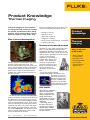
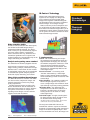
The image of the iron shows a highly emissive dark coated surface on the left compared
to a highly polished surface on the right. The