1
Calibration
4
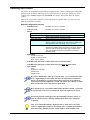
The DaqCal.exe calibration utility does not support Personal Daq/3000 Series
devices at present. Please contact the factory for the latest calibration information
concerning these products.
Every range of a Personal Daq/3000 Series device is calibrated at the factory using a digital NIST traceable
calibration method. This method works by storing a correction factor for each range on the unit at the time
of calibration. The user can adjust the calibration of the board while it is installed in the acquisition system
without destroying the factory calibration. This is accomplished by having 3 distinct calibration tables in
the on-board EPROM.
The user can select any of the three cal tables provided [factory, user, or self-cal tables] by API call or from
within software. Self-cal can be performed automatically via the included software and without the use of
external hardware or instruments. Self-cal derives its tracebility through an on-board reference which has a
stability of 0.005% per year.
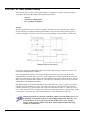
Note that a 2-year calibration period is recommended for Personal Daq/3000 Series modules.
Using a Temperature Calibrator
The Personal Daq/3000 Series module provides accurate and repeatable temperature measurements across
a wide range of operating conditions. However, all instrumentation is subject to drift with time and with
ambient temperature change. If the ambient temperature of the operating environment is below 18°C or
above 28°C, or if the product is near or outside its calibration interval, then the absolute accuracy may be
improved through the use of an external temperature calibrator.
A temperature calibrator is a temperature simulation instrument that allows selection of thermocouple type
and temperature. For proper operation, it must be connected to the Personal Daq/3000 Series module with
the same type thermocouple wire and connector that is used in normal testing. The calibrator then
generates and supplies a voltage corresponding to that which would be generated by the TC type [at the
associated temperature].
The temperature selected on the calibrator will be dictated by the nature of normal testing. 0°C is usually
the best choice. Calibrators are the most accurate at this setting, and the connecting thermocouple wire will
contribute very little error at this temperature. However, if the dynamic range of the normal testing is, for
example, 100°C to 300°C, a selection of 200°C may give better results. In either case, the level of
adjustment is determined by comparing the unit reading to the selected calibrator temperature. For
example, if the calibrator is set to 0°C output, and the Personal Daq/3000 Series module reads 0.3°C, then
an adjustment of minus 0.3°C is required. That is, the adjustment value is determined by subtracting the
Personal Daq module’s reading from the calibrator setting.
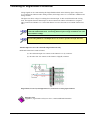
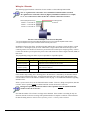
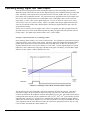
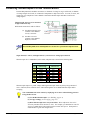
To implement the adjustment in DaqView:
1.
Ensure that the acquisition process is turned off.
2.
Click on the cell in the Units column for the channel that is connected to the calibrator. The
engineering units pull-down menu above the grid becomes active.
3.
Click on the down arrow and select the “mx+b” option. This option allows post-acquisition
mathematical manipulation.
4.
For the example adjustment, enter -0.3 for “b.” The channel under calibration will now
read 0°C.
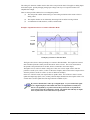
Note that this adjustment is a mathematical operation only, and in no way alters the hardware calibration of
the product. Moreover, it operates on a per channel basis, with the settings for a given channel having no
influence on any other channels.
Personal Daq/3000 Series User’s Manual
898194
Calibration
4-1