1
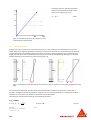
 for 2‰ ≤ Ɛc ≤ 3,5‰ (2.1.1b) (2.1.1c) (2.1.1d) (2.1.1e) for 0 ≤ Ɛc ≤ Ɛc2 (2.1.1f) for Ɛc2 ≤ Ɛc ≤ Ɛcu2 (2.1.1g) for fck ≥ 50MPa: ‰
2,0
0.085
‰
2,6
1.4
23.4
1
50
35
1
,
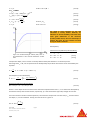
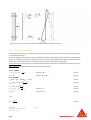
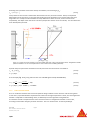
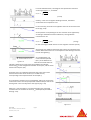
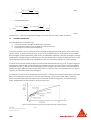
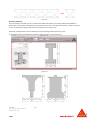
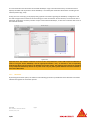
The initial Ɛo strain influence on the ULS calculation is usually limited. However, its influence on the Serviceability Limit State may cause great differences in the necessary quantity of FRP. Hence, the user should input a realistic Mo value for the expected moment during the CFRP installation. Subsequently: Internal force equilibrium (initial situation): Figure 2-5: Parabola-rectangle scheme (blue) used for
the determination of the concrete deformation at initial
state
(2.1.1h) ∙
∙
(2.1.1i) ∙
∙
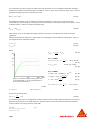
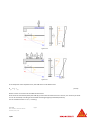
(2.1.1j) Compressive depth, δ and Fc values are exactly determined by the software in an iterative process. Assuming that Ɛco < 2‰, the compressive force developed by the parabola stress block can be estimated by the equation: ∙ ∙
6
∙ 1000 ∙
1000 ∙
(2.1.1k) (2.1.1l) (2.1.1m) And δ depth can be estimated by: ∙
∙ 2
∙
∙
∙
∙
Moment equilibrium (initial situation): where xo is the depth of neutral axis from the extreme compressive fibre and Fs1, Fs2 are the forces developed by the bottom and top steel reinforcement, respectively. fck is the characteristic (cylinder) strength of concrete. From the numerical solution of these equations, the maximum compressive concrete strain, Ɛco, and the neutral axis depth, xo, can be calculated. Finally, the initial strain Ɛo is given as: User Guide English Sika® Carbodur® calculation software December, 2013, 1.0.0. 5/47 (2.1.1n)