1
3.3 Evaluation
3.3.2 Properties of the Tool
Let us have a look at the properties of the plug-in. First of all, we need another Frama-C
plug-in to annotate the IR with warnings. We use the value analysis to annotate the
warnings. However, our plug-in should work with every other Frama-C plug-in that
annotates the IR with warnings. Further, the plug-in checks the whole expression that
throws a warning for structurally equality to group them. It also allows a combination
of warnings to make up the most general warning.
According to the aforementioned definition of EOI, we use the whole expression to
track it. Muske et al. track only the denominator for a division-by-zero or the index
of an array for an array-index-out-of-bound(AIOB) warning. However, one has to save
what kind of warning the EOI referred to. For the division-by-zero that approach should
work well. Saving only the index for an array for AIOB warning can lead to a problem:
1
2
3
4
5
6
7
8
9
void f 1 ( int x ) {
const int a [ ] = { 0 , 1 , 2 , 3 , 4 , 5 ,
const int b [ ] = { 0 , 1 , 2 , 3 , 4 } ;
/∗@ a s s e r t Value : i n d e x b o u n d : 0 ≤
/∗@ a s s e r t Value : i n d e x b o u n d : x <
int h = a [ x ] ;
/∗@ a s s e r t Value : i n d e x b o u n d : x <
int h = b [ x ] ;
}
6 , 7 , 8 , 9};
x ; ∗/
1 0 ; ∗/
5 ; ∗/
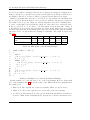
Listing 3.1: Array Example Code
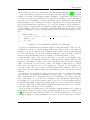
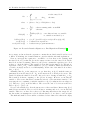
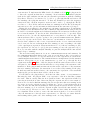
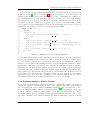
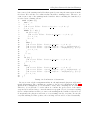
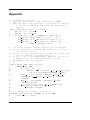
The example of Lst. 3.1 illustrates the problem. In case we only save the x as EOI,
we might group these warnings together. However, we access arrays of different sizes.
Removing the second warning would be unsound, but is possible by following the flow
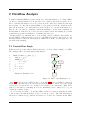
equations of Fig. 2.4. Removing the second warning, we would run into problems if
x = [5, 9]. In that case, we would conclude that the first warning is a false positive, but
the second warning’s fault occurs. However, since the first is a false positive we would
not look at the second warning.
If we would only save the denominator for a division-by-zero and the index for an
AIOB, we could not differentiate between a[x] and 1/x since we would save x in both
cases. Saving the whole expression, however, ensures that we only compare warnings
thrown by exactly the same expression. We also do not have to track what kind of
warning it is since we save the whole expression. Nevertheless, there are also a few
drawbacks. If the array length is the same, it would be nice to group the warnings
together if they have the same index. On the other hand the value analysis of Frama-C
is already good when it comes to AIOB warnings. If two arrays have the same length,
the value analysis only throws one warning. A second drawback, in the implementation
we compare expressions to be structurally equal. The comparison yields that x1 6= x2 .
Therefore, two division-by-zero warnings end up in different baskets if they have different
numerators. However, if two warnings are in the same set, we are sure that they belong
together. Hence, we use the whole expression.
17