1
6.2. Generate coordinated multi-axis profiles
The TMC-3D motion controller can coordinate up to 8 axes (including itself) connected together in
a CAN network. Taking advantage of the intelligence embedded in all the Technosoft drives, the
TMC-3D can either generate complex 2D/3D trajectories or coordinate various single axis
trajectories inside a distributed controlled network. It employs an efficient synchronization
mechanism that insures the internal clock of each drive remains synchronous to the Motion
Controller. In case of the 2D/3D trajectories instead of sending the position information at each
position control loop, the TMC-3D sends PVT (Position, Velocity, Time) points at predefined time
intervals, minimizing the traffic on the CAN network. Based on the received PVT points, the
slaves reconstruct the desired trajectory performing a 3rd order interpolation between the points.
6.2.1. Coordinated multi axis modes and application management
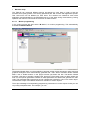
The 2D/3D trajectories can be generated using the Linear Interpolation and/or the Vector Mode
wizards.
•
Linear Interpolation
Linear Interpolation allows the generation of complex 2D or 3D paths using linear segments. The
master generates the reference for each projection and sends the position commands as PVT
(position, velocity and time) points.
• Vector Mode
Vector Mode allows the generation of 2D profiles that need to combine linear segments with
circular ones. It also has the possibility to control a third axis which will remain tangent to the
trajectory. This is useful for example in cutting applications. The master generates the reference
for each projection and sends the position commands as PVT (position, velocity and time) points.
•
Error handling
The motion controller has a powerful mechanism of detecting and handling the errors that may
occur in the system:
•
The TMC3D can program the slaves to report error situations. The user can configure, at
initialization time, which errors will be reported by the slaves.
•
The TMC-3D can monitor the slaves presence in the CAN network through the Slave
Guarding functionality. When the Slave Guarding is activated the motion controller
periodically interrogates the slaves drives/motors and monitors their answers. A node
failure error is triggered if a slave fails to respond back to the master within one slave
guarding period. The Slave Guarding is configurable by the user
In case of a slave error or node failure the TMC-3D can trigger a TML interrupt and execute
application specific TML code. The TML interrupt can be enabled/disabled by the user.
•
Program flow control
A new type of multi axis events was added in order to maintain a high level of synchronization
between the master and the slaves in the multi-axis application.
© Technosoft 2008
62
TMC3D Technical Reference