1
Chapter 01
7/5/07
4:00 PM
Page 1
Home
Quit
Key Words
• hypotenuse
• adjacent side
• opposite side
• right triangle
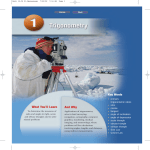
What
You’ll Learn
To determine the measures
of sides and angles in right
triangles and acute triangles
and to solve related problems
• sine
• cosine
And Why
Real-world situations in
surveying, navigation,
construction, and design can
involve determining the measures
of sides and angles in triangles.
• tangent
• primary
•
•
•
•
•
•
trigonometric ratios
acute angle
angle of elevation
angle of inclination
angle of depression
sine law
cosine law
Chapter 01
7/5/07
4:00 PM
Page 2
Home
CHAPTER
1
Quit
Activate Prior Knowledge
Metric Units of Length
Prior Knowledge for 1.1
The metre is a unit of length in the metric system.
The metric system of units is based on powers of 10.
1 cm 10 mm 1 m 100 cm 1 km 1000 m
1 mm 0.1 cm 1 cm 0.01 m 1 m 0.001 km
0 cm 1
2
3
4
5
Example
The longest cartoon strip in Guinness World Records 2006 was made by a group of 596
artists. The strip measures 238.4 m.
a) What is this length in centimetres?
b) What is this length in kilometres?
Solution
a)
Since 1 m 100 cm, multiply by 100
to convert to centimetres.
238.4 100 23 840
The cartoon strip is 23 840 cm long.
b)
Since 1 km 1000 m, divide by
1000 to convert to kilometres.
238.4 1000 0.2384
The cartoon strip is 0.2384 km long.
✓ Check
1. Convert each measure to the unit indicated.
4560 m to kilometres
d) 7.2 cm to millimetres
a)
156 cm to metres
e) 34.5 m to kilometres
b)
2.5 km to metres
f) 9.81 mm to metres
c)
2. Which metric unit would you use for each measure? Explain each choice.
Length of your pencil
c) Thickness of a piece of wire
a)
Length of a bedroom
d) Distance from North Bay to Toronto
b)
3. Joanna and Kush want to create a banner equal to the length of the gym.
They measure the length of the gym as 2600 cm.
The fabric is sold by the metre. What length of fabric do they need?
4. Katie uses a square sheet of paper with side length 7 cm
to roll up 50 pennies. Each penny is 1.45 mm thick.
Can Katie roll up all the pennies? Justify your answer.
2
CHAPTER 1: Trigonometry
6
7
Chapter 01
7/5/07
4:00 PM
Page 3
Home
Quit
Imperial Units of Length
Prior Knowledge for 1.1
The imperial units of length are still in use in many industries.
Inch (in.), foot (ft.), yard (yd.), and mile (mi.) are units of length in the imperial system.
1 ft. 12 in.
1 yd. 3 ft.
1 mi. 1760 yd.
1 mi. 5280 ft.
A symbol for foot is and for inch is .
0 in.
1
2
A height of 6 ft. 6 in. is written 6 6.
3
Example
From a blueprint, a carpenter calculated the length of baseboard needed for a room.
The perimeter of the room, excluding the doorway, is 532 in.
What length of baseboard, sold by the foot, should the carpenter purchase?
Solution
Since 1 ft. 12 in., divide 534 by 12 to convert to feet.
532 ÷ 12 44 R4
So, 532 in. 44 ft. 4 in.
The carpenter should purchase 45 ft. of baseboard.
The length is rounded
up to 45 ft. so that the
baseboard is not
shorter than 44 ft. 4 in.
✓ Check
1. Convert each measure to the unit indicated.
6 to inches
d) 36 to yards
g) 7040 yd. to miles
a)
96 yd. to feet
e) 8 ft. 4 in. to inches
h) 192 in. to feet
b)
7 mi. to feet
f) 3 yd. 1 ft. to feet
i) 5 mi. to yards
c)
2. Which imperial unit would you use for each measure? Explain your choice.
Length of your classroom
c) Penalty spot distance in soccer
a)
Length of a sub sandwich
d) Length of the St. Lawrence Seaway
b)
3. Roger is replacing the liner of a chimney. The length of liner required is 33 ft.
Roger has 400 in. of stainless steel pipe for the liner.
Is this enough? Justify your answer.
4. Marlene uses a 2 ft. by 1 ft. rectangular tray to hold her potted plants.
The diameters of the top of the pots are 4 and 6.
a) How many 4 pots can fit on this tray? How many 6 pots fit?
b) Marlene puts five 4 pots on one tray. How many 6 pots fit in the remaining space?
Show your work using a diagram.
Activate Prior Knowledge
3
Chapter 01
7/5/07
4:00 PM
Page 4
Home
Quit
Ratio
Prior Knowledge for 1.1
A ratio compares two quantities.
Example
ABC and DEF are similar triangles.
In ABC, a 16 cm, b 12 cm, and c 20 cm.
In DEF, d 12 cm, e 9 cm, and f 15 cm.
Determine the ratio for each pair of
B
corresponding sides.
Are the ratios equivalent? Justify your answer.
a) a:d
b) b:e
c) c:f
A
D
c
b
C
a
f
E
e
F
d
Each vertex is labelled with a capital
letter. Each side is labelled with the
lowercase letter of the opposite vertex.
Solution
a:d 16:12 4:3
b) b:e 12:9 4:3
c) c:f 20:15 4:3
The ratios are equivalent because each ratio is equivalent to 4:3.
a)
✓ Check
1. RST and WXY are similar triangles.
Determine each ratio.
a) r:w
b) s:x
c)
t:y
R
12"
W
18"
14"
21"
T
24"
S
Y
28"
X
2. a) What do you notice about the ratios for the corresponding sides in question 1?
b)
Make a prediction about the ratios for the corresponding sides of similar triangles.
Justify your prediction.
3. For the Canadian flag, the ratio of width to length is 1:2.
What is the perimeter of a Canadian flag that is 12 ft. long?
Are all Canadian flags similar shapes? Explain using a diagram.
4
CHAPTER 1: Trigonometry
Chapter 01
7/5/07
4:00 PM
Page 5
Home
Quit
Solving Equations
Prior Knowledge for 1.1
To solve an equation for a variable, perform the same operation on each side
of the equation to isolate the variable.
Example
Solve for x in each equation.
a) 6x 12
b) x 12
5
c)
4.2 3.5x
b)
x
5
Solution
a)
6x 12 Divide each side by 6.
6x
6
12
6
x
5
x2
c) 4.2 3.5x Divide each side by 3.5.
4.2
3.5
12 Multiply each side by 5
5 12 5
x 60
4.2x
3.5
1.2 x
✓ Check
1. Solve for x in each equation.
a)
20 8x
b)
9 6x
c)
39 0.75x
2. George spent $18.72 copying a story he wrote.
Photocopying costs $0.08 per page. How many pages are in George’s story?
Use an equation to solve this problem.
3. Raja has been offered two jobs.
Each of these jobs takes 24 weeks to complete.
One job pays $3440 every 8 weeks. The other job pays $2700 every 6 weeks.
Raja wants to accept the job that pays more per week.
Show how to use equations to help Raja make her choice.
4. Rashad pays $6.30 tax for a pair of shoes that is priced at $45.
His friend Zoe purchases another pair of shoes on sale for $25 in the same store.
How much tax does Zoe have to pay?
Solve the problem in two ways. Show your work.
What assumptions did you make?
Activate Prior Knowledge
5
Chapter 01
7/5/07
4:00 PM
Page 6
Home
Quit
Pythagorean Theorem
Prior Knowledge for 1.1
The Pythagorean theorem relates the area of the square on the hypotenuse
to the areas of the squares on the other two sides of a right triangle.
hypotenuse
c
b
The Pythagorean theorem states that in a right triangle,
c 2 a2 b 2, where c is the length of the hypotenuse
and a and b are the lengths of the other two sides.
a
Example
A builder needs to purchase material for the guy wires of a 56-m tall tower.
Each guy wire is anchored to the ground 20 m from the base of the tower.
The material is sold by the metre. What is the length needed for each guy wire?
Solution
Sketch a diagram. Let the length of a guy wire be c.
Use c 2 a2 b 2. Substitute: a 20 and b 56
c2 202 562 3536
59.46 m is rounded to 60 m instead of 59 m
c 冑35
苶36
苶
to ensure there is enough material for each guy wire.
c 59.46
The length of material needed for each guy wire is 60 m.
56 m
c
20 m
✓ Check
1. Determine each unknown length.
a)
7 ft.
b)
20 cm
16 ft.
12 cm
y
x
2. Jadie uses an 18 ft. ladder to reach the window of the second floor of her house.
She places the base of the ladder 4 ft. 6 in. away from the house to set the ladder
at a safe angle. How far up the wall of the house is the second-floor window?
3. Corey purchased a 17 flat screen for his computer. The height of the screen
11”
is 11. Determine its width. Would the screen fit into a 14 wide space? Explain.
4. A baseball diamond is a square with side length 90 ft. What is the distance
between first base and third base? Describe the method you used to solve this problem.
6
CHAPTER 1: Trigonometry
17”
Chapter 01
7/5/07
4:00 PM
Page 7
Home
1.1
Quit
Sides of Right Triangles
Many fire departments have aerial ladder
trucks. The ladder extends so that fire fighters
can spray water on a fire or rescue people
from upper floors.
Investigate
Make sure your
calculator is set to
degrees for angle
measures.
The sine of ∠A is
written sin A.
If these keystrokes do
not work for your
calculator, check your
User’s Manual.
Determining Sine, Cosine, and Tangent
Work with a partner.
You will need a protractor and
a scientific calculator.
B
Hypotenuse
Side
opposite
➢ Each draw a large right triangle,
∠A
and label it as shown.
➢ Measure the sides of your
triangle to the nearest tenth A
C
Side adjacent to ∠A
of a centimetre.
Measure the angles in your triangle
to the nearest degree.
Record the measurements on your triangle.
➢ Copy the table. Calculate
the ratios for the first
Ratios
ABC
3 rows as decimals,
length of side opposite ∠A
to 2 decimal places.
length of hypotenuse
➢ To determine sin A, press
length of side opposite ∠A
SIN . Then enter the
length of side adjacent to ∠A
measure of ∠A and
length of side adjacent to ∠A
length of hypotenuse
press ) . Record your
sine of ∠A, or sin A
answer in the table, to
cosine
of ∠A, or cos A
2 decimal places. Continue
tangent of ∠A, or tan A
for cos A and tan A.
Reflect
➢ How did you determine cos A and tan A?
➢ Compare your results with other pairs.
What do you notice about the sine, cosine, and tangent of
an angle in a triangle and the ratios of the triangle’s side lengths?
1.1 Sides of Right Triangles
7
Chapter 01
7/5/07
4:00 PM
Page 8
Home
Quit
Connect the Ideas
Primary
trigonometric
ratios
An acute angle is less
than 90°.
The primary trigonometric ratios are sine, cosine, and tangent.
You can use these trigonometric ratios to calculate
the length of a side of a right triangle if you know
the measures of one acute angle and one side.
When ∠A is an acute angle in a right triangle, then
sin A length of side opposite ∠A
length of hypotenuse
length of side adjacent to ∠A
cos A length of hypotenuse
tan A An angle of
elevation is also
called an angle of
inclination.
Use the sine ratio
opposite
length of side opposite ∠A
length of side adjacent to ∠A
From the diagram, the hypotenuse is 101 ft.
Determine the side length, b.
Since we know the length of the hypotenuse, c,
use the sine ratio.
length of side opposite ∠B
length of hypotenuse
Substitute: ∠B 63°, c 101
b
sin 63° 101
adjacent
A
b
C
Calculate the
total distance
Multiply each side by 101.
Press: SIN 63 ) 101 The base of the ladder is on top of the truck, which is 10 ft.
above the ground. So, add 10 ft. to the height of the ladder.
89.99 10 99.99
The ladder can reach about 100 ft. up the building.
8
CHAPTER 1: Trigonometry
101 ft.
63°
B
10 ft.
Each vertex is labelled with a capital
letter. Each side is labelled with the
lowercase letter of the opposite vertex.
b
sin 63° 101 101
101
sin 63° 101 b
89.99
b
A
C
A 10-ft. tall fire truck has an aerial ladder
mounted on it. The ladder can extend to 101 ft.
The angle of elevation of the ladder is 63.
How far up the building can the ladder reach,
to the nearest foot?
sin B hypotenuse
B
Chapter 01
7/5/07
4:00 PM
Page 9
Home
Quit
Practice
Give side lengths to the same number of decimal places as the given lengths.
1. For each triangle, name these sides for the marked angle
in one way with two capital letters, and in another way with one lower case letter.
a) hypotenuse
b) opposite
c) adjacent
i)
ii)
B
Y
z
c
X
x
a
A
A side of a triangle can be
named using the letters that
identify its end points. For
example, in ABC, side c can be
called AB.
y
b
C
Z
2. a) For each triangle, identify the hypotenuse, opposite side,
b)
and adjacent side for the angle whose measure is given.
For each triangle, which trigonometric ratio can you use
to calculate the length of the indicated side? Explain your choice.
Then, use the ratio to calculate the length.
i) C
2.7 m
36°
D
ii) F
g
iii)
23 cm
K
d
H
29°
M
49 in.
G
47°
m
N
E
3. Draw each triangle, then calculate.
In DEF, ∠D 57°, ∠F 90°, and f 150 ft. Determine e.
b) In XYZ, ∠Y 41°, ∠Z 90°, and z 4.5 m. Determine y.
c) In ABC, ∠B 27°, ∠C 90°, and a 35 cm. Determine b.
a)
Top of tree
4. Ava’s town is having a contest to find the tallest tree.
To measure the height of a pine tree on her family’s farm,
Ava walks 15.0 m from the base of the tree.
She measures the angle of elevation from
1 m = 100 cm
the ground to the top of the tree as 65.
How tall is the tree to the nearest 10 cm?
Ava 65°
15.0 m
Ground
1.1 Sides of Right Triangles
9
Chapter 01
7/5/07
4:00 PM
Page 10
Home
Quit
Sometimes, the unknown measure is the denominator of the ratio, not the numerator.
Example
A small plane is flying at an altitude of 3500 m
over Lake Ontario, toward an island.
The angle of depression to the island is 15°.
How much farther, to the nearest kilometre,
does the plane need to fly before it is above the island?
Solution
Let P represent the position of the plane.
Let q represent the horizontal distance
from the plane to the island in metres.
Sketch a triangle.
To determine the side length q,
use the tangent ratio.
tan P tan 15° tan 15° q q
q
15°
P
length of side opposite to ∠P
length of side adjacent ∠P
3500
q
3500
q
Multiply each side by q.
q
tan 15° q 3500
tan 15° q
tan 15°
3500 m
angle of
depression
To isolate q, divide each side by tan 15°.
3500
tan 15°
3500
tan 15°
Press: 3500 ÷ TAN 15 ) 13 062
q
1 km = 1000 m
The distance the plane needs to fly before it is above the island is about 13 km.
5. In each diagram:
Which trigonometric ratio would you use to calculate
the length of the labelled side? Explain your choice.
ii) Use the ratio to calculate the length to the nearest unit.
i)
a)
b)
Z
15 ft.
R
s
T
62°
c)
E
8 cm
50°
F
23 m
y
f
S
Y
35°
X
D
10
CHAPTER 1: Trigonometry
Chapter 01
7/5/07
4:01 PM
Page 11
Home
Quit
6. A carpenter is cutting a support brace
to reach the top of a 10 ft.-high wall.
She wants the brace to make an angle of 70 with the ground.
How long should the brace be, to the nearest foot?
10 ft.
70°
7. Assessment Focus A land surveyor draws a diagram
of a plot of land that is in the shape of a right triangle.
The longest side is 4.7 km long.
The angle between the longest side and one other side is 59.
a) How long are the two shorter sides?
b) Describe another method to solve the problem.
c) Which method do you prefer? Why?
59°
4.7 km
8. A hiker can see a forest ranger tower due north of his position.
He can see another tower that he knows is 5.0 km due east
of the first tower. Using his compass, he faces the first tower,
then turns 52 until he is facing the second tower.
How far is he from each tower?
5.0 km
N
W
E
S
52°
9. Take It Further Jovanna wants to cut a triangular piece
off a 4 by 8 sheet of plywood. She wants the piece to have one side 4 long,
and a 30 angle in the corner opposite the 4 edge.
30°
4'
8'
How far along the 8 side should she measure to mark
the cutting line, to the nearest inch? Include a diagram.
b) Sketch another way Jovanna could cut the sheet.
a)
The cosine of an acute angle in a right triangle has the same measure
as the sine of the other acute angle in the triangle.
Explain why. Include a drawing with your explanation.
1.1 Sides of Right Triangles
11
Chapter 01
7/5/07
4:01 PM
Page 12
Home
Quit
A Closer Look at Your Text
• Copy and complete the chart.
Use checkmarks in the left
columns to show whether you
agree or disagree with each
statement.
To start
Agree
Statement
Disagree
Later
Agree
Disagree
Math texts are mainly questions teachers assign for homework.
Math texts can be read just like any other book.
I use a math text only when instructed to do so by my teacher.
• Compare your thoughts on these statements with a partner.
Discuss reasons for any differences.
With your partner, complete this Text Quest.
Text Quest
1.
2.
3.
4.
5.
6.
7.
Look at the title page in a few chapters. List the features of the title pages.
This textbook has two indices. What are they? Why is each index useful?
Identify three types of technology addressed in the book.
Each chapter has a Literacy in Math feature.
Identify three topics covered in these features that you think will be useful.
Look at Connect the Ideas in a few lessons. What is the purpose of the trapezoids?
In the Mid-Chapter Review and What Should I Be Able to Do?,
there are red numbers in the margin. What do these numbers represent?
Choose something else in the text that you think can help you. Explain how it can help.
• Complete the right columns of your chart.
• Explain whether your thinking has changed. Why or why not?
12
CHAPTER 1: Trigonometry
Chapter 01
7/5/07
4:01 PM
Page 13
Home
1.2
Quit
Angles in Right Triangles
Mira is hiking due south of a park office. She knows
there is a campsite due east of the park office.
To hike directly to the campsite, she needs to determine
the direction to set her compass.
This requires determining an angle in a right triangle.
Investigate
Determining Angles in Right Triangles
Work with a partner.
You will need a protractor and a scientific
calculator.
If these keystrokes do
not work for your
calculator, check your
User’s Manual.
The legs are the two
shorter sides in a right
triangle.
➢ Each draw a right triangle in which the ratio of one leg
to the other leg is 3 to 5. For example, for one triangle,
draw a right angle with one line segment 6 cm and the other,
10 cm. Join the endpoints to draw the hypotenuse. Label the
dimensions. And for the other triangle, draw a right angle with
one segment 9 cm and the other 15 cm.
➢ Measure each acute angle in your triangle. Compare measures of
corresponding angles in the triangles. What do you notice?
➢ Press 2nd TAN . Enter a tangent ratio for your triangles by
pressing 3 ÷ 5. Press: ) . What do you notice?
➢ Press 2nd TAN . Enter the other tangent ratio for your triangles
by pressing 5 ÷ 3. Press: ) . What do you notice?
➢ Repeat this activity, using any ratio for the lengths of legs to draw
another pair of triangles. Are the same relationships true?
Reflect
➢ How do you know the ratio of one leg to the other in your first
pair of triangles is 3 to 5?
➢ Explain how you determined the sides lengths for your second
pair of triangles.
➢ Compare your results with other pairs.
How does the tangent of an angle appear to be related to the
lengths of sides in a right triangle?
1.2 Angles in Right Triangles
13
Chapter 01
7/5/07
4:01 PM
Page 14
Home
Quit
Connect the Ideas
Determine an
angle measure
When you press 2nd SIN , the calculator displays
the measure of the angle whose sine is the number you enter.
For example, if you press: 2nd SIN 0.75 ) , the calculator displays
.
48.59. This shows that sin 48.59° 0.75.
The 2nd COS and 2nd TAN keys work in the same way.
These 2nd function calculator keys represent inverse operations.
Mira is dropped off 1.4 km due south of the park office.
The campsite is 3.5 km due east of the park office.
To walk directly to the campsite, in what direction should Mira
set her compass?
Mira’s compass is marked at 2° intervals,
so round the answer to the nearest 2°.
∠P is a right angle because the north
and east directions intersect at 90°.
Draw a diagram
Determine the measure of ∠H.
The side opposite ∠H is 3.5 km.
The side adjacent to ∠H is 1.4 km.
Use the tangent
ratio
Since you know the opposite and
adjacent sides, use the tangent ratio.
H
length of side opposite ∠H
tan H length of side adjacent to ∠H
Substitute: length of side opposite ∠H 3.5,
length of side adjacent to ∠H 1.4
tan H 3.5
1.4
∠H 68.2°
Clockwise is the
direction that hands on
a clock move.
14
Press: 2nd TAN 3.5 ÷ 1.4 ) Mira should set her compass at 68°, or walk along a line that makes an
angle of about 68° measured clockwise from north.
CHAPTER 1: Trigonometry
Chapter 01
7/5/07
4:01 PM
Page 15
Home
Quit
Practice
Give angle measures to the nearest degree.
1. For each triangle, determine tan A. Then, determine the measure of ∠A.
a)
b)
B
1.5 km
B
A
c)
B
3.7 cm
47 m
3.1 cm
A
C
2.6 km
C
114 m
A
C
2. For the given information in each triangle,
which angle can be calculated using the sine ratio?
Determine its measure.
a) Q
17 cm
R
b)
c)
X
2.8 m
E
11 ft.
6 ft.
19 cm
Z
P
Y
3.4 m
D
F
3. Decide which trigonometric ratio can be used to determine the measure
of the marked angle in each diagram. Explain each choice.
Then, use the ratio to determine the angle measure.
a)
b)
B
T
6 in.
83 m
A
c)
120 m
C
R
3 in.
S
d)
Z
Z
0.098 km
4.1 cm
X
Y
X
7.8 cm
0.025 km
Y
1.2 Angles in Right Triangles
15
Chapter 01
7/5/07
4:01 PM
Page 16
Home
Quit
4. A boat is 100 m from the bottom of a 75-m high cliff.
Calculate the angle of elevation, ∠A, from the boat
to the top of the cliff.
5. The Royal Gorge Bridge Incline Railway
in Colorado is the steepest railway in the world.
The elevation increases 1096 ft. over the 1550 ft. incline.
Calculate the angle of inclination of the track.
6. Sketch each triangle, then calculate the angles.
In ABC, a 1.2 cm, b 4.5 cm, and ∠C 90°.
Determine the measure of ∠B.
b) In DEF, d 43 yd., f 92 yd., and ∠F 90°.
Determine the measure of ∠D.
c) In NPQ, p 49 m, q 25 m, and ∠P 90°.
Determine the measure of ∠N.
1550 ft.
1096 ft.
angle of
inclination
a)
When you sketch, you do
not need to draw to scale.
7. A canoeist uses a compass to navigate from
a lake entry point to a campsite on a small island.
The campsite is 2.4 km due north and
then 3.2 km due west of the lake entry point.
In what direction should the canoeist head
to go directly to the campsite?
Express your answer in degrees clockwise from
north, rounded to the nearest 2°.
3.2 km
N
8. A carpenter is cutting a board that is 14.0 cm wide.
She is using a radial saw that can be set to cut at any angle.
To fit under a stairway, the board needs to be
17.8 cm shorter on one side than the other.
At what angle should the carpenter make the cut,
to the nearest degree?
16
CHAPTER 1: Trigonometry
cut angle
14.0 cm
17.8 cm
Chapter 01
7/5/07
4:01 PM
Page 17
Home
Quit
Sometimes you need to determine the length of a side or convert a length
to different units before you can use a trigonometric ratio to solve a problem.
Example
A clinometer can be
used to measure
the angle of elevation
or the angle of
depression.
Solution
Enricho is checking the accuracy
of his clinometer.
The school’s flagpole is 6.0 m tall.
He walks 5.0 m from the base of the pole
and holds the clinometer at eye level,
120 cm above the ground.
The clinometer shows the angle of elevation
from Enricho’s eye to the top of
the flagpole as 45°. How accurate is the
reading on the clinometer, to the nearest
tenth of a degree?
A
Draw a diagram.
angle of
elevation
6.0 m
B
120 cm
100 cm = 1 m,
so, 120 cm = 1.2 m.
C
5.0 m
The flagpole is perpendicular to the ground, and
the ground is parallel to the horizontal line of sight.
So, ABC is a right triangle with ∠C 90°.
In ABC, the length of the side opposite ∠B is: 6.0 m 1.2 m 4.8 m.
The side adjacent to ∠B is 5.0 m.
Use the tangent ratio to calculate the angle of elevation:
length of side opposite ∠B
length of side adjacent to ∠B
Substitute 4.8 and 5.0.
tan B tan B 4.8
5.0
43.8°
∠B Press: 2nd TAN 4.8 ÷ 5 ) The clinometer reading was 45°.
45° 43.8° 1.2°
The device is accurate to within about 1.2°.
1.2 Angles in Right Triangles
17
Chapter 01
7/5/07
4:01 PM
Page 18
Home
Quit
9. A wheelchair ramp is 3.2 m long.
It rises from ground level to a porch that is 35 cm above the ground.
For safety reasons, there are maximum angles a wheelchair ramp
can make with the ground.
Does this ramp meet either of the following rules?
Justify each answer. Include diagrams.
a) For power wheelchairs, the maximum angle is 7.1°.
b) For self-propelled wheelchairs, the maximum angle is 4.8°.
10. Assessment Focus A train track runs along a river in a valley.
The track rises a vertical height of 600 m
over a horizontal distance of 25 km.
a) What is the angle of inclination of this section of the track,
to the nearest tenth of a degree?
b) Create another problem for the diagram.
Solve your problem.
c) Explain your thinking as you created the problem.
d) Trade problems with a classmate to solve.
Compare solutions.
600 m
25 km
11. Take It Further There are two support wires
on one side of a 15.0-m hydro pole.
Both wires are attached to the ground 3.5 m
from the base of the pole.
One wire goes to the top of the pole.
The other wire goes to the middle of the pole.
What is the angle between the two wires
where they meet at the ground?
C
M 15.0 m
A 3.5 m B
Press: 2nd COS 12 ÷ 13 ) .
What does the number in the display represent?
Illustrate your answer with a diagram.
18
CHAPTER 1: Trigonometry
Chapter 01
7/5/07
4:01 PM
Page 19
Home
1.3
Quit
The Sine Law
Many real-world situations involve triangles that do not contain right angles.
The primary trigonometric ratios only apply to right triangles.
However, there are other relationships between the sides and angles of triangles.
Inquire
Relating Sides and Angles in Triangles
Choose Using The Geometer’s Sketchpad or Making a Table.
Using The Geometer’s Sketchpad
You will need The Geometer’s Sketchpad.
➢ If you are using the file Triangle.gsp, open it and begin at question 9.
The triangle on your screen should look like the one at the right.
➢ If you are not using the file Triangle.gsp, complete all the questions.
1. Start the program.
From the Edit menu, select Preferences.
Set Angle to be measured in degrees to the nearest unit.
Set Distance to be measured in centimetres to the nearest
hundredth.
2. Use the Point tool.
Click on the screen in three places to construct
three points.
Use the Text tool.
Click on each point to label the points A, B, and C.
3. Use the Selection Arrow tool to select points A and B.
From the Construct menu, select Segments.
Use the Text tool.
Double click on line segment BC, and label it a.
Double click on line segment AC, and label it b.
Double click on line segment AB, and label it c.
1.3 The Sine Law
19
Chapter 01
7/5/07
4:02 PM
Page 20
Home
Quit
4. Use the Selection Arrow tool to select side a.
From the Measure menu, select Length.
The value of a is displayed. What is the value of a?
5. Deselect the objects. Repeat question 4 for sides b and c.
6. Use the Selection Arrow tool to select points B, A, and C, in this order.
Use the Selection
Arrow tool and click
on white space to
deselect objects.
From the Measure menu, select Angle.
The measure of ∠A will be displayed, labelled m∠BAC.
To change the label, double click on it using the Text tool.
Enter A as the new label. Then, click OK.
7. Use the Selection Arrow tool to select points A, B, and C, in this order.
Repeat question 6 for the measure of ∠B.
8. Select points B, C, and A, in this order.
Repeat question 6 for the measure of ∠C.
Use the Selection Arrow tool to drag points
so that each angle in the triangle is acute.
9. What are the side lengths and angle measures of ABC?
20
CHAPTER 1: Trigonometry
Your screen should
look like the one
above, but with
different side lengths
and angle measures.
Chapter 01
7/5/07
4:02 PM
Page 21
Home
10. The ratio
a
tan A
Quit
compares the value of a to the tangent of the angle opposite a.
What do the ratios tanb B and tanc C compare?
11. From the Measure menu, select Calculate.
Click on the value of a, click on the key,
select tan from the Functions list,
click on the measure of ∠A. Click on OK.
The value of tana A is displayed.
Follow a similar process to display tanb B and tanc C .
12. What do the ratios
a
, b , and cosc C
cos A cos B
compare?
Repeat question 11 to display these ratios.
13. What do the ratios
a
, b , and sinc C
sin A sin B
compare?
Repeat question 11 to display these ratios.
14. For which ratios are the values equivalent?
15. Drag one or more of the vertices of the triangle
to create a new acute triangle,
while keeping each angle less than 90°.
Are your observations about equivalent ratios
for the first triangle still true?
Repeat this process at least five more times.
16. The ratio sin A compares the sine of ∠A to the value of the side opposite ∠A.
a
What do the ratios sinb B and sinc C compare?
Have the program calculate and display these ratios.
What do you notice?
17. Drag one or more of the vertices of the triangle to create a new acute triangle.
Are your observations from question 16 still true?
Making a Table
You will need a protractor and a scientific calculator.
B
a
1. Draw a large triangle with three acute angles.
Label the sides and angles of your triangle as shown.
An acute angle is less
than 90°.
c
C
b
A
1.3 The Sine Law
21
Chapter 01
7/5/07
4:02 PM
Page 22
Home
Quit
2. Measure the sides of your triangle to the nearest tenth of a centimetre.
Measure the angles of your triangle to the nearest degree.
3. Copy this table, and create six blank columns.
Record your data in the first six rows of one column.
Include data from five classmates in your table
in the other columns.
4. The ratio
a
tan A
Triangle drawn by:
Length of a
Length of b
Length of c
Measure of ∠A
compares the length of a
Measure of ∠B
to the tangent of the angle opposite a.
What do the ratios tanb B and tanc C compare?
5. What do the ratios
a
, b , and cosc C
cos A cos B
compare?
6. What do the ratios
a
, b , and sinc C
sin A sin B
compare?
7. Record the ratios in questions 4, 5, and 6,
to 3 decimal places in your table.
8. For which ratios are the values close?
9. The ratio sin A compares the sine of ∠A to the value of a.
a
What do the ratios sinb B and sinc C compare?
10. Calculate the ratios in question 9.
Measure of ∠C
a
tan A
b
tan B
c
tan C
a
cos A
b
cos B
c
cos C
a
sin A
b
sin B
c
sin C
Enter the data, to 3 decimal places, in your table.
What do you notice about the values?
Reflect
➢ The sine law shows this relationship for acute triangles:
a
sin A
sinb B sinc C and sina A sinb B sinc C
How does your investigation verify the sine law?
➢ Does your investigation show a relationship for cosines or for
tangents? Justify your answer.
➢ Did you use The Geometer’s Sketchpad or a table?
What is an advantage or disadvantage of this tool?
22
CHAPTER 1: Trigonometry
Chapter 01
7/5/07
4:02 PM
Page 23
Home
1.4
Quit
Applying the Sine Law
N
B
Navigation involves determining the position of a ship or
aircraft and plotting its course.
In navigation, direction is often represented using a bearing.
The bearing is given as a three-digit angle measured clockwise
from the north line to a given direction.
20°
The bearing of B from A is 020°.
A
Investigate
Using the Sine Law to Solve a Problem
Work with a partner.
You will need a scientific calculator.
The pilot of an ultralight plane, Carmen,
is flying from Kingston, A, to Bancroft, B.
Because of an error in compass readings,
she flies off course by an angle of 25°.
She travels 50 mi. before she realizes
that she is going in the wrong direction.
N
B
40°
C
Her new course is on a bearing of 040°
to correct her flight path.
This triangle represents her situation.
80°
50 mi.
25°
A
➢ You know that b 50 mi.
How could you determine the measure of ∠B?
What is its measure? Calculate sinb B .
➢ You know ∠A 25°. What do you know about sina A ?
How can you determine a? Calculate this length.
➢ How far is the plane from Bancroft, to the nearest mile,
when Carmen realizes the error?
Reflect
➢ Describe the strategy you used to solve the problem.
Was it a reasonable strategy? Explain.
➢ How could you determine the distance from Kingston to
Bancroft?
1.4 Applying the Sine Law
23
Chapter 01
7/5/07
4:02 PM
Page 24
Home
Quit
Connect the Ideas
The sine law
The sine law relates the sides and angles in a triangle.
The length of any side …
In any ΔABC:
a
sin A
sinb B sinc C
divided by the sine of the
opposite angle …
is the same for all 3 pairs
of sides and angles.
sin A
a
The sine of any angle …
sinb B sinc C
divided by the length of the
opposite side …
is the same for all 3 pairs
of sides and angles.
Saima is in a boat directly west of Richard’s boat.
The distance between the boats is 150 ft.
Each person can see a buoy, B, from her or his boat.
The buoy indicates
shallow water.
Saima sees the buoy on a bearing of 027°.
Richard sees it on a bearing of 342°.
How far is Saima’s boat from the buoy, to the nearest foot?
Draw a diagram
We know the value of b. Determine ∠B.
In SRB, the measure of ∠S is 90° 27° 63°.
The sum of the angles
in a triangle is 180°.
Use the sine law
B
Draw a triangle. Label its vertices S, R, and B
to represent Saima, Richard, and the buoy.
West is 3 90° 270° clockwise from north.
So, subtract 270° to determine the measure
of ∠R in SRB: 342° 270° 72°
The measure of ∠B is 180° 63° 72° 45°.
N
r
S
sins S sinb B
Substitute: ∠S 63°, ∠R 72°, ∠B 45°, and b 150
r
sin 72°
24
CHAPTER 1: Trigonometry
sins63° sin150
45°
N
27°
To determine the value of r, write the sine law for SRB
with r in the numerator.
r
sin R
s
Equate the 1st and 3rd ratios.
150 ft.
R
342°
Chapter 01
7/5/07
4:02 PM
Page 25
Home
Quit
r
sin 72°
Solve the
equation
r
sin 72°
sin150
45°
Multiply each side by sin 72° to isolate r.
sin 72° sin150
sin 72°
45°
r 150sinsin45°72°
Press: 150 SIN 72 ) ÷ SIN 45 ) r 201.75
Saima’s boat is about 202 ft. from the buoy.
Practice
1. Calculate the value of c in each expression.
Give your answers to 1 decimal place.
4 sin 40°
15 sin 25°
a) c b) c sin 65°
sin 75°
c)
c 6.9sinsin34°58°
2. In Connect the Ideas, how far is Richard’s boat from the buoy?
3. Determine the lengths of the unknown sides in each triangle.
a)
b)
X
c)
D
B
17"
y
47°
Z
52°
a
230 km
Y
x
f
d
70°
2.7 cm
59°
45°
F
C
c
35°
E
A
4. Choose one triangle in question 3. Explain how you calculated the side lengths.
5. A landscape gardener plans a garden that includes
C
a bridge over a small pond.
73o
He marks the points on the shore where he wants
5m
the bridge to begin and end, A and B.
He marks another point on the shore, 5 m from
one end of the bridge.
64o
A
He measures the angles between the lines of sight
joining the points.
a) What is the distance across the pond, AB,
that the bridge must span?
b) The landscape gardener can order prefabricated bridges
that span 5.25 m, 7.25 m, or 9.25 m.
Which size of bridge should he order? Explain.
1.4 Applying the Sine Law
B
25
Chapter 01
7/5/07
4:02 PM
Page 26
Home
Quit
You have used the sine law to determine the side length of a triangle.
You can also use the sine law to determine the measure of an angle.
Example
What are the measures of the other
two angles in this triangle,
to the nearest degree?
A
3.2 cm
47°
B
Solution
C
3.6 cm
The measure of one angle and the lengths of two sides are given.
One of the given sides is opposite the given angle.
Use the sine law:
sin A
a
sin B
b
sin C
c
Substitute: a 3.6, c 3.2, ∠C 47°
sin A
3.6
sin A
3.6
sin A 3.6
3.6 sin A sin B sin 47°
b
3.2
sin 47°
3.2
sin 47° 3.6
3.2
sin 47° 3.6
3.2
Equate the 1st and 3rd ratios.
Multiply each side by 3.6.
Press: 2nd SIN SIN 47 ) 3.6 ÷ 3.2 ) 55.3633°
∠A ∠B 180° 47° 55.3633°
77.64°
∠B The measures of the other two angles are 55° and 78°,
to the nearest degree.
The sum of the angles
in a triangle is 180°.
6. In each expression, what is the measure of ∠C, to the nearest degree?
a)
83°
sin C 13 sin
18
b)
50°
sin C 19 sin
21
c)
72°
sin C 8.4 sin
9.5
7. Determine the measures of the angles in each triangle, to the nearest degree.
a)
b)
B
F
c)
264 mm
68°
X
1.6 yd.
E
Y
370 mm
23 cm
3.7 yd.
C
82°
25°
15 cm
A
26
CHAPTER 1: Trigonometry
D
Z
Chapter 01
7/5/07
4:02 PM
Page 27
Home
Quit
8. Choose one triangle in question 7.
Describe how you calculated the angles.
9. Assessment Focus A surveyor has surveyed a triangular
plot of land. One side of the plot lies along a county road.
This side is 400 ft. long.
An adjacent side makes an angle of 88° with the side along
the road. The side opposite this angle is 550 ft. long.
550 f t .
88o
400 f t .
Determine the length of the third side of the plot,
to the nearest foot.
b) Describe how you calculated the angles.
Explain whether your strategy was reasonable.
a)
10. Take It Further Amanjeet is flying a kite in a flat, open field.
She lets out 15 m of string. The angle of elevation of the kite from her position is 64°.
Her friend Stephanie is also playing in the field, facing Amanjeet.
The angle of elevation of the kite from Stephanie’s position is 35°.
a) Sketch a triangle using the given information.
b) How far apart are the girls, to the nearest metre?
The measures of two angles in a triangle are known.
Suppose you want to determine the length of one side.
What additional information do you need to use the sine law?
Illustrate your answer with an example.
Identify three places after this section where you can find out more
about the sine law.
1.4 Applying the Sine Law
27
Chapter 01
7/5/07
4:02 PM
Page 28
Home
Quit
Triangle Challenge
Materials
B
• triangle cards
• scientific calculators
B
c
32°
A
7.5 cm
A
18.5 m
12.0 cm
C
C
A
C
5"
3"
B
Play in a group of 2 or 3.
➢ Shuffle the cards. Place them face down in a pile.
➢ Each player takes a card.
The player whose triangle shows the longest side length goes first.
➢ Replace the cards.
Shuffle again and place them face down in a pile.
Each card shows a
triangle with some
measures labelled, but
one angle or side to be
determined.
➢ The first player takes the top card from the pile
and places it face up.
He or she says what side or angle is to be determined.
➢ Each player determines that measure.
➢ Players compare answers.
If the player who turned over the card has the correct answer,
he or she keeps the triangle card.
If the player is not correct, the triangle card is returned
to the bottom of the pile.
Decide which rule you
want to use for ending
the game before you
start playing.
28
➢ The players take turns displaying cards from the pile.
➢ The game ends when each card in the pile
has been used once
or when there are no cards left in the pile.
The player with the most cards is the winner.
CHAPTER 1: Trigonometry
Chapter 01
7/5/07
4:02 PM
Page 29
Home
Quit
Mid-Chapter Review
1.1 1. Name the trigonometric ratio that can be
b)
used to calculate each length. Explain
each choice. Then, calculate the lengths.
a)
X
Y
B
3.5 cm
A
∠X
17'
12'
37°
a
Z
4. Simon measures the angle of elevation
C
b)
Z
1.5 mm
from the ground to the top of an
18-m high wind turbine.
He sets a clinometer on the ground
25 m from the base of the tower.
What is the angle of elevation?
Y
z
39°
8m
X
2. In 1966, the Falls Incline Railway
opened in Niagara Falls.
It moves people from upper parking
areas down to Queen Victoria Park.
The incline track is 170 ft. long and has
an angle of inclination of 36°.
What is the vertical distance between the
top station and the bottom station?
1.3 5. Determine the measure of ∠A.
1.4
a)
A
b
4.7 m
35°
C
1.2 3. Determine the measure of the angle
named. Explain your method.
a) ∠A
b)
A
10.2 cm
C
A
B
7.2 m
8.3 cm
29 cm
52°
14 cm
B
a
B
C
Mid-Chapter Review
29
Chapter 01
7/5/07
4:02 PM
Page 30
Home
1.5
Quit
The Cosine Law
A welder needs to cut a triangular shape
from a piece of metal. He knows the lengths of the sides,
but not the angle measures. He needs to know
the angles.
The sine law cannot be used if no angles are known.
Another relationship relating the sides and angles
is needed.
Inquire
Relating Sides and Angles in Triangles
Choose Using The Geometer’s Sketchpad or Making a Table.
Using The Geometer’s Sketchpad
You will need The Geometer’s Sketchpad.
➢ If you are using the file Triangle2.gsp, open it and begin at question 7.
➢ If you are not using the file Triangle2.gsp, complete all the questions.
1. Start the program.
From the Edit menu, select Preferences.
Set Angle to be measured in degrees to the nearest tenth.
Set Distance to be measured in centimetres to the nearest hundredth.
2. Use the Point tool.
Click on the screen in three places to construct three points.
Use the Text tool.
Click on each point to label the points A, B, and C.
3. Use the Selection Arrow tool to select points A and B.
From the Construct menu, select Segment.
Use the Text tool. Double click on line segment BC, and label it a.
Double click on line segment AC, and label it b.
Double click on line segment AB, and label it c.
30
CHAPTER 1: Trigonometry
Use the Selection
Arrow tool and click
on white space to
deselect objects.
Chapter 01
7/5/07
4:02 PM
Page 31
Home
Quit
4. Use the Selection Arrow tool to select side a.
From the Measure menu, select Length.
The value of a will be displayed.
5. Deselect the objects. Repeat question 5 for sides b and c.
6. Use the Selection Arrow tool to select points A, C, and B,
in this order. From the Measure menu, select Angle.
The measure of ∠C will be displayed, labelled m∠ACB.
To change the label, double click on it using the Text tool.
Enter C as the new label. Then, click OK.
7. Use the Selection Arrow tool to drag point C
so that ∠C is as close to 90° as possible.
From the Measure menu, select Calculate.
Click on the value of a, then click on the keys ^ 2 .
Click on the value of b, then click on the keys ^ 2. Click OK.
From the Measure menu, select Calculate.
Click on the value of c, then click on the keys ^ 2. Click OK.
Your screen should
look like the one
above, but with
different side lengths
and angle measures.
8. Does the calculation of a2 b2 and c2 fit the Pythagorean theorem
for this triangle? Explain.
9. Drag a vertex of the triangle to change the values of a and b
while keeping ∠C 90°. Does the Pythagorean theorem still hold?
10. Drag point C so that ∠C is less than 90°.
Does the Pythagorean theorem still hold?
How do the values of a2 b2 and c2 compare?
11. Drag a vertex of the triangle to change the values of a and b
while keeping ∠C less than 90°.
How do the values of a2 b2 and c2 compare?
12. Use the Calculate feature to determine which expression
results in the closest value to c2 for your triangle.
a2 b2 2ab cos C
a2 b2 2ab tan C
a2 b2 2ab sin C
13. Change the size and shape of your triangle while keeping ∠C less than 90°.
Does the same expression give the result closest to c 2?
1.5 The Cosine Law
31
Chapter 01
7/5/07
4:02 PM
Page 32
Home
Quit
Making a Table
B
You will need a protractor and a scientific calculator.
a
1. Draw a triangle with three acute angles
as large as possible.
Label the sides and angles of your triangle
as shown.
2. Measure the sides of your triangle
to the nearest tenth of a centimetre.
Measure ∠C to the nearest degree.
3. Copy this table, and create six blank columns.
Record your data in the first four rows.
Include data from five classmates in your table.
4. Calculate the values for the next five rows of the table.
C
c
b
Triangle drawn by:
Length of a
Length of b
Length of c
Measure of ∠C
a2 b2
c2
a2 ⴙ b2 ⴚ 2ab sin C
a2 ⴙ b2 ⴚ 2ab cos C
5. The Pythagorean Theorem states that
a2 ⴙ b2 ⴚ 2ab tan C
if ∠C 90°, a2 b2 c 2.
In your triangle, ∠C is less than 90°.
Is the Pythagorean Theorem true for your triangle?
What about for your classmates’ triangles?
6. Look at the other expressions you calculated.
Which is close to the value of c 2 for your triangle?
Is this same relationship true for your classmates’ triangles?
Reflect
➢ The cosine law shows this relationship:
c2 a2 b2 2ab cos C
How does your investigation verify the cosine law?
➢ Does your investigation show a relationship between c 2 and
a2 b2 2ab sin C or between c 2 and a2 b2 2ab tan C?
Justify your answer.
➢ Did you use The Geometer’s Sketchpad or a table?
What is an advantage or a disadvantage of this tool?
32
CHAPTER 1: Trigonometry
A
Chapter 01
7/5/07
4:02 PM
Page 33
Home
1.6
Quit
Applying the Cosine Law
Surveyors need to determine distances that cannot
be measured directly.
Investigate
Using the Cosine Law to Solve a Problem
You will need a scientific calculator.
A surveyor needs to determine
the length of a gorge.
She is standing at a point 2.3 km
from the north end of the gorge.
She is 1.9 km from the south end
of the gorge. The surveyor uses a transit
to measure the angle between the
two lines of sight as 73°.
A
2.3 km
C 73o
1.9 km
B
Discuss these questions with a partner.
➢ Which line segment represents the length of the gorge?
➢ Can you use the sine law to determine this length? Why or why not?
➢ Can you use the cosine law to determine
the length of the gorge? Why or why not?
➢ On your own, determine the length of the gorge.
Then, compare strategies and solutions with your partner.
Reflect
➢ Explain your strategy for solving the problem.
➢ Are your results reasonable? How do you know?
1.6 Applying the Cosine Law
33
Chapter 01
7/5/07
4:02 PM
Page 34
Home
Quit
Connect the Ideas
The cosine law
The cosine law relates the sides and
angles in a triangle.
A
a
In any ABC,
c2
The square of
any side
equals
C
b
c
B
a2
b2
the sum of the
squares of the
other two sides
minus
2ab
(
twice the
product of
these sides
cos C
times
the cosine
of the angle
between them.
)
The towns of Rockcliff and Sutton are separated by a mountain.
A straight railway tunnel is to be built joining the towns.
Rockcliff, R, is 7.1 km from Treyford, T.
Sutton, S, is 6.9 km from Treyford.
The angle between the lines joining
each town to Treyford is 40°.
What is the distance between Rockcliff
and Sutton, to the nearest tenth of a
kilometre?
Use the cosine
law
Solve the
equation
In RST, you know the values of
r and s and the measure of the angle
between them, ∠T.
Determine the value of t.
Write the cosine law in terms of
r, s, t, and ∠T.
t2 r2 s2 2rs cos T
6.9 km
R
7.1 km
Substitute: r 6.9, s 7.1, ∠T 40°
t2 6.92 7.12 2 6.9 7.1 cos 40°
22.963
Take the square root of each side to determine t.
t2 2
冑苶
冑
t 22.963
4.79
t
The tunnel will be about 4.8 km long.
34
S
CHAPTER 1: Trigonometry
T
Chapter 01
7/5/07
4:02 PM
Page 35
Home
Quit
Practice
Round angle measures to the nearest degree in your answers.
1. Identify the triangle with the unknown length that can be determined using each formula.
Explain how you know the formula you chose is correct.
a) c2 a2 b2 2ab cos C
b) b2 a2 c 2 2ac cos B
c) a2 b2 c 2 2bc cos A
i)
ii)
B
a
iii)
A
7m
13 ft.
B
29 cm
b
c
55°
38°
C
11 ft.
C 85°
B
10 m
A
C
30 cm
A
2. Write the formula you can use to determine the length of the unknown side
in each triangle. Explain how you know your formula is correct.
a)
b)
c)
N
A
Q
4.4 m
7.1 cm
69°
75°
3.4 cm
M
r
B
6.0 km
m
a
P
3.8 m
C
7.1 km
38°
R
K
3. Determine the length of the unknown side in each triangle.
C
a)
b)
E
c) P
f
a
D
0.67 m
q
B
78°
45 cm
F
1.20 m
120'
R
42 cm
86°
35°
92'
Q
A
1.6 Applying the Cosine Law
35
Chapter 01
7/5/07
4:03 PM
Page 36
Home
Quit
4. A hiker walked 4.9 km due north from her campsite.
N
Then, she walked a further 5.8 km on a bearing of 110°.
How far from the campsite is she now?
110°
5.8 km
4.9 km
When you know the lengths of three sides of a triangle, you can use the cosine law
to determine the measure of any angle in the triangle.
Example
Determine the measure of ∠A in ABC
to the nearest degree.
A
3.8 cm
B
Solution
2.7 cm
3.3 cm
C
Use the cosine law formula with a2 on the left and cos A on the right.
a2 b2 c2 2bc cos A
Substitute: a 3.3, b 2.7, c 3.8
3.32 2.72 3.82 (2 2.7 3.8 cos A)
Remember the order of
operations.
10.89 21.73 28.08 cos A
Subtract 21.73 from each side.
10.89 21.73 21.73 20.52 cos A 21.73
10.84 20.52 cos A
10.84
20.52
cos A
58.112°
∠A ∠A is about 58°.
36
CHAPTER 1: Trigonometry
Divide each side by 20.52.
Press: 2nd COS 10.84 ÷ 20.52 ) Chapter 01
7/5/07
4:03 PM
Page 37
Home
Quit
5. Write the formula you could use to determine the measure
of the marked angle in each triangle.
Then, determine the angle measure.
a) ∠A
b) ∠B
A
c)
∠C
A
C
4.0 cm
B
3.9 cm
10.9 m
213 km
276 km
4.2 cm
12.3 m
C
A
C
B
195 km
6.1 m
B
6. In the Investigate, suppose you knew the length of the gorge is 2.5 km,
but did not know that ∠C 73°.
How could you determine the measure of ∠C?
7. a) Create your own problem about the gorge in the Investigate.
Solve your problem.
c) Explain your strategy for creating your own problem.
d) Trade problems with a classmate. Solve the problems.
b)
8. Assessment Focus A golfer hooks his first drive on a 250 yd. golf hole.
It lands 225 yd. from the tee, but is 33° off line, as shown in the diagram.
a) Determine how far from the hole the ball lands, to the nearest yard.
b) The golfer hits his next shot directly toward the hole. It travels 121 yd.
Will the ball reach the hole?
If so, how do you know? If not, how far from the hole will it be, to the nearest yard?
c) Explain how you know your solution is correct.
Ball lands here
225 yd.
tee
250 yd.
1.6 Applying the Cosine Law
37
Chapter 01
7/5/07
4:03 PM
Page 38
Home
Quit
9. The diagram shows two airplanes approaching
a control tower.
The first plane, A, is 105 km from the tower, T,
on a bearing of 040°.
The second plane, B, is 220 km from the tower, T,
on a bearing of 115°.
a) What is the measure of ∠ATB?
b) How far apart are the airplanes?
N
A
105 km
40°
T
115°
220 km
B
10. A ranger sights a forest fire. The fire, F, is 4.8 mi.
F 4.8 mi.N
from her observation tower, T, on a bearing of 304°.
She calls a forest protection service station, S.
The station is 8.9 mi. from the tower, on a bearing of 219°.
a) What is the measure of ∠FTS?
b) How far is the fire, F, from the station, S?
304°
219°
8.9 mi.
S
11. Take It Further How are the cosine law and the Pythagorean theorem the same?
How are they different?
Include diagrams in your answer.
The lengths of two sides in a triangle are known.
What additional information do you need to use the cosine law?
Explain two possible solutions.
Describe two ways you can use this text to find out about the cosine law.
38
CHAPTER 1: Trigonometry
Chapter 01
7/5/07
4:03 PM
Page 39
Home
1.7
Quit
The Sine Law and the Cosine Law
When solving a problem with an acute triangle, you may need
to decide whether to use the sine law or the cosine law.
Investigate
Choosing the Sine or Cosine Law
Work with a partner.
You will need a scientific calculator.
Alecia’s plan for building a porch shows only some of measurements
she needs for the pieces of wood.
➢ Alecia needs the length of b in ABC, the measure of ∠D in DEF,
the length of z in XYZ, and the measure of ∠Q in PQR.
➢ Decide whether she should use the sine law or the cosine law
to determine each measurement. For each triangle,
record the law you choose, entering the known measurements.
A
D
e
b
37°
F
6.2 m
82°
c
C
5.1 m
82°
4.6 m
E
B
X
P
6.5 m
2.9 m
z
Z
72°
3.5 m
R
2.1 m
Q
5.1 m
Y
Reflect
➢ Justify each decision about which law to use.
➢ Is it necessary to solve for each measurement to know whether
you chose the law Alecia can use? Explain.
1.7 The Sine Law and the Cosine Law
39
Chapter 01
7/5/07
4:03 PM
Page 40
Home
Quit
Connect the Ideas
The sine law
When you know the
measures of two
angles in a triangle,
you can calculate the
measure of the third
angle. The sum of the
angles in a triangle is
180°.
In any ABC
Use the sine law when:
➢ you know the measures of two angles and the length of any side
a
sin A
sinb B sinc C
B
a
c
C
A
b
➢ you know the lengths of two sides and the measure of an angle that
is not between these sides
sin A
a
B
sinb B sinc C
a
c
C
The cosine law
A
b
Use the cosine law when:
➢ you know the lengths of two sides and the measure of the angle
between them
B
b2 a2 c 2 2ac cos B
a
c
C
A
b
➢ you know the lengths of all three sides
B
a
C
40
CHAPTER 1: Trigonometry
c
b
A
Chapter 01
7/5/07
4:03 PM
Page 41
Home
Write the cosine
law in a different
way
Quit
You can solve a2 b2 c2 2bc cos A for cos A.
Then, determine the measure of an angle.
Add 2bc cos A to each side.
a2 b2 c2 2bc cos A
2
2
2
a 2bc cos A b c 2bc cos A 2bc cos A
Subtract a2 from each side.
a2 2bc cos A b2 c2
a2 2bc cos A a2 b2 c2 a2
2bc cos A b2 c2 a2
Divide each side by 2bc.
2bc cos A
2bc
2
2
2
b c a
cos A b2
Note the position of A
and a in the formula.
2bc
2bc
c2
a2
Max is designing a wooden plant stand
with a triangular top. The side lengths
of the triangle are 45 cm, 60 cm, and 70 cm.
To make the triangle, Max needs to know
the angle measures.
Choose the sine
law or the cosine
law
C
45 cm
60 cm
B
70 cm
A
Since he knows three side lengths,
he can use the cosine law to find any angle.
To determine the measure of ∠B,
write the cosine law:
2
c2 b2
cos B a 2ac
Substitute: a 70, c 45, and b 60
45 60
cos B 702 70 45
cos B 0.5278
58.1
∠B 2
2
2
Press: ( 70 x2 45 x2
60 x2 ) ÷ ( 2 70 45 ) ∠B is about 58°.
1.7 The Sine Law and the Cosine Law
41
Chapter 01
7/5/07
4:03 PM
Page 42
Home
Quit
Practice
1. Determine the unknown measurements from the Investigate.
2. Write the equation you would use to determine the cosine
P
of each angle in this triangle.
a) ∠Q
q
b) ∠R
c) ∠P
r
R
Q
p
3. Decide whether to use the sine law or the cosine law to determine
the indicated measure in each triangle. Justify your choices.
a) b
b) ∠X
X
C
b
a
6.4 m
40°
60°
5.8 m
A
21 cm
B
Y
Z
7.2 m
4. Determine the measure of ∠A for those triangles in which you can use the cosine law.
Explain why you cannot use the cosine law in the other triangle.
What other strategy could you use to find ∠A in that triangle?
a)
b)
B
10.3 cm
A
c)
B
A
23.0 m
6.5 cm
B
20.8 m
15'
9.5 cm
10'
C
A
57°
C
24.2 m
C
5. For each diagram, write an equation you can use to determine the unknown measure.
Then calculate the measure.
a) ∠B
b) ∠C
c)
B
145 yd.
C
67°
42
a
4.7 cm
3.9 cm
C
c
B
5.4 cm
CHAPTER 1: Trigonometry
A
C
13.0 km
8.2 km
A
A
42°
c
127 yd.
B
Chapter 01
7/5/07
4:03 PM
Page 43
Home
Quit
6. Assessment focus A plane, P, is 320 km from its
N
destination, D.
Because of severe weather conditions, the plane
is diverted to an airport, A, 250 km from the original
destination, D.
The pilot changes his bearing from 060° to 103°.
How far must the plane fly to reach the airport, A?
Explain how you decided which law to use.
D
60°
320 km
250 km
P
103°
A
Sometimes you need to use more than one trigonometric law to solve a problem.
This is often true if two triangles are involved.
Example
Determine the values of x and y.
C
5.1 cm
A
67°
35°
x
4.8 cm
41°
D
Solution
Remember the order of
operations.
y
B
Use the cosine law to determine the value of x.
a2 b2 + c2 – 2bc cos A
Substitute: a x, b 5.1, c 4.8, ∠A 35°
x2 5.12 + 4.82 – 2 5.1 4.8 cos 35°
8.9443
x2 Take the square root of each side to determine x.
2
冑苶
x 冑8苶
.9443
2.99070
x
To determine the value of y, use the sine law.
c
sin C
d
sin D
Substitute: c y, d x 2.9907, ∠C 67°, ∠D 41°
y
sin 67°
y
sin 67°
=
2.9907
sin 41°
sin 67° y
Round the value of x
to 1 decimal place
after calculating.
Multiply both sides by sin 67°.
2.9907
sin 41°
2.9907
sin 41°
sin 67°
sin 67°
4.196
y
The value of x is about 3.0 cm and the value of y is about 4.2 cm.
1.7 The Sine Law and the Cosine Law
43
Chapter 01
7/5/07
4:03 PM
Page 44
Home
Quit
7. Determine the measures of ∠CBD, ∠CDB, side d and side b.
C
46°
b
57 cm
d
A
75°
D
46 cm
21 cm
B
8. Jaime’s kite looks like this.
0.5 m
80°
50°
35°
What is the width of the kite?
b) The two longest edges of the kite have the same length. Determine this length.
a)
9. Take It Further Bogdan and Chloe are standing 70 ft.
apart on opposite sides of the base of a lighthouse.
The angle of elevation from each person to the top of the lighthouse is
37° from Bogdan and 56° from Chloe.
a) How tall is the lighthouse?
b) Explain the strategy you used to solve this problem.
Tom says he always uses the sine law to determine unknown measures
because it is easier to use.
Amber says you can’t use the sine law in every problem.
Who is correct? Explain how you would convince the other person.
44
CHAPTER 1: Trigonometry
Chapter 01
7/5/07
4:03 PM
Page 45
Home
Quit
Chapter Review
What Do I Need to Know?
Primary Trigonometric Ratios: Sine, Cosine, and Tangent
For ∠A in a right triangle,
sin A length of side opposite ∠A
length of hypotenuse
cos A length of side adjacent to ∠A
length of hypotenuse
tan A length of side opposite ∠A
length of side adjacent to ∠A
B
A
C
The Sine Law
In any acute ABC,
a
sin A
sinb B sinc C
sin A
a
sinb B sinc C
B
a
C
To use the sine law, you must know:
• the lengths of two sides and the measure of an angle
opposite one of these sides or
• the measures of two angles and the length of any side
c
b
A
The Cosine Law
In any acute ABC,
c2 a2 + b2 – 2ab cos C
2
2
2
cos C a b c
2ab
To use the cosine law, you must know:
• the lengths of two sides and the measure of the angle between them or
• the lengths of all three sides
Chapter Review
45
Chapter 01
7/5/07
4:03 PM
Page 46
Home
Quit
What Should I Be Able to Do?
1.1
1. Calculate the measure of each unknown
side. Explain your steps.
a)
1.4
c
sides and angles.
35°
2.5 cm
34°
19 cm
c
C
b
b)
4. Determine the measures of the unknown
a) A
B
A
1.3
70° C
a
S
B
b) C
q
1.90 cm
30°
r
A
a
0.97 cm
51°
R
15 m
Q
B
2. A tree casts a shadow 10 m long when the
sun’s rays make an angle of 25° with the
ground.
a) Draw a diagram.
b) What is the height of the tree? Which
trigonometric ratio did you use?
1.2
3. Calculate the measure of the unknown
angles. Explain your steps.
Y
X
23"
5. Two forest rangers, René and Micheline,
observe the same fire from their
observation towers. René’s tower is 19 km
due east of Micheline’s. René sights the
fire on a bearing of 305° from his tower.
Micheline sights the fire on a bearing of
032° from her tower. How far is the fire
from each tower?
N
305°
Z
CHAPTER 1: Trigonometry
N
32°
10"
Micheline
46
Fire
19 km
René
Chapter 01
7/5/07
4:03 PM
Page 47
Home
1.5
1.6
6. Determine the measures of the unknown
sides and angles.
a)
B
54 in.
C
1.7
For each of questions 9 to 11, explain how you
decided which law to use.
9. A bridge, KL, is to be built across a river.
27 in.
Point M is 50 m from L. ∠L is 85° and
∠M is 35°. How long will the bridge be,
to the nearest metre?
A
59 in.
b)
Quit
R
7.7 cm
32°
P
8.3 cm
Q
7. A bus station is at the intersection of
Main St. and King St. The angle between
the streets is 67°.
Two buses leave the bus station at the
same time. After 15 min, one bus has
travelled 2.5 km along Main St. The other
bus has travelled 5.0 km along King St.
How far apart are the buses?
10. A gold mine has two ventilation shafts
that start at the same work area below
ground. The vents of the shafts at ground
level are 3.2 km apart. One shaft is 2.1 km
long and the other is 2.5 km long.
a) What is the angle of depression of
each shaft?
b) How far below ground is the work area?
Shaft vent
Ground
2.1 km
Bus A
2.5 km
Work area
2.5 km
Main St.
Station
Shaft vent
3.2 km
11. To measure the length of a glacier,
67°
5.0 km
King St.
Bus B
8. Determine the measure of the least angle
in a triangle whose sides are 6 in., 7 in.,
and 9 in.
a geographer stands at a point
where she can see both ends of the
glacier. The angle between the lines
of sight from where she stands to the
ends of the glacier is 62°. She measures
the distance from where she stands to the
ends to be 250 m and 215 m.
How long is the glacier?
Chapter Review
47
Chapter 01
7/5/07
4:03 PM
Page 48
Home
Quit
Practice Test
Multiple Choice: Choose the correct answer for questions 1 and 2. Justify each choice.
1. Which ratio can you use to determine ∠A?
B
5 cm
A
A.
3 cm
4 cm
C
sin A 34
B.
sin A 35
C.
cos A 35
2. Which ratio can you use to determine the length of a?
A.
C.
a
sin 69°
a
sin 69°
sin2.935°
B.
sin2.835°
D.
a
sin 35°
a
sin 35°
tan A 54
B
sin2.969°
2.8 cm
a
sin2.869°
Show all your work for questions 3 to 6.
D.
C
69°
35°
2.9 cm
A
11 ft.
C
3. Knowledge and Understanding Determine the measure
of side b to the nearest foot, and the measures of ∠A and ∠C
to the nearest degree.
35°
b
12 ft.
4. Communication Explain how you know when to use the sine law
A
or the cosine law in an acute triangle.
Use an example for each law in your explanation.
N
5. Application A cruise ship sights channel marker A
on a bearing of 041° and channel marker B on
a bearing of 092°.
The distance from the ship to channel marker A is 2.0 km.
The distance from the ship to channel marker B is 2.8 km.
What is the distance between the channel markers?
41°
92°
S
is shown in the diagram.
What is the distance from the tee directly
to the hole?
48
CHAPTER 1: Trigonometry
B
2.8 km
Water Hazard
Tee
6. Thinking The layout of a golf hole
A
2.0 km
35°
225 yd.
Hole
150 yd.
B