1
Instruction
2.
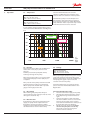
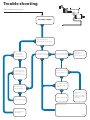
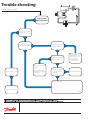
Trouble shooting guide for APP, APP S and APP S 674 pumps
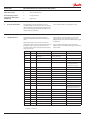
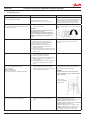
Reduced flow/reduced pressure
Cause
Remedy
Comments
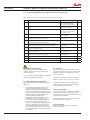
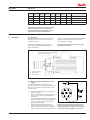
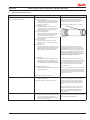
2.1 Wear on pump
Large internal leakage due to:
2.1.1 Dismantle the pump.
2.1.2 Check valve plate.
Valve plate has marks/scratches on the
surface facing the port plate. Minor wear
on valve plate can cause large internal
leakage. See Index 6.1.
2.1.3 Check port plate.
Port plate has marks/scratches on the
surface facing the valve plate. Minor wear
on port plate can cause large internal
leakage. See Index 6.2.
2.1.4 Check cylinder barrel.
Liners in cylinder barrel may be scratched
or worn. Insert a piston in the liner and
check the fit. If there is any space
(clearance) between liner and piston, liner
or piston is worn.
2.1.5 Pre-treatment
Analyse fluid for content of particles.
- Check that filters are OK and working
correctly.
2.1.6 Main filtration
Check that the correct filter type is used
(particles in fluid must not exceed 10 μm).
Danfoss High Pressure Pumps supplies
filters, please contact the sales office.
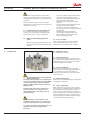
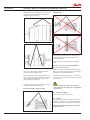
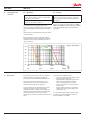
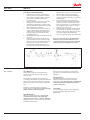
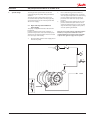
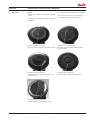
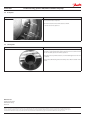
Typical signs of wear:
Polished surface all over the swash plate.
Normally, only half of the swash plate = the
pressure side is polished. See index 6.3.
2.1.7 Fluid type
The APP, APP S and APP S 674 pumps are
designed for seawater operation; for any
other fluid, please contact Danfoss High
Pressure Pumps sales office for further help.
-
2.1.8 High fluid temperature
If fluid temperature is above 50°C, stop the
pump immediately.
If the ring is missing, the piston is very worn.
The filters can be bypassed, even if they are
correctly mounted. Some filters can create
channelling where particles can pass through
the filter in tunnels. String wounded filters are
typically channelling filters. A string wounded
filter may have a filtration efficiency of only
50%, which will cause internal wear and must
always be followed by a main filter.
Insufficient filtration means that too many or
too large hard particles can pass the main filter
because it is damaged, bypassed or simply too
poor. Filtration efficiency must be 99.98%
(Beta = 5000) at 10 μm to prevent abnormal
wear of the pump.
Temperature > 50° C will cause wear on internal
pump parts. Mount a temperature switch and
check its set point / function. The temperature
switch will ensure that the pump stops at fluid
temperatures > 50° C.
- Check internal parts (see above).
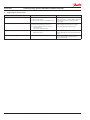
2.2 Low inlet pressure
2.2.1 Check that booster pump supplies the
right pressure/flow.
2.2.2 Check if filters require replacement.
If the pressure drop across the filters is too high,
the booster pump does not deliver sufficient
flow/pressure. No pressure or low pressure
results in cavitation and insufficient internal
lubrication causing wear on internal pump
parts.
Mount a low-pressure switch in front of the
pump and check its set point/ function. The
low-pressure switch ensures that the pump
does not start until the inlet pressure has
reached 1 bar.
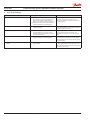
2.3 Rotation speed (rpm)
2.3.1 If VFD-operated, check frequency.
2.3.2 Check that rotation speed of the electric
motor is as stated on name plate on
electric motor. Check that the motor rotor
winding is not damaged.
180R9265 / IOM APP 16-22 Appendices - v04 / 11.2013
08.2013
Speeds below min. limit (see User manual)
result in insufficient internal lubrication causing
wear on the internal pump parts.
49
5