1
Telecomunicazioni semplici per il tuo business
www.devitalia.it +39 050-7846000 [email protected]
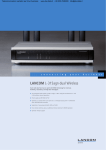
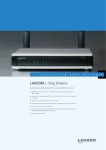
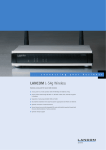
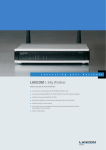
LANCOM L-54ag Wireless
Scope of features: as of LCOS version 7.6x
WLAN
Frequency band 2.4 GHz or 5 GHz
2400-2483.5 MHz (ISM) or 5150-5825 MHz (depending on country- specific restrictions)
Data rates 802.11b/g
54 Mbps to IEEE 802.11g (fallback to 48, 36, 24, 18, 12, 9, 6 Mbps, Automatic Rate Selection) compatible to IEEE 802.11b (11,
5.5, 2, 1 Mbps, Automatic Rate Selection), 802.11 b/g compatibility mode or pure g or pure b, Super A/G with Turbo Mode (108
Mbps), bursting, compression
Data rates 802.11a/ h
54 Mbps to IEEE 802.11a/h (fallback to 48, 36 , 24, 18, 12, 9, 6 Mbps, Automatic Rate Selection), Super A/G with Turbo Mode
(108 Mbps), bursting, compression, fully compatible with TPC (adjustable power output) and DFS (automatic channel selection,
radar detection) according to ETSI regulations.
Range 802.11a/b/g *
Up to 150 m (up to 30 m in buildings) *
Output power at antenna connector,
2.4 GHz
802.11b: +19 dBm @ 1 and 2 Mbps, +19 dBm @ 5.5 and 11 Mbps;
Output power at antenna connector, 5
GHz
802.11a/h: +18 dBm @ 6 Mbps, +12 dBm @ 54 Mbps with transmission power control (TPC) and manual power settings
Max. radiated power (EIRP), 2.4 GHz
band
802.11b/g: Up to 20 dBm / 100 mW EIRP (transmission power control according to TPC or manual settings)
Max. radiated power (EIRP), 5 GHz
band
802.11a/h: Up to 30 dBm / 1000 mW or up to 36 dBm / 4000 mW EIRP (depending on national regulation on channel usage and
subject to further obligations such as TPC and DFS)
Minimum transmission power
Transmission power reduction in software in 1 dB steps to min. 0.5 dBm
Reception sensitivity 2.4 GHz
802.11b: - 87 dBm @ 11 Mbps, - 94 dBm @ 1 Mbps
Radio channels 2.4 GHz
Up to 13 channels, max. 3 non- overlapping (2.4 GHz band)
Radio channels 5 GHz
Up to 26 non- overlapping channels (available channels and further obligations such as automatic DFS2 dynamic channel
selection depending on national regulation)
Roaming
Seamless handover between radio cells, IAPP support, IEEE 802.11d support
WPA2 fast roaming
Pre- authentication and PMK caching for fast roaming
Fast client roaming
With background scanning, moving LANCOM "client mode" access points pre- authenticate to alternative access points which
offer a better signal before Roaming fails
VLAN
VLAN ID definable per interface, WLAN SSID, point- to- point connection and routing context (4094 IDs)
Dynamic VLAN assignment
Dynamic VLAN assignment for target user groups based on MAC addresses, BSSID or SSID by means of external RADIUS server.
Q- in- Q tagging
Support of layered 802.1q VLANs (double tagging)
Multi- SSID
Simultaneous use of up to 8 independent WLAN networks per WLAN interface
Security
IEEE 802.11i / WPA2 with passphrase or 802.1x and hardware- accelerated AES, closed network, WEP64, WEP128, WEP152,
user authentication, 802.1x /EAP, LEPS, WPA1/TKIP
RADIUS server
Integrated RADIUS server for MAC address list management
EAP server
Integrated EAP server for authentication of 802.1x clients via EAP- TLS, EAP- TTLS, PEAP, MSCHAP or MSCHAPv2
Quality of Service
Prioritization according to Wireless Multimedia Extensions (WME, subset of IEEE 802.11e)
Bandwidth limitation
Each WLAN client (MAC address) can be assigned maximum transmit and receive rates and an individual VLAN ID
Background scanning
Detection of rogue AP's and the channel information for all WLAN channels during normal AP operation.
802.11g: +19 dBm @ 6 Mbps, +14 dBm @ 54 Mbps
The Background Scan Time Interval defines the time slots in which an AP or Router searches for a foreign WLAN network in its
vicinity. The time interval can be specified in either milliseconds, seconds, minutes, hours or days.
Client detection
Rogue WLAN client detection based on probe requests
802.1x supplicant
Authentication of an access point in WLAN client mode at another access point via 802.1X (EAP- TLS, EAP- TTLS and PEAP)
*) Note
The effective distances and transmission rates that can be achieved are depending of the site RF conditions.
WLAN operating modes
WLAN access point
Infrastructure mode (autonomous operation or managed by LANCOM WLAN Controller)
WLAN bridge
Point- to- multipoint connection of up to 7 Ethernet LANs (mixed operation optional), broken link detection, blind mode, up to
32 VLANs simultaneously for WLAN connections.
When configuring Pt- to- Pt links, pre- configured names can be used as an alternative to MAC Adresses for creating a link.
WLAN router
Use of the LAN connector for simultaneous DSL over LAN, IP router, NAT/Reverse NAT (IP masquerading) DHCP server, DHCP
client, DHCP relay server, DNS server, PPPoE client (incl.Multi- PPPoE), PPTP client and server, NetBIOS proxy, DynDNS client,
NTP, port mapping, policy- based routing based on routing tags, tagging based on firewall rules, dynamic routing with RIPv2,
VRRP, rapid spanning- tree protocol to support redundant routes in Ethernet networks
WLAN client
Transparent WLAN client mode for wireless Ethernet extensions, e.g. connecting PCs or printers by Ethernet; up to 64 MAC
addresses