1
RF Detector (BUG Detector)
ST 107
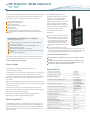
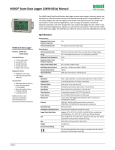
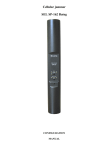
The ST 107 RF Detector (BUG Detector) is designed to detect
and locate the sources of electromagnetic radiation from
surveillance devices (eavesdropping devices), such as:
radio microphones (Bugs);
telephone transmitters;
radio-stethoscopes;
hidden wireless video cameras;
radio beacons;
tracking devices;
unauthorized use of GSM and DECT cellular phones;
unauthorized use of Bluetooth and 802.11 (WLAN, WiFi)
devices.
ST 107 Detector of a field differs from ST 007
additional opportunities:
the Additional frequency range of 2.5-7 GHz (together
with the SHF antenna);
threshold level and accuracy of measurement of a
frequency meter is raised;
identification BLUETOOTH is improved;
identification of a signal 802.1g and base DECT is added;
USB port;
Built in Li-Pol accumulator.
The ST 107 utilizes the principles of wideband detection of
electric fields. The ST 107 operates in three main modes:
Search, Monitoring, Log view.
Search Mode
This mode is intended for detecting sources of
electromagnetic radiation.
In this mode, the ST 107 receives radio signals, detects them,
and outputs them to the built-in display and as an audio
signal to the earphones and the built-in speaker. The level of
the signal is indicated on two 32-segment level meters on
the display.
Adjacent segments light up to indicate the average value of
the level of the detected signal, while a single lit up segment
shows its peak value.
The ST 107 can measure current frequency values of the
radio signal and determine its most stable value (for signals
with a constant carrier frequency).
The ST 107 also displays the detection of GSM, DECT,
Bluetooth, and 802.11g (WLAN, WiFi) signals.
Monitoring Mode
The Monitoring mode is intended for detecting sources of
electromagnetic radiation and storing data in NVRAM. The
maximum number of events that can be stored in NVRAM is
4,096. The events can be viewed when the detector is in the
Log View mode.
The Monitoring mode has an
extended range of alarm signals,
which can be triggered if the
signal passes a certain level or
frequency threshold, or if a certain
type of signal is detected (GSM,
DECT, Bluetooth, 802.11). It is possible for the user to schedule the
ST 107 to turn on and off.
This mode has two basic
operations:
user controlled operation the ST
107 is placed so that it is visible
to the user. This is useful for detecting devices for the unauthorized obtaining of information
among the visitors of an office,
for example. Autonomous operation;
the ST 107 is placed in an area
where the use of eavesdropping devices is suspected, and
the electromagnetic environment will be monitored during
a pre-programmed period without user interference.
ST 107 PC Software intended to:
display real-time data and the resuts of operation of the
ST 107;
load and display textual and graphical information of the
operation of the device in Monitoring Mode (Event Log);
operate the device remotely from the PC.
Specifications
Frequency range, MHz
Frequency range 1, MHz
Frequency range 2, MHz
50-7000
50-2500
2500-7000
Frequency range 1
Threshold Input sensitivity, dBm
Display dynamic range, db
Frequency meter sensitivity, dBm
Frequency measurement error,%
Low-pass filter cutoff frequency, MHz
-75 (50MHz)
-70 (1500MHz)
-50 (2500MHz)
55 (50-2000MHz)
40 (2000-2500MHz)
-35 (500MHz)
-40 (1500MHz)
-20 (2500MHz)
0.005
750
Frequency range 2
Threshold Input sensitivity, W/cm2
Dynamic range, db
Power supply, V:
internal Li pol battery
external power supply/charger
Current consumption, mA
Dimensions Prime Unit (without antennas),
mm
Dimension SHF antenna
Weight Prime Unit (without antennas), kg
(2-9)* 10-10
45
3.6V
5
<80
85x53x19
D= 16, L=72
0.15