1
10
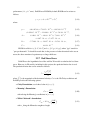
• U and V are the depth-integrated velocity in computational domain.
• Q is the source/sink term which is defined as follows:
Z 0
(qin − qout ) dσ + P − E.
Q=H
(2.4)
−1
In Equation 2.4, H = d + ζ, P is the precipitation, E is the evaporation, qin is any
source of water, and qout is any sink for water (such as an intake of power plant for its cooling
system).
2.2.2 Momentum Equation in Horizontal Direction
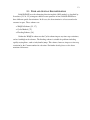
The momentum equation can be written as:
∂u
=
∂t
u ∂u
v ∂u
ω u
−p
−p
−
Gξξ ∂ξ
Gηη ∂η d + ζ ∂σ
p
p
∂ Gηη
∂ Gξξ
v2
uv
+p p
−p p
Gξξ Gηη ∂ξ
Gξξ Gηη ∂η
+f v + Fξ + Mξ
∂u
1
∂
1
Pξ +
νV
− p
(d + ζ)2 ∂σ
∂σ
ρ0 Gξξ
∂v
=
∂t
u ∂v
v ∂v
ω v
−p
−p
−
Gξξ ∂ξ
Gηη ∂η d + ζ ∂σ
p
p
∂ Gηη
∂ Gξξ
u2
uv
+p p
−p p
Gξξ Gηη ∂ξ
Gξξ Gηη ∂η
−f u + Fη + Mη
1
1
∂
∂v
− p
Pη +
νV
,
(d + ζ)2 ∂σ
∂σ
ρ0 Gηη
(2.5)
and
(2.6)
where u and v are the eastward and northward velocity in the physical domain, respectively;
νV is the vertical eddy viscosity coefficient [34]; Fξ and Fη represent the unbalance of the
horizontal Reynold’s stresses; Mξ and Mη represent the contribution due to external sources
or sinks; and f is the Coriolis coefficient.
2.2.3 Vertical Velocity
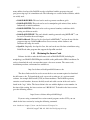
Remember that ω in Equations 2.5 and 2.6 is the vertical velocity relative to the sigma
Plane, and that it is not the vertical velocity in the physical domain. ω is calculated from the