1
Theory, Operation and Calibration
2-27
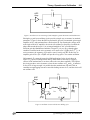
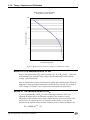
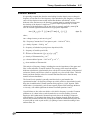
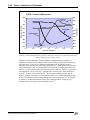
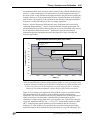
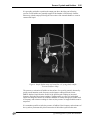
0.1M Pyrrole in 0.1M HCLO4
Figure 11. Voltammogram and massogram data for the oxidation of pyrrole to form a polypyrrole
film on a gold coated QCM Sensor Crystal. Seven cycles of voltammetry, between - 0.4 and 0.95 V
were conducted in this experiment. Pyrrole monomer can be oxidized to its radical at 0.65 V. As
this happens, a thin polypyrrole film is formed on the crystal surface, resulting in a decrease in the
fundamental frequency of oscillation of the crystal. The continuous growth of the film is evidenced
by the irreversible decrease in frequency during the scans.
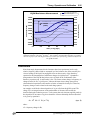
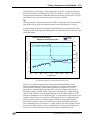
A straightforward way to detect changes in film viscoelastic properties of redox films is
to simultaneously monitor the series resonance resistance, R, of the quartz oscillator
during the electrochemical experiment31. Some theoretical models32, based on the
simultaneous measurement of 'f and 'R, have been discussed in the literature for the
extension of EQCM gravimetric measurements to non-rigid films. The viscoelastic
analysis of polymeric thin films in EQCM systems, is complex because the shear wave
exists simultaneously in the quartz crystal, the viscoelastic film and the adjacent solution,
so reflection of the shear wave must be taken into account. However, solution of this
problem would be worthwhile, specially if the material properties of the film could be
derived. This would allow correlation of the electrochemical behavior of the film with its
material properties33.
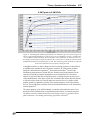
The unique property of the QCM technique is its ability to determine the mass of very
thin layers while simultaneously giving information about their viscoelastic properties.
The ability to measure both mass and structural changes means it is possible to detect
phase-transitions, cross-linking and swelling in polymeric thin films34.
QCM100 Quartz Crystal Microbalance