1
S E C T I O N
1
INTRODUCTION
1.7 Macroduct Sweat Collector
Advantages of Macroduct
(a) By preventing any exposure to an air space the collected sweat is
not subject to condensate error.
(b) Evaporation of sweat can only occur at the advancing meniscus in
the plastic collecting duct. This has been found by measurement to produce a negligible loss of 0.1 microliters per hour.
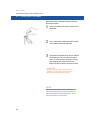
(c) The operator can gauge the amount of sweat produced at any time,
a unique and unprecedented feature that eliminates guesswork in
deciding the duration of the collection period.
(d) The patient has complete mobility during the collection period. (The
collector can be over-wrapped with an elastic bandage to keep curious
young fingers from causing mischief.)
(e) Macroduct collects sweat passively and automatically, driven by the
same hydraulic pressure that causes sweat to move from the base of
the sweat gland to the skin surface.
There is no “harvesting” procedure during which the integrity of the
sweat specimen is liable to be compromised by human error or other
factors.
Notes Regarding Sweat Yield
Technologists experienced with the Gibson and Cooke pad absorption
method of sweat collection often raise the question of the “100 mg
Rule,” or some variation, which requires a minimum sweat volume for
the analytical result to be valid. To the extent that such requirements
were imposed to mitigate the error possibilities of the pad absorption
method, they may be disregarded, since Macroduct collection is free of
such errors.
On the other hand, some authorities have suggested that the minimum
yield rules were promulgated because low sweating rates are associated with anomalous electrolyte concentrations, and therefore may give
rise to a misleading diagnostic result. In order to establish an equivalent
minimum yield threshold for Macroduct, one must take into account the
differences in electrode size (area) and the recommended collection
times for the two methods.
Applying these ratios shows that an average collection of 50 µL in 15
minutes using Macroduct is equivalent to a yield, in terms of sweating
rate, of approximately 350 mg by the pad absorption method.
Conversely, the sweat yield with Macroduct corresponding to the “100
mg Rule” is approximately 15 µL.
17