1
Section 2 Operation
2.8 Redirecting the Lights.
13. Raise the tower by turning the Tower switch
clockwise and holding it there.
14. Release the Tower switch when the lights
reach either the required height or maximum.
You will hear a change in the pitch of the
hydraulic motor when the mast is fully
extended.
Note:
It is normal for the mast to appear wet as
it is raised: the hydraulic fluid acts as a
lubricant for the seals between the
telescopic sections. Subsequent leakage
from a raised mast could indicate a
problem with a seal. Seals and O-rings
can be replaced as detailed in Sections
5.11 Mast O-ring Replacement and 5.12
Mast Seal Replacement.
15. Set the Supply Selector switch (if fitted) to
Generator.
To use the auxiliary supply, follow the instructions
given in Section 2.5 Using the Lights but set the
Supply Selector switch to Aux Input in Step 15.
On completion, turn off the generator, leaving the
lights powered from the Auxiliary mains input.
Where an output socket is fitted, it provides either
110V centre-tap earth (cte) or 220V output
(depending on version/region) from the internal
alternator.
2.7 Moving the Trailer
The trailer cannot be moved with the tower raised.
(Releasing the brake causes the tower to
telescope down.) To move the trailer:
1.
Turn off the lights and allow time for them to
cool.
2.
Lower the tower.
3.
Ensure that the jockey wheel is down and
locked so that the unit will not tip over when
the jacks are removed.
4.
Raise, retract and stow the four jacks.
5.
Ensure mast rotation clamp is secure, to
prevent movement in transit.
16. Set the Light switches to On (clockwise).
The lamps take a minute or two to warm up.
17. Close the cover to protect the Control Panel.
Closing down the unit is the reverse of this
procedure.
Before lowering the tower, switch off the lights and
allow time for them to cool.
To stop the engine, turn the Key Switch to 0.
2.6 Auxiliary Supply (Optional)
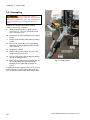
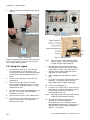
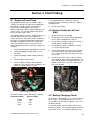
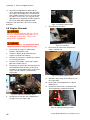
Where an input plug is fitted (Fig 2-15), the lamps
can be powered from a local mains supply instead
of from the generator. Connect the mains supply
to the Aux input plug (Fig 2-15).
The unit can be either manhandled or towed to
the new location.
Before towing:
• Check that the hitch and coupling on the
towing vehicle are rated equal to, or greater
than, the trailer's "gross vehicle weight rating"
(GVWR).
• Inspect the hitch and coupling for wear or
damage. DO NOT tow trailer using defective
parts!
• Make sure the coupling is securely fastened to
the vehicle.
• Check tyres on trailer for tread wear, inflation,
and condition.
• Connect breakaway safety line securely to
towing vehicle.
• Make sure directional, reverse and trailer lights
are connected and working properly.
• Check that wheel nuts are tight and that none
are missing.
• Connect the road running lights, if applicable,
and check that they work.
Fig 2-15 Auxiliary supply connectors
Note:
To avoid depleting the battery, the unit is
configured so that the mast can only be
raised with the engine running.
Ecolite Workshop Manual, TCP-3247-01 Iss.B
The maximum recommended speed for highway
towing is 75 kph. Recommended maximum offroad towing speed is 15 kph (less on uneven
terrain).
19