1
FMFP71928_9R197558RA_18GA BRAD NAILER_MAN_JM_SB1850BN_9R195756RA_FM_SB1850BN_MAN_CC 1/
OPERATION
The operator must not hold the trigger pulled on contact trip tools except during
fastening operation, as serious injury could result if the trip accidentally contacted
someone or something, causing the tool to cycle.
Keep hands and body away from the discharge area of the tool. A contact trip tool
may bounce from the recoil of driving a fastener and an unwanted second fastener
may be driven, possibly causing injury.
SEQUENTIAL TRIP
The Sequential Trip requires the operator to hold the tool against the work before pulling the trigger. This makes
accurate fastener placement easier, for instance on framing, toe nailing and crating applications.The
Sequential Trip allows exact fastener location without the possibility of driving a second fastener on recoil. The
Sequential Trip Tool has a positive safety advantage because it will not accidentally drive a fastener if the tool
is contacted against the work – or anything else – while the operator is holding the trigger pulled.
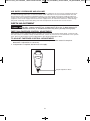
MODEL IDENTIFICATION:
Refer to Operation Instructions on page 7
before proceeding to use this tool.
SEQUENTIAL TRIP
Identified by:
GRAY TRIGGER
TOOL OPERATION CHECK:
Remove all fasteners from tool before performing tool operation check.
SEQUENTIAL TRIP OPERATION:
A. Press the contact trip against the work surface, without touching the trigger.
THE TOOL MUST NOT CYCLE.
B. Hold the tool off the work surface and pull the trigger.
THE TOOL MUST NOT CYCLE.
Release the trigger. The trigger must return to the trigger stop on the frame.
C. Pull the trigger and press the contact trip against the work surface.
THE TOOL MUST NOT CYCLE.
D. With finger off the trigger, press the contact trip against the work surface. Pull the trigger.
THE TOOL MUST CYCLE.
MAINTAINING THE PNEUMATIC TOOL
When working on air tools, note the warnings in this manual and use extra care
evaluating problem tools.
Pusher spring (constant force spring). Caution must be used when working with the
spring assembly. The spring is wrapped around, but not attached to, a roller. If the
spring is extended beyond its length, the end will come off the roller and the spring will
roll up with a snap, with a chance of pinching your hand. Also the edges of the spring
are very thin and could cut. Care must also be taken to insure no permanent kinks are
put in the spring as this will reduce the springs force.
REPLACEMENT PARTS:
STANLEY replacement parts are recommended. Do not use modified parts or parts which will not give
equivalent performance to the original equipment.
ASSEMBLY PROCEDURE FOR SEALS:
When repairing a tool, make sure the internal parts are clean and lubricated. Use Parker “O”-LUBE or
equivalent on all “O”-rings. Coat each “O”-ring with “O”-LUBE before assembling. Use a small amount of oil
on all moving surfaces and pivots. After reassembly add a few drops of Air Tool Lubricant through the air
line fitting before testing.
-7-