1
Abstract
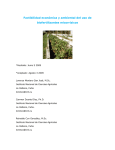
In the teaching experimental area of Agronomía's Faculty of Matanzas's University,
Camilo Cienfuegos Took to end the investigation with the aim of evaluating the
influence of the height of emitters in the optimal distribution of the water of irrigation
and the productive answer of the cultivations of lettuce ( Lactuca sativa, L ) and
carrot ( Daucus expensive L.), The r utilized a system of irrigation localized with
broadcasting microjet of the type itself 1-140, determinándose the uniformity
coefficient, half plate received, contained of humidity in the ground and
components of the performance of cultivations. As a result it was obtained than
when emitters are placed to a height of five centimeters on the ground level and
the lateral buried, they get better stockings from cultivations, just like the productive
answer, with a performance that surpassed the 2.8 kg/m2, a profitability of the
72.59 % and the cost for weight of production is of 0.58 $ once by weight the
obtained performance was produced in the cultivation of the Lettuce and in the
event of the cultivation of the Carrot he was 5.50 kg/m2, with the 79 %'s profitability
and he is the cost for weight of production of 0.56 $. For what is concluded, that
to for to make the irrigation in cultivations above-mentioned they can place to five
centimeters on the ground level, with the lateral buried the emitters, and making
new studies including another cultivations in low evaluations recommends himself
same conditions.
Key words: Irrigation, organopónico, uniformidad
Materiales y Métodos
La investigación se realiza en el área docente experimental de la Facultad de
Agronomía de la “Universidad de Matanzas”, “Camilo Cienfuegos” anexo 1 Se
realizó un experimento con el fin de evaluar la influencia de la variación de la
altura de los emisores de riego en la óptima distribución del agua y la respuesta
productiva de los cultivos de la lechuga (Lactuca sativa, L) y la zanahoria
(Daucus carota L.). El mismo se encuentra ubicado sobre un suelo ferralítico rojo
(Instituto de Suelos, 1999), a una altura de 40 m sobre el nivel del mar, con un pH
promedio neutro, geográficamente se encuentra ubicado en las coordenadas
23º01’56’’N y 81º30’32’’ W, las cuales se determinaron mediante el software de
exploración geográfica Google Earth v 5.0 (Anónimo, 2009).
Para desarrollar el experimento se utilizó un área de cuatro canteros de 25 metros
de largo y un metro de ancho, se empleó un diseño de Cuadrado Latino (Anexo 2),
se estudiaron cuatro tratamientos con cuatro réplicas, los cuales cuentan con un
área de 6 m2 se aplicó 10 kg/m2 de materia orgánica a cada uno.
Revista Avanzada Científica Enero – Abril Vol. 15 No. 2 Año 2012
Este obra está bajo una licencia de Creative Commons Reconocimiento-NoComercial-SinObraDerivada 3.0
Unported.
2