1
• Press the button and the tool will run; release the button and the tool will stop.
OPERATING IN MANUAL MODE
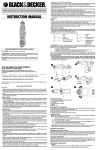
• Rotate the collar shown in Figure E to the position marked MANUAL.
• Use the tool as any conventional non-powered screwdriver. With the collar in this position,
the forward/reverse button will not be active.
Troubleshooting
Problem
• Unit will not start.
• Battery will not charge.
Possible Cause
• Battery not charged.
• Charger not plugged in.
Possible Solution
• Check battery charging requirements.
• Plug charger into a working outlet.
Refer to “Important Charging Notes” for
more details.
• Check current at receptacle by
plugging in a lamp or other appliance.
• Check to see if receptacle is
connected to a light switch which turns
power off when you turn out the lights.
• Surrounding air
• Move charger and tool to a
temperature too hot or
surrounding air temperature of
too cold.
above 40 degree F(4,5°C)
or below 105 degree F (+40,5°C).
For assistance with your product, visit our website www.blackanddecker.com for the
location of the service center nearest you or call the BLACK & DECKER help line at
1-800-544-6986.
TOURNEVIS SANS FIL À TROIS POSITIONS
D E 2 , 4 V O LT S , M O D È L E 9 0 7 3
MODE D’EMPLOI
M ERCI D ’ AVOIR CHOISI B LACK & D ECKER !
V ISITEZ WWW.B LACKAND D ECKER . COM /N EW O WNER
POUR ENREGISTRER VOTRE NOUVEAU PRODUIT.
AVANT DE RETOURNER CE PRODUIT POUR QUELQUE
RAISON QUE CE SOIT, COMPOSER LE
1-800-544-6986
Maintenance
Use only mild soap and damp cloth to clean the tool. Never let any liquid get inside the tool;
never immerse any part of the tool into a liquid.
IMPORTANT: To assure product SAFETY and RELIABILITY, repairs, maintenance and
adjustment (other than those listed in this manual) should be performed by authorized service
centers or other qualified service organizations, always using identical replacement parts.
Lubrication
AVANT D’APPELER, AYEZ EN MAIN LE N° DE CATALOGUE ET LE CODE DE DATE. DANS LA PLUPART
DES CAS, UN REPRÉSENTANT DE BLACK & DECKER PEUT RÉSOUDRE LE PROBLÈME PAR
TÉLÉPHONE. SI VOUS AVEZ UNE SUGGESTION OU UN COMMENTAIRE, APPELEZ-NOUS. VOS
IMPRESSIONS SONT CRUCIALES POUR BLACK & DECKER.
Black & Decker tools are properly lubricated at the factory and are ready for use.
CONSERVER CE MANUEL POUR UN USAGE ULTÉRIEUR.
Accessories
Recommended accessories for use with your tool are available from your local dealer or
authorized service center. If you need assistance regarding accessories, please call:
1-800-54-HOW-TO. (800-544-6986)
CAUTION: The use of any accessory or attachment
not recommended may be hazardous.
The RBRC™ Seal
The RBRC™ (Rechargeable Battery Recycling Corporation) Seal on the nickelcadmium battery (or battery pack) indicates that the costs to recycle the battery (or
battery pack) at the end of its useful life have already been paid by Black & Decker. In some
areas, it is illegal to place spent nickel-cadmium batteries in the trash or municipal solid waste
stream and the RBRC program provides an environmentally conscious alternative.
RBRC in cooperation with Black & Decker and other battery users, has established programs
in the United States and Canada to facilitate the collection of spent nickel-cadmium batteries.
Help protect our environment and conserve natural resources by returning the spent nickelcadmium battery to an authorized Black & Decker service center or to your local retailer for
recycling. You may also contact your local recycling center for information on where to drop
off the spent battery, or call 1-800-8-BATTERY.
BATTERY PACK REMOVAL
IMPORTANT: This tool is designed for easy disassembly for the purpose of battery pack
removal. It is not designed to be re-assembled by the consumer. Before attempting to disassemble this tool, turn it on and run it in either direction until it stops to ensure a complete discharge of the battery pack. To disassemble the tool, remove the screws in the side of the tool
body. Take the two body halves apart and you will find the battery pack. Lift the battery pack
out and pull off the terminal clips.
Service Information
All Black & Decker Service Centers are staffed with trained personnel to provide customers
with efficient and reliable power tool service. Whether you need technical advice, repair, or
genuine factory replacement parts, contact the Black & Decker location nearest you. To find
your local service location, refer to the yellow page directory under "Tools—Electric" or call:
1-800-544-6986 or visit www.blackanddecker.com
Full Two-Year Home Use Warranty
Black & Decker (U.S.) Inc. warrants this product for two years against any defects in material
or workmanship. The defective product will be replaced or repaired at no charge in either of
two ways.
The first, which will result in exchanges only, is to return the product to the retailer from whom
it was purchased (provided that the store is a participating retailer). Returns should be made
within the time period of the retailer’s policy for exchanges (usually 30 to 90 days after the
sale). Proof of purchase may be required. Please check with the retailer for their specific
return policy regarding returns that are beyond the time set for exchanges.
The second option is to take or send the product (prepaid) to a Black & Decker owned or
authorized Service Center for repair or replacement at our option. Proof of purchase may be
required. Black & Decker owned and authorized Service Centers are listed under
"Tools-Electric" in the yellow pages of the phone directory and available on our website
www.blackanddecker.com.
This warranty does not apply to accessories. This warranty gives you specific legal rights and
you may have other rights which vary from state to state. Should you have any questions,
contact the manager of your nearest Black & Decker Service Center. This product is not
intended for commercial use.
FREE WARNING LABEL REPLACEMENT: If your warning labels become illegible or are
missing, call 1-800-544-6986 for a free replacement.
Imported by
Black & Decker (U.S.) Inc.,
701 E. Joppa Rd.
Towson, MD 21286 U.S.A.
See ‘Tools-Electric’
– Yellow Pages –
for Service & Sales
IMPORTANTS RENSEIGNEMENTS :
CHARGEMENT : il faut charger le tournevis pendant 12 heures avant de l’utiliser
pour la première fois.
FONCTIONNEMENT : le bouton noir doit être placé en position de marche avant ou
de marche arrière. Enfoncer le bouton pour faire fonctionner l’outil dans un sens
ou dans l’autre et le mettre en position centrale pour verrouiller l’outil.
INSTALLATION DE LA MÈCHE : pour installer une mèche, il suffit de l’enfoncer
fermement dans la cavité de la broche jusqu’à ce qu’elle soit bien enclenchée. Si la
mèche ne s’insère pas correctement dans la broche, la faire pivoter et l’insérer à
nouveau.
MESURES DE SÉCURITÉ
AVERTISSEMENT : Lire et comprendre toutes les directives. Le non-respect de toutes les
directives suivantes présente des risques de secousses électriques, d’incendie ou de
blessures graves.
CONSERVER CES MESURES.
ZONE DE TRAVAIL
• S’assurer que la zone de travail est propre et bien éclairée. Des établis encombrés et
des endroits sombres présentent des risques d’accidents.
• Ne pas utiliser des outils électriques en présence de vapeurs explosives (comme
celles dégagées par des liquides, des gaz ou des poussières inflammables). Les
étincelles générées par le moteur des outils électriques peuvent enflammer les poussières
ou les vapeurs.
• Éloigner les curieux, les enfants et les visiteurs de la zone de travail lorsqu’on utilise
un outil électrique. Une distraction peut entraîner la perte de maîtrise de l’outil.
MESURES DE SÉCURITÉ RELATIVES À L’ÉLECTRICITÉ
• Les outils à double isolation comportent une fiche polarisée (une lame plus large que
l’autre). La fiche n’entre que d’une façon dans une prise polarisée. Lorsque la fiche n’entre
pas à fond dans la prise, essayer de nouveau après avoir inversé les broches de la fiche. Si
la fiche n’entre toujours pas dans la prise, communiquer avec un électricien certifié afin de
faire installer une prise polarisée. Ne modifier en aucune façon la fiche. La double
isolation élimine le besoin d’un cordon trifilaire mis à la terre et d’un système
d’alimentation mis à la terre.
• Éviter de toucher à des surfaces mises à la terre comme des tuyaux, des radiateurs,
des cuisinières et des réfrigérateurs. Les risques sont alors plus élevés si le corps de
l’utilisateur est mis à la terre.
• Protéger les outils électriques de la pluie ou des conditions mouillées. Une infiltration
d’eau dans l’outil augmente les risques de secousses électriques.
• Manipuler le cordon avec soin. Ne jamais se servir du cordon afin de transporter l’outil ni
tirer sur le cordon pour débrancher l’outil. Éloigner le cordon des sources de chaleur, des
flaques d’huile, des arêtes tranchantes et des pièces mobiles. Remplacer immédiatement
les cordons endommagés. Les cordons endommagés augmentent les risques de secousses
électriques.
• Lorsqu’on utilise un outil électrique à l’extérieur, se servir d’un cordon de rallonge
prévu pour l’extérieur, portant la mention “W-A” ou “W”. Ces cordons sont conçus pour
servir à l’extérieur et minimisent les risques de secousses électriques.
SÉCURITÉ PERSONNELLE
• Demeurer vigilant, prendre soin et faire preuve de jugement lorsqu’on utilise un outil
électrique. Ne pas s’en servir lorsqu’on est fatigué ou affaibli par des drogues, de l’alcool
ou des médicaments. De graves blessures peuvent résulter d’un moment d’inattention lors
de l’utilisation d’un outil électrique.
• Porter des vêtements appropriés. Éviter de porter des vêtements amples ou des
bijoux. Recouvrir la chevelure si elle est longue. Éloigner les cheveux, les vêtements et
les gants des pièces en mouvement qui peuvent les happer.
• Éviter les démarrages accidentels. S’assurer que l’interrupteur est en position hors
tension avant de brancher l’outil. Afin d’éviter les risques de blessures, ne pas
transporter l’outil avec le doigt sur l’interrupteur ni brancher un outil dont l’interrupteur est
en position sous tension.
• Enlever les clés de réglage avant de mettre l’outil sous tension. Une clé qui est laissée
sur une pièce rotative de l’outil présente des risques de blessures.
• Ne pas dépasser sa portée. Garder son équilibre en tout temps. On s’assure d’une
meilleure maîtrise de l’outil dans des situations imprévues grâce à une position stable et un
bon équilibre.
• Porter de l’équipement de sécurité. Toujours porter des lunettes de sécurité. Dans
certaines conditions, il faut porter des masques respiratoires, des chaussures
antidérapantes, un casque de sécurité ou des protège-tympans.
UTILISATION ET ENTRETIEN DE L’OUTIL
• Utiliser des pinces de serrage ou de tout autre moyen pratique afin de fixer et de
soutenir la pièce à ouvrer sur une plate-forme stable. La pièce est instable lorsqu’elle
est retenue par la main ou le corps de l’utilisateur. Cela présente des risques de perte de
maîtrise de l’outil.
• Ne pas forcer l’outil. Utiliser l’outil approprié à la tâche. L’outil approprié fonctionne
mieux et sûrement lorsqu’on s’en sert à son rendement nominal.
• Ne pas se servir de l’outil lorsque l’interrupteur est défectueux. Le cas échéant, l’outil
est dangereux et il faut le réparer.
• Débrancher l’outil de la source d’alimentation avant de le régler, d’en remplacer les
accessoires ou de le ranger. On minimise de la sorte le risque de démarrage accidentel
de l’outil.