1
09241-k001-001
29.04.2004
14:52 Uhr
Seite 10
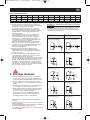
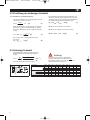
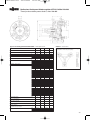
Tightening torques in Nm:
Class
8.8
10.9
12.9
M5
5,5
8,1
9,5
M6
9,5
13
16
M8
23
33
39
M10
46
65
78
M12
80
110
140
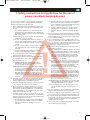
15. When screws are replaced or loosened, defective
replacements or inadequate fastening may cause
personal injuries and material damage.
Unless specified otherwise, all fastening screws must
be tightened to the torques recommended by the screw
manufacturer for the relevant strendth class.
All fastening screws, which account of their application,
must be frequently loosened and retightened, in conjunction with resetting work for example, must be coated
with antiseize (grease paste) in the thread area and on
the head contact surface at intervals of 6 months.
When replacing the original screws, make sure that the
replacements have the same strength class (normally
12.9). The tightening torques for sizes M5-M24, classes
8.8, 10.9 and 12.9, are listed in the table at the top of
this page.
16. Always use class 12.9 for screw fastening clamping
inserts, top jaws, stationary locators, cylinder covers and
similar elements.
17. The manufacturer undertakes no responsibility for
spares other than original RÖHM parts. To eliminate
doubts and assure correct performance of the order,
state the 6-digit identification number engraved in the
assembly when ordering spares or individual parts.
However, in many casas the item number stated in the
assemply drawing or parts list and a good description of
the component may be sufficient information for filling
your order.
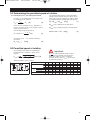
M14
130
180
220
M16
190
270
330
M18
270
380
450
M20
380
530
640
M22
510
720
860
M24
670
960
1120
Nm
Nm
Nm
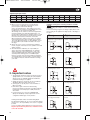
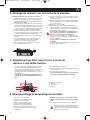
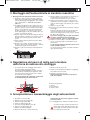
Examples of dangerous chucking situations and their
remedy
When chucking the workpiece, certain criteria must be taken
in account.
Incorrect chucking can give rise to danger of injury due to workpieces flying off the equipment at high speed, or breakage of
the jaws.
Wrong
Right
Projecting length of mounted
workpiece too great relative to
chucked length.
Support workpiece between
centres or using a stady
Chucking diameter too
great.
Use a larger chuck
Workpiece too heavy,
chucking step too short.
Support between centres,
extend chucking step
Chucking diameter too
small
Chuck using greatest possible
chucking diameter
Workpiece has a casting
or forging-related taper
Chuck using self-aligning
inserts
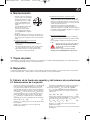
2. Important notes
1. The maximum speed may only be used if the chuck is
equipped with a set of reversible jaws (UB) supplied
with the chuck as standard equipment and with the
maximum actuating force applied.
2. At high speeds, the chuck may only be used with an
adequately dimensioned protective hood.
3. Soft top jaws or special jaws, if used, should be as
light as possible.
4. Performance (piston movement ad actuating
pressure) should be monitored in accordance with the
requirements of the Employers’ Liability Assurance
Association.
5. In other respects, we refer you to DIN EN 1550
(European standard), ”Safety requirements for the
configuration and design of rotary chucks”.
If cutting interrupted, reduse feed and cutting depth.
The illustrated examples do not cover all possible danger
situations. It is the responsibility of the user to recognize
possible
sources of danger and to adopt the necessary measures.
Despite all precautionary measures, an element of risk
cannot be excluded.
10