1
RAPID CHARGE STATION
MILWAUKEE LITHIUM-ION BATTERY PACKS
Fuel Gauge
Use the Fuel Gauge to determine the battery pack's
remaining run time. Press the Fuel Gauge button to
display the lights. The Fuel Gauge will light up for
2-3 seconds. When less than 10% of charge is left,
1 light on the fuel gauge will flash slowly.
Approximate Run
Time Remaining
Maintenance and Storage
Do not expose your battery pack or cordless tools
to water or rain, or allow them to get wet. This could
damage the tool and battery pack. Do not use oil
or solvents to clean or lubricate your battery pack.
The plastic casing will become brittle and crack,
causing a risk of injury.
Store battery packs at room temperature away from
moisture. Do not store in damp locations where corrosion of terminals may occur. As with other battery
pack types, permanent capacity loss can result if
the pack is stored for long periods of time at high
temperatures (over 120° F). MILWAUKEE LithiumIon battery packs maintain their charge during
storage longer than other battery pack types. After
about a year of storage, charge the pack as normal.
78-100%
55-77%
33-54%
10-32%
Less than 10% if bottom light is flashing
NOTE: If the Fuel Gauge doesn't appear to be
working, place the battery pack on the charger and
charge as needed.
Compared to NiCd battery pack types, MILWAUKEE
Lithium-Ion battery packs deliver fade-free power
for their entire run time. The tool will not experience
a slow, gradual loss of power as you work. To signal
the end of discharge, 1 light on the fuel gauge will
flash quickly for 2-3 seconds and the tool will not
run. Charge the battery pack.
NOTE: Immediately after using the battery pack,
the Fuel Gauge may display a lower charge than
it will if checked a few minutes later. The battery
cells "recover" some of their charge after resting.
WARNING To reduce the risk of injury or explosion, never burn or incinerate
a battery pack even if it is damaged, dead or
completely discharged. When burned, toxic
fumes and materials are created.
Disposing of MILWAUKEE Lithium-Ion Battery
Packs
MILWAUKEE Lithium-Ion battery packs are more
environmentally friendly than some other types of
power tool battery packs (e.g., nickel-cadmium).
Always dispose of your battery pack according to
federal, state and local regulations. Contact a recycling agency in your area for recycling locations.
Even discharged battery packs contain some
energy. Before disposing, use electrical tape to
cover the terminals to prevent the battery pack from
shorting, which could cause a fire or explosion.
Battery Pack Protection
To protect itself from damage and extend its life,
the battery pack’s intelligent circuit monitors current
draw and temperature. In extremely high torque,
binding, stalling, and short circuit situations, the
battery pack will turn OFF the tool if the current
draw becomes too high. All the fuel gauge lights
will flash. Release the trigger and restart.
Under extreme circumstances, the internal temperature of the battery could become too high. If
this happens, the fuel gauge lights will flash in an
alternating pattern and the tool will not run. Allow
the battery to cool down.
Fuel Gauge Lights
Lights 1 - 4 Solid
1 Light, flashing
slowly
1 Light, flashing
quickly
Lights 1-4, flashing
quickly
Lights 1&3 / 2&4,
flashing alternatingly
RBRC Battery Recycling Seals
The RBRC™ Battery Recycling Seals (see "Symbology") on your tool battery packs indicate that
MILWAUKEE has arranged for the recycling of
that battery pack with the Rechargeable Battery
Recycling Corporation (RBRC). At the end of your
battery pack's useful life, return the battery pack to
a MILWAUKEE Branch Office/Service Center or the
participating retailer nearest you. For more information, visit the RBRC web site at www.rbrc.org.
Diagnosis
Solution
Remaining run time Continue working
Less than 10% run Prepare to charge pack
time left
End of discharge
Charge pack
Current draw too
high
Battery temperature
too high
Release trigger and
restart, reduce pressure
Release trigger and
allow battery to cool
Cold Weather Operation
MILWAUKEE Lithium-Ion battery packs are designed to operate in temperatures below freezing.
When the battery pack is too cold, it may need to
warm up before normal use. Put the battery on a
tool and use the tool in a light application. It may
“buzz” for a short time until it warms up. When the
buzzing stops, use the tool normally.
•A fully discharged battery pack with an internal
temperature in the normal range will charge in 30
to 90 minutes, depending on the battery pack.
•Heavily cycled batteries may take longer to charge
completely.
•The Fuel Gauge lights on M18 battery packs are
displayed as the pack is being charged, indicating
how fully charged the pack is. The fuel gauge will
turn off when charging is complete.
•After charging is complete, the continuous green
light will come on.
•The charger will keep the battery pack fully
charged if it is left on the charger. The light indicator will flash green during this maintenance
charging.
•If the light indicator flashes red and green, check
that the battery pack is fully seated into the bay.
Remove the battery pack and reinsert. If the light
continues to flash red and green, the battery pack
may be extremely hot or cold, or wet. Allow the
battery pack to cool down, warm up, or dry out
and then reinsert. If the problem persists, contact
a MILWAUKEE service facility.
•If the light indicator does not come on, check
that the battery pack is fully seated into the bay.
Remove the battery pack and reinsert. If the light
indicator still does not come on, remove pack(s)
and unplug charger for at least 2 minutes. After 2
minutes, plug charger back in and insert pack. If
after these attempts the light indicator still does not
come on, contact a MILWAUKEE service facility.
WARNING
Charge only MILWAUKEE
M18™ Lithium-Ion batteries in this
MILWAUKEE Lithium-Ion charger. Other
types of batteries may cause personal injury
and damage.
When to Charge the Battery Pack with this
MILWAUKEE Charger
Remove the battery pack from the tool for
charging when convenient for you and your job.
MILWAUKEE batteries do not develop a "memory"
when charged after only a partial discharge. It is
not necessary to run down the battery pack before
placing it on the charger.
•Use the Fuel Gauge to determine when to charge
your MILWAUKEE Lithium-Ion battery pack.
•You can "Top-Off" your battery pack's charge
before starting a big job or long day of use.
•The only time it is necessary to charge the
MILWAUKEE Lithium-Ion battery pack is when the
battery pack has reached the end of its charge.
To signal the end of charge, power to the tool will
drop quickly, allowing you just enough power to
finish making a cut, drilling a hole, or driving a
fastener. Charge the battery pack as needed.
How to Charge the Battery Pack
Align the battery pack with the bay and slide the
battery pack into the charger as far as possible.
The red light will come on, either flashing quickly
(battery pack is too hot or cold), flashing slowly
(battery pack is waiting for another pack to finish
charging) or continuous (pack is charging).
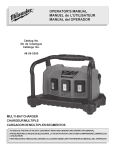
•The 48-59-1807 charges up to three battery
packs at a time, one in each of the three M12/
M18 sets. The first pack loaded in each charger
set will charge first. The second pack inserted in
the charger set will begin charging when the first
pack inserted is fully charged.
SET 1
SET 2
Charging a Hot or Cold Battery Pack
The Red Flashing Indicator light on the charger
indicates that the battery pack temperature is outside the charging range. Once the battery pack is
within the acceptable range, normal charging will
take place and the red light will be continuous. Hot
or cold batteries may take longer to charge.
Lithium-Ion Charging Status
Battery Pack
Temperature
Too Hot
Normal Range
Too Cold
SET 3
Red Charger
Indicator Light
Fast Flashing
Continuous
Fast Flashing
Charging Status
Not charging
Normal charging
Not charging
Powering the Charger with an Inverter or
Generator
The charger will operate with most generators and
inverters rated at 600 Watts or higher.
Maintenance and Storage
Store your charger in a cool, dry place.
As a general practice, it is best to unplug battery
chargers and remove batteries when not in use.
No battery pack damage will occur, however, if
the charger and battery pack are left plugged in.
Repairs
The charger has no serviceable parts.
4
5
Mouting to the Wall
Use the wall mount guides to mark the hanging
points.