1
VIGNOLES P., DREYFUSS G. & RONDELAUD D.
followed from 2001 to 2009. Two other ditches only
frequented by frogs and newts were also considered:
the first (45° 56’ 7” N, 1° 11’ 8” E) is located on the
commune of Nieul (site iii), whereas the other ditch
(46° 7’ 42” N, 1° 11’ 2” E) is situated on the commune
of Rancon (site iv). These four stations were chosen
because of small distances between sites i and iv
(500 m), or between sites ii and iii (10.5 km). In each
habitat, a population of G. truncatula was living.
When a natural infection with H. cylindracea in snails
was found on November or December in either site,
monthly samples of 8-15 adult snails each were collected the next year from mid-January to mid-May. The
low number of G. truncatula collected from each site
for each sampling date was chosen because of the
small size of snail populations in these ditches (< 100
overwintering snails per site) and the high prevalence
of infection (often > 50 %) found in H. cylindraceainfected snails on acid soil (Rondelaud et al., 2009).
When sites were watered, temperature was measured
at 2 p.m. in the most superficial layer (thickness, 4
cm) of water. Snails were first subjected to an artificial light for three days at a constant temperature of
20 °C to stimulate cercarial shedding and count shed
cercariae. They were then dissected under a stereomicroscope to count free cercariae within each snail.
Lastly, samples of 20 (2007) or 30 (2009) cercariae
each were randomly collected from cercariae-shedding
snails originating from three sites. Cercariae were heat
killed and several lengths were measured with an
ocular micrometer according to the parameters used
by Combes (1968) and Grabda-Kazubska (1970) for
the study of plagiorchiid cercariae. These measurements were performed to analyze the morphological
Year
Total number
of snails collected
Number of snails infected
with H. cylindracea
(prevalence in %)
Overall prevalence
of H. cylindracea
infection (%)
Rancon (site i)
2004
2005
33
37
11 (33.3)
16 (43.2)
38.5
Veyrac (site ii)
2001
2002
2005
2007
2009
55
51
47
44
49
24
17
32
19
14
(43.6)
(33.3)
(68.0)
(43.1)
(28.5)
43.0
Nieul (site iii)
2002
2004
2009
54
47
34
34 (62.9)
11 (23.4)
16 (47.0)
45.1
Rancon (site iv)
2004
2006
2007
49
54
46
26 (53.0)
20 (37.0)
29 (63.0)
50.3
Snail site
Sites only frequented
by B. bufo
Sites frequented
by frogs and newts
variability of H. cylindracea cercariae according to G.
truncatula populations and also to determine if a close
related plagiorchiid species: Haplometra brevicaeca,
known to infect toads (Timon-David, 1961), would
not be present in snail populations living in ditches
frequented by B. bufo (sites i and ii).
The first three parameters were the prevalence of snail
infection for each site and each year, the number of
shed cercariae, and that of free cercariae present in the
body of snails after their dissection. Measurements performed on heat-killed cercariae were the total length
of the body, that of the tail, the diameter of both suckers, and the length of the stylet. Water temperature
was also considered. Individual values recorded for
each parameter and each type of site (stations only
frequented by B. bufo, or by frogs and newts) between
2001 and 2009 were pooled and were expressed for a
single year, taking into account sampling month. A χ2
test and one-way analysis of variance (Stat-Itcf, 1988)
were used to determine levels of significance.
In sites only frequented by B. bufo, the temperature of
water at 2 p.m. was 5.3 °C (± 0.9 °C) at mid-January
and increased up to 14.1 °C (± 1.3 °C) at mid-April
(data not shown). Similar findings were also noted
in the other two ditches, with values ranging from
5.8 °C ± 1.0 °C (at mid-January) to 15.4 °C ± 2.6 °C
(at mid-May). The differences between both types of
sites were not significant, whatever the date of snail
sampling.
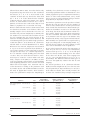
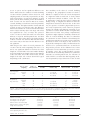
The annual prevalence of H. cylindracea infection
(Table I) in snails ranged from 28.5 % to 68.0 % in sites
only frequented by B. bufo and from 23.4 % to 63.0 %
in the other two ditches. If the overall prevalence for
each site was considered, the percentages ranged from
Table I. – Total number of G. truncatula collected from each site and overall prevalence of H. cylindracea infection between 2001 and
2009.
182
Research note
Parasite, 2011, 18, 181-184