1
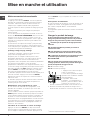
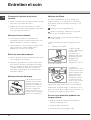
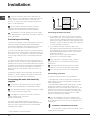
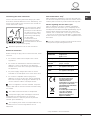
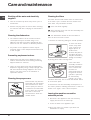
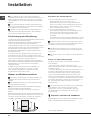
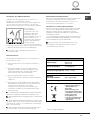
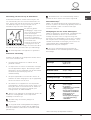
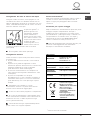
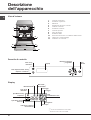
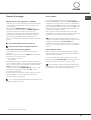
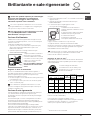
Rinse aid and refined salt Only use products which have been specifically designed for dishwashers. Do not use table salt or industrial salt, or washing up liquid. Follow the instructions given on the packaging. If using a multi-functional product it is not necessary to add rinse aid; however, we recommend that you add salt, especially if you live in an area where the water is hard or very hard. If you do not add salt or rinse aid, the LOW SALT* and LOW RINSE AID* indicator lights flash/remain lit. Loading the rinse aid Rinse aid makes it easier for the crockery to dry, as water runs off surfaces more readily and therefore does not leave streaks or marks. The rinse aid dispenser should be filled: whenever the indicator light (H) signals that it is empty. Illuminated light: add rinse aid; unlit light: there is no shortage of rinse aid in the dispenser. When the LOW RINSE AID* indicator light on the control panel/display is illuminated; 1. Open the dispenser by turning H the lid (G) in an anticlockwise direction. 2. Pour in the rinse aid, making sure it does not overflow from the F dispenser. If this happens, clean the spill immediately with a dry G cloth. 3. Screw the lid back on. NEVER pour the rinse aid directly into the appliance tub. In order to obtain the best possible results from a wash cycle, make sure that the dispenser is never empty. Refined salt removes limescale from the water, thus avoiding the formation of deposits on crockery. The salt dispenser is located in the lower part of the dishwasher (see Description) and should be filled: when the green float* cannot be seen by simply looking at the cap of the salt dispenser; When the LOW SALT* indicator light on the control panel/ display is illuminated; if your machine is not equipped with an indicator light or a green float: approximately every 30 wash cycles; 1. Remove the lower rack and unscrew the cap of the dispenser (in an anticlockwise direction). 2. For the first wash cycle only: fill the dispenser up to the edges with water. 3. Position the funnel* provided correctly (see figure) and fill the salt dispenser up to the edges (approximately 2 kg); it is normal for a little water to leak out. 4. Remove the funnel*, wipe away any salt residue from the thread and screw the cap on tightly, so that detergent does not leak into the dispenser during the wash cycle (this could damage the water softening system beyond repair). When necessary, measure out the salt before a wash cycle so that any saline solution which has leaked out of the salt dispenser is removed. Adjusting the amount of salt* It is possible to adjust the amount of salt used according to the hardness of the water in your area (this information is available from your local water board). 1. Unscrew the dispenser cap. 2. Turn the arrow on the neck of the dispenser (see figure) towards the + or symbols, using the table below as a guide. Adjusting the amount of rinse aid If you are not completely satisfied with the drying results, you may adjust the quantity of rinse aid used. Use a screwdriver to turn the dosage adjuster to one of the 6 pre-set positions (the default position is set to 4): if there are white streaks on the crockery, set the adjuster to a lower number (1-3). if drops of water remain on the crockery or there are limescale marks present after the cycle has finished, set the adjuster to a higher number (4-6). If you are using multi-functional tablets and you wish to further improve the drying performance of the appliance, fill the dispenser and set the dosage adjuster to 2. Loading the refined salt Every dishwasher is equipped with a water softener which, by using refined salt designed especially for this type of appliance, supplies water without limescale which is then used to wash the crockery. This dishwasher offers a setting which helps to reduce pollution and optimises washing performance in accordance with the water hardness level in your area. This information can be obtained from the organisation which supplies your household with water. °dH °fH °mmol/l Selector knob position 0 - 10 0 - 17 0 - 1.7 / 0 / 10 – 25 18 – 44 1.8 – 4.4 - 20 60 25 – 50 45 – 89 4.5 – 8.9 MED 40 40 > 50 > 89 > 8.9 + 60 25 Hardness of the water Salt Autonomy consumption (cycles/2 kg) (grams/cycle) (°dH = hardness measured in German degrees - °f = hardness measured in French degrees - mmol/l = millimoles per litre) The default setting of the water softening system is +. - If using multi-functional tablets fill the salt dispenser and set the adjuster to -; if the hardness of the water is greater than 60°fH, set it to +. * Only available in selected models. 21 EN