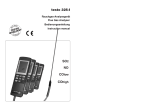
1
testo 305-1
testo 305-2
Abgasmessgerät
Flue gas analyser
to
5 O2 /CO2
,°
30
C
/ °F
te
s
Bedienungsanleitung
Instruction manual
r
in
ic
fo
e
TÜV tested
st
all
ation and
se
rv
Vorwort / Allgemeine Hinweise
Inhalt
Vorwort
Bedienungsanleitung ......................................1
Liebe Testo-Kundin, lieber Testo-Kunde,
Vorwort / Allgemeine Hinweise ..........................2
wir gratulieren Ihnen zum Kauf des testo 305. Mit seiner einfachen Bedienung und dem durchdachten Zubehör sorgt es dafür, dass Sie Gasthermen und Ölbrenner schnell und professionell einstellen
können.
Inhalt ..................................................................3
Lesen Sie bitte die vorliegende Bedienungsanleitung aufmerksam durch und machen Sie sich mit der
Bedienung des Gerätes vertraut, bevor sie es einsetzen.
Sollten einmal Probleme auftreten die sich nicht selbst beheben können, wenden Sie sich bitte an
unseren Kundenservice oder Ihren Händler. Wir bemühen uns, schnelle und kompetente Hilfe zu
leisten, damit Ihnen lange Ausfallzeiten erspart bleiben.
Wir hoffen, dass Sie an Ihrem neuen testo 305 lange Freude haben werden und es Sie bei Ihrer
Arbeit hilfreich unterstützt.
Allgemeine Hinweise
Warnhinweise und besonders wichtige Informationen, die beim Umgang mit dem testo 305 zu
beachten sind, sind in dieser Bedienungsanleitung wie folgt gekennzeichnet:
Warnhinweise
Warnhinweise werden durch ein Piktogramm gekennzeichnet. Das zugehörige Signalwort gibt den
Grad der Gefährdung an:
Signalwort!
1. Grundlegende Sicherheitshinweise ..................4
2. Produktbeschreibung ........................................5
2.1 Stromversorgung ..........................................................5
2.2 Anzeige- und Bedienelemente ......................................5
2.3 Messwerte und Gebietsversionen ................................6
3. Bedienung ..........................................................7
3.1 Einstellen ......................................................................7
3.2 Messen ..........................................................................8
4. Wartung ..........................................................10
4.1
4.2
4.3
4.4
4.5
Batterien / Akkus wechseln ........................................10
Kondensatfalle leeren ..................................................10
Filter wechseln ............................................................10
O2-Messzelle wechseln ..............................................11
Abgaspumpe reinigen..................................................12
Vorsicht! bedeutet: Leichte Körperverletzungen oder Sachschäden können eintreten,
wenn die genannten Vorsichtsmaßnahmen nicht getroffen werden.
5. Fehlermeldungen ............................................14
Sonstige Gefährdungsgrade treten beim testo 305 nicht auf.
6. Technische Daten ............................................15
Lesen Sie alle Warnhinweise besonders aufmerksam und treffen Sie die genannten
Vorsichtsmaßnahmen, um Gefahren zu vermeiden.
Wichtige Informationen
Messfehler! Ein Ausrufezeichen kennzeichnet Informationen, die beachtet werden müssen, um
korrekte Messergebnisse zu erhalten.
Hinweise
Hinweise, die Ihnen den Umgang mit dem testo 305 erleichtern sollen, werden wie hier dargestellt gekennzeichnet.
6.1 Messbereiche und -genauigkeiten ..............................15
6.2 Weitere Gerätedaten ..................................................15
6.3 Berechnungsgrundlagen..............................................16
7. Zubehör / Ersatzteile........................................17
8. Garantie ..........................................................17
9. Kundenservice ................................................18
Instruction manual ........................................19
Testo weltweit ..................................................37
Die Geräte testo 305-1 und testo 305-2 erfüllen laut Konformitätsbescheinigung die
Richtlinien gemäß 89/336/EWG.
2
3
1. Grundlegende Sicherheitshinweise
Lesen Sie bitte die nachfolgenden Sicherheitshinweise aufmerksam durch:
2. Produktbeschreibung
2.1 Stromversorgung
Elektrische Gefahren vermeiden:
Die Stromversorgung erfolgt über 4 Batterien (1,5V, Typ AA).
Messen Sie mit dem testo 305 niemals an spannungsführenden Teilen!
Batterien einlegen
Messzellen schützen:
Lagern Sie das testo 305 nie zusammen mit Lösungsmitteln (z.B. Aceton).
➁
➀
Entleeren Sie die Kondensatfalle nur bei ausgeschalteter Pumpe.
Korrekt messen:
2 Legen Sie die Batterien in das Batteriefach ➁. Achten Sie
dabei auf die richtige Polung (siehe Kennzeichnung im
Batteriefach).
3 Verschließen Sie das Gerät wieder.
Prüfen Sie vor jeder Messung das komplette Messsystem (Sonde, Kondensatfalle, Schläuche und
Anschlüsse) auf Dichtigkeit um Fehlmessungen durch Ziehen von Falschluft zu vermeiden.
Sorgen Sie dafür, dass der Gasausgang am testo 305 stets frei ist. Nur so kann Messgas ungehindert entweichen.
1 Nehmen Sie den Batteriedeckel auf der Rückseite des
Gerätes ab ➀.
- Das Gerät ist betriebsbereit.
2.2 Anzeige- und Bedienelemente
Produktsicherheit wahren:
Displayanzeigen
Messsonde (fest
angeschlossen)
Betreiben Sie das Gerät nur innerhalb der in den technischen Daten vorgegebenen Parameter.
Messgrößen
Behandeln Sie das Gerät nur sach- und bestimmungsgemäß.
Wenden Sie niemals Gewalt an!
Öffnen Sie das Gerät nur, wenn dies zu Wartungs- oder Instandhaltungszwecken ausdrücklich in
der Bedienungsanleitung beschrieben ist.
Messwerte
Ein- / Ausschalter
(Seite)
Führen Sie nur Wartungs- und Instandsetzungsarbeiten durch, die in der Bedienungsanleitung
beschrieben sind. Halten Sie sich dabei an die vorgegebenen Handlungsschritte. Verwenden Sie
aus Sicherheitsgründen nur Original-Ersatzteile von Testo.
Gebietsversionen
Display
Messgrößen
Darüber hinausgehende Arbeiten dürfen nur von autorisiertem Fachpersonal ausgeführt werden.
Andernfalls wird die Verantwortung für die ordnungsgemäße Funktion des Gerätes nach der
Instandsetzung und für die Gültigkeit von Zulassungen von Testo abgelehnt.
Pumpe
läuft
Bedientasten
Fachgerecht entsorgen:
Messzellen enthalten in geringer Konzentration Säuren bzw. Laugen. Entsorgen Sie sie daher als
Sondermüll.
Geben Sie defekte Akkus sowie leere Batterien an den dafür vorgesehenen Sammelstellen ab.
Senden Sie das testo 305 nach Ende der Nutzungszeit direkt an uns. Wir sorgen für eine
umweltschonende Entsorgung.
Gasausgang
Akku- / Batteriefach (Rückseite)
Kondensatfalle
mit Filter und
MAX.-Anzeige
(Rückseite)
Angleich
O2-Messzelle
Batterie /
Akku leer
MesswertEinheiten
Brennstoff
Anzeige “Batterie / Akku leer”
Wenn
blinkt, beträgt die verbleibende
Restkapazität bei
• Batterien: ca. 1 Std.
• Akkus: ca. 0,5 Std.
Kondensatauslass
mit Verschlussstopfen
4
5
2. Produktbeschreibung
3. Bedienung
3.1 Einstellen
2.3 Messwerte und Gebietsversionen
Display-
Messwert
Einheit
anzeige
Wenn Sie versehentlich eine falsche Eingabe gemacht haben:
Schalten Sie das Gerät bitte aus und führen Sie Ihre Einstellungen nochmals durch.
Gebietsversion
I
II
III
IV
Abgas-Temperatur (AT)
T1
°C oder °F
x
x
x
x
VerbrennungsluftTemperatur (VT)
T2
°C oder °F
x
x
x
x
Sauerstoff
O2
%
x
x
x
x
CO2
%
x
x
x
x
x
x
x
x
Legen Sie die Batterien/Akkus in das Batteriefach ein (siehe
4.1 Batterien/Akkus wechseln, S. 10)
Erstes Einschalten des Gerätes
Kohlendioxid
1 Schalten Sie das Gerät ein, indem Sie den Ein-/Ausschalter an
der linken Seite des Gerätes betätigen ➀.
Ein
Aus
Kohlenmonoxid unverdünnt 1
u CO
ppm
x
x
x
x
- Das Gerät führt einen Displaytest durch. Alle Segmente leuchten für ca. 5sec auf. Danach wird die Versionsnummer des Gerätes für ca. 3sec angezeigt.
Ratio 1
Rat.
-
x
-
-
-
- CALC und die voreingestellte Gebietsversion (III) blinken ➁.
Rat.
-
-
-
-
x
qR
%
-
-
-
x
2 Wählen Sie mit
oder
die gewünschte Gebietsversion
(I, II, III oder IV, siehe 2.2 Messwerte und Gebietsversionen,
S. 6) und bestätigen Sie Ihre Auswahl mit
.
Kohlenmonoxid
Giftindex (GI)
1
CO
1
Abgasverlust bez. auf Ho
2
ppm oder
mg/m3
qR*
%
-
-
-
x
Abgasverlust
qA
%
-
-
x
-
Abgasverlust bez. auf
VT = 25 °C
qA*
%
-
-
x
-
Wirkungsgrad bez. auf Ho
EFF GROS
%
x
-
-
-
Wirkungsgrad bez. auf Hu
EFF NET
%
x
-
-
-
Wirkungsgrad
EFF
%
-
x
-
-
Wirkungsgrad
η
%
-
-
x
x
Lambda
λ
-
-
-
x
x
Excess Air (EXA)
EA
%
x
x
-
-
Abgasverlust bez. auf Hu
➀
➁
3 Wählen Sie mit
die gewünschte Temperatureinheit (°C oder °F).
Nur bei testo 305-1:
Wählen Sie mit
die gewünschte CO-Einheit (ppm oder mg/m3,
Umrechnungsformel: O2-Bezug fest auf 3% eingestellt).
4 Bestätigen Sie Ihre Auswahl mit
1
Nur bei testo 305-1
2 nur bei Brennstoff GAS
➂
.
- Das Gerät startet eine Nullungsphase (Pumpe startet,
blinkt und die noch benötigte Restzeit wird angezeigt ➂.
5 Schalten Sie das Gerät aus, indem Sie den Ein-/Ausschalter
an der linken Seite des Gerätes betätigen ➀ . Das Ende der
Nullungsphase muss hierzu nicht abgewartet werden!
Einstellungen ändern
1 Schalten Sie das Gerät ein, indem Sie den Ein-/Ausschalter an
der linken Seite des Gerätes betätigen ➀ und drücken Sie
während des Segmenttests gleichzeitig
und
.
- CALC und die eingestellte Gebietsversion (I, II, III oder IV) blinken ➁.
Gebietsversion
spezifische Messwerte
für z. B.
I
Rat., EFF GROSS, EFF NET, EA
GB
II
EFF, EA
USA
III
qA, qA*, η, λ
D, F, E, I, J, B, A, CH, TR, S, GUS, RO, SLO, CZ, H, DK
IV
Rat. (GI), qR, qR*, η, λ
NL
6
Führen Sie die Bedienschritte 2 bis 5 wie oben beschrieben
durch.
7
3. Bedienung
3. Bedienung
3.2 Messen
Thermoelement
1 Schalten Sie das Gerät ein, indem Sie den Ein-/Ausschalter an
der linken Seite des Gerätes betätigen ➀.
falsch!
Messfehler! Die Messsonde darf sich während der Nullung des
Gerätes nicht im Abgaskanal befinden ➁.
➀
- Das Gerät führt eine Nullung durch (Dauer: 60sec): Die Pumpe startet,
blinkt und die noch benötigte Restzeit wird angezeigt ➂. Die Pumpe stoppt nach der Nullung automatisch.
➁
Abgaskanal
Messsonde
➂
Thermoelement
richtig!
➅
- Das Gerät führt einen Displaytest durch. Alle Segmente leuchten für ca. 5sec auf. Danach wird die Versionsnummer des Gerätes für ca. 3sec angezeigt.
Ein
Aus
➄
• An der Messsonde herunterlaufende Kondensattropfen können zu einer schlagartigen Absenkung der Temperatur führen: Positionieren Sie die Messsonde immer waagerecht ➅.
• Die Spitze der Messonde muss sich bei den Messungen im
Kernstrom befinden ➆: Positionieren Sie die Messonde so,
dass die Temperaturanzeige T1 den höchsten Wert erreicht.
➆
Kernstrom
Messsonde
Abgaskanal
➇
Während der Nullung wird die Verbrennungslufttemperatur (T2)
gemessen. Dieser Wert wird auch zur Berechnung anderer
Messgrößen verwendet und wird solange gespeichert, bis das
Gerät ausgeschaltet wird.
• Die Spitze des Thermoelements darf das Sondenrohr nicht
berühren: Wenn nötig, biegen Sie die Spitze zurecht ➄.
3 Führen Sie die Messsonde in den Abgaskanal und drücken
Sie
um die Messung zu starten.
- Die Pumpe startet,
angezeigt ➇.
blinkt und der aktuelle Messwert wird
4 Drücken Sie
oder
um zwischen den verfügbaren Messwertanzeigen zu wechseln.
5 Drücken Sie
um die Messung zu beenden.
- Die Pumpe stoppt und die zuletzt gemessenen Messwerte
werden im Display festgehalten.
2 Wählen Sie mit
oder
den gewünschte Brennstoff (GAS
oder OIL) aus und bestätigen Sie Ihre Auswahl mit
.
6 Drücken Sie
oder
um zwischen den verfügbaren Messwertanzeigen zu wechseln.
Um die Einstellung des Brennstoffes erneut zu ändern: Schalten Sie das Gerät bitte aus und führen Sie die beschriebenen
Handlungen ab Bedienschritt 1 erneut durch.
Die Messwerte werden so lange angezeigt, bis die Pumpe erneut
eingeschaltet oder das Gerät ausgeschaltet wird.
Überfüllung der Kondensatfalle!
Restgas im Gerät! Keine automatische Spülung integriert!
Beschädigung der Pumpe und der Messzellen!
Überprüfen Sie vor jedem Messvorgang den Füllstand der Kondensatfalle: Halten
Sie das Gerät senkrecht und lesen Sie den Füllstand am Sichtfenster auf der Rückseite des Gerätes ab. Leeren Sie die Kondensatfalle spätestens bei Erreichen der
MAX.-Linie (siehe 4.2 Kondensatfalle leeren, S. 10).
Vorsicht!
Beschädigung der Messzellen!
Vorsicht!
Spülen Sie das Gerät nach jeder Messung mit Frischluft: Nehmen Sie dazu die
Messsonde aus dem Abgaskanal und drücken Sie
um die Pumpe zu starten.
Warten Sie, bis der angezeigte Wert für O2 größer als 20,0% ist. Drücken Sie
um die Pumpe zu stoppen.
Verschmutzter Filter!
Beschädigung der Pumpe!
Überprüfen Sie von Zeit zu Zeit den Zustand des Filters: Legen Sie dazu das Gerät
auf die Frontseite und nehmen Sie den Service-Deckel vom Gerät ab.
Vorsicht!
7 Führen Sie weitere Messungen durch (siehe Bedienschritt 3)
-oderSchalten Sie das Gerät aus, indem Sie den Ein-/Ausschalter
an der linken Seite des Gerätes betätigen ➀.
Bei optisch erkennbarer Verschmutzung des Filters (Schwärzung) muss dieser gewechselt werden (siehe 4.3 Filter wechseln, S. 10).
Thermoelement
verdeckt
Abgasstrom
falsch!
8
➃
Thermoelement
frei
Abgasstrom
richtig!
Messfehler! Beachten Sie beim Messen folgende Punkte, um
Messfehler zu vermeiden:
• Das Thermoelement muss immer frei im Abgasstrom liegen,
es darf nicht von einem Steg des Sondenrohrs verdeckt sein:
Richten Sie die Messonde entsprechend aus ➃.
9
4. Wartung
4. Wartung
4.1 Batterien/Akkus wechseln
4 Legen Sie einen neuen Filter ein und verschließen Sie das
Filterfach mit dem Filterdeckel. Filterdeckel fest andrücken!
Schalten Sie das Gerät vor dem Öffnen aus und leeren Sie
die Kondensatfalle (siehe 4.2 Kondensatfalle leeren, S. 10)!
➁
➀
1 Legen Sie das Gerät auf die Frontseite und nehmen Sie den
Service-Deckel vom Gerät ab ➀.
2 Entnehmen Sie die leeren Batterien/Akkus aus dem Batteriefach ➁.
5 Verschließen Sie das Gerät mit dem Service-Deckel.
4.4 O2-Messzelle wechseln
Schalten Sie das Gerät vor dem Öffnen aus und leeren Sie
die Kondensatfalle (siehe 4.2 Kondensatfalle leeren, S. 10)!
3 Legen sie neue Batterien/Akkus in das Batteriefach. Achten
Sie dabei auf die richtige Polung (siehe Kennzeichnung im
Batteriefach).
➀
4 Verschließen Sie das Gerät mit dem Service-Deckel.
4.2 Kondensatfalle leeren
2 Entnehmen Sie die Akkus/Batterien aus dem Batteriefach ➀.
➂
3 Entfernen Sie mit einem Kreuz-Schraubendreher die Schraube
am unteren Ende des Gerätes ➁.
➁
➂
Schalten Sie das Gerät vor dem Leeren der Kondensatfalle
aus!
➀
1 Legen Sie das Gerät auf die Frontseite und nehmen Sie den
Service-Deckel vom Gerät ab.
1 Halten Sie das Gerät so, dass der Kondensatausfluss nach
oben zeigt.
2 Ziehen Sie den Verschlussstopfen ein kleines Stück aus dem
Kondensatauslass ➀.
➁
➃
7 Lösen Sie auf der Rückseite der Baugruppe den Clip des
O2-Messzellen-Aufnehmers ➄ und ziehen Sie diesen zusammen mit der O2-Messzelle nach oben heraus ➅.
3 Drehen Sie das Gerät so, dass der Kondensatausfluss nach
unten zeigt ➁.
➂
8 Entnehmen Sie die defekte O2-Messzelle aus dem O2-Messzellen-Aufnehmer und legen sie eine neue O2-Messzelle ein.
Anschlussleitung durch die große mittlere Öffnung des O2-Messzellen-Aufnehmer fädeln (siehe ➅).
- Das im Gerät befindliche Kondensat fließt aus.
➊
4 Verschließen Sie den Kondensatausgang mit dem Verschlussstopfen ➂.
➋
4.3 Filter wechseln
➀
Filterdeckel
Schalten Sie das Gerät vor dem Öffnen aus und leeren Sie
die Kondensatfalle (siehe 4.2 Kondensatfalle leeren, S. 10)!
➅
➄
Filterfach
1 Legen Sie das Gerät auf die Frontseite und nehmen Sie den
Service-Deckel vom Gerät ab.
2 Entnehmen Sie den Filterdeckel vom Filterfach ➀.
3 Entnehmen Sie mit Hilfe eines kleinen Schraubendrehers den
verschmutzten Filter aus dem Filterfach ➁.
➇
➈
10
9 Schieben Sie den O2-Messzellen-Aufnehmer wieder in die
Baugruppe (zuerst oben ➊, dann unten ➋ drücken, bis O2Messzellen-Aufnehmer einrastet) und schließen Sie die zweipolige Steckverbindung auf der Frontseite der Baugruppe an.
10 Befestigen Sie die Anschlussleitung der O2-Messzelle in den
Leitungshalterungen auf der Frontseite der Baugruppe ➆.
Filter
➁
5 Entnehmen Sie die Baugruppe aus dem Gehäuse-Oberteil.
Achtung! Achten Sie darauf, dass die Schalterabdeckung
nicht verloren geht.
6 Lösen Sie auf der Frontseite der Baugruppe die zweipolige
Steckverbindung der O2-Messzelle ➃.
➆
Das Kondensat besteht aus einem schwachen Säuregemisch.
Vermeiden Sie Hautkontakt. Entleeren Sie das Kondensat in
einen Ausguss.
4 Lösen Sie die beiden Clip-Verschlüsse an den Seiten des
Gehäuse-Unterteils, indem Sie dieses nach außen drücken ➂
und nehmen Sie das Gehäuse-Unterteil ab.
11 Legen Sie die Baugruppe in das Gehäuse-Oberteil, hängen
Sie das Gehäuse-Unterteil an den Halterungsnasen ➇ des
Gehäuse-Oberteils ein und clipsen Sie das Gehäuse-Unterteil
auf.
Achtung! Achten Sie darauf, dass die Schalterabdeckung
korrekt auf dem Schalter sitzt: Die orange markierte Seite ➈
muss zum oberen Ende des Gerätes zeigen.
11
4. Wartung
4. Wartung
12 Befestigen Sie mit einem Kreuz-Schraubendreher die Schraube am unteren Ende des Gerätes.
5 Entnehmen Sie die Baugruppe aus dem Gehäuse-Oberteil.
6 Lösen Sie die zweipolige Steckverbindung der Abgaspumpe
auf der Baugruppe ➃.
➄
13 Legen Sie die Akkus/Batterien in das Batteriefach ein. Achten
Sie dabei auf die richtige Polung (siehe Kennzeichnung im
Batteriefach).
7 Ziehen Sie die Abgaspumpe ➄ nach vorne aus der Baugruppe heraus.
14 Verschließen Sie das Gerät wieder mit dem Service-Deckel.
15 Schalten Sie das Gerät ein, indem Sie den Ein-/Ausschalter
an der linken Seite des Gerätes betätigen und drücken Sie
innerhalb von 8sec gleichzeitig
und
.
➉
- Die Pumpe startet. CAL, O2 und
blinken und die benötigte
Restlaufzeit für den Abgleich der O2-Messzelle (Dauer: 15min)
wird angezeigt ➉ Nach dem Abgleich stoppt die Pumpe automatisch und das Gerät führt einen Displaytest durch.
Messfehler! Führen Sie den Abgleich an Frischluft durch. Der
Abgleich der O2-Messzelle darf nicht unterbrochen werden,
da die neuen Zellen-Koeffizienten erst nach Ablauf der
Abgleichzeit gespeichert werden. Wurde der Angleich unterbrochen: Schalten Sie das Gerät bitte aus, und führen Sie die
beschriebenen Handlungen ab Bedienschritt 15 erneut durch.
8 Stecken Sie das Pump Tool in die Führungen des Pumpenkopfes und ziehen Sie diesen heraus ➅.
➃
➅
Pump Tool
Pumpenkopf
Membrane
12 Setzen Sie den Pumpenkopf auf die Abgaspumpe und nehmen sie anschließend das Pump Tool ab.
MembranAufnehmer
13 Setzen Sie die Abgaspumpe wieder in die Baugruppe ein.
14 Schließen Sie die zweipolige Steckverbindung der Abgaspumpe auf der Baugruppe an.
Abgaspumpe
➇
Zur Reinigung benötigen Sie das Pump Tool (0192.0468).
Schalten Sie das Gerät vor dem Öffnen aus und leeren Sie
die Kondensatfalle (siehe 4.2 Kondensatfalle leeren, S. 10)!
➀
➆
15 Legen Sie die Baugruppe in das Gehäuse-Oberteil, hängen
Sie das Gehäuse-Unterteil an den Halterungsnasen ➆ des
Gehäuse-Oberteils ein und clipsen Sie das GehäuseUnterteil auf.
Achtung! Achten Sie darauf, dass die Schalterabdeckung
korrekt auf dem Schalter sitzt: Orange markierte Seite nach
oben ➇.
16 Befestigen Sie mit einem Kreuz-Schraubendreher die Schraube am unteren Ende des Gerätes.
17 Legen Sie die Akkus/Batterien in das Batteriefach ein. Achten
Sie dabei auf die richtige Polung (siehe Kennzeichnung im
Batteriefach).
18 Verschließen Sie das Gerät wieder mit dem Service-Deckel.
1 Legen Sie das Gerät auf die Frontseite und nehmen Sie den
Service-Deckel vom Gerät ab.
➂
2 Entnehmen Sie die Akkus/Batterien aus dem Batteriefach ➀.
➁
➂
12
10 Reinigen Sie die entnommenen Teile und den Pumpenteller
mit Spiritus oder Wasser.
11 Legen Sie die Membrane wieder in den Membranaufnehmer
und fügen Sie diesen in den Pumpenkopf ein.
16 Führen Sie Ihre Messungen durch (siehe 3.2 Messen, Bedienschritt 2, S. 8)
-oderSchalten Sie das Gerät aus, indem Sie den Ein-/Ausschalter
an der linken Seite des Gerätes betätigen.
4.5 Abgaspumpe reinigen
9 Nehmen Sie den Membranaufnehmer und die Membrane vom
Pumpenkopf ab.
3 Entfernen Sie mit einem Kreuz-Schraubendreher die Schraube
am unteren Ende des Gerätes ➁.
4 Lösen Sie die beiden Clip-Verschlüsse an den Seiten des
Gehäuse-Unterteils, indem Sie dieses nach außen drücken ➂
und nehmen Sie das Gehäuse-Unterteil ab.
13
5. Fehlermeldungen
6. Technische Daten
Sollten Störungen auftreten, die hier nicht beschrieben sind, wenden Sie sich bitte an den TestoKundenservice (siehe 9. Kundenservice, S. 18) oder Ihren Händler.
Mögliche Ursachen
Messbereich
Messart
Störungen während der Nullung des Gerätes:
Fehlermeldung
6.1 Messbereiche und -genauigkeiten
Behebung
Temperatur
1
-10...+400°C
Messwertgenauigkeit
Anzeigeauflösung
-10 bis +99,9°C:
±2°C
³100°C:
±2% v. Mw.
0,1°C
-
0,1%
T4 blinkt und Nullung Betriebstemperatur zu
startet erneut
niedrig / hoch
Gerät in den zulässigen Betriebstemperaturbereich (5°C...45°C) bringen
Wirkungsgrad
0...99,9%
O2 blinkt und Nullung Sauerstoffgehalt zu niedrig,
startet erneut
weil Sonde in Abgaskanal
Messsonde aus dem Abgaskanal nehmen
Abgasverlust
0...99%
-
0,1%
Sauerstoff (O2) 2
0...21Vol.%
±0,3Vol.% absolut
0,1%
0...CO2max.
-
0,1Vol.%
0...400ppm
<100ppm:
±30ppm
>100ppm: ±30% v. Mw.
5ppm
O2-Messzelle defekt
T1 und °C oder °F
blinken und Nullung
startet erneut
Thermoelement der Messsonde gebrochen
Err und x blinken
x = Fehlernummer
(1 bis 7)
Vielfältig
O2-Messzelle wechseln
(siehe 4.4 O2-Messzelle wechseln, S. 11)
Thermoelement prüfen (Sichtkontrolle). Bei
Bruch: Testo-Kundenservice (siehe 9. Kundenservice, S. 18) oder Ihren Händler kontaktieren
Gerät ausschalten und den Testo-Kundenservice (siehe 9. Kundenservice, S. 18)
oder Ihren Händler kontaktieren
Kohlendioxid (CO2)
2
Kohlenmonoxid (CO)
3, 4
1
Messwertaufnehmer: Thermoelement Typ K (NiCr-Ni) nach DIN IEC 584 Teil 2, Klasse 1
Einstellzeit t90: 50sec.
3 Einstellzeit t90: 100sec.
4 nur testo 305-1
2
6.2 Weitere Gerätedaten
Störungen während des Messbetriebs:
Stromversorgung
Batterie: 1,5V Mignon Alkaline IEC LR6 Typ AA
Akku: 1.5V IEC KR 15/51 (entspr. Typ AA)
Batteriestandzeit (bei 20°C)
ca. 16 Std.
Akkustandzeit (bei 20°C)
ca. 8 Std.
O2-Messzelle wechseln
(siehe 4.4 O2-Messzelle wechseln, S. 11)
Betriebstemperatur
+5...+45°C
Lager-/Transporttemperatur
-20...+50°C
Betriebstemperatur zu
niedrig / hoch
Gerät in den zulässigen Betriebstemperaturbereich (5°C...45°C) bringen
Gewicht
400 g
Gehäusematerial
ABS / TPE
- - - - leuchtet und
CO und ppm oder
mg/m3 blinken 1
CO-Messsensor defekt
Gerät ausschalten und den Testo-Kundenservice (siehe 9. Kundenservice, S. 18)
oder Ihren Händler kontaktieren
Abmessungen (H x B x L)
60 x 90 x 230 mm
Pumpe schaltet ab
und CO* blinkt 1
Messwert liegt über der
hinterlegten Abschaltschwelle
Messsonde aus dem Abgaskanal nehmen und
Gerät mit Frischluft spülen.
Achtung! Messung nur fortführen, falls unbedingt
notwendig. Zerstörung der Messzellen möglich!
Fehlermeldung
Mögliche Ursachen
- - - - leuchtet und
T1 und °C oder °F
blinken
Thermoelement der Messsonde gebrochen
O2 blinkt
O2-Messzelle defekt
T4 blinkt
1
Behebung
Thermoelement prüfen (Sichtkontrolle). Bei
Bruch: Testo-Kundenservice (siehe 9. Kundenservice, S. 18) oder Ihren Händler kontaktieren
Nur bei testo 305-1
14
15
6. Technische Daten
7. Zubehör / Ersatzteile
6.3 Berechnungsgrundlagen
Bezeichnung
Diese Gleichungen werden zur Berechnung folgender Werte verwendet. Angegeben sind nur die
Formeln für Werte, die in der Gebietsversion III angezeigt werden:
Akku-Ladegerät (inkl. 4 Akkus) 0554.0110
CO2max • (21% - O2)
Kohlendioxid:
CO2 =
Abgasverlust:
qA = (AT - VT) •
CO2max: brennstoffspezifischer maximaler
Kohlendioxid-Wert
21 %:
Sauerstoffgehalt der Luft
O2:
Gemessener Sauerstoffgehalt in %
21%
(
)
A2
+B
21% - O2
AT:
VT:
A2 / B:
21%:
O2:
Abgastemperatur
Verbrennungstemperatur
brennstoffspezifische Faktoren
Sauerstoffgehalt der Luft
gemessener Sauerstoffgehalt in %
Bestellnummer
Bezeichnung
Bestellnummer
Membrane
0193.0072
Filter (10 Stück)
0554.3383
O2- Messzelle
0390.0085
Konus
0554.0168
Pump Tool
0192.0468
Kunststoffkoffer
0516.0315
Serviceetiketten (80 Stück)
0554.0442
8. Garantie
Testo gewährt auf dieses Produkt 24 Monate Garantie ab dem Zeitpunkt des Ersterwerbs. Für CO-Messzellen gilt
eine Garantie von 6 Monaten, für O2-Messzellen von 12 Monaten. Von der Garantie abgedeckt sind alle Materialund Fabrikationsfehler.
Während der Garantiezeit auftretende Mängel werden die Testo AG, deren autorisierte Vertriebsgesell-schaften oder
deren autorisierte Fachhändler gemäß den nachstehenden Bedingungen ohne Berechnung der Arbeits- und
Materialkosten beseitigen.
Feuerungstechnischer
Wirkungsgrad: η = 100 - qA
qA:
berechneter Abgasverlust
Nach eigenem Ermessen von Testo werden defekte Teile entweder durch neue Ersatzteile ausgetauscht oder das
komplette Produkt durch ein neues Produkt ersetzt.
Von dieser Herstellergarantie ausgeschlossen sind:
Luftüberschusszahl:
λ=
CO2max
CO2max: brennstoffspezifischer maximaler
Kohlendioxid-Wert
CO2:
berechneter Kohlendioxid-Wert
CO2
Kohlenmonoxid
unverdünnt:
u CO = CO • Lambda
CO:
λ:
gemessener Kohlenmonoxid-Wert
berechnete Luftüberschußzahl
Umrechnung von ppm in mg/m3, bezogen auf die O2-Bezugzahl:
CO (mg/m3) =
21% - 3%
(21% -O2)
• CO (ppm) • 1,25
21%:
O2:
3%:
Sauerstoffgehalt der Luft
gemessener Sauerstoffgehalt in %
O2-Bezugzahl für GAS und OIL
-
Verschleißteile (z. B. Akkus/Batterien, Druckwerke) und Verbrauchsmaterialien (z. B. Druckerpapier).
-
Schäden durch:
- nicht bestimmungsgemäßen Gebrauch oder Gebrauch unter Nichtbeachtung der Bedienungsanleitung
und/oder der Sicherheitshinweise,
- mangelnde Sorgfalt, Unfälle oder normale Abnutzung,
- äußere Einwirkungen (z. B. Transportschäden, Beschädigungen durch Erschütterungen, Überhitzung, Wasser,
Feuchtigkeit oder Säuren),
- Verwendung ungeeigneter Zubehörteile.
Diese Garantie erlischt:
- wenn Typen- oder Seriennummer des Produktes geändert, gelöscht, entfernt oder unleserlich gemacht wurden,
- Reparaturen und Abänderungen von dritter nicht autorisierter Seite vorgenommen wurden.
Diese
-
Garantie deckt keinen der folgenden Punkte ab:
Regelmäßige Wartung und Reparatur oder Ersatz von Teilen bedingt durch normalen Verschleiß,
Kosten für Verpackung und Transport,
Transportrisiken, die unmittelbar oder mittelbar mit dieser Garantie zusammenhängen,
Kosten für neben den Garantieleistungen durchgeführte notwendige Reparaturen, Justagen oder dergleichen.
Wenden Sie sich im Garantiefall an Ihren Fachhändler oder an die für Ihr Land zuständige Vertriebsgesellschaft.
Die Adressen finden Sie im Internet unter www.testo.com.
Legen Sie dem Produkt eine kurze Mängelbeschreibung und den Kaufbeleg bei, aus dem das Liefer- bzw.
Kaufdatum ersichtlich ist. Geben Sie für eventuelle Rückfragen bitte auch Ihre Telefonnummer an.
Garantieleistungen bewirken keine Verlängerung der Garantiezeit.
Weitergehende Ansprüche gegenüber Testo wie Wandelung, Minderung oder Schadenersatz - gleich welcher Art sind ausgeschlossen.
16
17
9. Kundenservice
testo 305-1
testo 305-2
Falls Ihr Testo-Gerät einmal nicht funktioniert, können Ihnen unsere gut ausgebildeten und
erfahrenen Service-Techniker sicher weiterhelfen.
Testo-Service Lenzkirch
In unserem Kundencenter am
Hauptsitz in Lenzkirch bieten wir
Wartung und Reparatur von allen
unseren Messgeräten.
Testo-Kundencenter
In unseren regionalen Kundencentern
bieten wir Wartung und Reparatur von
tragbaren Abgas-Analysegeräten.
Service-Zeiten:
Mo. - Fr.:
08.00 - 12.00 Uhr
13.00 - 17.00 Uhr
(außer an Feiertagen)
Testo AG
Kundencenter Nord
Kulemannstieg 34
22457 Hamburg
Tel. (0 40) 57 00 70 92
Fax (0 40) 57 00 70 95
Testo AG
Kundencenter West
Bonsfelder Str. 57
42555 Velbert - Langenberg
Tel. (0 20 52) 80 08 22
Fax (0 20 52) 80 08 25
Testo AG
Kundendienst
Kolumban-Kayser-Str. 17
79853 Lenzkirch
Testo AG
Kundencenter Nordost
Residenzstr. 9
13409 Berlin
Tel. (0 30) 49 85 74 82
Fax (0 30) 49 85 74 85
Testo AG
Kundencenter Südwest
Karl-Henschel-Str. 24
72770 Reutlingen
Tel. (0 71 21) 5 15 36 52
Fax (0 71 21) 5 15 36 55
Service-Hotline Abgas:
Tel. (0 76 53) 6 81 - 6 20
Testo AG
Kundencenter Mitte
Mühlweg 17
65520 Bad Camberg
Tel. (0 64 34) 93 07 02
Fax (0 64 34) 93 07 05
Testo AG
Kundencenter Südost
Nürbanum Business Park, Geb. L3
Allersberger Str. 185
90461 Nürnberg
Tel. (09 11) 4 24 58 92
Fax (09 11) 4 24 58 95
18
e
ic
in
r
Mit einer einmaligen Kombination an DKD-Kalibrierlaboratorien, akkreditiert nach ISO 17025 für
Temperatur, relative Feuchte, Strömungsgeschwindigkeit, relativ / absolut Druck und elektrischen
Parametern, sind wir für Sie der richtige Partner.
5 O2 /CO2
,°
30
C
TÜV tested
fo
Service-Zeiten:
Mo. - Do.: 07.00 - 19.00 Uhr
Fr.:
07.00 - 17.30 Uhr
(außer an Feiertagen)
to
/ °F
Service-Hotline Kaufmännische
Abwicklung, Ersatzteile:
Tel. (0 76 53) 6 81 - 6 00
Fax (0 76 53) 6 81 - 6 01
te
s
Service-Hotline Software:
Tel. (0 76 53) 6 81 - 6 30
In vielen Industrieunternehmen ist der Einsatz eines Messgerätes ohne geeignete Kalibrierung
undenkbar geworden. Wir haben den passenden Service dazu:
- DKD oder ISO Zertifikate für Handmessgeräte
- Kalibrierung vor Ort / Qualifizierung von stationären Anlagen
- Praxisseminare zur Kalibrierung / Qualifizierung
Testo CAL GmbH
Testo-Straße 1
79853 Lenzkirch
Tel. (0 76 53) 6 81 - 3 40
Fax (0 76 53) 6 81 - 3 35
Bedienungsanleitung
Instruction manual
Service-Hotline Klima:
Tel. (0 76 53) 6 81 - 6 10
Kalibrierdienst
Unsere Ansprechpartner freuen sich auf Ihre Anfrage
Abgasmessgerät
Flue gas analyser
st
all
ation and
se
rv
Introduction / General information
Contents
Introduction
Bedienungsanleitung (German) ....................1
Dear Customer
Instruction manual ........................................19
Congratulations on the purchase of testo 305. Its user-friendly operation and practical accessories
ensure that you can adjust gas heaters and oil burners quickly and professionally.
Introduction / General information....................20
Please take the time to read the instrument manual carefully and make sure you become familiar with
how the instrument operates before using it.
If there are any problems, please contact our Customer Service Department or your nearest
distributor. We will do our best to help you quickly and competently in order to reduce downtimes.
We hope the testo 305 will serve you well and support you in your work.
Content ............................................................21
1. Basic safety information ..................................22
2. Product description ..........................................23
2.1 Power supply ..............................................................23
2.2 Display and operating elements ..................................23
2.3 Readings and Area versions ......................................24
3. Operation ........................................................25
General information
Warnings and other important information relating to testo 305 are highlighted as follows in this
instruction manual:
Warnings
Warnings are highlighted by a pictogram. The accompanying Text indicates the degree of danger:
Caution means: Physical injury or damage to property may occur if the specified safety
measures are not implemented.
Other degrees of danger do not occur in testo 305.
Text!
Please read all warnings carefully and carry out safety measures as specified to
avoid risks.
Important information
Measurement errors! An exclamation sign highlights information which has to be observed in order
to achieve correct measured results.
3.1 Adjusting ......................................................................25
3.2 Measuring ....................................................................26
4. Maintenance ....................................................28
4.1
4.2
4.3
4.4
4.5
Changing rechargeable batteries/batteries ................28
Emptying the condensate trap ....................................28
Changing the filter ......................................................28
Changing the O2 measuring cell ................................29
Cleaning the flue gas pump ........................................30
5. Error messages................................................32
6. Technical data ..................................................33
6.1 Measuring ranges and accuracies ..............................33
6.2 Additional instrument data ..........................................33
6.3 Calculation fundamentals ............................................34
7. Accessories / Spare parts................................35
8. Warranty ..........................................................35
Notes
Notes which should help you to work better with testo 305 are highlighted in this way.
9. Customer service ............................................36
Testo worldwide ..............................................37
According to the conformity certificate, testo 305-1 and testo 305-2 instruments fulfill
89/336/EWG guidelines.
20
21
1. Basic safety information
Please read the following safety information carefully:
2. Product description
2.1 Power supply
Avoid electricity:
4 batteries are used to supply power (1.5V, Type AA).
Never use testo 305 to measure on live parts!
Insert batteries
1 Take off the battery cover on the back of the instrument ➀.
Protect measuring cells:
Never store testo 305 with solvents (e.g. acetone).
➁
➀
The pump should be switched off when emptying the condensate trap.
2 Place the batteries in the battery compartment ➁. Ensure
polarity is correct (see markings in battery compartment).
3 Close the instrument.
Measuring correctly:
- The instrument is now ready to operate.
The complete measuring system (probe, condensate trap, hoses and connections) should be
checked for leaks prior to every measurement in order to eliminate incorrect measurements caused
by inleaked air.
Always ensure that the gas output in testo 305 is free of obstacles so that sample gas can
escape unhindered.
2.2 Display and operating elements
Product safety:
Displays
testo 305 should only be operated within the parameters specified in the Technical data.
Measuring probe
Parameters
(permanently
attached)
Please use testo 305 appropriately and according to instructions.
Never use force!
testo 305 should not be opened except if expressly described in this instruction manual for
maintenance purposes.
Only maintenance and repair work which is described in the instruction manual should be carried
out. Keep to the instructions. For safety reasons, only original spare parts from Testo should be
used.
Readings
On/Off
switch
(side)
Area
versions
Display
Parameters
Any other additional work, which may be required, should only be carried out by authorised trained
personnel. Otherwise, the responsibility for the correct functioning of the
instrument following repair work and for the validity of approvals will be refused by Testo.
Disposal:
Measuring cells contain low concentrations of acids and alkaline solution. Please dispose of
carefully.
Defect rechargeable batteries or empty batteries should be disposed of appropriately.
Please return the testo 305 to us once it has been taken out of operation and we will dispose of
it for you.
Reading
Adjustment
units
O2 measuring
cell
Fuel
Battery/rechargeable
battery empty
Pump is
running
Gas
outlet
Operating
buttons
Rechargeable
battery/battery
compartment
(rear)
Condensate trap
with filter and
MAX display
(rear)
Display: “Battery / Rechargeable empty”
If
is flashing, the capacity remaining is
as follows:
• Batteries: Approx. 1 hour
• Rechargeable batteries: Approx. 0.5 hours
Condensate
outlet with plug
22
23
2. Product description
3. Operation
2.3 Readings and Area versions
3.1 Adjusting
Display
Reading
Unit
If you have input incorrectly by mistake: Please switch off the
instrument and enter your settings again
Area version
I
II
III
IV
Flue gas temperature (FT)
T1
°C or °F
x
x
x
x
Ambient air temperature (AT)
T2
°C or °F
x
x
x
x
Oxygen
O2
%
x
x
x
x
CO2
%
x
x
x
x
x
x
x
x
Place the batteries/rechargeable batteries in the battery
compartment (See 4.1 Changing batteries/rechargeable
batteries, P. 28)
When first switching on the instrument
Carbon dioxide
1 Switch on instrument using the On/Off switch on the left side
of the instrument ➀.
On
Off
Carbon monoxide, undiluted1
u CO
ppm
x
x
x
x
- The instrument runs a display test. All segments light up for
approx. 5 s. The version number of the instrument is then
displayed for approx. 3 s.
Ratio 1
Rat.
-
x
-
-
-
- CALC and the preset area version (III) flash ➁.
Rat.
-
-
-
-
x
qR
%
-
-
-
x
2 Using
or
, select the required area version
(I, II, III or IV, See 2.2 Readings and Area versions,
S. 24) and confirm your choice with
.
Carbon monoxide
Poison index (GI)
1
CO
1
Flue gas loss ref. to Ho
2
ppm or
mg/m3
qR*
%
-
-
-
x
Flue gas loss
qA
%
-
-
x
-
Flue gas loss referred to
AT = 25 °C
qA*
%
-
-
x
-
Efficiency referred to Ho
EFF GROSS
%
x
-
-
-
Efficiency referred to Hu
EFF NET
%
x
-
-
-
Efficiency
EFF
%
-
x
-
-
Efficiency
η
%
-
-
x
x
Lambda
λ
-
-
-
x
x
Excess Air (EXA)
EA
%
x
x
-
-
Flue gas loss ref. to Hu
➀
➁
3 Using
select the required temperature unit (°C or °F)
Only in testo 305-1:
Using
, select the required CO unit (ppm or mg/m3,
conversion formula: O2 reference fixed at 3%).
4 Confirm your selection with
1
Only in testo 305-1
2 Only with GAS fuel
➂
.
- The instrument starts a zeroing phase (pump starts,
flashes and the required time is indicated ➂.
5 Switch off instrument using the On/Off switch on the left side
of the instrument ➀. It is not required to wait on the zeroing
phase to finish!
Changing the settings
1 Switch on the instrument using the On/Off switch on the left
and
simultaneously
side of the instrument ➀ and press
during the segment test.
- CALC and the set area version (I, II, III or IV) flash ➁.
Area version
Specific readings
for example
I
Rat., EFF GROSS, EFF NET, EA
GB
II
EFF, EA
USA
III
qA, qA*, η, λ
D, F, E, I, J, B, A, CH, TR, S, GUS, RO, SLO, CZ, H, DK
IV
Rat. (GI), qR, qR*, η, λ
NL
24
Carry out steps 2 to 5 as described above.
25
3. Operation
3. Operation
3.2 Measuring
1 Switch on the instrument using the On/Off switch on the left
side of the instrument ➀.
Wrong!
On
Off
Measurement error! The measuring probe should not be in the
flue gas duct when the instrument is being zeroed ➁.
➀
- The instrument runs a zero phase (duration: 60s): the pump
starts,
flashes and the remaining time is displayed ➂. The
pump stops automatically following zeroing.
➁
Measuring
probe
➂
Thermocouple
Right!
➅
- The instrument runs a display test. All segments light up for
approx. 5 s. The instrument version number is displayed for
approx. 3 s.
Flue gas
duct
➄
Thermocouple
• The tip of the thermocouple should not touch the probe pipe:
The tip should be bent, if necessary ➄.
• Condensate drops running down the measuring probe can
lead to a dramatic drop in temperature. Always place the
measuring probe in a horizontal position ➅.
• The tip of the measuring probe must be in the central flow
during measurements ➆: Position the measuring probe so
that the temperature display T1 reaches the highest value.
➆
Central flow
Flue gas duct
Measuring
probe
➇
3 Place the measuring probe in the flue gas duct and press
to start the measurement.
- The pump starts,
displayed ➇.
flashes and the current reading is
The ambient air temperature (T2) is measured during the zero
phase. This value is also used to calculate other parameters and
is saved until the instrument is switched off.
4 Press
or
available.
2 Use
or
to select the required fuel (GAS
or OIL) and confirm your selection with
.
- The pump stops and the readings last measured are displayed
5 Press
to end the measurement.
6 Press
or
available.
To change the set fuel: Switch the instrument off and go
through the steps from 1 onwards
to switch between the reading displays
to switch between the reading displays
The readings are displayed until the pump is switched on or the
instrument is switched off.
Condensate trap is too full!
Residue gas in instrument! Automatic rinsing is not installed!
Damage to pump and measuring cells!
Check the level in condensate trap prior to every measurement: Keep the instrument vertical and observe the level through the window at the back of the instrument. Empty the condensate trap once the MAX line has been reached (See
4.2 Emptying the condensate trap, P. 28).
Caution!
Damage to measuring cells
Caution!
Rinse the instrument with fresh air after every measurement: To do this, take the
measuring probe from the flue gas duct and press
to start the pump.
Wait until the displayed value for O2 is greater than 20.0%. Press
to stop the pump.
Dirty filter!
Damage to the pump!
Check the condition of the filter from time to time: Place the instrument on its front
side and remove the service cover from the instrument.
Caution!
If the filter is visibly dirty, it must be changed (See 4.3 Changing the filter, P. 28).
Thermocouple
covered
Flue gas
flow
Wrong!
26
➃
Thermocouple
free
Flue gas
flow
Right!
7 Continue measuring (See Step 3)
-orSwitch the instrument off using the On/Off switch on the left
side of the instrument ➀.
Measurement error! Observe the following points when
measuring to avoid errors:
• The thermocouple should always be unhindered in the flue
gas flow, it should not be covered by the probe pipe frame:
Position the measuring probe accordingly ➃.
27
4. Maintenance
4. Maintenance
4.1 Changing batteries/rechargeable batteries
4.4 Changing the O2 measuring cell
Switch the instrument off before opening and empty the
condensate trap (See 4.2 Emptying condensate trap P. 28)!
➁
➀
Switch the instrument off prior to opening and empty the
condensate trap (See 4.2 Emptying condensate trap, P.28)!
1 Place instrument on its front side and remove the service
cover from the instrument ➀.
➀
2 Remove the empty batteries/rechargeable batteries from the
battery compartment ➁.
3 Place new batteries/rechargeable batteries in the battery
compartment. Observe the right polarity (see signs in battery
compartment).
1 Place the instrument on its front side and remove the service
cover from the instrument.
2 Remove the rechargeable batteries/batteries from the battery
compartment ➀.
➂
➁
3 Remove the screw at the bottom end of the instrument using a
crosstip screwdriver ➁.
➂
4 Close the instrument with the service cover.
4.2 Emptying the condensate trap
➀
➃
Switch off the instrument before emptying the condensate trap.
➆
1 Hold the instrument so that the condensate outlet is pointing
upwards
The condensate is made up of a weak acidic mixture. Avoid
contact with skin. Empty the condensate in a basin.
3 Turn the instrument so that the condensate outlet is pointing
downward ➁.
➋
4 Close the condensate outlet using the plug ➂.
➂
➀
Filter cover
Filter
➁
Filter
section
➅
➄
1 Place the instrument on its front side and remove the service
cover from the instrument.
2 Remove the filter cover from the filter section ➀.
4 Put in a new filter and seal the filter section with the filter
cover. Press filter cover firmly.
9 Push the O2 measuring cell holder back into the unit (first
press upward ➊, then downward ➋ until O2 measuring cell
sensor clicks into place) and connect the 2-pin plug-in
connection at the front of the unit.
10 Position the O2 measuring cell cable in the cable holders at
the front of the unit ➆.
11 Place the unit in the top part of the housing, attach the bottom
part of the housing to the holder noses ➇ in the top part of the
housing and clip the bottom part of the housing back on.
Note! Ensure that the switch cover is positioned correctly on
the switch: orange side ➈ should be located towards the top of
the analyser.
Switch instrument off before opening it and empty the
condensate trap (See 4.2 Emptying the condensate trap, P. 28)!
3 Remove the dirty filter from the filter section ➁ using a small
screwdriver.
6 Release the 2-pin plug-in connection at the front of the unit
from the O2 measuring cell ➃.
8 Remove the defect O2 measuring cell from the O2 measuring
cell holder and put in a new O2 measuring cell. Thread
connection cable through the large central opening of the O2
measuring cell sensor (see ➅).
➊
- The condensate inside the instrument flows out.
4.3 Changing the filter
5 Remove the unit from the top part of the housing.
Note! Please ensure that the switch cover does not get lost.
7 Release the O2 measuring cell holder clip at the back of the
unit ➄ and pull it out together with the O2 measuring cell ➅.
2 Pull the plug slightly out of the condensate outlet ➀.
➁
4 Release the two clip locks at the side of the bottom part of the
housing by pressing it outward ➂ and remove the bottom part
of the housing.
➇
➈
12 Screw in the screw at the bottom end of the instrument using a
crosstip screwdriver.
13 Place the rechargeable batteries/batteries in the battery
compartment. Observe the correct polarity (see signs in
battery compartment).
5 Close the instrument with the service cover.
28
29
4. Maintenance
4. Maintenance
14 Close the instrument again with the service cover.
5 Remove the unit from the top part of the housing.
15 Switch the instrument on using the On/Off switch on the left
side of the instrument and press
and
simultaneously
within 8 seconds.
➉
- The pump starts. CAL, O2 and
flash and the remaining time
needed for adjusting the O2 measuring cell (duration: 15min)
is shown ➉ The pump stops automatically following
adjustment and the instrument runs a display test.
Measurement error! Führen Sie den Abgleich an Frischluft
durch. Adjustment of the O2 measuring cell should not be
interrupted since the new cell coefficients are only saved after
the adjustment time is through. Please switch off the
instrument, if adjustment has been interrupted, and carry out
the described steps again starting with step 15.
16 Start your measurement (See 3.2 Measuring, Step 2, P. 26)
-orSwitch off the instrument using the On/Off switch on the left
side of the instrument.
6 Release the 2-pin plug-in connection from the flue gas pump
on the unit ➃.
➄
7 Pull the flue gas pump ➄ forward out of the unit.
8 Place the Pump Tool in the guides of the pump head and then
pull it out ➅.
➃
9 Remove the membrane holder and the membrane from the
pump head.
➅
Pump Tool
11 Put the membrane back into the membrane holder and
position it in the pump head.
Pumpenkopf
12 Place the pump head on the flue gas pump and then remove
the Pump Tool.
Membrane
13 Put the flue gas pump back into the unit.
MembranAufnehmer
14 Connect the 2-pin plug-in connection of the flue gas pump to
the unit.
Abgaspumpe
15 Place the unit in the top part of the housing, attach the bottom
part of the housing to the holder noses ➆ in the top part of the
housing and clip the bottom part of the housing back on.
Note! Ensure that the switch cover is positioned correctly on
the switch: orange side should show ➇.
4.5 Cleaning the flue gas pump
You will need the Pump Tool (0192.0468) for cleaning.
Switch the instrument off before opening and empty the
condensate trap (See 4.2 Emptying condensate trap, P. 28)!
➀
1 Place the instrument on its front side and remove the service
cover.
➂
2 Take the rechargeable batteries/batteries out of the battery
compartment ➀.
➁
➂
3 Remove the screw at the bottom of the instrument using a
crosstip screwdriver ➁.
10 Clean the removed parts and the pump plate using spirit or
water.
➇
➆
16 Attach the screw at the bottom end of the instrument using a
crosstip screwdriver.
17 Place the rechargeable batteries/batteries in the battery
compartment. Make sure the polarity is correct (look for the
signs in the battery compartment).
18 Close the instrument again with the service cover.
4 Release the two clip locks at the side of the bottom part of the
housing by pressing it outward ➂ and remove the bottom part
of the housing.
30
31
5. Error messages
6. Technical data
If faults should occur, which are not described here, please contact the Testo Customer Service
Department or your local distributor.
6.1 Measuring ranges and accuracies
Meas. range
Type of measurement
Breakdowns during the zero phase of the instrument:
Display resolution
-10 to +99,9°C:
±2°C
³100°C:
±2% of reading
0.1°C
-
0.1%
Possible causes
T4 flashes and
zeroing starts again
Operating temperature too
low/high
Introduce instrument to permissible operating
temperature range (5°C to 45°C)
Efficiency
0...99.9%
O2 flashes and
zeroing starts again
Oxygen level too low because
of probe in flue gas duct
Remove measuring probe from flue gas duct
Flue gas loss
0 to 99%
-
0.1%
Oxygen (O2) 2
0 to 21Vol.%
±0.3vol.% absolute
0.1%
O2 measuring cell defect
Change O2 measuring cell
(See 4.4 Changing the O2 measuring cell, P. 29)
0 to CO2max.
-
0.1Vol.%
0 to 400ppm
<100ppm:
±30ppm
>100ppm: ±30% of reading
5ppm
Thermocouple in
measuring probe defect
Err and x flash
x = Error number
(1 to 7)
Numerous
Check thermocouple (visual check). If
malfunctioning contact Testo or your local
distributor.
Switch off instrument and contact the Testo
Customer Service or your local distributor
Temperature
Carbon dioxide (CO2)
-10 to +400°C
Reading accuracy
Error message
T1 and °C or °F flash
and zeroing starts
again
Remedy
1
2
Carbon monoxide (CO)
3, 4
1
Sensor: Type K thermocouple (NiCr-Ni) to DIN IEC 584 Part 2, Class 1
Response time t90: 50s
3 Response time t90: 100s
4 testo 305-1 only
2
6.2 Additional instrument data
Breakdowns during measurement
Error message
Possible causes
- - - - appears and
T1 and °C or °F flash
Thermocouple in
measuring probe defect
Remedy
Check thermocouple (visual check). If
malfunctioning contact Testo or your local
distributor.
Power supply
Battery: 1.5V round cell Alkaline IEC LR6 Type AA
Rechargeable battery: 1.5V IEC KR 15/51 (corresponds to Type AA)
Battery life (at 20°C)
Approx. 16 hours
Rech. battery life (at 20°C)
Approx. 8 hours
O2 flashes
O2 measuring cell defect
Change O2 measuring cell
(See 4.4 Changing the O2 measuring cell, P. 29)
Operating temperature
+5 to +45°C
Storage/transport temperature
-20 to +50°C
T4 flashes
Operating temperature too
low / high
Introduce instrument to permissible operating
temperature range (5°C to 45°C)
Weight
400 g
Housing material
ABS / TPE
Switch off instrument and contact the Testo
Customer Service or your local distributor
Dimensions (H x W x L)
60 x 90 x 230 mm
- - - - appears and
CO measuring sensor
CO and ppm or mg/m3 defect
flash 1
Pump switches off
and CO* switches off
Reading is over saved
switch-off threshold
1
1
Take measurement probe out of the flue gas
duct and rinse instrument with fresh air.
Attention! Only continue with measurement if
absolutely necessary. Meas. cells could be damaged.
Only with testo 305-1
32
33
6. Technical data
7. Accessories / Spare parts
6.3 Calculation fundamentals
Name
These equations are used to calculate the following values. Only formulae for values displayed in area
version I are given:
Battery recharger (incl. 4 rech.) 0554.0110
CO2max • (21% - O2)
Carbon dioxide:CO2 =
CO
CO2 • 100
Rat. =
Ratio:
CO2max: Maximum carbon dioxide value
specific to fuel
21 %:
Oxygen level in air
O2:
Measured oxygen level in %
21%
CO:
CO2:
Efficiency referred to Ho:
EFF GROSS = 100 -
((
)
)
A
+ B • (FT - AT) + C
21% - O2
A/B/C:
21 %:
O2:
FT:
AT:
EA =
(
)
21%
-1
21% - O2
• 100
Carbon monoxide
undiluted:
u CO = CO • Lambda
21 %:
O2:
CO:
λ:
Fuel-specific factors
Oxygen level of air
Measured oxygen level in %
Flue gas temperature
Ambient temperature
Oxygen level in air
Measured oxygen level in %
Measured carbon monoxide value
Calculated excess air value
CO
=
21% - 3%
(21% -O2)
34
• CO (ppm) • 1.25
21%:
O2:
3%:
Part no.
Membrane
0193.0072
Filter (10 off)
0554.3383
O2 measuring cell
0390.0085
Probe stop
0554.0168
Pump Tool
0192.0468
Plastic case
0516.0315
Service labels (80 off)
0554.0442
8. Warranty
Testo gives a 2 year warranty on this product from the date of purchase. CO measuring cells carry a 6 month
warranty while O2 measuring cells have a 1 year warranty. All material and manufacturing errors are covered by the
warranty.
Any faults occurring during the warranty time will be repaired by Testo AG, Testo’s authorised sales companies or
authorised dealers in accordance with the following conditions and without charge for working and material costs.
It is left to Testo`s discretion as to whether defect parts are to be replaced by new spare parts or if the complete
product is to be replaced by a new product.
The following are excluded from the manufacturer’s warranty:
-
Working parts (e.g. rechargeable batteries/batteries, printing mechanisms) and expendables (e.g. printer paper).
-
Damage caused by:
- inexpert handling or non-observance of the Instruction manual and/or safety information,
- lack of care, accidents or normal use,
- outside influences (e.g. damage during transport, damage caused by vibration, excess heat, water, moisture
or acids),
- use of unsuitable accessories.
This warranty is invalid if:
- the type or serial number of the product is changed, deleted, removed or made illegible
- repairs or modifications are undertaken by third parties or unauthorised persons.
This warranty does not cover the following:
- Regular maintenance and repair or the replacement of parts as a result of normal wear and tear,
- Costs of packaging and transport,
- Transport risks connected directly or indirectly to this warranty,
- Costs for necessary repairs, adjustments or similar carried out outside the warranty.
If you have a warranty claim, please contact your local distributor or the sales company responsible for your
company. You will find the address in Internet in www.testo.com.
Conversion of ppm in mg/m3, referred to O2 reference value
(mg/m3)
Name
Measured carbon monoxide value
Calculated carbon dioxide value
Efficiency referred to Hu:
EFF NET is calculated using the same formula as for EFF GROS. However, the fuel-specific factors are
different.
Excess Air
(EXA):
Part no.
Please send a brief description of the fault and your receipt showing date of delivery and purchase with the product.
Also include your telephone number should we need to contact you.
Oxygen level in air
Measured oxygen level in %
O2 reference value for GAS and OIL
Warranty services rendered do not extend the warranty time.
Other claims directed at Testo, such as cancellation, mitigation or compensation, regardless of type, are not
admitted.
35
9. Customer service
If your flue gas analyser is not functioning to your satisfaction, please contact the nearest Testo
service point where our well-trained, experienced service engineers will do their best to help you.
Testo worldwide
Testo weltweit
ARGENTINA
Testo Argentina S.A.
C1440ACR - Buenos Aires
Tel. (11) 46 83 - 50 50
Fax (11) 46 83 - 50 50
[email protected]
CHILE
ANWO S.A
Santiago
Tel. (2) 7 31 00 00
Fax (2) 2 73 04 04
[email protected]
EL SALVADOR
Eco Control S.A de C.V.
San Salvador
Tel. 2 60 66 01
Fax 2 60 66 02
[email protected]
IRAN
Mehr Kanaz Sanat Co.
Tehran
Tel. (21) 2 26 26 89
Fax (21) 2 22 37 77
[email protected]
ASIA
Testo (Asia) Ltd.
Shatin, N. T., Hong Kong
Tel. (2) 26 36 38 00
Fax (2) 26 47 23 39
[email protected]
CHINA
Testo Instruments International
Trading (Shanghai) Co., Ltd.
Shanghai 200031
Tel. (21) 54 56 - 14 48
Fax (21) 54 56 - 14 70
[email protected]
FINLAND
Humitec Oy
00410 Helsinki
Tel. (9) 5 30 84 00
Fax (9) 53 08 40 99
[email protected]
ISRAEL
Manoraz Ltd.
Azur 58001
Tel. (3) 5 59 33 99
Fax (3) 5 58 44 95
[email protected]
FRANCE
testo Sàrl
57602 Forbach
Tel. 3 87 29 29 00
Fax 3 87 87 40 79
[email protected]
ITALY
Testo S.p.A.
20019 Settimo Milanese (Mi)
Tel. (02) 3 35 19 - 1
Fax (02) 3 35 19 - 200
[email protected]
GREECE
Sigma Hellas Ltd.
18536 Piraeus
Tel. (210) 4 52 27 45
Fax (210) 4 51 90 20
[email protected]
JAPAN
Testo K.K.
Yokohama 222-0033
Tel. (45) 4 76 22 88
Fax (45) 4 76 22 77
[email protected]
Sigma Hellas Ltd.
54644 Thessaloniki
Tel. (23 10) 98 80 40
Fax (23 10) 98 92 72
[email protected]
JORDAN
Al-Masar Technique Est.
Sahab 115-12
Tel. (6) 4 02 95 22
Fax (6) 4 02 35 64
[email protected]
AUSTRALIA
Testo Pty. Ltd.
Wantirna 3152
Tel. (3) 98 00 43 99
Fax (3) 98 00 46 99
[email protected]
AUSTRIA
Testo Ges. mbH
1170 Wien
Tel. (1) 4 86 26 11- 0
Fax (1) 4 86 26 11 20
[email protected]
BELGIUM / LUXEMBURG
S. A. Testo N. V.
1741 Ternat
Tel. (2) 5 82 03 61
Fax (2) 5 82 62 13
[email protected]
BOLIVIA
T.E.C.
Cochabamba
Tel. (4) 4 40 09 17
Fax (4) 4 28 60 02
[email protected]
Helios SRL
Santa Cruz
Tel. (3) 49 26 03
Fax (3) 12 57 45
[email protected]
BOSNIA-HERZIGOWINA
Tehnounion Sarajevo
Sarajevo
Tel. (33) 20 59 44
Fax (33) 44 40 00
BRAZIL
Testo do Brazil
13028-015 Campinas - SP
Tel. (19) 37 31 - 58 00
Fax (19) 37 31 - 58 19
[email protected]
BULGARIA
Global Test OOD
1408 Sofia
Tel. (2) 9 53 07 96,
Fax (2) 9 52 51 95
[email protected]
36
CIS
Global Export GmbH
105 023 Moscow
Tel. (0 95) 3 60 53 68
Fax (0 95) 3 60 53 68
[email protected]
COLOMBIA
Arotec Colombiana S. A.
Bogota D. E.
Tel. (1) 2 88 77 99
Fax (1) 2 85 36 04
[email protected]
COSTA RICA
Representaciones
Corelsa S. A.
Santo Domingo de Heredia
Tel. 2 44 25 50
Fax 2 44 30 90
[email protected]
CROATIA
"H.I.P." Zagreb d.o.o.
10090 Zagreb
Tel. (1) 3 73 40 07
Fax (1) 3 73 40 44
[email protected]
CYPRUS
Deksa Ltd.
Nicosia
Tel. (2) 2 45 55 55
Fax (2) 2 49 70 59
[email protected]
CZECH REPUBLIC
Testo s.r.o.
158 00 Praha 5
Tel. (2) 57 29 02 05
Fax (2) 57 29 04 10
[email protected]
DENMARK
Buhl & Bonsoe A/S
2830 Virum
Tel. 45 95 04 10
Fax 45 95 04 12
[email protected]
EGYPT
Future Plants Contractors
Heliopolis 11361, Cairo
Tel. (2) 4 18 67 79
Fax (2) 4 18 95 04
[email protected]
GREAT BRITAIN / IRELAND
Testo Ltd.
Alton, Hampshire GU34 2QJ
Tel. (14 20) 54 44 33
Fax (14 20) 54 44 34
[email protected]
HUNGARY
Testo Kft.
1139 Budapest
Tel. 237 17 47
Fax 237 17 48
[email protected]
ICELAND
Rafn Jensson, Mechanical
Engineers ehf
110 Reykjavik
Tel. 5 67 80 30
Fax 5 67 80 15
[email protected]
INDIA
Siskin Instruments Co. Ltd.
Bangalore 560 054
Tel. (80) 3 60 25 60
Fax (80) 3 60 36 79
[email protected]
WAAREE Instruments Ltd.
Mumbai 400 093
Tel. (22) 26 87 47 78
Fax (22) 26 87 36 13
[email protected]
KOREA (Republic of)
Testo (Korea) Ltd.
Seoul 150-102
Tel. (2) 26 72 72 00
Fax (2) 26 79 98 53
[email protected]
MALTA
Technoline Ltd.
Gzira GZR 06
Tel. (21) 34 23 66
Fax (21) 34 39 52
[email protected]
MACEDONIA
Pharmachem Skopje
1060 Skopje
Tel. (2) 33 11 93
Fax (2) 33 14 34
[email protected]
MEXICO
Grupo de Instrumentación y
Medición Industrial de México,
S.A. de C.V.
08920 Mexico, D.F.
Tel. (55) 56 34 04 02
Fax (55) 56 33 04 01
[email protected]
MOROCCO
A.F.M.I.L. SARL
Belevedere-Casablanca
Tel. (22) 24 01 84
Fax (22) 24 01 87
[email protected]
37
Testo worldwide
Testo weltweit
NETHERLANDS
Testo B.V.
1314 BH Almere-Stad
Tel. (36) 5 48 70 00
Fax (36) 5 48 70 09
[email protected]
SLOVAKIA
K - Test s.r.o.
042 60 Kosice
Tel. (1) 55 625 36 33
Fax (1) 55 625 36 33
[email protected]
NEW ZEALAND
Eurotec Instruments Ltd.
Auckland
Tel. (9) 5 79 19 90
Fax (9) 5 25 33 34
[email protected]
SLOVENIA
Tehnounion D.D.
1000 Ljubljana
Tel. (1) 5 13 50 88
Fax (1) 5 13 52 96
[email protected]
NICARAGUA
Adolfo Gröber & Cía Ltda.
Managua
Tel. 2 66 51 36
Fax 2 66 51 39
[email protected]
SOUTH AFRICA
Unitemp
Landsdowne, Cape Town,
7779
Tel. (21) 7 62 89 95
Fax (21) 7 62 89 96
[email protected]
NORWAY
Max Sievert A/S
0134 Oslo
Tel. (22) 17 30 85
Fax (22) 17 25 11
[email protected]
PERU
JJL Asociados S.A.
Lima 17
Tel. (1) 2 61 17 52
Fax (1) 2 61 46 07
[email protected]
PHILIPPINES
Keystone Industrial
Trading Corporation
Pasay City 1300,
Tel. (2) 8 31 95 71
Fax (2) 8 31 40 13
[email protected]
SPAIN
Instrumentos Testo S. A.
08348 Cabrils (Barcelona)
Tel. (93) 753 95 20
Fax (93) 753 95 26
[email protected]
SWEDEN
Nordtec Instrument
40241 Göteborg
Tel. (31) 7 04 10 70
Fax (31) 12 50 42
[email protected]
SWITZERLAND
Testo AG
8604 Volketswil
Tel. (1) 9 08 40 50
Fax (1) 9 08 40 51
[email protected]
POLAND
Testo Sp. z.o.o.
02-362 Warszawa
Tel. (22) 8 63 74 22
Fax (22) 8 63 74 15
[email protected]
SYRIA
Medical Business Center
Damascus
Tel. (11) 2 32 23 01
Fax (11) 2 32 23 02
[email protected]
PORTUGAL
Testo Portugal Lda.
3800-559 Cacia (Aveiro)
Tel. 9 67 60 45 34
Fax 2 34 08 37 08
[email protected]
TAIWAN, R.O.C.
Hot Instruments Co. Ltd.
Chungho City, 235
Tel. (2) 89 23 23 18
Fax (2) 89 23 23 17
[email protected]
ROMANIA
Test Line SRL
72217 Bucharest
Tel. (21) 6 87 34 62
Fax (21) 2 42 68 24
[email protected]
THAILAND
Entech Associate Co. Ltd.
Bangkok 10210
Tel. (2) 9 54 54 99
Fax (2) 9 54 54 95
[email protected]
SINGAPORE / MALAYSIA /
INDONESIA
Futron Electronics PTE LTD
Singapore 329 714
Tel. (65) 62 50 24 56
Fax (65) 62 50 65 92
[email protected]
TUNISIA
Starepr
2000 Le Bardo
Tel. (71) 50 92 86
Fax (71) 58 49 20
[email protected]
38
Notizen
Notes
TURKEY
Testo Elektronik ve Test Ölcüm
Cihazlari Dis Ticaret Ltd. STi
80290 Gayrettepe-Istanbul
Tel. (212) 2 17 01 55
Fax (212) 2 17 02 21
[email protected]
UNITED ARAB EMIRATES
Enviro engineering (W.L.L.)
General Trading
Dubai
Tel. (14) 2 27 70 20
Fax (14) 2 23 36 83
[email protected]
USA
Testo Inc.
Flanders, NJ. 07836
Tel. (973) 2 52 17 20
Fax (973) 2 52 17 29
[email protected]
VENEZUELA
G & M International Service,
C. A.
San Antonio de los Altos,
Edo. Miranda
Tel. (2) 3 72 77 70
Fax (245) 5 71 67 74
[email protected]
Sermatic srl
Carabobo
Tel. (45) 71 36 35
Fax (45) 71 36 35
[email protected]
VIETNAM
MTC
Measuring and Testing
Equipment Company Ltd.
Hanoi
Tel. (4) 7 33 36 36
Fax (4) 7 33 21 03
[email protected]
SMICO
Scientific Equipment &
Measuring and Testing
Hanoi
Tel. (4) 8 46 50 57
Fax (4) 8 46 50 64
[email protected]
________________________
Stand: 19.12.02
Stets aktualisierte Adressdaten
unserer Töchter und LandesVertriebspartner finden Sie im
Internet unter: www.testo.com
19.12.02
The most up-to-date address
details of our subsidiaries and
agencies can be found in
Internet at: www.testo.com
39
Testo AG
Postfach 11 40, D-79849 Lenzkirch
Testo-Straße 1, D-79853 Lenzkirch
Tel.
Fax
(0 76 53) 6 81 - 0
(0 76 53) 6 81 - 1 00
E-Mail: [email protected]
http://www.testo.de
0973.3050/T/dr/PC_qxd/01.03