1
eng
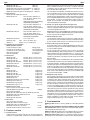
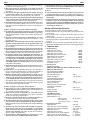
D) Power tool use and care
a) Do not force the power tool. Use the correct power tool for your
application. The correct power tool will do the job better and safer at the
rate for which it was designed.
b) Do not use the power tool if the switch does not turn it on and off. Any
power tool that cannot be controlled with the switch is dangerous and must
be repaired.
c) Disconnect the plug from the power source before making any adjustments, changing accessories, or storing power tools. Such preventive
safety measures reduce the risk of starting the power tool accidentally.
d) Store idle power tools out of the reach of children and do not allow
persons unfamiliar with the power tool or these instructions to operate
the power tool. Power tools are dangerous in the hands of untrained users.
e) Maintain power tools. Check for misalignment or binding of moving
parts, breakage of parts and any other condition that may affect the
power tools operation. If damaged, have the power tool repaired by a
qualified expert or by an authorised REMS after-sales service facility
before use. Many accidents are caused by poorly maintained power tools.
f) Keep cutting tools sharp and clean. Properly maintained cutting tools
with sharp cutting edges are less likely to bind and are easier to control.
g) Secure the workpiece. Use clamps or a vice to hold the workpiece. This
is safer than holding it with your hand, and also it frees both hands to operate the equipment.
h) Use the power tool, accessories and tool bits etc., in accordance with
these instructions and in the manner intended for the particular type
of power tool, taking into account the working conditions and the work
to be performed. Use of the power tool for operations different from those
intended could result in a hazardous situation. All unauthorised modifications to the power tool are prohibited for safety reasons.
E) Battery tool use and care
a) Ensure the switch is in the off position before inserting battery pack.
Inserting the battery pack into power tools that have the switch on invites
accidents.
b) Recharge only with the charger specified by the manufacturer. A charger that is suitable for one type of battery may create a risk of fire when used
with another battery pack.
c) Use battery tools only with specifically designated battery packs. Use
of any other battery packs may create a risk of injury and fire.
d) When battery pack is not in use, keep it away from other metal objects
like paper clips, coins, keys, nails, screws, or other small metal objects
that can make a connection from one terminal to another. Shorting the
battery terminals may cause bums or a fire.
e) Under abusive conditions, liquid may be ejected from the battery, avoid
contact. If contact accidentally occurs, flush with water. If liquid contacts eyes, additionally seek medical help. Liquid ejected from the
battery may cause irritation or bums.
f) Do not use the battery/charger at battery/charger temperatures or
ambient temperatures of 5°C/40°F or b 40°C/105°F.
g) Do not dispose defective batteries in the normal domestic waste. Take
them to an authorised REMS after-sales service facility or to a reputed
waste disposal company.
F) Service
a) Have your power tool serviced by a qualified repair person using only
identical replacement parts. This will ensure that the safety of the power
tool is maintained.
b) Comply with maintenance instructions and instructions on tool
replacements.
c) Check mains lead of power tool regularly and have it replaced by a
qualified expert or an authorised REMS after-sales service facility in
case of damage. Check extension cable regularly and replace it when
damaged.
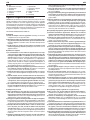
Specific Safety Instructions
•
•
•
•
•
Use personal safety equipment (e.g. goggles, ear defenders).
Warning! Chips eject sidewards and to the front. Keep other people away.
Do not overload the saw and the saw blade. Do not use too high feed
pressure.
Watch that no residual water runs into the motor while sawing lines caryingwater. Danger: electric shock.
On dusty work (with materials containing asbestos, stone etc.) comply
with the accident prevention regulations.
eng
•
•
•
Hold power tool by insulated gripping surfaces when performing an operation where the cutting tool may contact hidden wiring or its own cord.
Contact with a “live” wire will make exposed metal parts of the tool “live”
and shock the operator.
Use clamps or another practical way to secure and support the workpiece
to a stable platform. Holding the work by hand or against your body leaves
it unstable and may lead to loss of control.
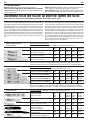
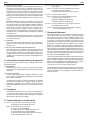
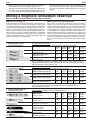
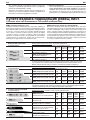
1. Technical Data
1.1. Article numbers
REMS Tiger ANC drive unit
REMS Tiger ANC VE drive unit
REMS Tiger ANC SR drive unit
REMS Tiger ANC pneumatic drive unit
REMS Panther ANC VE drive unit
REMS Cat ANC VE drive unit
REMS Akku-Cat ANC VE drive unit
REMS High-Power-Battery 18 V
Rapid-charger 12–18 V
560000
560008
560001
560002
560005
560004
560007
565210
565220
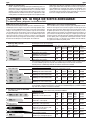
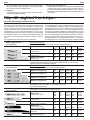
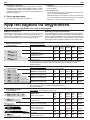
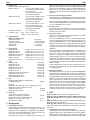
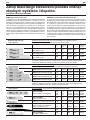
1.2. Capacities
Square sawing
REMS Tiger ANC, REMS Tiger ANC VE, REMS Tiger ANC SR,
REMS Tiger ANC pneumatic
With guide support 563000 and
REMS special saw blade 561001
Pipes (including plastic coated)
Metal, wood, plaster, etc.
up to 2”
3 mm and thicker
With guide support 563100 and
REMS special saw blade 561002
Pipes (including plastic coated)
Metal, wood, plaster, etc.
up to 4”
3 mm and thicker
REMS Tiger ANC SR with guide support
and REMS universal saw blade
Stainless steel pipes (INOX)
Metal, wood, plastic
up to 2” or 4”
1.5 mm and thicker
Hand-held sawing
all REMS reciprocating saws
REMS universal saw blades and
REMS saw blades (see 2.4.)
Steel pipes and others
Other metal profiles,
Nail-embedded wood, pallets
1.3. Number of strokes (idling speed)
REMS Tiger ANC
REMS Tiger ANC VE (infinitely variable)
REMS Tiger ANC SR (infinitely variable)
REMS Tiger ANC 48 V
REMS Tiger ANC pneumatic
REMS Panther ANC VE (infinitely variable)
REMS Cat ANC VE (infinitely variable)
REMS Akku-Cat ANC VE (infinitely variable)
Ø ≤ 6”, 160 mm
≤ 250 mm
2200 rpm
0 ... 2200 rpm
700 ... 2200 rpm
1300 rpm
1800 rpm
0 ... 2200 rpm
0 ... 2200 rpm
0 ... 1700 rpm
1.4. Electric data
REMS Tiger ANC, REMS Tiger ANC VE,
REMS Cat ANC VE
230 V; 50–60 Hz; 1050 W; 5 A or
110 V; 50–60 Hz; 1050 W; 10 A or
48 V; 750 W; 16.5 A
all-insulated (73/23/EWG)
interference-suppressed (89/336/EWG)
REMS Tiger ANC SR
230 V; 50–60 Hz; 1400 W; 6.4 A or
110 V; 50–60 Hz; 1400 W; 12.8 A
all-insulated (73/23/EWG)
interference-suppressed (89/336/EWG)
REMS Panther ANC VE
230 V; 50–60 Hz; 500 W; 2.3 A or
110 V; 50–60 Hz; 500 W; 4.6 A
all-insulated (73/23/EWG)
interference-suppressed (89/336/EWG)
REMS Akku-Cat ANC VE
Rapid-charger (1 h)
18 V=; 2.0 Ah; 30 A
Input 230 V~; 50–60 Hz; 1.0 A
Output 12–18 V=; 50 W; 2.65 A