1
This chainsaw is not intended for felling, but mostly for small jobs such as removing branches and sawing
logs. However, it can be used on exception for felling small trees. Ask someone who knows how to use
a chainsaw for advice if you are in the least unsure of how to use the chainsaw.
Protective equipment should always be used for forestry work: Helmet with ear defenders and visor, chainsaw
trousers or leggings, chainsaw boots or shoes with non-slip soles and toe caps and of course a first aid kit. Also
use work clothes in a visible colour that stands out.
• Small trees can often be felled with one cut almost entirely through the whole trunk and pushed in
the correct direction by hand or by a shoulder. (Do not cut completely through, save a little of the trunk to be
used as a hinge).
• Larger trees require directional cuts. Directional cuts determine the direction of the fall.
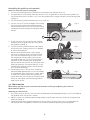
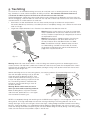
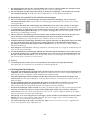
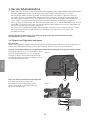
Warning: Always make sure that you have an escape route
ready. If needed take away bushes and branches that are in
the way. The best escape route (A) is diagonally to the rear of
the expected line of fall.
Warning: If the terrain is sloped or uneven, the chainsaw
operator should keep on the uphill side of the tree, as
the tree is likely to roll or slide downhill after it is felled.
Note: The direction of fall (B) is determined by the notch
cut. Before felling, consider the natural lean of the tree,
the location of larger branches and the wind direction to
judge which way the tree will fall.
B
2
Fig. 20
A
45°
3
Warning: Never fell a tree alone if there is a risk of it falling onto something which can be damaged such as
a house or fence. Get help from a professional. Never fell a tree close to a power line or telephone line. Check
2 up often and check that no one is
that there are no onlookers or pets close by before you begin cutting. Look
approaching the danger area.
1
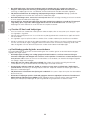
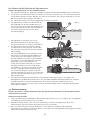
Normal tree felling consists of two cutting phases, the notching undercut (C) and the felling back cut (D).
1
2
Start with the upper notching cut (C) on the side
of the tree facing the direction of fall (E). Then
make the lower, horizontal notching cut so that
it meets the upper notching cut (do not cut too
far). The notching undercut should be wide
enough to steer the tree during as much of
the fall as possible.
Warning: Never walk in front of a tree in
which you have made a notching undercut.
Make the felling back cut (D) from the other
side of the tree, parallel to but 3–5 cm higher
than the horizontal notching cut.
E
Fig. 21
3/4
1/4
D
C
3–5 cm
F
NEVER cut completely through the remaining trunk. ALWAYS leave a hinge (F). It is the hinge that steers the tree
during the fall. The hinge wood keeps the tree from twisting and falling in the wrong direction. Do not cut
through the hinge. As the saw chain gets close to the hinge, a felling wedge should be inserted into the felling
back cut. If the entire felling cut is made before a felling wedge has been placed in the saw cut, there is a risk
of the tree rocking backwards and pinching the saw chain. Before felling the tree by driving in the felling wedge,
make sure that there are no bystanders or pets in the fall area.
15
ENGLISH
9. Tree felling