1
17. When (the) battery pack is not in use, keep it
away from other metal objects, like paper clips,
coins, keys, nails, screws or other small metal
objects, that can make a connection from one
terminal to another.
18. Under abusive conditions, liquid may be ejected
from the battery; avoid contact. If contact
accidentally occurs, flush with water.
SAVE THESE INSTRUCTIONS.
This appliance is intended for household use.
ENB114-3
ADDITIONAL SAFETY RULES
1.
2.
3.
4.
5.
6.
Read this instruction manual and the charger
instruction manual carefully before use.
Do not pick up the following materials:
– Hot materials such as lit cigarettes or spark/
metal dust generated by grinding/cutting
metal
– Flammable materials such as gasoline,
thinner, benzine, kerosene or paint
– Explosive materials like nitroglycerin
– Ignitable materials such as Aluminum, zinc,
magnesium, titanium, phosphorus or
celluloid
– Wet dirt, water, oil or the like
– Hard pieces with sharp edges, such as wood
chips, metals, stones, glasses, nails, pins or
razors
– Powder to clot such as cement or toner
– Conductive dust such as metal or carbon
– Fine particle like concrete dust
Such action may cause fire, injury and/or property damage.
Stop operation immediately if you notice
anything abnormal.
If you drop or strike the cleaner, check it
carefully for cracks or damage before operation.
Do not bring close to stoves or other heat sources.
Do not block the intake hole or vent holes.
SAVE THESE INSTRUCTIONS.
ENC007-8
IMPORTANT SAFETY INSTRUCTIONS
FOR BATTERY CARTRIDGE
1.
2.
3.
4.
5.
Before using battery cartridge, read all instructions and cautionary markings on (1) battery
charger, (2) battery, and (3) product using battery.
Do not disassemble battery cartridge.
If operating time has become excessively
shorter, stop operating immediately. It may
result in a risk of overheating, possible burns
and even an explosion.
If electrolyte gets into your eyes, rinse them out
with clear water and seek medical attention right
away. It may result in loss of your eyesight.
Do not short the battery cartridge:
(1) Do not touch the terminals with any conductive material.
(2) Avoid storing battery cartridge in a container
with other metal objects such as nails, coins,
etc.
(3) Do not expose battery cartridge to water or
rain.
A battery short can cause a large current flow,
overheating, possible burns and even a breakdown.
6. Do not store the tool and battery cartridge in
locations where the temperature may reach or
exceed 50°C (122°F).
7. Do not incinerate the battery cartridge even if it
is severely damaged or is completely worn out.
The battery cartridge can explode in a fire.
8. Be careful not to drop or strike battery.
9. Do not use a damaged battery.
10. Follow your local regulations relating to disposal
of battery.
SAVE THESE INSTRUCTIONS.
Tips for maintaining maximum battery life
1.
2.
3.
4.
Charge the battery cartridge before completely
discharged.
Always stop tool operation and charge the battery cartridge when you notice less tool power.
Never recharge a fully charged battery cartridge.
Overcharging shortens the battery service life.
Charge the battery cartridge with room
temperature at 10°C – 40°C (50°F – 104°F). Let a
hot battery cartridge cool down before charging
it.
Charge the battery cartridge once in every six
months if you do not use it for a long period of
time.
FUNCTIONAL DESCRIPTION
CAUTION:
• Always be sure that the tool is switched off and the battery cartridge is removed before adjusting or checking
function on the tool.
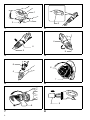
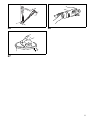
Installing or removing battery cartridge (Fig. 1)
• Always switch off the tool before insertion or removal of
the battery cartridge.
• To remove the battery cartridge, withdraw it from the
tool while pressing the buttons on both sides of the
cartridge.
• To insert the battery cartridge, hold it so that the battery
cartridge front shape fits to that of the battery
installment opening and slip it into place. Always insert
it all the way until it locks in place with a little click. If
not, it may accidentally fall out of the tool, causing
injury to you or someone around you.
• Do not use force when inserting the battery cartridge. If
the cartridge does not slide in easily, it is not being
inserted correctly.
Switch action (Fig. 2)
CAUTION:
• Before inserting the battery cartridge into the tool,
always check to see that the switch trigger actuates
properly and returns to the “OFF” position when
released.
To start the tool, simply pull the switch trigger. Release
the switch trigger to stop.
7