1
Landroid's new home - your garden
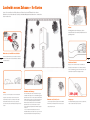
Let's start by having a closer look at Landroid's new home—your lawn—highlighting the areas where it can
safely go and areas it’s best for Landroid®M to avoid.
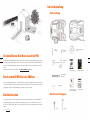
Trees
If there are roots emerging from the ground, this area should be
avoided in order not to damage the roots.
Obstacles that can be hit
When hitting any obstacle that’s rigid, stable and taller than
6
15cm—such as a wall or a fence—your Landroid®M will simply
7
stop and re-direct away from the obstacle.
Depressions and bumps
EN
In the case of large bumps or dips, please consider if the blades
could touch the ground; if this is the case, either make the
inclines smoother or exclude those areas from your Landroid’s
operation.
Stones
Stones that are heavy enough not to be moved by your
Landroid®M can be safely hit. However, if any stone has an
inclined surface that your Landroid®M can climb, you should
either remove it or exclude from the working area.
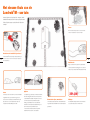
Driveways
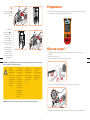
35% (20°)
If your driveway is level with your lawn, without any protruding
®
surface, the Landroid M can freely run over it. If you'd like the
Landroid®M to avoid it, then only a 10cm* space between the
Boundary Wire and the driveway is needed.
If it’s covered with gravel, you should not allow the Landroid®M
to travel over it, using the distance gauge in this case, keeping a
35cm* space between the boundary wire and the driveway.
*This is the recommended distance, because the Landroid®M
cannot calculate the distance itself. Use the provided distance
gauge to ensure proper installation.
Flowerbeds, ponds, pools...
Slopes
You certainly don’t want your Landroid®M to mow your flowers,
Your Landroid®M has the ability to safely climb slopes up to 35%
or fall into the water. These areas should be avoided.
(20°), so just avoid anything steeper than this.
EN