1
Always read instructions carefully prior to use.
Safety Information
• Read and understand all safety precautions and operating instructions contained in this manual.
• Always wear eye protection when performing a compression test.
• Do not exceed the maximum rating of the tester; 1000
psi (69 bar) (6,900 kPa)
• Prior to testing, set the gearbox to neutral on all vehicles
or machinery having a standard transmission, or park for
automatic transmissions.
• Prior to engaging ignition, ensure that the fuel supply is
disabled using manufacturer’s recommended method.
• Make sure that all connections are secure prior to testing.
• Take precautions to avoid contact with hot engine surfaces.
Included in this Kit
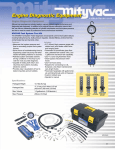
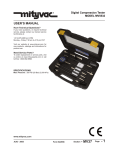
• Analog Diesel Compression Tester comprising of test
gauge with rubber boot, 15” (375 mm) long, high pressure hose, and 90° female quick release swivel coupler.
• Custom molded case
• User’s Manual (English, French, Spanish and German)
Functional Overview
The Mityvac Analog Diesel Compression Tester is designed for testing the compression produced in the cylinders of a diesel engine. It can measure, compression
values of up to 1,000 psi (69 bar) (6,900 kPa) .
Before Running a Compression Test
• To achieve accurate results, the engine should be run
until it reaches normal operating temperature, prior to
testing. Testing should be completed before the engine
cools.
• Ensure battery(s) are fully charged to provide power for
adequate cranking speed. Check engine manufacturer’s specifications to determine if a minimum cranking
speed is required. It is recommended that a charger be
connected, or a backup or auxiliary battery be used to
maintain required cranking speed.
Performing a Compression Test
Diesel engines utilize either a direct or indirect fuel injection system. Direct injection engines inject fuel directly into
the cylinder, while indirect injection engines use a small
pre-combustion chamber. Spark plugs are not required for
either type of diesel engine. Instead, the high compression
achieved in a diesel engine cylinder heats the air, which
ignites the fuel. However, a cold diesel engine requires a
means to preheat the air in the cylinder, pre-combustion
chamber or manifold, to facilitate starting. This is most often accomplished with a glow plug. Depending on whether
the engine has a glow plug, and its location, will determine
whether a glow plug adapter or injector adapter is required
for compression testing. The best way to determine the
type of adapter to use, and the appropriate test method
Form 822858
is to consult a service manual. A full line of glow plug and
injector style test adapters for most makes and models of
vehicles and heavy equipment are available from Mityvac.
Testing with Glow Plug Adapter
Prior to starting a compression test, consult manufacturer’s
specifications and/or appropriate service manual to determine the correct procedure for performing the compression
test. Familiarize yourself with the proper specifications and
any unique testing procedures, and follow the recommended procedures for removing and installing the glow plugs.
1. Put the vehicle in neutral or park, and set the parking
brake.
2. Run the engine to normal operating temperature.
3. Ensure the battery has a full charge and/or connect a
charger or auxiliary battery.
4. Thoroughly clean the area around each glow plug to
eliminate any chance of dirt or contamination entering
the engine.
5. Remove the glow plugs, label them by cylinder number,
and protect them from damage.
6. Disable the fuel supply system.
7. Select the appropriate glow plug adapter and install it
into cylinder 1.
8. Connect the tester to the glow plug adapter installed in
cylinder 1.
9. While watching the gauge, crank the engine and count
the compression strokes by listening to one of the adjacent cylinders. Watch for the pressure to peak around
6 to 10 strokes, then stop cranking. Make note of the
number of strokes required to reach peak compression.
10. Record the cylinder number and its peak compression
value.
11. Press the pressure relief button on the side of the tester
to release the pressure.
12. Disconnect the gauge and remove the glow plug
adapter.
13. Install the glow plug adapter in cylinder 2, and reconnect the tester.
14. Repeat the compression test on cylinder 2 and all
remaining cylinders. Be sure to crank the engine the
same number or strokes and to record the peak compression value for each cylinder.
15. After completing the test on all cylinders, remove the
tester and adapter, and replace the glow plugs.
Testing with Injector Adapter
Prior to starting a compression test, consult manufacturer’s
specifications and/or appropriate service manual to determine whether the test should be performed while cranking
or running. Familiarize yourself with the proper specifications and any unique testing procedures, and follow the
recommended procedures for removing and installing the
injectors.
1. Put the vehicle in neutral or park, and set the parking
brake.
2. Thoroughly clean the area around each injector to eliminate any chance of dirt or contamination entering the
engine.
Page Number - 3