1
Embedded MegaRAID Software User Guide
June 2011
Overview
RAID Overview
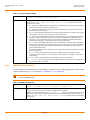
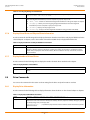
RAID 5 addresses the bottleneck issue for random I/O operations. Because each drive contains both data and parity,
numerous writes can take place concurrently.
Uses
Provides high data throughput. Use RAID 5 for transaction processing applications because each drive can read
and write independently. If a drive fails, the RAID controller uses the parity drive to recreate all missing
information. Use also for office automation and online customer service that requires fault tolerance. Use for
any application that has high read request rates but low write request rates.
Strong Points
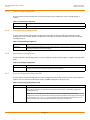
Provides data redundancy, high read rates, and good performance in most environments. Provides redundancy
with lowest loss of capacity.
Weak Points
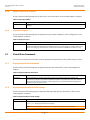
Not well suited to tasks requiring lot of small writes. Suffers more impact if no drive cache is used (clustering).
Drive performance is reduced if a drive is being rebuilt or a background initialization is in progress.
Environments with few processes do not perform as well because the RAID overhead is not offset by the
performance gains in handling simultaneous processes.
Drives
Three to eight
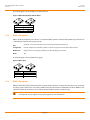
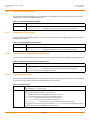
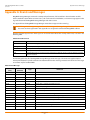
The following figure shows a RAID 5 drive group with six drives.
Figure 3 RAID 5 Array
Segment 1
Segment 7
Segment 2
Segment 8
Segment 3
Segment 9
Segment 4
Segment 10
Segment 13
Segment 19
Segment 25
Parity (26–30)
Segment 14
Segment 20
Parity (21-25)
Segment 26
Segment 15
Parity (16-20)
Segment 21
Segment 27
Parity (11–15)
Segment 16
Segment 22
Segment 28
Segment 5
Parity (6-10)
Segment 11
Segment 17
Segment 23
Segment 29
Parity (1-5)
Segment 6
Segment 12
Segment 18
Segment 24
Segment 30
Note: Parity is distributed across all drives in the array.
1.2.4
RAID 10 Description
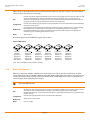
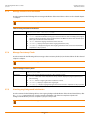
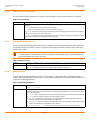
RAID 10, a combination of RAID 1 and RAID 0, has mirrored drives. It breaks up data into smaller blocks, and then
stripes the blocks of data to each RAID 1 RAID set. Each RAID 1 RAID set then duplicates its data to its other drive. The
size of each block is determined by the strip size parameter, which is 64 KB. RAID 10 can sustain one drive failure in
each drive group while maintaining data integrity.
NOTE On a RAID 10 array, you can create only one virtual drive, and that virtual drive must occupy the entire
space of the RAID 10 array.
Uses
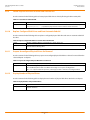
Works best for data storage that must have 100 percent redundancy of RAID 1 (mirrored drive groups) and that
also needs the enhanced I/O performance of RAID 0 (striped drive groups); RAID 10 works well for
medium-sized databases or any environment that requires a higher degree of fault tolerance and moderate to
medium capacity
Strong Points
Provides both high data transfer rates and complete data redundancy
Weak Points
Requires twice as many drives
Drives
Four, six, or eight
LSI Corporation
- 12 -