1
5.
Trouble-shooting for faults
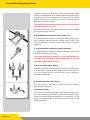
If the safety valve blows too early because of foreign body penetration caught up inside then the blow-off valve is to be fully
opened on the head of safety valve by turning counter-clockwise
so that the compressed air can escape. If, due to this, the foreign
body is not removed then the upper part of the safety valve is to
be unscrewed when the safety valve is disassembled. To do this,
position the pipe wrench in the centre and unscrew by turning to
the left.
Carefully take out the valve ball and remove foreign body. Firmly
screw on the upper part of the valve again, assemble the safety
valve and check operation. The set pressure must not be changed.
Should the sealing or sealing plate on
the upper part of the valve be removed
then correct operation can no longer
be guaranteed.
The safety valve is to be exchanged.
If operational faults occur on the pressure reducer or controller
due to icing at high air humidity in connection with low temperatures then a normal defrosting agent (the same as in cars) should
be used.
6.
Repetitive tests
Lifting bag systems are to be subjected to repetitive tests according to DIN EN 13731 and national regulations (e.g. GUV-G 9102).
99 Testing on acceptance Testing for completeness by the person/people delegated by
the user.
Visual check and operation test by a trained person according to the operation manual.
99 Visual check and operation test after each application/use by
a trained person.
This test is to be documented.
99 The lifting bag system is to be subjected at least once every
year to a visual check and operation test by a trained person
according to the following check list.
This test is to be documented.
99 The lifting bag system is to be given a pressure test, by user or
manufacturer, according to DIN EN 13 731 and recommendation of the manufacturer, every 5 years or if there is any doubt
about the safety or reliability.
The user is responsible for the correct and professional execution
of the repetitive tests.
Page 10/18