1
The Patient-Rated Tennis Elbow Evaluation (PRTEE)©
User Manual
June 2010
© Joy C. MacDermid, BScPT, MSc, PhD
School of Rehabilitation Science, McMaster University, Hamilton, Ontario, Canada
Clinical Research Lab, Hand and Upper Limb Centre, St. Joseph’s Health Centre, London,
Ontario, Canada
E-mail: [email protected] or [email protected]
Table of Contents
Introduction
What is the PRTEE?......................................................................................……… p. 3
Instrument Development
Designing the PRTEE……………………………………………………………… p. 4
Testing the PRTEE………………………………………………………………… p. 4
Recent Revisions…………………………………………………………………… p. 4
How to Score the PRTEE
Computing the subscales ………………………………………………………….. p. 5
Computing the total score……………………………………………...................... p. 5
Sample Scoring ……………………………………………………………………. p. 5
Interpretation ………………………………………………………………………. p. 6
Common Questions ………………………………………………………..……………….p. 7
Instrument Properties and Outcome Studies
Table 1 – Reliability …………………………………………………..................... p. 9
Table 2 – Validity …………………………………………………………………. p. 10
Table 3 – Responsiveness ………………………………………………………. p. 12
Table 4 – Comparative Data ………………………………………………………. p. 13
Bibliography of Published Studies …………………………………………........................p. 15
Page 2
Introduction
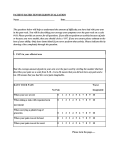
What is the Patient-Rated Tennis Elbow Evaluation (PRTEE)?
The PRTEE, formerly known as the Patient-Rated Forearm Evaluation Questionnaire
(PRFEQ), is a 15-item questionnaire designed to measure forearm pain and disability in patients
with lateral epicondylitis (also known as “tennis elbow”). The PRTEE allows patients to rate
their levels of tennis elbow pain and disability from 0 to 10, and consists of 2 subscales:
1) PAIN subscale (0 = no pain, 10 = worst imaginable)
¾ Pain - 5 items
2) FUNCTION subscale (0 = no difficulty, 10 = unable to do)
¾ Specific activities - 6 items
¾ Usual activities - 4 items
In addition to the individual subscale scores, a total score can be computed on a scale of 100
(0 = no disability), where pain and functional problems are weighted equally (see “How to Score
the PRTEE” for detailed scoring instructions).
Page 3
Instrument Development
Designing the PRTEE
Formerly known as the Patient-Rated Forearm Evaluation Questionnaire (PRFEQ), the
PRTEE was developed so that tennis elbow braces could be evaluated for a master’s project.
The PRTEE was based on the Patient-Rated Wrist Evaluation (PRWE) and also incorporated
information from a previous study that evaluated the psychometric properties of outcome
measures for patients with lateral epicondylitis.
The pain subscale consisted of 4 (out of 5) items from the PRWE with the term “arm”
replacing “wrist”. The “usual activities” items in the PRTEE’s function subscale were identical
to the PRWE’s “usual activities”, whereas the PRTEE’s “specific activities” were comprised of
activities that may be affected by tennis elbow.
To keep the instrument brief and easy to use in a clinic, the questionnaire format was
limited to five pain questions and ten function questions. A total score out of 100 can be
computed by equally weighting the pain score (sum of five items) and the disability score (sum
of ten items, divided by 2).
Testing the PRTEE
To test the PRTEE’s test-retest reliability, 47 patients with unilateral lateral epicondylitis
completed the PRTEE on two consecutive days. The pain (ICC = 0.89), function (1CC=0.83),
and the total (ICC = 0.89) scores all demonstrated excellent reliability. When the reliability was
assessed by subgroups (men vs. women; chronic vs. acute; work-related vs. non-work-related),
the ICCs were all greater than 0.75.
Concurrent validity was assessed by correlating the PRTEE scores with the pain-free grip
strength. The total PRTEE score (r = -0.36) and the pain subscale (r = -0.37) had a significant
moderate correlation with the pain-free grip strength but not the function subscale (r = -0.30).
(Reference: Overend et al., 1999 (1))
Recent Revisions
Since calling the instrument the Patient-Rated Forearm Evaluation Questionnaire was
misleading, the title was recently changed to the Patient-Rated Tennis Elbow Evaluation to
indicate that the measure was specifically designed for tennis elbow.
Minor modifications were also made on the wording of some of the items:
1) “turning a doorknob” is now “turn a doorknob and key”
2) “carry a plastic bag of groceries” is now “carry a grocery bag or briefcase by the handle”
3) “wringing out a facecloth or dishrag” is now “wring out a washcloth or wet towel”
Page 4
How to Score the PRTEE
*To minimize nonresponse, check forms once patients complete them.
Computing the Subscales
Pain Score = Sum of the 5 pain items (out of 50)
Best Score = 0, Worst Score = 50
Function Score = Sum of the 10 function items,
Divided by 2 (out of 50)
Best Score = 0, Worst Score = 50
Computing the Total Score
Total Score = Sum of pain + function scores
Best Score = 0, Worst Score = 100
Note: responses to the fifteen items are totaled out of 100, where pain and disability are equally
weighted
Sample Scoring
Pain score = 2 + 8 + 7 + 5 + 9 = 31/50
Page 5
Function score = (1+ 3 + 0 + 5 + 0 + 3 + 1 + 5 + 4 + 6) / 2 = 14/50
Total score = 31 + 14 = 45/100
Interpretation
¾ The total PRTEE score rates pain and disability equally.
¾ Higher score indicates more pain and functional disability (e.g., 0 = no disability).
Page 6
Common Questions
1) How are missing data treated?
If there is an item missing, you can replace the item with the mean score of the subscale.
2) What if patients leave the question blank because they cannot do it?
Make sure the patients understand that they should have answered “10” for the item and make
corrections, if necessary.
3) What if patients rarely perform the task?
If patients are unsure about how to answer a task that is rarely performed, encourage them to
estimate their average difficulty. Their estimate will be more accurate than leaving the question
blank.
4) What if patients do not do the task?
If patients never do the task, they should leave the question blank.
Page 7
Instrument Properties and Outcome Studies
Reliability
Test-Retest Reliability: the stability of the instrument over time.
Standard Error of Measurement: the confidence around the value of the score.
Validity
Construct Validity: the extent to which the instrument corresponds to theoretical constructs.
Criterion/Concurrent Validity: the extent to which the instrument relates with a gold standard or
more established measure.
Responsiveness
Responsiveness: The ability of the instrument to detect change.
Page 8
Table 1 – Reliability of the PRTEE in published studies
Study
Overend et
al., 1999 (1)
Population
47 patients
(age=45.0; 24M,
23F)
Type
T-R
reliability
PRTEE Results
Pain ICC = 0.89
Function ICC = 0.83
Total ICC = 0.89
Comparators
None
Subgroup analyses:
ICC > 0.75
SEM
Leung et al.,
2004 (2)
Newcomer et
al., 2005 (3)
Rompe et al.,
2007 (4)
74 patients
(age=28-69) with
lateral epicondylitis
94 patients (age =
45.5; 53.2% F)
with lateral
epicondylitis
78 patients with
chronic, unilateral,
MRI-confirmed
lateral elbow
tendinopathy that
were randomized
to: i) treatment (n =
38; age = 45 (23-
Pain = 0.6
Function = 0.9
Total = 0.6
Subgroup analyses:
ICC > 0.5
(Hong Kong Chinese PRFEQ)
T-R
reliability
Pain ICC = 0.99
Function ICC = 0.99
Total ICC = 0.99
SEM
Pain = 0.99
Function = 2.38
Total = 3.28
(PRFEQ)
(n=22)
T-R
reliability (3
days)
T-R
reliability (1
week)
Pain ICC = 0.96
Function ICC = 0.92
Total ICC = 0.96
Pain r2 = 0.92
Function: SA r2 = 0.87
Function: UA r2 = 0.77
Total r2 = 0.87
Internal
Consistency
Pain α = 0.92
Function: SA α = 0.90
Functions UA α = 0.70
None
None
Page 9
Nilsson et al.,
2008 (6)
Altan et al.,
2010 (7)
Blanchette et
al., 2010 (8)
69); 47% F); ii)
placebo (n = 40;
age = 45 (18-68);
50% F)
54 patients (age =
46; 25F, 29M) with
unilateral
epicondylitis/
epicondylalgia
50 patients (age =
47.52 (34-60);
14M, 36F) with
lateral epicondylitis
32 patients (age =
45 (12); 14M, 18F)
with lateral
epicondylitis
Total α = 0.94
(Swedish PRTEE)
Occasion 1
Pain ICC = 0.58
Function ICC =
0.91
Total ICC = 0.90
Occasion 2
Pain ICC= 0.60
Function ICC =
0.90
Total ICC = 0.90
SEM
Pain = 0.25
Function = 0.32
Total = 0.27
Pain = 0.60
Function = 0.31
Total = 0.27
Internal
Consistency
Pain α = 0.84
Function α = 0.93
Total α = 0.94
(Turkish PRTEE)
Pain α = 0.83
Function α = 0.92
Total α = 0.94
T-reliability
(2 hours)
Pain rs = 0.922
Function: SA rs = 0.906
Function: UA rs = 0.907
Overall rs = 0.920
Internal
Consistency
Pain α = 0.733
Function: SA α = 0.712
Function: UA α = 0.755
Total α = 0.837
Pain α = 0.80
Function α = 0.92
Total α = 0.93
T-R
reliability
(30 minutes)
Internal
Consistency
Item-total correlation r = 0.58-0.85
Legend: ICC = intraclass correlation coefficient; SEM = standard error of measurement; T-R reliability = test-retest reliability; r2 = coefficient of determination; α
= Cronbach’s alpha
Abbreviations: F = female; M = male; PRFEQ = Patient-Rated Forearm Evaluation Questionnaire; PRTEE = Patient-Rated Tennis Elbow Evaluation; Function:
SA = Functions: Special Activities subscale; Function: UA = Function: Usual Activities
Page 10
Table 2 – Validity of the PRTEE in Published Studies
Study
Overend et al.,
1999 (1)
Leung et al., 2004
(2)
Newcomer et al.,
2005 (3)
Population
Type
47 patients
(age=45.0; 24M,
23F)
Criterion
74 patients (age=2869) with lateral
epicondylitis
Construct
94 patients (age =
45.5; 53.2% F) with
lateral epicondylitis
r with painfree grip
PRTEE Results
Comparators
None
Pain r = -0.36
Function r = -0.30
Total r = -0.30
(Hong Kong Chinese PRFEQ)
rs with flexed
elbow
Pain rs = -0.39
Function rs = -0.38
Total rs = -0.40
rs with
extended
elbow
Concurrent
Pain rs = -0.38
Function rs = -0.38
Total rs = -0.40
(PRFEQ)
rs with VAS
Pain rs = 0.62
Function rs = 0.64
Total rs = 0.66
rs with PFG
Pain rs = -0.35
Function rs = -0.45
Total rs = -0.45
rs with DASH
Pain rs = 0.56
Function rs = 0.74
Total rs = 0.72
rs with SF-36
SF
Pain rs = -0.33
Function rs = -0.32
Total rs = -0.31
rs with SF-36
RP
Pain rs = -0.32
Function rs = -0.37
Total rs = -0.38
None
None
Page 11
Alizadehkhaiyat et
al., 2007 (5)
Rompe et al., 2007
(4)
Nilsson et al.,
2008 (6)
16 patients (age=49
(40-66); 50% F) with
lateral epicondylitis;
16 healthy controls
(age=40 (26-59);
44% F)
78 patients with
chronic, unilateral,
MRI-confirmed
lateral elbow
tendinopathy that
were randomized to:
i) treatment (n = 38;
age = 45 (23-69);
47% F); ii) placebo
(n = 40; age = 45 (1868); 50% F)
54 patients (age = 46;
25F, 29M) with
unilateral
epicondylitis/
epicondylalgia
rs with SF-36
BP
Pain rs = -0.60
Function rs = -0.62
Total rs = -0.65
rs with SF-36
PF
Concurrent
Pain rs = -0.59
Function rs = -0.57
Total rs = -0.61
(PRFEQ)
r with DASH
r = 0.86
r with PRWE
r = 0.89
DASH
r = 0.73
Construct
r2 with
Thomsen test
Pain r2 = 0.75
Function: SA r2 = 0.80
Function: UA r2 = 0.55
Total r2 = 0.84
r2 with UEFS
Pain r2 = 0.05*
Function: SA r2 =0.02*
Function: UA r2 = 0.01*
Total r2 = 0.03*
r2 with Roles
and Maudsley
Pain r2 = 0.01*
Function: SA r2 = 0.02*
Function: UA r2 = 0.00*
Total r2 = 0.02*
r2 with DASH
Pain r2 = 0.67
Function: SA r2 = 0.69
Function: UA r2 = 0.45
Total r2 = 0.75
(Swedish PRTEE)
Construct/
Concurrent
rs with DASH
(symptoms)
Pain rs = 0.79
Function rs = 0.83
German PREE
rs = 0.61
Page 12
Total rs = 0.84
Altan et al., 2010
(7)
50 patients (age =
47.52 (34-60); 14M,
36F) with lateral
epicondylitis
rs with DASH
(function)
Pain rs = 0.82
Function rs = 0.90
Total rs = 0.91
rs = 0.83
rs with DASH
(total)
Pain rs = 0.78
Function rs = 0.90
Total rs = 0.88
rs = 0.73
rs with Roles
& Maudsley
Pain rs = 0.67
Function rs = 0.79
Total rs = 0.78
(Turkish PRTEE)
Concurrent
rs with DASH
Pain rs = 0.501
Function: SA rs = 0.622
Function: UA rs = 0.568
Total rs = 0.676
rs with QuickDASH
Pain rs = 0.403
Function: SA rs = 0.523
Function: UA rs = 0.554
Total rs = 0.589
Construct
rs with
Tenderness
rs with
maximum
group strength
Blanchette et al.,
2010 (8)
32 patients (age = 45
(12); 14M, 18F) with
lateral epicondylitis
Construct
Baseline
r with VAS
Pain rs = – 0.411
Function: SA rs = – 0.204*
Function: UA rs = – 0.423
Total rs = – 0.441
Pain rs = – 0.356
Function: SA rs = – 0.366
Function: UA rs = – 0.352
Total rs = – 0.427
(Canadian French PRTEE)
Pain r = 0.65
Function r = 0.73
Page 13
Total r = 0.72
r with painfree grip
12 weeks
r with VAS
r with painfree grip
Pain r = - 0.39
Function r = - 0.35*
Total r = - 0.38
Total r = 0.77
Total r = - 0.49
3 months
Total r = 0.64
r with VAS
Legend: r = Pearson correlation coefficient; rs = Spearman’s correlation coefficient; * = not statistically significant, p > 0.05
Abbreviations: DASH = Disabilities of the Arm, Shoulder, Hand; F = female; M = male; PFG = Pain-Free Grip; PRFEQ = Patient-Rated Forearm Evaluation
Questionnaire; PRTEE = Patient-Rated Tennis Elbow Evaluation; SF-36 BP = SF=36 Bodily Pain; SF-36 PF = SF-36 Physical Function; SF-36 RP = SF-36 Role
Physical; SF-36 SF = SF-36 Social Function; VAS = Visual Analogue Scale; UEFS = Upper Extremity Functions Scale; PREE = Patient-rated elbow evaluation
Page 14
Table 3 - Responsiveness to Change (or Longitudinal validation) of the PRTEE in published studies
Study
Newcomer et al.,
2005 (3)
Population
94 patients (age =
45.5; 53.2% F) with
lateral epicondylitis
Type
(PRFEQ)
Pain = 1.2
Function = 0.8
Total = 1.0
PFG
0.8
VAS
1.0
DASH
0.9
SF-36 BP
0.7
ES
Pain = 1.3
Function = 0.8
Total = 1.0
0.6
1.1
0.9
0.8
Pain = 1.8
Function = 1.6
Total = 1.9
1.3
1.5
Pain = 1.8
Function = 1.4
Total = 1.6
(treatment group, n = 38)
1.4
1.3
Thomsen
Test
1.73
UEFS
Roles and
Maudsley
1.52
DASH
3.50 (2.02)
23.37
(14.83)
1.39 (0.92)
32.15
(20.05)
ES
78 patients with
chronic, unilateral,
MRI-confirmed
lateral elbow
tendinopathy that
were randomized to:
i) treatment (n = 38;
age = 45 (23-69);
47% F); ii) placebo
(n = 40; age = 45 (1868); 50% F)
Comparators
6 weeks
SRM
12 weeks
SRM
Rompe et al., 2007
(4)
PRTEE Results
3 months
SRM
Pain = 2.01
Function = 2.01
ES
Pain = 33.67 (16.67)
Function = 50.00 (24.88)
1.58
1.60
Posttreatment –
pretreatment
changes
r2 with Thomsen test
Pain r2 = 0.73*
Function: SA r2 = 0.84*
Function: UA r2 = 0.25*
Total r2 = 0.84*
r2 with UEFS
Pain r2 = 0.36*
Function: SA r2 = 0.25*
Page 15
Function: UA r2 = 0.15*
Total r2 = 0.33*
Blanchette et al.,
2010 (8)
32 patients (age = 45
(12); 14M, 18F) with
lateral epicondylitis
r2 with Roles and
Maudsley
Pain r2 = 0.39*
Function: SA r2 = 0.23*
Function: UA r2 = 0.09
Total r2 = 0.31*
r2 with DASH
Pain r2 = 0.80*
Function: SA r2 =0.92 *
Function: UA r2 = 0.52*
Total r2 = 0.66*
(Canadian French PRTEE)
VAS
PFG
6 weeks
SRM
0.9 (95% CI = 0.5, 1.3)
1.0 (95% CI = 0.6, 1.5)
-0.5 (95% CI = -0.9, -0.1)
ES
0.8 (95% CI = 0.4, 1.2)
1.0 (95% CI = 0.6, 1.4)
-0.2 (95% CI = -0.3, 0.0)
3 months
SRM
1.0 (95% CI = 0.6, 1.4)
1.0 (95% CI = 0.5, 1.3)
ES
1.0 (95% CI = 0.6, 1.4)
1.0 (95% CI = 0.6, 1.5)
Longitudinal
Construct Validity
Baseline to 6 weeks
r with VAS
0.68
r with PFG
- 0.26*
Baseline to 3
months
0.88
R with VAS
Legend: ES = effect size; SRM = standardized response mean; * = statistically significant, p < 0.05, 95% CI = 95% confidence intervals
Abbreviations: DASH = Disabilities of the Arm, Shoulder, Hand; F = female; M = male; PFG = Pain-Free Grip; PRFEQ = Patient-Rated Forearm Evaluation
Questionnaire; PRTEE = Patient-Rated Tennis Elbow Evaluation; SF-36 BP = SF=36 Bodily Pain; VAS = Visual Analogue Scale
Page 16
Table 4 - Comparative Scores for the PRTEE
Study
Overend et al.,
1999 (1)
Leung et al., 2004
(2)
Van der Streek et
al., 2004 (9)
Population
47 patients
(age=45.0; 24M,
23F)
74 patients (age=2869) with lateral
epicondylitis
43 patients with
lateral epicondylitis
Follow-up Time
Day 1
Total (n=47)
PRTEE Results
Mean (SD)
Comparators
None
Pain = 4.1 (1.8)
Function = 3.4 (2.1)
Total = 3.8 (1.8)
Males (n=24)
Pain = 3.5 (1.4)
Function = 2.8 (1.9)
Total = 3.1 (1.6)
Females
Pain = 4.7 (1.9)
Function = 4.1 (2.1)
Total = 4.4 (1.9)
Acute (n=35)
Pain = 4.2 (1.6)
Function = 3.6 (2.0)
Total = 3.9 (1.7)
Chronic (n=12)
Pain = 3.6 (2.1)
Function = 3.1 (2.2)
Total = 3.3 (2.0)
Work-related
(n=21)
Pain = 4.5 (1.6)
Function = 4.2 (2.3)
Total = 4.4 (1.8)
Non-workrelated (n=26)
Pain = 3.7 (1.9)
Function = 2.8 (1.7)
Total = 3.3 (1.7)
(Hong Kong Chinese PRFEQ)
None
Pain = 27.96 (9.39)
Function = 47.50 (23.49)
Total = 75.46 (32.10)
(PRFEQ)
Maximal grip strength (kgf)
Page 17
Study
Population
randomized to wear:
i) elbow band (n=20;
age=43.50 (9.39);
70% F); ii)
forearm/hand splint
(n=23; age=42.30
(9.88); 70% F)
Follow-up Time
PRTEE Results
Mean (SD)
Comparators
Group I
Group II
Group I
Group II
Pain = 25.5
(7.5)
Function =
56.3 (21.6)
Total = 81.8
(28.0)
Pain = 25.2
(8.0)
Function =
47.5 (18.5)
Total = 72.7
(24.0)
37.4 (13.7)
26.3 (11.8)
Chronic
symptoms
(group I: n = 8;
group II: n = 10)
Pain = 28.2
(5.5)
Function =
55.1 (12.6)
Total = 83.4
(12.9)
Pain = 28.0
(8.1)
Function =
54.7 (21.4)
Total = 82.7
(28.9)
31.6 (10.3)
26.7 (5.2)
Total symptoms
(group I: n = 19;
group II: n = 21)
Pain = 26.7
(6.7)
Function =
55.8 (17.7)
Total = 82.5
(22.0)
Pain = 26.6
(8.0)
Function =
50.9 (19.7)
Total = 77.5
(26.3)
29.2 (12.2)
26.5 (9.0)
Pain = 19.0
(7.7)
Function =
40.4 (18.3)
Total = 59.3
(25.4)
Pain = 18.7
(11.4)
Function =
31.9 (18.1)
Total = 50.6
(28.0)
27.9 (12.3)
31.3 (16.0)
Pain = 18.6
(6.7)
Function =
34.6 (17.6)
Total = 53.3
(23.4)
Pain = 233
(13.4)
Function =
43.4 (28.5)
Total = 66.7
(41.3)
34.4 (8.6)
29.4 (6.4)
Baseline
Acute symptoms
( group I: n = 11;
group II: n = 11)
6 weeks
Acute symptoms
Chronic
symptoms
Page 18
Study
Population
Follow-up Time
Total symptoms
MartinezSilvestrini et al.,
2005 (10)
Faes et al., 2006
(11)
Alizadehkhaiyat et
al., 2007 (5)
Radpasand, 2007
(12)
94 patients (50M;
age=45.5) with
chronic lateral
epicondylitis treated
with one of:
stretching; concentric
strengthening with
stretching; eccentric
strengthening with
stretching
63 patients with
lateral epicondylitis
received: extensor
brace (n=30; age=46;
63% F) or no brace
treatment (n=33;
age=48; 48% F)
16 patients (age=49
(40-66); 50% F) with
lateral epicondylitis;
16 healthy controls
(age=40 (26-59);
44% F)
Patient (age = 57, F)
with lateral
epicondylitis who
underwent 10-week
sequential
multimodal treatment
Baseline
Six weeks
Baseline
Baseline
End of treatment
PRTEE Results
Mean (SD)
Comparators
Pain = 18.8
Pain = 20.9
(7.0)
(12.3)
Function =
Function =
37.8 (17.7)
37.4 (23.5)
Total = 56.6
Total = 58.3
(24.0)
(35.1)
(PRFEQ)
Stretching Total = 3.7 (1.7)
Concentric Total = 3.8 (1.7)
Eccentric Total = 3.3 (1.5)
DASH
Stretching = 27 (14)
Concentric = 26 (13)
Eccentric = 25 (13)
VAS
Stretching = 48 (21)
Concentric = 49 (21)
Eccentric = 46 (20)
Pain-Free Grip
Stretching = 23 (15)
Concentric = 17 (9.7)
Eccentric = 22 (12)
Stretching Total = 1.5 (1.6)
Concentric Total = 1.3 (1.8)
Eccentric Total = 1.2 (1.7)
Stretching = 15 (14)
Concentric = 17 (14)
Eccentric = 16 (15)
Stretching = 25 (24)
Concentric = 35 (25)
Eccentric = 24 (24)
Stretching = 30 (17)
Concentric = 25 (12)
Eccentric = 26 (14)
(PRFEQ)
Brace = 5.2 (1.9)
Control = 4.6 (1.7)
VAS
Brace = 4.3 (2.1)
Control = 4.3 (1.8)
(PRFEQ)
Patient
Control
Pain = 31 (8) Pain = 1 (2)
Function = 29 Function = 0
(11)
(1)
Total = 60
Total = 1 (3)
(19)
Pain = 28
Function: SA = 48
Function: UA = 32
Total = 68
DASH
Patient
Symptom= 54
(20)
Work = 46 (22)
30.6 (11.1)
30.4 (12.2)
Control
Symptom = 2
(4)
Work = 2 (7)
PRWEQ
Patient
Pain = 30 (16)
Function = 26
(15)
Total = 56 (31)
Control
Pain = 1 (4)
Function = 0 (1)
Total = 2 (4)
Pain = 2
Function: SA = 0
Function: UA = 1
Page 19
Study
Population
Follow-up Time
PRTEE Results
Mean (SD)
Comparators
Total = 2
3 weeks
Nilsson et al.,
2008 (6)
Connell et al.,
2009 (13)
Grewal et al., 2009
(14)
54 patients (age = 46;
25F, 29M) with
unilateral
epicondylitis/
epicondylalgia
12 patients (age =
39.1 (29-48); 5M,
7F) with refractory
lateral epicondylitis
treated with injection
of collagenproducing cells into
sites of
intrasubstance tears
and fibrillar
discontinuity
36 patients (age =
45.3 (7; 29-61); 20M,
16F) with chronic
lateral epicondylitis
treated with
arthroscopic release
Pain = 4
Function: SA = 1
Function: UA = 1
Total = 5
(Swedish PRTEE)
Occasion 1
Pain = 4.18 (1.81)
Function = 3.90 (2.38)
Total = 4.04 (2.00)
Occasion 2 (after
30 minutes)
Pain = 3.77 (1.80)
Function = 3.70 (2.29)
Total = 3.74 (1.97)
Pre-treatment
78 (IQR =71- 88)
Post-treatment
(6 weeks)
47 (IQR =17.5-80)
(3 months)
35 (IQR = 0-42)
(6 months)
12 (IQR = 9-25)
42 months (1974 months)
Worker’s
Compensation
claim ( n = 23)
No worker’s
compensation
claim (n = 13)
Ultrasonography Assessment
Thickness
Hypoechogenicity
(mm)
4.35 (IQR = 4
7 (IWR = 6 -8)
-4.5)
4.2 (ICR = 4 4.4)
MEPI
3 (IQR = 2.75 4.5)
ASES-e
Neovascularity/
hypervascularity
3 (IQR = 2.75 4.25)
Tears (mm)
1 (IQR = 0 1.25)
2 (IQR = 0 -5)
5 (IQR = 3-6)
SF-12
36.7
71.8
Pain = 21.0
Function = 24.1
Satisfaction = 7.0
Mental = 47.7
Physical = 41.4
7.6
90.0
Pain = 6.8
Function = 34.3
Satisfaction = 9.8
Mental = 54.3
Physical =51.3
Page 20
Study
Population
Follow-up Time
5 patients with
chronic lateral
epicondylitis
randomized to 1 of 2
multimodal therapy
groups: i) Group A
(n=3; age = 38.0
(9.0); 3M); ii) Group
Comparators
Heavy/ repetitive
work (n = 25)
31.2
75.1
Pain = 18.6
Function = 25.9
Satisfaction = 7.7
Mental = 48.6
Physical =42.2
No heavy/
repetitive work
(n = 11)
13.1
85.7
Pain = 8.1
Function 33.0=
Satisfaction =9.9
Mental = 55.1
Physical = 54.0
Pain r = 0.530
Function r = 0.560
Total r = 0.530
r = - 0.375*
Pain r = 0.320*
Function r = 0.516
Mental r =- 0.724
Physical r =- 0.530
Mental demands
Pain r = 0.558
Function r = 0.646
Total r = 0.638
r = - 0.412*
Pain r = 0.598
Function r = - 0.607
Mental r = - 0.914
Physical r = - 0.660
Output demands
Pain r = 0.390*
Function r = 0.405*
Total r = 0.401*
r = - 0.324*
Pain r = 0.287*
Function r = - 0.532
Mental r = - 0.436*
Physical r = - 0.412*
Social demands
Pain r = 0.326*
Function r = 0.436
Total r = 0.410*
r = - 0.195*
Pain = 0.431
Function = - 0.448
Mental r = - 0.760
Physical r = - 0.599
Physical
demands
Pain r = 0.560
Function r = 0.612
Total r = 0.589
Group A
Group B
Pain = 19.0
Pain = 17.0
(8.5)
(2.9)
Function: SA Function: SA
= 12.0 (4.2)
= 22.5 (17.7)
Function: UA Function: UA
= 11.0 (1.4)
= 11.0 (5.7)
Total = 28.5
Total = 35.8
r = - 0.436
Pain r = 0.484
Function r = - 0.696
Mental r = - 0.741
Physical r = - 0.706
r with WLQ:
Scheduling
demands
Radpasand et al.,
2009 (15)
PRTEE Results
Mean (SD)
Baseline
VAS
Group A
Least pain = 9.0
(4.3)
Worst pain =
34.0 (25.5)
Pain-free grip strength
Group B
Least pain =
23.0 (9.9)
Worst pain =
56.0 (5.7)
Group A
56.2 (18.0)
Group B
16.0 (16.0)
Page 21
Study
Population
Follow-up Time
B (n = 2; age = 44.5
(7.0); 1M, 1F)
(20.1)
Post-treatment
(12 weeks)
Clarke et al., 2010
(16)
62 patients (age = 43
(25-61); 30M, 32F)
with lateral elbow
tendinopathy who
underwent 6 months
of non-operative
standardized
treatment
PRTEE Results
Mean (SD)
Comparators
(1.4)
Pre-treatment
Pain = 7.5
Pain = 8.0
(5.0)
(2.9)
Function: SA Function: SA
= 6.5 (2.1)
= 6.5 (0.8)
Function: UA Function: UA
= 7.0 (2.8)
= 6.5 (0.7)
Total = 14.8
Total = 14.2
(5.3)
(28.1)
78 (10.8; 51-97)
Post-treatment
28 (35.0; 0-91)
Mean change
– 49 (33.6, – 91-20)
Least pain = 7.5
(5.0)
Worst pain =
21.5 (16.3)
Least pain =
10.5 (19.7)
Worst pain =
19.5 (22.0)
58.0 (34.4)
19.5 (22.0)
Legend: r = Pearson’s correlation coefficient; * = statistically insignificant, p > 0.05
Abbreviations: DASH = Disabilities of the Arm, Shoulder, Hand; F = Female; M = Male; PRFEQ = Patient-Rated Forearm Evaluation Questionnaire; PRTEE =
Patient-Rated Tennis Elbow Evaluation; VAS = Visual Analogue Scale; Function: SA = Functions: Special Activities subscale; Function: UA = Function: Usual
Activities; IQR = interquartile range; MEPI = Mayo Elbow Performance Index; ASES-e = American Shoulder and Elbow Surgeons Elbow score; SF-12 = ShortForm 12
Page 22
Bibliography of Published Studies
1. Overend TJ, Wuori-Fearn JL, Kramer JF, et al. Reliability of a patient-rated forearm
evaluation questionnaire for patients with lateral epicondylitis. J Hand Ther
1999;12:31-37
2. Leung HB, Yen CH, Tse PYT. Reliability of Hong Kong Chinese version of the Patient-rated
Forearm Evaluation Questionnaire for lateral epicondylitis. Hong Kong Med J
2004;10:172-177
3. Newcomer KL, Martinez-Silvestrini JA, Schaefer MP, et al. Sensitivity of the Patient-rated
Forearm Evaluation Questionnaire in lateral epicondylitis. J Hand Ther
2005;18:400-406
4. Rompe JD, Overend TJ, MacDermid JC. Validation of the Patient-rated Tennis Elbow
Evaluation Questionnaire. J Hand Ther. 2007; 20(1): 3-10.
5. Alizadehkhaiyat O, Fisher AC, Kemp GJ, Frostock SP. Pain, functional disability, and
psychologic status in tennis elbow. Clin J Pain 2007; 23(6): 482-489.
6. Nilsson P, Baigi A, Marklund B, Mansson J. Cross-cultural adaptation and determination of
the reliability and validity of PRTEE-S (Patientskattad Utvardering av
Tennisarmbage), a questionnaire for patients with lateral epicodylalgia, in a
Swedish population. BMC Musculoskeletal Disorders 2008; 9: 79.
7. Altan L, Ercan I, Konur S. Reliability and validity of Turkish version of the patient-rated
tennis elbow evaluation. Rheumatol Int. 2010; 30 (8): 1049-1054.
8. Blanchette MA, Normand MC. Cross-cultural adaptation of the Patient-rated Tennis Elbow
Evaluation to Canadian French. J Hand Ther. 2010 Apr 18. [Epub ahead of print].
9. van der Streek MD, van der Schans CP, de Greef MHG, Postema K. The effect of a
forearm/hand splint compared with an elbow band as a treatment for lateral
epicondylitis. Prosthetics and Orthotics International 2004; 28: 183-189.
10. Martinez-Silvestrini JA, Newcomer KL, Gay RE, Schaefer MP, Kortebein P, Arendt KW.
Comparative effectiveness of a home exercise program including stretching alone
versus stretching supplemented with eccentric or concentric strengthening. J
Hand Ther 2005; 18:411-420
11. Faes M, van den Akker B, de Lint J, et al. Dynamic extensor brace for lateral epicondylitis.
Clinical Orthopaedics & Related Research 2006; 442:149-157
12. Radpasand M. Combination of manipulation, exercise, and physical therapy for the treatment
of a 57-year-old woman with lateral epicondylitis. J Manipulative Physiol Ther.
2007; 32(2): 166-172.
Page 23
13. Connell D, Datir A, Alyas F, Curtis M. Treatment of lateral epicondylitis using skin-derived
tenocyte-like cells. Br J Sports Med 2009; 43: 293-298.
14. Grewal R, MacDermid JC, Shah P, King GJW. Functional outcomes of arthroscopic extensor
carpi radialis brevis tendon release in chronic lateral epicondylitis. J Jand Surg.
2009; 34A: 849-857.
15. Radpasand M, Owens E. Combined multimodal therapies for chronic tennis elbow: pilot
study to test protocols for a randomized clinical trial. J Manipulative Physiol
Ther. 2009; 32 (7): 571-585.
16. Clarke AW, Ahmad M, Curtis M, Connell DA. Lateral elbow tendinopathy: correlation of
ultrasound findings with pain and functional disability. Am J Sports Med. 2010
38 (6): 1209-1214.
Page 24