1
E-97-M:dcp100/200module IOM-4/01
8/18/09
4:22 PM
Page 2
NORMALLY OPEN CONTRACTS
RECEIVER
DAISY
CHAIN
OUT
TB4
DAISY
CHAIN
IN
4-20 MA
SOURCE
EXTERNAL
INTERNAL ALARM CONTACTS
RECEIVER
OPTIONAL
CONNECTION
USING EXTERNAL
POWER SUPPLY
MASTER CONTROLLER
INPUT MUST NOT BE
CONNECTED
TB5
ALARM
LOAD
MASTER CONTROLLER
TO ADDITIONAL
EXPANDER MODULES
DAISY
CHAIN
IN
DAISY
CHAIN
OUT
SUPPLY
TB2
TB3
4-20 MA
OUTPUT
USING DCT1000
24V SUPPLY
SUPPLY
ALARM MAN D1 ALARM
COM MODE OVR CLN RESETCOM
LOW
HIGH
LIMIT COM LIMIT
4-20 mA CONNECTIONS
C3Ø4
(INTERNALLY CONNECTED)
(10 CHANNEL SHOWN)
TB1
F1
L1
L2
LINE
INPUT
SOL
COM
1
2
3
4
5
6
7
8
9
10
SLAVE CHANNEL EXPANDER
SOLENOIDS
Fig. 1 - Switch
Connections
(INTERNALLY CONNECTED)
(10 CHANNEL SHOWN)
TB1
L1
L2
LINE
INPUT
3.0 Pressure Module Maintenance 4
1.0 Installation
Caution: Prior to installing the
DCP100A/200A please review the
operating specifications carefully.
Some operating systems, especially in
pneumatic conveying applications, may see
static pressure or vacuum conditions that
exceed
the
capability
of
the
DCP100A/200A pressure module. For
these conditions there are a number of
alternate Dwyer Instruments, Inc. pressure
products that can be used to meet your
application requirements, all of which can
be terminated to the Dwyer® DCT1000 Dust
Collector Timer Controller. For more information on these and other Dwyer® products, please call us at (219) 879-8000, or
visit us on the web at www.dwyer-inst.com
or www.dust-controls.com.
1.1 Location
The system should be located in an enclosure that meets relevant safety standards
and electrical codes. There are no other
special orientation requirements as the
pressure module is not orientation sensitive.
2
SOL
COM
1
2
3
4
5
6
7
8
9
10
SOLENOIDS
Care should be observed when routing the
air hoses to ensure that any potential condensation or moisture will not drain into the
sensor. Where heavy condensation is present, a drip loop or an in-line filter should be
installed to ensure long term operation.
1.2 Connections
When a pressure module is installed, the 420 mA process signal and the alarm relay
contacts are available. The circuit may be
used with the internal 24-volt power source
or with an external source. In either case,
the 4-20 mA circuit is isolated from ground
and other signals. The alarm relay contacts
are isolated, normally open contacts.
Pressure connections may be made to the
stepped hose barbs with either 1/8″ or
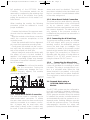
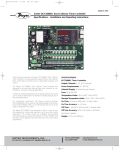
3/16″ I.D. tubing. The following subparagraphs describe the external switch connections. Refer to Figure 1 (above) for
switch connection illustration.
1.3 Pressure Module Installation
The pressure module is attached to the
Master Controller using integral connectors
on both units. The insertion ports for the
pressure module are located in the upper