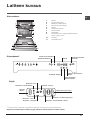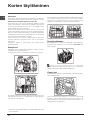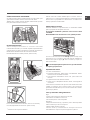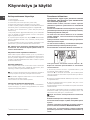
1
Operating instructions DISHWASHER EN NO SE Contents Product Fiche, 2 English,1 DA Dansk, 47 Norsk, 17 FI Suomi, 61 Svenska, 31 Precautions and advice, 3-4 General safety Disposal Saving energy and respecting the environment Installation, 5-6 Positioning and levelling Connecting the water and electricity supplies Advice regarding the first wash cycle Technical data Description of the appliance, 7 Overall view Control panel DFP 58B1 Loading the racks, 8-9 Lower rack Cutlery basket Upper rack Adjusting the upper rack Unsuitable crockery Start-up and use, 10 Starting the dishwasher Measuring out the detergent Wash cycles, 11 Table of wash cycles Special wash cycles and Options, 12 Rinse aid and refined salt, 13 Measuring out the rinse aid Measuring out the refined salt Care and maintenance, 14 Shutting off the water and electricity supplies Cleaning the dishwasher Preventing unpleasant odours Cleaning the sprayer arms Cleaning the water inlet filter Cleaning the filters Leaving the machine unused for extended periods Troubleshooting, 15 Product fiche EN Product Fiche Brand INDESIT Model DFP 58B1 Rated capacity in standard place settings (1) 13 Energy efficiency class on a scale from A+++ (low consumption) to D (high consumption) A+ Energy consumption per year in kWh (2) 295.0 Energy consumption of the standard cleaning cycle in kWh 1.04 Power consumption of the off-mode in W 0.5 Power consumption of the left-on mode in W 5.0 Water consumption per year in litres (3) 3080.0 Drying efficacy class on a scale from G (low efficacy) to A (high efficacy) A Programme time for standard cleaning cycle in minutes 190 The duration of the left-on mode in minutes 10 Noise in dB(A) Re 1pW 49 Built-in model No NOTES 1) The information on the label and fiche relates to the standard cleaning cycle, this programme is suitable to clean normally soiled tableware and it is the most efficient programme in terms of combined energy and water consumption. The standard cleaning cycle corresponds to the Eco cycle. 2) Based on 280 standard cleaning cycles using cold water fill and the consumption of the low power modes. Actual energy consumption depends on how the appliance is used. 3) Based on 280 standard cleaning cycles. Actual water consumption depends on how the appliance is used. 2 Precautions and advice This appliance was designed and manufactured in compliance with international safety standards The following information has been provided for safety reasons and should therefore be read carefully. Keep this instruction manual in a safe place for future reference. If the appliance is sold, given away or moved, please ensure the manual is kept with the machine. Please read these instructions carefully: they contain important information on installation, use and safety. This appliance is designed for domestic use or similar applications, for example: - staff kitchen areas in shops, offices and other work environments; - farmhouses; - use by guests in hotels, motels and other residential settings; - bed & breakfasts. General safety • The appliance should not be operated by people (including children) with reduced physical, sensory or mental capacities, or by inexperienced people who are not familiar with the product, unless supervision or instructions on how to use it are provided by someone who assumes responsibility for their safety. • An adult must supervise children at all times to prevent them from playing with the appliance. • The appliance was designed for domestic use inside the home and is not intended for commercial or industrial use. • The appliance must be used by adults only to wash domestic crockery in accordance with the instructions in this manual. • The appliance must not be installed outdoors, even in covered areas. It is extremely dangerous to leave the machine exposed to rain and storms. • Do not touch the appliance when barefoot. • When unplugging the appliance always pull the plug from the mains socket. Do not pull on the cable. • The water supply tap must be shut off and the plug should be removed from the electrical socket before cleaning or maintaining the appliance. • If the appliance breaks down, do not under any circumstances touch the internal parts in an attempt to perform the repair work yourself. • Do not lean or sit on the open door of the appliance: this may cause the appliance to overturn. • The door should not be left open as it may create a dangerous obstacle. • Keep detergent and rinse aid out of reach of children. • The packaging material should not be used as a toy for children. EN Disposal • Disposal of packaging material: observe local legislation so that the packaging may be reused. • The European Directive 2012/19/EU relating to Waste Electrical and Electronic Equipment (WEEE) states that household appliances should not be disposed of using the normal solid urban waste cycle. Exhausted appliances should be collected separately in order to optimise the re-using and recycling rate of the materials inside the machine, while preventing potential damage to the environment and public health. The crossed-out dustbin symbol is marked on all products to remind the owners of their obligations regarding separated waste collection. For further information relating to the correct disposal of household appliances, owners may contact the relevant public authority or the local appliance dealer. Saving energy and respecting the environment Saving water and energy • Only begin a wash cycle when the dishwasher is full. While waiting for the dishwasher to be filled, prevent unpleasant odours using the Soak cycle (see Wash cycles). • Select a wash cycle that is suited to the type of crockery and to the soil level of the crockery using the Table of wash cycles: - for dishes with a normal soil level use the Eco wash cycle, which ensures low energy/water consumption levels. - If the load is smaller than usual activate the Half Load option* (see Start-up and use). • If your electricity supply contract gives details of electricity-saving time bands, run wash cycles when electricity prices are lower. The Delayed Start button * (see Start-up and use) helps you organise the wash cycles accordingly. * Only available in selected models. 3 EN Phosphate-free and chlorine-free detergents containing enzymes • We strongly recommend that you use detergents that do not contain phosphates or chlorine, as these products are harmful to the environment. • Enzymes provide a particularly effective action at temperatures around 50°C. As a result detergents containing enzymes can be used in conjunction with low-temperature wash cycles in order to achieve the same results as a normal 65°C wash cycle. • To avoid wasting detergent, use the product in appropriate quantities based on the manufacturer’s recommendations, the hardness of the water, the soil level and the quantity of crockery to be washed. Even if they are biodegradable, detergents contain substances which may alter the balance of nature. 4 Installation If the appliance must be moved at any time, keep it in an upright position; if absolutely necessary, it may be tilted onto its back. Positioning and levelling 1. Remove the appliance from all packaging and check that it has not been damaged during transportation. If it has been damaged, contact the retailer and do not proceed any further with the installation process. The hose should not be bent or compressed. EN Connecting the water outlet hose Connect the outlet hose (without bending it) to a drain duct with a minimum diameter of 4 cm. The outlet hose must be at a height ranging from 40 to 80 cm from the floor / surface where the dishwasher rests (A). 2. Arrange the dishwasher so that its sides or back panel are in contact with the adjacent cabinets or the wall. This appliance can also be recessed under a single worktop* (see the Assembly Instruction sheet.) 3. Position the dishwasher on a level sturdy floor. If the floor is uneven, the front feet of the appliance should be adjusted until it reaches a horizontal position. If the appliance is levelled correctly, it will be more stable and much less likely to move or cause vibrations and noise while it is operating. 4*. To adjust the height of the rear foot, turn the red hexagonal bushing on the lower central part at the front of the dishwasher using a hexagonal spanner with an opening of 8 mm. Turn the spanner in a clockwise direction to increase the height and in an anticlockwise direction to decrease it (see Building-in Instruction sheet attached to the documentation.) Connecting the water and electricity supplies Connection to the water and electricity supplies should only be performed by a qualified technician. The dishwasher should not stand on the water hoses or electricity supply cable. The appliance must be connected to the water supply network using new hoses. Never use old or second hand hose sets. Do not reuse hose sets from any previously installed dishwasher. The water inlet and outlet hoses and the electricity supply cable may be positioned towards the right or the left in order to achieve the best possible installation. Connecting the water inlet hose • To a suitable cold water connection point: before attaching the hose, run the water until it is perfectly clear so that any impurities that may be present in the water do not clog the appliance; after performing this operation, screw the inlet hose tightly onto a tap with a ¾ gas threaded connection. • To a suitable hot water connection point: your dishwasher may be supplied with hot water from the mains supply (if you have a central heating system with radiators) provided that it does not exceed a temperature of 60°C. Screw the hose to the tap as described for connection to a cold water supply. If the inlet hose is not long enough, contact a specialist store or an authorised technician (see Assistance.) The water pressure must be within the values indicated in the Technical Data table (see adjacent information.) Before connecting the water outlet hose to the sink drain, remove the plastic plug (B). Anti-flooding protection To ensure floods do not occur, the dishwasher: - is provided with a special system which blocks the water supply in the event of anomalies or leaks from inside the appliance. Some models are also equipped with the supplementary safety device New Acqua Stop*, which guarantees anti-flooding protection even in the event of a supply hose rupture. WARNING: HAZARDOUS VOLTAGE! Under no circumstances should the water inlet hose be cut, as it contains live electrical parts. Electrical connection Before inserting the plug into the electrical socket, make sure that: • The socket is earthed and complies with current regulations. • the socket can withstand the maximum load of the appliance, which is indicated on the data plate located on the inside of the door (see Description of the appliance); • The power supply voltage falls within the values indicated on the data plate on the inside of the door. • The socket is compatible with the plug of the appliance. If this is not the case, ask an authorised technician to replace the plug (see Assistance); do not use extension cables or multiple sockets. Once the appliance has been installed, the power supply cable and the electrical socket should be easily accessible. The cable should not be bent or compressed. If the power supply cable is damaged, it must be replaced by the manufacturer or its Technical Assistance Service in order to prevent all potential hazards (see Assistance.) * Only available in selected models. 5 EN Anti-condensation strip* After installing the dishwasher, open the door and stick the adhesive transparent strip under the wooden shelf in order to protect it from any condensation which may form. Advice regarding the first wash cycle After the installation, remove the stoppers from the racks and the retaining elastic elements from the upper rack, if any. Immediately before the fist washing, completely fill the salt dispenser with water and add only then approximately 1 kg of salt (see chapter entitled Rinse aid and refined salt). The water may overflow: this is normal and is not a cause for concern. Select the water hardness value (see chapter entitled Rinse aid and refined salt). - After the salt has been poured into the machine, the LOW SALT indicator light* switches off. If the salt container is not filled, the water softener and the heating element may be damaged as a result. The machine has a buzzer/set of tones (depending on the dishwasher model) to inform the user that a command has been implemented: power on, cycle end etc. The symbols/indicator lights/LEDs on the control panel/ display may vary in colour and may have a flashing or fixed light (depending on the dishwasher model). The display provides useful information concerning the type of wash cycle, drying/wash-cycle phase, remaining time, temperature etc etc. Technical data Dimensions width 60 cm height 85 cm depth 60 cm Capacity 13 standard place-settings Water supply pressure 0,05 ÷ 1MPa (0.5 ÷ 10 bar) 7,25 – 145 psi Power supply voltage See appliance data plate Total absorbed power See appliance data plate Fuse See appliance data plate This dishwasher conforms to the following European Community Directives: -2006/95/EC (Low Voltage) -2004/108/EC (Electromagnetic Compatibility) -2009/125/EC (Comm. Reg. 1016/2010) (Ecodesign) -97/17/EC (Labelling) -2012/19/EU Waste Electrical and Electronic Equipment (WEEE) * Only available in selected models. 6 Description of the appliance Overall view EN Upper rack Upper sprayer arm Tip-up dispensers Rack height adjuster Lower rack Lower sprayer arm Washing filter Salt dispenser Detergent dispenser, rinse-aid dispenser and Active Oxygen device* Data plate Control panel*** 1. 2. 3. 4. 5. 6. 7. 8. 9. 10. 11. Control panel Select wash cycle button Button and indicator lights Start/Pause Display ON/OFF/Reset button Half load button Delayed start button Multi-functional tablets button (Tabs) Display Washing indicator light Rinse-aid indicator light Wash cycle number Salt indicator light Half load indicator light Drying indicator light Remaining time indicator Delayed start indicator light Multi-functional tablets indicator light (Tabs) ***Only in completely built-in models. * Only available in selected models. The number and type of wash cycles and options may vary depending on the dishwasher model. 7 Loading the racks EN Tips Before loading the racks, remove all food residues from the crockery and empty liquids from glasses and containers. No preventive rinsing is needed under running water. Arrange the crockery so that it is held in place firmly and does not tip over; and arrange the containers with the openings facing downwards and the concave/convex parts placed obliquely, thus allowing the water to reach every surface and flow freely. Make sure that the lids, handles, trays and frying pans do not prevent the sprayer arms from rotating. Place any small items in the cutlery basket. Since plastic dishes and non-stick frying pans usually retain more water drops, their drying will be not so good as that of ceramic or stainless-steel dishes. Lightweight items such as plastic containers should be placed in the upper rack and arranged so that they cannot move. After loading the appliance, make sure that the sprayer arms can rotate freely. Several dishwasher models are fitted with tip-up sectors*. They can be used in a vertical position when arranging dishes or in a horizontal position (lower) to load pans and salad bowls easily. Cutlery basket The basket is equipped with top grilles for improved cutlery arrangement. The cutlery basket should be positioned only at the front of the lower rack Lower rack The lower rack can hold pans, lids, dishes, salad bowls, cutlery etc. Large plates and lids should ideally be placed at the sides. Knives and other utensils with sharp edges must be placed in the cutlery basket with the points facing downwards or they must be positioned horizontally in the tip-up compartments on the upper rack Upper rack Load this rack with delicate and lightweight crockery such as glasses, cups, saucers and shallow salad bowls. Very soiled dishes and pans should be placed in the lower rack because in this sector the water sprays are stronger and allow a higher washing performance. Several dishwasher models are fitted with tip-up sectors*. They can be used in a vertical position when arranging tea/ dessert saucers or in a lower position to load bowls and food containers. *Only available in selected models with different numbers and positions. 8 Tip-up compartments with adjustable position The side tip-up compartments can be positioned at three different heights to optimize the arrangement of crockery inside the rack. Wine glasses can be placed safely in the tip-up compartments by inserting the stem of each glass into the corresponding slots. The upper rack can be adjusted for height based on requirements: high position to place bulky crockery in the lower rack and low position to make the most of the tip-up compartments/sectors by creating more space upwards. Adjusting the height of the upper rack In order to make it easier to arrange the crockery, the upper rack may be moved to a higher or lower position. The height of the upper rack should be adjusted WHEN THE RACK IS EMPTY. NEVER raise or lower the rack on one side only. Cutlery tray* Some dishwasher models are fitted with a sliding tray which can be used to hold serving utensils or small cups. For optimum washing performance avoid positioning bulky crockery directly below the tray. The cutlery tray can be removed (see Figure). If the rack is equipped with a Lift-Up device* (see figure), lift it up by holding its sides. To restore the lower position, press the levers (A) at the sides of the rack and follow the rack down. Unsuitable crockery • Wooden crockery and cutlery. • Delicate decorated glasses, artistic handicraft and antique crockery. Their decorations are not resistant. • Parts in synthetic material which do not withstand high temperatures. • Copper and tin crockery. • Crockery soiled with ash, wax, lubricating grease or ink. The colours of glass decorations and aluminium/silver pieces can change and fade during the washing process. Some types of glass (e.g. crystal objects) can become opaque after a number of wash cycles too. Damage to glass and crockery Caused by: Before loading the tray, make sure the supports are properly coupled to the upper rack (see Figure). • Type of glass and glass production process. • Chemical composition of detergent. • Water temperature of rinse cycle. Tips: • Only use glasses and porcelain guaranteed by the manufacturer as dishwasher safe. • Use a delicate detergent suitable for crockery. • Collect glasses and cutlery from the dishwasher as soon as the wash cycle is over. * Only available in selected models. 9 EN Start-up and use EN Starting the dishwasher Measuring out the detergent 1. Turn the water tap on. 2. Press the ON/OFF button. 3. Open the door and pour in a suitable amount of detergent A good wash result also depends on the correct amount of detergent being used. Exceeding the stated amount does not result in a more effective wash and increases environmental pollution. (see below). 4. Load the racks (see Loading the racks) and shut the door. 5. Select the wash cycle in accordance with the type of crockery and its soil level (see Table of wash cycles) by pressing the P button. 6. Select the wash options* (see Special wash cycles and options.) 7. Start the cycle by pressing the Start/Pause button: The wash indicator light goes on and the time left to the end of the cycle appears on the display together with the wash-cycle number. 8. At the end of the cycle, the display shows END. Switch off the appliance by pressing the ON/OFF button, shut off the water tap and unplug the appliance from the electricity socket. 9. Wait a few minutes before removing the crockery to avoid getting burnt. Unload the racks, beginning with the lower level. Based on how soiled the items are, the amount can be adjusted to individual cases using powder or liquid detergent. In the case of normally soiled items, use approximately either 35 gr (powder detergent) or 35 ml (liquid detergent). If tablets are used, one tablet will be enough. If the crockery is only lightly soiled or if it has been rinsed with water before being placed in the dishwasher, reduce the amount of detergent used accordingly. For good washing results also follow the instructions shown on the detergent box. For further questions please ask the detergent producers' Advice Offices. To open the detergent dispenser use the opening device “A”. - The machine will switch off automatically during long periods of inactivity in order to minimise electricity consumption. Changing a wash cycle in progress If a mistake was made in the wash-cycle selection process, it is possible to change the cycle provided that it has only just begun: Once the wash cycle has started, in order to change the wash cycle switch off the machine by pressing and holding the ON/ OFF/Reset button. Switch it back on using the same button and select the desired wash cycle and options. Adding extra crockery Press the Start/Pause button and open the door, taking care to avoid the escaping steam. Then place the crockery inside the dishwasher. Press the Start/Pause button: The cycle will start again after a long beep has been emitted. If the delayed start has been set, at the end of the countdown the wash cycle will not start. It will stay in Pause mode. Press the Start/Pause button to pause the machine; the wash cycle is stopped. At this stage the wash cycle cannot be changed. Accidental interruptions If the door is opened during the wash cycle or there is a power cut, the cycle stops. It starts again from the point at which it was interrupted once the door has been shut or the electricity supply restored. Introduce the detergent into the dry dispenser “B” only. Place the amount of detergent for pre-washing directly inside the tub. 1. When measuring out the detergent refer to the Table of wash cycles to add the proper quantity. Compartment B comprises a level showing the maximum quantity of liquid or powder detergent that can be added to each cycle. 2. Remove detergent residues from the edges of the dispenser and close the cover until it clicks. 3. Close the lid of the detergent dispenser by pulling it up until the closing device is secured in place. The detergent dispenser automatically opens up at the right time according to the wash cycle. If all-in-one detergents are used, we recommend using the TABS option, because it adjusts the cycle so that the best washing and drying results are always achieved. Only use detergent which has been specifically designed for dishwashers. DO NOT USE washing-up liquid. Using excessive detergent may result in foam residue remaining in the machine after the cycle has ended. The use of tablets is only recommended for models which offer the MULTI-FUNCTIONAL TABLETS option. * Only available in selected models. 10 To achieve the best results from each washing and drying cycle, powder detergent, liquid rinse aid and salt should be used. Wash cycles Wash-cycle data is measured under laboratory conditions according to European Standard EN 50242. Based on the different conditions of use, the wash-cycle duration and data can change. EN The number and type of wash cycles and options may vary depending on the dishwasher model. Drying Options Wash Cycle Duration Water Consumption (l/cycle) Energy Consumption (kWh/cycle) 1. Eco Yes Delayed start – Tabs – Half Load 03:10’ 11,0 1,04 2. Intensive Yes Delayed start – Tabs – Half Load 02:30’ 16,5 1,65 3. Normal Yes Delayed start – Tabs – Half Load 02:00’ 16,0 1,30 4. Sixty No Delayed start – Tabs – Half Load 01:00 11,5 1,1 5. Delicates Yes Delayed start – Tabs – Half Load 01:30’ 12,0 1,10 6. Rapid No Delayed start – Tabs 00:30’ 8,5 0,45 7. Prewash No Delayed start – Half Load 00:10’ 4,0 0,01 8. Hygiene Yes Delayed start 01:20’ 11,5 1,3 Wash Cycle Instructions on wash-cycle selection and detergent dosage 1. The ECO wash cycle is the standard cycle to which the energy label data refers. It can be used to wash crockery with a normal soil level and is the most efficient cycle in terms of energy and water consumption for this type of crockery. 27 gr/ml + 6 gr/ml** – 1 Tab (**Quantity of pre-washing detergent) 2. Heavily soiled dishes and pans (not to be used for delicate items). 30 gr/ml – 1 Tab 3. Normally soiled pans and dishes. 27 gr/ml + 6 gr/ml** – 1 Tab 4. Limited quantity of daily soiling (ideal for 4 place settings) 25 gr/ml – 1 Tab 5. Cycle for delicate items, which are more sensitive to high temperatures 30 gr/ml – 1 Tab 6. Fast cycle to be used for slightly dirty dishes (ideal for 2 place settings) 25 gr/ml – 1 Tab 7. Pre-wash while awaiting completion of the load with the dishes from the next meal. No detergent. 8. High-temperature disinfecting cycle. Ideal to clean crockery and feeding bottles. 30 gr/ml – 1 Tab Standby consumption: Left-on mode consumption: 5,0 W - Off mode consumption: 0.5 W 11 Special wash cycles and Options EN Notes: Optimum performance levels when using the “Rapid” and “Sixty” cycles can be achieved by respecting the specified number of place settings. To reduce consumption even further, only run the dishwasher when it is full. Note for Test Laboratories: for information on comparative EN testing conditions, please send an email to the following address: [email protected] Wash options* The OPTIONS may only be set, changed or reset after the wash cycle has been selected and before the Start/ Pause button has been pressed. Only the options which are compatible with the type of wash cycle set may be selected. If an option is not compatible with the selected wash cycle (see Table of wash cycles), the corresponding symbol flashes rapidly 3 times. If an option is selected which is not compatible with another (previously selected) option, it will flash 3 times and switch off, while the most recently selected option will remain active. To deselect an option which has been set by mistake, press the corresponding button again. Delayed start It is possible to delay the start time of the cycle by a period of time between 1 and 24 hours: 1. Select the desired wash cycle and any other options required; press the DELAYED START button. The indicator light will go on. Use the same button to select when the wash cycle will start (h01, h02 etc.) 2. Confirm the selection using the START/PAUSE button to start the countdown. 3. Once this time has elapsed, the DELAYED START indicator light goes off and the wash cycle begins. To deselect the DELAYED START option, press the DELAYED START button until the text OFF appears. The Delayed Start function cannot be set once a wash cycle has started. 12 Multi-functional tablets This option optimises washing and drying results. When using multi-functional tablets, press the MULTIFUNCTIONAL TABLETS button, the indicator light will illuminate. The “Multi-functional tablets” option results in the lengthening of the wash cycle. The use of tablets is only recommended when the MULTI-FUNCTIONAL TABLETS option is available. This option is not recommended for use with wash cycles which do not specify the use of multi-functional tablets. Half load If there are not many dishes to be washed, a half load cycle may be used in order to save water, electricity and detergent. Select the wash cycle and press the HALF LOAD button: the indicator light will illuminate. Press the HALF LOAD button to deselect this option. Remember to halve the amount of detergent. Rinse aid and refined salt Only use products which have been specifically designed for dishwashers. Do not use table/industrial salt or washing-up liquid. Follow the instructions given on the packaging. If using a multi-functional product it is not necessary to add any rinse aid. However, we recommend that you add salt, especially if you live in an area where the water is hard or very hard. (Follow the instructions given on the packaging). If you do not add salt or rinse aid, the LOW SALT* and LOW RINSE AID indicator lights will stay lit. Measuring out the rinse aid Rinse aid makes it easier for the crockery to dry, as water runs off the surfaces more readily and therefore does not leave streaks or marks. The rinse aid dispenser should be filled: • When the LOW RINSE AID indicator light* on the control panel is illuminated, a reserve supply of rinse aid is still available for 1-2 cycles; hardness level in your area. Ask your local water supplier for this information. - Switch on the dishwasher using the ON/OFF button, wait a few seconds and switch it off using the ON/OFF button. Hold down the Start/Pause button for min. 3 seconds; switch on the machine using the ON/OFF button and access the adjustment menu - the salt indicator light is lit. - Select the desired level (1 to 5* max. based on the dishwasher model) using the P button (water softener set to medium level). Press the ON/OFF button to save the setting. Even if using multi-functional tablets, fill the salt dispenser. Water Hardness Table level 1 2 3 4 5* °dH 0-6 6 - 11 12 - 17 17 - 34 34 - 50 °fH 0 - 10 11 - 20 21 - 30 31 - 60 61 - 90 mmol/l 0-1 1,1 - 2 2,1 - 3 3,1 - 6 6,1 - 9 Average salt dispenser capacity duration** months 7 months 5 months 3 months 2 months 2/3 weeks For values between 0°f and 10°f, we do not recommend the use of salt. * a setting of 5 may increase cycle duration. ** 1 wash cycle per day. MA X (°dH = hardness measured in German degrees - °f = hardness measured in French degrees – mmol/l = millimoles per litre) Measuring out the refined salt 1. Open the dispenser “D” by pressing and pulling up the tab on the lid; 2. Carefully introduce the rinse aid as far as the maximum reference notch of the filling space - avoid spilling it. If this happens, clean the spill immediately with a dry cloth. 3. Press the lid down until you hear a click to close it. NEVER pour the rinse aid directly into the appliance tub. Rinse-aid quantity setting If you are not completely satisfied with the drying results, you can adjust the quantity of rinse aid. Switch on the dishwasher using the ON/OFF button, wait a few seconds and switch it off using the ON/OFF button Press the Start/Pause button 3 times; switch on the machine using the ON/OFF button and access the adjustment menu - the rinse-aid indicator light is lit (set to factory level). Select the level of rinse-aid supply using the P wash-cycle button P. (0 to 4 max.) Press the ON/OFF button to save the setting. If the rinse-aid level is set to ZERO, no rinse aid will be supplied. The LOW RINSE AID indicator light will not go on if you run out of rinse aid. • If there are streaks on the crockery, set a low number (1-2). • If there are drops of water or limescale marks, set a high number (3-4). Setting water hardness Every dishwasher is equipped with a water softener which, by using refined salt designed specially for this type of appliance, supplies water without limescale which is then used to wash the crockery. This dishwasher has a setting that helps reduce pollution and optimises washing performance in accordance with the water In order to obtain the best possible results from a wash cycle, make sure that the salt dispenser is never empty. Refined salt removes limescale from the water, thus avoiding the formation of deposits on crockery. The salt dispenser is located in the lower part of the dishwasher (see Description) and should be filled: • When the green float* cannot be seen by simply looking at the cap of the salt dispenser; • When the LOW RINSE AID indicator light on the control panel is illuminated *; 1. Remove the lower rack and unscrew the cap (anticlockwise). 2. The first time you do this: fill the water tank right up to its edge. 3. Position the funnel* (see figure) and fill the salt dispenser up to the edge (approximately 1 kg). It is normal for a little water to leak out. 4. Remove the funnel* and wipe any salt residues away from the opening; rinse the cap under running water and then screw it on, the head facing downwards so as to let the water flow out of the four slots (star-shaped arrangement) in the lower part of the cap (cap with green float*). It is advisable to perform this procedure every time you add salt to the dispenser. Make sure the cap is screwed on tightly so that no detergent can get into the container during the wash cycle (this could damage the water softener beyond repair). When necessary, measure out the salt before a wash cycle so that any saline solution which has leaked out of the salt dispenser is removed. * Only available in selected models. 13 EN Care and maintenance EN Shutting off the water and electricity supplies • Turn off the water tap after every wash cycle to avoid leaks. • Always unplug the appliance when cleaning it and when performing maintenance work. Cleaning the dishwasher • The external surfaces of the machine and the control panel can be cleaned using a non-abrasive cloth which has been dampened with water. Do not use solvents or abrasive products. • Any marks on the inside of the appliance may be removed using a cloth dampened with water and a little vinegar. Preventing unpleasant odours • Always keep the door of the appliance ajar in order to avoid moisture from forming and being trapped inside the machine. • Clean the seals around the door and detergent dispensers regularly using a damp sponge. This will avoid food becoming trapped in the seals, which is the main cause behind the formation of unpleasant odours. Cleaning the filters The filter assembly consists of three filters which remove food residues from the washing water and then recirculate the water. They should be cleaned if you wish to achieve the best results in every wash. Clean the filters regularly. The dishwasher should not be used without filters or if the filter is loose. • After several washes, check the filter assembly and if necessary clean it thoroughly under running water, using a non-metallic brush and following the instructions below: 1. Turn the cylindrical filter C in an anti-clockwise direction and pull it out (fig. 1). 2. Remove the cup filter B by exerting a slight pressure on the side flaps (fig. 2); 3. Slide out the stainless-steel plate filter A. (fig. 3). 4. Inspect the trap and remove any food residues. NEVER REMOVE the wash-cycle pump protection (black detail) (fig.4). Cleaning the sprayer arms Food residue may become encrusted onto the sprayer arms and block the holes used to spray the water. It is therefore recommended that you check the arms from time to time and clean them with a small non-metallic brush. The two sprayer arms may both be removed. To remove the upper sprayer arm, turn the plastic locking ring in an anti-clockwise direction. The upper sprayer arm should be replaced so that the side with the greater number of holes is facing upwards. The lower sprayer arm can be removed by pressing on the side tabs and pulling it upwards. After cleaning the filters, re-place the filter assembly and fix it in position correctly; this is essential for maintaining the efficient operation of the dishwasher. Leaving the machine unused for extended periods Cleaning the water inlet filter* If the water hoses are new or have not been used for an extended period of time, let the water run to make sure it is clear and free of impurities before performing the necessary connections. If this precaution is not taken, the water inlet could become blocked and damage the dishwasher. Clean the water inlet filter at the tap outlet regularly. - Turn off the water tap. - Unscrew the end of the water inlet hose, remove the filter and clean it carefully under running water. - Re-place the filter and screw the water hose back into position. 14 • Disconnect the appliance from the electricity supply and shut off the water tap. • Leave the door of the appliance ajar. • When you return, run a wash cycle when the dishwasher is empty. * Only available in selected models. Troubleshooting Whenever the appliance fails to work, check for a solution from the following list before calling for Assistance. Problem: Possible causes / Solutions: The dishwasher does not start or cannot be controlled. • Switch off the appliance by pressing the ON/OFF button, switch it back on after approximately one minute and reset the program. • The appliance has not been plugged in properly. • The dishwasher door has not been shut properly. The door won’t close. • The lock was released. Strongly push the door until a “clacking” noise is heard. The dishwasher makes excessive noise. • The dishwasher cycle has not yet finished. • The water inlet hose is bent (see Installation). • The drain duct is blocked. • The filter is clogged up with food residues. • The dishes are rattling against each other or against the sprayer arms. • Excessive foam presence: the detergent has not been measured out correctly or it is not suitable for use in dishwashers. (see Start-up and use). The dishes and glasses are covered in a white film or limescale deposits. • The level of the refined salt is low or the dosage setting is not suited to the hardness of the water (see Rinse aid and salt). • The lid on the salt dispenser is not closed properly. • The rinse aid has been used up or the dosage is too low. The dishes and glasses are streaked or have a bluish tinge. • The rinse aid dosage is too high. The crockery has not been dried properly. • A wash cycle without a drying programme has been selected. • The rinse aid has been used up or the dosage is too low (see Rinse aid and salt). • The rinse aid dispenser setting is not high enough. • The crockery is made from non-stick material or plastic. No water drains out from the dishwasher. The dishes are not clean. The dishwasher does not take any water in - Tap shut-off alarm. (indicator light ON/OFF flashing; H2O displayed; F 6 appears after a few seconds). EN • The racks are overloaded (see Loading the racks). • The crockery has not been arranged well. • The sprayer arms cannot move freely. • The wash cycle is too gentle (see Wash cycles). • Excessive foam presence: the detergent has not been measured out correctly or it is not suitable for use in dishwashers. (see Start-up and use). • The lid on the rinse aid compartment has not been shut correctly. • The filter is dirty or blocked (see Care and maintenance). • The refined salt level is low (see Rinse aid and salt). • There is no water in the mains supply. • The water inlet hose is bent (see Installation.) • Turn on the tap and the appliance will start after a few minutes. • The appliance stopped because no action was taken when the beep sounded*. Switch off the machine using the ON/OFF button, turn on the tap and switch the machine back on after a few seconds by pressing the same button. Re-program the appliance and restart the wash cycle. * Only available in selected models. 15 EN 16 Bruksanvisning OPPVASKMASKIN NO Norsk, 17 Innholdsfortegnelse Forholdsregler, nyttige råd og service, 1819 Generelle sikkerhetsregler Avfallsbehandling Energisparing og miljøhensyn Service Installasjon, 20-21 Plassering og avvatring. Vann- og strømtilkoblinger Tekniske data Anvisninger for første gangs vask Beskrivelse av apparatet, 22 Oversikt Betjeningspanel DFP 58B1 Fylle kurvene, 23-24 Underkurv Bestikkurv Overkurv Bestikkskuff Justering av overkurv Servise som ikke er egnet for maskinvask Start og bruk, 25 Starte oppvaskmaskinen Fylle på oppvaskmiddel Programmer, 26 Programtabell Spesielle programmer og tilleggsfunksjoner, 27 Glansemiddel og regenereringssalt, 28 Fylle på glansemiddel Fylle på regenereringssalt Vedlikehold og ettersyn, 29 Koble fra vann og strøm Rengjøre oppvaskmaskinen Unngå dårlig lukt Rengjøre spylearmene Rengjøring av vanninntakets filter Rengjøre filtrene Hvis du reiser bort Feil og feilretting, 30 Forholdsregler, nyttige råd og service NO Apparatet er utviklet og fremstilt i overensstemmelse med de internasjonale sikkerhetsstandarder. Disse forholdsreglene gis av sikkerhetsmessige årsaker og må leses nøye. Det er viktig at du tar godt vare på håndboken, slik at du har den for hånden når du trenger den. Ved eventuelt salg, overdragelse eller flytting, må man forsikre seg om at håndboken følger med maskinen. Les anvisningene nøye: Her finnes viktig informasjon om installasjon, bruk og sikkerhet. Dette apparatet er prosjektert for husholdningsbruk eller lignende, for eksempel: - kjøkken som brukes av personalet i butikker, kontorer og andre arbeidsmiljøer; - feriekolonier; - for kunder på hoteller, moteller og andre overnattingssteder; - bed and breakfast. Generelle sikkerhetsregler • Dette husholdningsapparatet skal ikke benyttes av personer (inkludert barn) med reduserte fysiske, sensoriske eller mentale evner, personer som ikke har erfaring eller kunnskap om produktet med mindre de overvåkes eller har mottatt anvisninger om bruk av apparatet av en person som er ansvarlig for sikkerheten deres. • En voksen må uansett passe på, slik at barn ikke leker med husholdningsapparatet. • Apparatet er ment for ikke-profesjonelt bruk i en alminnelig husholdning. • A p p a r a t e t s k a l k u n b e n y t t e s t i l husholdningsoppvask. Det skal kun brukes av voksne, og i overensstemmelse med anvisningene i denne håndboken. • Apparatet må ikke installeres utendørs, selv ikke dersom området er beskyttet, fordi det er veldig farlig å utsette det for regn og uvær. • Rør ikke oppvaskmaskinen når du er barbeint. • Ikke trekk i kabelen når du skal ta støpselet ut av stikkontakten, men ta godt tak i støpselet. • Det er nødvendig å stenge av vannkranen og trekke støpselet ut av stikkontakten før rengjøring og vedlikehold utføres på maskinen. • Oppstår det en feil, må du aldri prøve å reparere de innvendige mekanismene. • Ikke len deg eller sett deg på den åpne døren: apparatet kan velte. • La ikke døren bli stående åpen, man kan snuble i den. • Oppvaskmiddelet og glansemiddelet skal oppbevares utilgjengelig for barn. • Emballasjen er ikke leketøy for barn. 18 Avfallsbehandling • Håndtering av emballasjen: Følg de lokale forskrifter slik at emballasjen kan gjenvinnes. • Det europeiske direktivet 2012/19/EØF om avfallsbehandling av elektriske og elektroniske apparater (RAEE), foreskriver at hvitevarer ikke kastes sammen med vanlig husholdningsavfall. Brukte apparater skal samles inn separat, slik at man oppnår økt gjenbruk og gjenvinning av materialene de består, og for å unngå mulige skadevirkninger på helse og miljø. Søppelkurvsymbolet med kryss over finnes på alle produktene for å minne om kravet om separat innsamling. For ytterligere opplysninger om korrekt avfallsbehandling av hvitevarer, kan man henvende seg til det lokale renholdsverket eller til forhandlerne. Energisparing og miljøhensyn Spare vann og energi • Sett i gang oppvaskmaskinen først når den er helt full. I påvente av at oppvaskmaskinen blir full, kan du unngå at det dannes dårlig lukt ved å kjøre en bløtleggingssyklus (se Programmer). • Velg et program som er egnet for serviset som skal vaskes og etter hvor skittent det er ved hjelp av Programtabellen: - For normalt skitten oppvask, bruk programmet Eco, som har lavt strøm- og vannforbruk. - Hvis det er lite som skal vaskes, kan du bruke funksjonen Halvfull maskin* (se Start og bruk). • Hvis energiselskapet ditt har lavere strømpriser på visse tider av døgnet, bør du bruke oppvaskmaskinen når det er billigst. Funksjonen Utsatt start* (se Start og bruk) kan i så fall være til god hjelp. Fosfat- og klorfrie oppvaskmidler med enzymer • Det anbefales på det sterkeste å bruke fosfatog klorfrie oppvaskmidler som er de mest miljøvennlige. • Enzymene har spesielt god effekt ved temperaturer rundt 50 °C. Det gjør at man kan innstille lavere vasketemperaturer og allikevel få de samme resultatene som ved 65 °C. • Dosere oppvaskmiddelet etter produsentens anvisninger, vannets hardhet, hvor skittent serviset er og hvor full maskinen er, slik at du unngår sløsing. Selv om vaskemidlene er biologisk nedbrytbare, inneholder de stoffer som endrer naturens balanse. Service NO Før du kontakter Teknisk assistanse: • Sjekk om du kan løse feilen selv (se Feil og feilretting). • Start programmet på nytt for å se om problemet er blitt løst. • I motsatt fall, kontakt et autorisert Servicesenter. Henvend deg aldri til uautoriserte teknikere. Oppgi: • type feil • maskinmodell (Mod.) • serienummer (S/N). Disse opplysningene finner du på merkeskiltet som sitter på apparatet (se Beskrivelse av apparatet). * Finnes kun i enkelte modeller. 19 Installasjon NO Hvis maskinen må flyttes, må den holdes i loddrett stilling. Om nødvendig kan den vippes bakover. Plassering og avvatring. 1. Ta av emballasjen og kontrollere at maskinen ikke har blitt påført skader under transporten. Hvis den er skadet, må du ikke koble den til, men kontakte forhandleren. Tilkobling av vannavløpsslangen Koble avløpsslangen til et avløpsrør med en diameter på minst 4 cm, uten å bøye den. Avløpsrøret skal festes i en høyde av mellom 40 og 80 cm fra gulvet eller oppvaskmaskinens bæreflate (A). 2. Plassere oppvaskmaskinen slik at sidene eller baksiden står inntil møblene ved siden av eller veggen. Oppvaskmaskinen kan også bygges inn under en hel arbeidsbenk * (se Monteringsarket). 3. Plassere vaskemaskinen på et flatt og hardt gulv. Rett opp eventuelle ujevnheter ved å skru bena ut eller inn til maskinen står helt vannrett. En nøyaktig avvatring gjør at maskinen står stødig og forhindrer vibrasjoner, støy og bevegelser. 4.*. For å justere høyden på støttebenet bak, vri den røde sekskantede bøssingskruen på undersiden, foran, midt på oppvaskmaskinen med en 8 mm unbrakonøkkel. Vri med urviseren for å øke høyden og mot urviseren for å minske den. (se vedlagte ark med anvisninger for innbygging) Vann- og strømtilkoblinger Tilpasningen av det elektriske og det hydrauliske anlegget for installasjonen må bare utføres av kyndig personale. Oppvaskmaskinen må ikke hvile på slangene eller på strømledningen. Apparatet må kobles til vannforsyningsnettet med nye slanger. Gamle slanger skal ikke brukes på nytt. Vanninntaksslangen, avløpsslangen og strømledningen kan vris til høyre eller venstre for enklere installasjon. Tilkobling av vanninntaksslangen • Til et kaldtvannsuttak: Skru inntaksslangen godt til en stengekran med 3/4" gjenget munnstykke. Før du skrur den på skal du la vannet renne til ser klart ut, slik at eventuelle urenheter ikke stopper til oppvaskmaskinen. • T i l e t v a r m t v a n n s u t t a k : H v i s d u e r t i l k o p l e t e t sentralvarmeanlegg, kan oppvaskmaskinen forsynes med varmtvannet fra anlegget såfremt temperaturen ikke overstiger 60 °C. Skru slangen fast til kranen som beskrevet for kaldtvannsuttaket. Dersom vanninntaksslangen ikke er lang nok, må du henvende deg til en spesialforhandler, eller en autorisert tekniker (se Service). Vanntrykket må ligge mellom de verdiene som er oppgitt i tabellen for tekniske data (se ved siden av). Pass på at røret ikke bøyes eller klemmes. 20 Før du kobler avløpsslangen til vaskens vannlås, må du fjerne plastdekselet (B). Vannsikring For å sikre seg mot oversvømmelse: - er oppvaskmaskinen utstyrt med en funksjon som stanser vanninntaket dersom det har oppstått en feil eller innvendige lekkasjer. Noen modeller er utstyrt med en ekstra sikkerhetsanordning New Acqua Stop*, som beskytter mot oversvømmelse også hvis tilførselsslangen går i stykker. ADVARSEL: FARLIG SPENNING! Vanninntaksslangen må aldri skjæres av, da den inneholder deler som er under spenning. Strømtilkobling Forsikre deg om følgende før du setter støpselet inn i stikkontakten: • stikkontakten er jordet og i samsvar med gjeldende lover • kontakten tåler maskinens toppbelastning, som er angitt på merkeskiltet som sitter på innsiden av døren (se kapittelet Beskrivelse av oppvaskmaskinen) • nettspenningen ligger innenfor verdiene som er angitt på merkeskiltet som sitter på innsiden av døren • stikkontakten passer til apparatets støpsel. I motsatt fall, få en godkjent tekniker til å skifte ut støpselet (se Service). Ikke bruk skjøteledninger eller grenuttak. Når apparatet er installert skal strømledningen og stikkontakten være lett tilgjengelige. Ledningen må ikke bøyes eller komme i klem. Hvis strømledningen er ødelagt, skal den byttes ut av fabrikanten eller av et autorisert Servicesenter, slik at man unngår enhver risiko. (se Service) Produsenten fraskriver seg ethvert ansvar dersom disse forskriftene ikke overholdes. Selvklebende bånd for å forhindre kondens* Når oppvaskmaskinen har blitt bygget inn, åpner du døren og limer det gjennomsiktige tapebåndet fast under treplaten for å beskytte den mot eventuell kondens. Anvisninger for første gangs vask Når apparatet er installert, fjerner du stopperne som sitter på kurvene og stroppene som holder overkurven (hvis disse finnes). Før første vask, skal du fylle saltbeholderen full med vann og deretter helle i ca. 1 kg regenereringssalt (se kapittelet Glansemiddel og regenereringssalt) : Det er normalt at vannet renner over. Velg vannets hardhetsgrad (se kapittelet Glansemiddel og regenereringssalt ). Når du har fylt saltbeholderen, slukker varsellampen MANGEL PÅ SALT* . Hvis man ikke fyller saltbeholderen, kan det føre til skader på vannmyknerenheten og varmeelementet. Oppvaskmaskinen er utstyrt med et system som (avhengig av maskinmodellen) varsler med lydsignal/-toner at: maskinen er startet, syklusen er avsluttet osv. Symbolene/kontrollampene på kontrollpanelet/displayet kan ha forskjellige farger, og blinke eller lyse fast. (avhengig av maskinmodellen). Displayet viser nyttige informasjoner om hvilken type program som er lagt inn, om vaske-/tørkefasen, resttid, temperatur osv. Tekniske data Mål Kuverter Bredde cm 60 Høyde cm 85 Dybde cm 60 13 standardkuverter Tilførselstrykk 0,05 ÷ 1MPa (0,5 ÷ 10 bar) 7,25 – 145 psi Nettspenning se merkeskiltet Totalt strømopptak se merkeskiltet Sikring se merkeskiltet Dette apparatet er i overensstemmelse med følgende fellesskapsdirektiver: -2006/95/EF (Lavspenning) -2004/108/EF (Elektromagnetisk kompatibilitet) -2009/125/EF (Komm. forord. 1016/2010) (Miljøvennlig design) -97/17/EF (Merking) -2012/19/EU (EE-avfall) * Finnes kun i enkelte modeller. 21 NO Beskrivelse av apparatet NO Oversikt 1. Overkurv 2. Øvre spylearm 3.Kopphyller 4. Innstillingsmekanisme for kurvhøyde 5.Underkurv 6. Nedre spylearm 7.Vaskefilter 8.Saltbeholder 9. Beholdere for vaskemiddel, glansemiddel og Active Oxigen-utstyr* 10. Merkeskilt 11. Betjeningspanel*** Betjeningspanel Tast for programvalg On/Off/Reset-tast Display Tast for halvfull maskin Tast og kontrollampe for Start/pause Tast for utsatt start Tast for "all-in-1" oppvasktabletter - tabs Display Kontrollampe for vask Varsellampe for glansemiddel Kontrollampe for tørking Programnummer Varsellampe for salt Kontrollampe for halvfull maskin Indikasjon for gjenstående tid Kontrollampe for utsatt start Kontrollampe for "all-in-1" oppvasktabletter - tabs ***Bare på helintegrerte modeller *Finnes kun i enkelte modeller. Antall og type programmer samt tilleggsfunksjoner varierer iht. oppvaskmaskinmodellen. 22 Fylle kurvene Tips Før du setter serviset inn i maskinen, må du fjerne alle matrester og tømme glassene og koppene. Det er ikke nødvendig å skylle oppvasken under springen. Plassere serviset slik at det står støtt og ikke velter. Bokser og beholdere plasseres med åpningen ned, og buede gjenstander plasseres sidelengs slik at vannet når alle flater og kan renne av. Pass på at spylearmene ikke hindres av lokk, håndtak, stekepanner og fat. Legg små gjenstander i bestikkurven. Plastservise og stekepanner med slipp-lett belegg har en tendens til å holde på vanndråpene. De tørker derfor ikke like godt som keramikk- eller stålservise. Lette gjenstander, som f.eks. plastbokser, skal helst plasseres i overkurven og legges slik at de ikke beveger på seg. Etter at oppvasken er satt inn, må du sjekke at spylearmene roterer fritt. Underkurv Noen modeller er utstyrt med nedfellbare støtter*. Disse kan brukes enten i loddrett stilling til tallerkener, eller i vannrett (nedfelt) stilling til gryter og salatboller. Bestikkurv Bestikkurven er forsynt med rist som holder bestikket fra hverandre. Denne skal kun plasseres foran i underkurven. I underkurven kan du plassere gryter, lokk, tallerkener, salatboller, bestikk, osv. Store tallerkener og lokk skal helst plasseres ytterst på kurvens sider. Kniver og spisse redskaper må settes i bestikkurven med spissene ned, eller legges horisontalt på kopphyllene i overkurven. Overkurv For skjørt og lett servise: glass, kopper, asjetter, lave salatboller. For best mulig resultat, anbefaler vi at svært skitne deler av serviset plasseres i underkurven hvor vannspruten er kraftigst. Noen modeller er utstyrt med nedfellbare deler* som kan brukes enten i loddrett stilling til asjetter eller desserttallerkener, eller felles ned til boller og oppbevaringsbokser. *Finnes kun i enkelte modeller, i forskjellig antall og plassering. 23 NO NO Justerbare kopphyller Kopphyllene på siden kan settes i tre forskjellige stillinger slik at plassen i kurven utnyttes optimalt. Stettglass kan festes i kopphyllene ved å skyve stetten inn i åpningene i kopphyllene. Overkurven kan høydejusteres etter behov: i høy stilling når man har behov for å sette inn store deler, i lav stilling slik at man får større høyde og på denne måten kan utnytte plassen på kopphyllene eller i de nedfellbare ristene. Justere høyden på overkurven For å gjøre det enklere å plassere oppvasken, kan overkurven settes i høy eller lav stilling. Du bør bare justere kurvhøyden når KURVEN ER TOM. Kurven må ALDRI løftes eller senkes på bare én side. Bestikkskuff* Noen maskinmodeller har en skyvbar bestikkskuff for serveringsbestikk eller små kopper. For å få best mulig resultat bør du unngå å legge store ting under denne skuffen. Bestikkskuffen kan tas ut. (se figuren) Hvis kurven er utstyrt med Lift-Up* (se figuren), tar du tak i kurvens sider og hever den. For å flytte kurven ned, trykker du på utløserne (A) på siden av kurven og senker den. Når overkurven står i øverste stilling, kan ikke kopphyllene settes loddrett. Servise som ikke er egnet for maskinvask • Trebestikk og -servise • Skjøre dekorerte glass, brukskunst og antikviteter. Dekorasjonene tåler ikke maskinvask. • Deler av syntetisk materiale som ikke tåler høy temperatur. • Kobber- og tinnservise. • Deler som er tilsølt med aske, stearin, smørefett eller blekk. Glassdekorasjoner, deler av aluminium og sølv kan endre farge og blekne når de vaskes i maskin. Enkelte typer glass, f.eks krystallgjenstander, kan bli matte hvis de maskinvaskes ofte. Kontrollere at støttene er skikkelig festet til overkurven før du fyller bestikkskuffen. (se figuren) Skader på glass og servise Årsaker: • Glasstypen og hvordan glasset er fremstilt. • Vaskemiddelets kjemiske sammensetning. • Skyllevannets temperatur. Råd: • Bruk kun glass og porselen som fabrikanten garanterer tåler oppvaskmaskin. • Bruk et mildt oppvaskmiddel. • Ta glass og bestikk ut av oppvaskmaskinen så fort som mulig når programmet er ferdig. * Finnes kun i enkelte modeller. 24 Start og bruk Starte oppvaskmaskinen 1. Åpne vannkranen. 2. Trykk på tasten ON/OFF: 3. Åpne døren og ha i riktig mengde vaskemiddel (se nedenfor). 4. Legg oppvasken i kurvene (se Fylle kurvene) og lukk døren. 5. Velg program etter hva som skal vaskes og hvor skittent det er (se programtabellen) ved å trykke på tasten P. 6. Velg vaskefunksjonene* (se Tilleggsfunksjoner og Spesielle programmer). 7. Start programmet ved å trykke på tasten Start/ Pause. Kontrollampen for vasking tennes og displayet viser hvor lang tid som gjenstår til syklusen er slutt. 8. Når programmet er slutt, viser displayet END. Slå av maskinen ved å trykke på ON/OFF-tasten, steng vannkranen og trekk støpselet ut av stikkontakten. 9. Vent noen minutter før du tar ut oppvasken, slik at du ikke brenner deg. Ta oppvasken ut av kurvene. Start med å tømme den nederste kurven. - Noen ganger - når maskinen IKKE blir brukt på en lang stund - slår maskinen seg automatisk av. På denne måten reduseres strømforbruket. Fylle på oppvaskmiddel Et godt vaskeresultat avhenger også av en riktig dosering av oppvaskmiddelet. Å ha i for mye, er ikke ensbetydende med et godt resultat, og forurenser miljøet. Mengden av oppvaskmiddel, enten det er pulver eller flytende, kan avpasses i hvert tilfelle etter hvor skittent serviset er. Til normalt skittent servise bruker man vanligvis ca. 35 g (pulver) eller 35 ml (flytende). Hvis man brukes tabletter, er det nok med én. Hvis oppvasken er lite skitten eller har blitt skylt av først, kan du reduser mengden oppvaskmiddel en god del. For best mulig resultat, bør du også lese anvisningene på vaskemiddelpakningen. Har du flere spørsmål, anbefaler vi at du kontakter vaskemiddelleverandørens kundeservice. Trykk på åpningsmekanismen "A" for å åpne vaskemiddelskuffen. Endre et vaskeprogram som er i gang Hvis du har valgt feil vaskeprogram, kan du endre det hvis det nettopp har startet: Hvis oppvaskmaskinen allerede er i gang, må man slå den av for å endre vaskesyklusen ved å trykke lenge på ON/OFF/Reset-tasten. Slå så maskinen på igjen med den samme tasten og velg program og ønskede tilleggsfunksjoner. Sette inn mer oppvask. Trykk på Start/Pause-tasten, åpne døren - pass deg for dampen som kommer ut - og legg inn oppvasken. Trykk på start/pausetasten: etter en lang pipelyd starter vaskeprogrammet igjen. Hvis du har programmert utsatt start og nedtellingen er avsluttet, starter ikke vaskeprogrammet, men blir stående i pause-modus. Hvis du trykker på start/pause-tasten for å sette maskinen på pause, avbrytes programmet. I denne fasen er det ikke mulig å endre program. Plutselig avbrudd Hvis døren åpnes under vask, eller strømmen går, avbrytes programmet. Når døren lukkes igjen, eller strømmen kommer tilbake, starter det igjen fra det punktet det ble avbrutt. Ha vaskemiddel bare i skuffen "B" som må være tørr. Ønsker du forvask, heller du vaskemiddelet direkte i bunnen av maskinen. 1. Se Programtabellen for korrekt dosering av vaskemiddelet. I skuffen B er det en markering som viser maks. mengde oppvaskmiddel, flytende eller pulver, du kan fylle på for hver syklus. 2. Fjern rester av oppvaskmiddel fra skuffens kanter og lukk lokket til det knepper. 3. Lukk lokket til oppvaskmiddelbeholderen ved å skyve det oppover til lukkemekanismen låser seg. Oppvaskmiddelbeholderen åpner seg automatisk til riktig tid, avhengig av programmet. Hvis man bruker alt-i-1 vasketabletter, bør man bruke TABSfunksjonen som tilpasser vaskeprogrammet slik at man får best mulig vaske- og tørkeresultat. Bruk bare oppvaskmiddel for oppvaskmaskiner. IKKE BRUK oppvaskmiddel beregnet på oppvask for hånd. For mye oppvaskmiddel kan etterlate skumrester når vaskeprogrammet er avsluttet. Bruk av tabletter anbefales bare for de modellene som har tilleggsfunksjonen ALT-I-1 VASKETABLETTER. * Finnes kun i enkelte modeller. De beste vaske- og tørkeresultatene oppnår man bare når man bruker oppvaskmiddel i pulver, flytende glansemiddel og salt. 25 NO Programmer NO Programdataene er laboratoriemålte verdier iht. den europeiske EN 50242 standarden. Varigheten og programdataene kan variere avhengig av de forskjellige bruksforholdene. Antall og type programmer samt tilleggsfunksjoner varierer iht. oppvaskmaskinmodellen. Program 1. Øko 2. Intensiv 3. Normal 4. Sixty 5. Skånsom 6. Express 7. Bløtlegging 8. Hygiene Tørking Tilleggsfunksjoner Programmets varighet Vannforbruk (l pr. vask) Energiforbruk (KWt/vask) Ja Utsatt start Halvfull maskin - Tabs 03:10’ 11,0 1,04 Ja Utsatt start Halvfull maskin - Tabs 02:30’ 16,5 1,65 Ja Utsatt start Halvfull maskin - Tabs 02:00’ 16,0 1,30 Nei Utsatt start Halvfull maskin - Tabs 01:00 11,5 1,1 Ja Utsatt start Halvfull maskin - Tabs 01:30’ 12,0 1,10 Nei Utsatt start Tabs 00:30’ 8,5 0,45 Nei Utsatt start Halvfull maskin 00:10’ 4,0 0,01 Ja Utsatt start 01:20’ 11,5 1,3 Anvisninger for programvalg og dosering av vaskemiddelet 1. ØKO-vaskeprogrammet er standardprogrammet som energimerkingen henviser til. Denne syklusen er egnet for normalt skittent servise, og er det mest effektive programmet for denne typen servise når de gjelder forbruk av energi og vann. 27 g/ml + 6 g/ml** – 1 tab (**Vaskemiddelmengde for forvask) 2. Meget skittent servise og gryter (må ikke brukes til skjøre og ømtålige gjenstander). 30 g/ml – 1 tab 3. Normalt skittent servise og gryter. 27 g/ml + 6 g/ml** – 1 tab 4. Begrenset mengde daglig skittent servise. (Ideelt for 4 kuverter) 25 g/ml – 1 tab 5. Program for skjøre og ømtålige gjenstander som ikke tåler høye temperaturer. 30 g/ml – 1 tab 6. Hurtigprogram for lite skittent servise. (Ideelt for 2 kuverter) 25 g/ml – 1 tab 7. Forvask i påvente av å fylle maskinen etter neste måltid. Uten vaskemiddel 8. Hygieneprogram med høye temperaturer. Ideelt for servise og tåteflasker. 30 g/ml – 1 tab Standby-forbruk: Forbruk i "left-on"-modus: 5 W - forbruk i "off"-modus: 0,5 W 26 Spesielle programmer og tilleggsfunksjoner Merk: Med programmene “Sixty - Express” oppnår man best resultat hvis man ikke overstiger det anbefalte antall kuverter. Forbruket reduseres hvis du venter til oppvaskmaskinen er full før du setter den i gang. Merknad for testlaboratoriene: Opplysninger om betingelsene for EN-sammenligningstesten kan fås ved å sende en forespørsel til e-postadresse: [email protected] Halvfull maskin Hvis det er lite oppvask, kan man vaske med halvfull maskin, og spare vann, strøm og oppvaskmiddel. Velg programmet, trykk på tasten HALVFULL: kontrollampen tennes. Trykk én gang til på tasten HALVFULL for å velge den bort. Du kan bruke halv mengde vaskemiddel. Utsatt start Funksjonsvalg for vask* FUNKSJONSVALGENE kan programmeres, endres eller nullstilles først etter at man har valgt vaskeprogram, og før man trykker på start/pause-tasten. Det er kun mulig å velge funksjoner som er forenlig med det valgte programmet. Hvis en tilleggsfunksjon ikke er forenlig med det valgte programmet (se programtabellen), blinker det respektive symbolet/ledlyset raskt 3 ganger. Hvis man velger en funksjon som ikke er forenlig med den allerede valgte tilleggsfunksjonen eller vaskeprogrammet, vil den første blinke 3 ganger og slukke, mens den sist valgte innstillingen fortsatt lyser. Trykk én gang til på den tilhørende tasten for å slette et feilvalg. Det er mulig å utsette programstarten med 1 til 24 timer: 1. Velg ønsket oppvaskprogram og eventuelle andre funksjonsalternativer. Trykk på tasten UTSATT START: kontrollampen tennes. Bruk den samme tasten for å velge når du ønsker å starte oppvaskprogrammet. (h01, h02, osv.) 2. Bekreft valget med START/PAUSE-tasten; nedtellingen begynner. 3. Når tiden er utløpt, slukkes UTSATT START-symbolet og programmet starter. For å velge bort UTSATT START, trykker du på tasten UTSATT START til du ser det står OFF.. Det er ikke mulig å programmere utsatt start når vaskeprogrammet har startet. Funksjon for alt-i-1 vasketabletter (Tabs) Med denne tilleggsfunksjonen oppnår du enda bedre vaske- og tørkeresultat. Når du bruker alt-i-1 vasketabletter, må du trykke på tasten ALT-I-1 VASKETABLETTER. Den respektive varsellampen tennes. Et nytt trykk velger bort denne funksjonen. Tilleggsfunksjonen "Alt-i-1 vasketabletter" medfører at programmet forlenges. Bruk av vasketabletter anbefales bare hvis denne tilleggsfunksjonen finnes. Det anbefales ikke for programmer som ikke er beregnet for vasketabletter. 27 NO Glansemiddel og regenereringssalt NO Bruk kun produkter som er beregnet for oppvaskmaskin. Ikke bruk matsalt eller oppvaskmiddel beregnet på vask for hånd. Følg anvisningene på pakken. Hvis du benytter et "alt-i-1"-produkt er det ikke nødvendig å tilsette glansemiddel. Vi anbefaler derimot å bruke salt, spesielt hvis vannet er hardt eller veldig hardt. (Følg anvisningene på pakken). lokale vannverket. - Slå maskinen på med ON/OFF-tasten, vent noen sekunder og slå den av igjen med ON/OFF-tasten. Hold Start/pause-tasten inne i minst 3 sekunder. Slå maskinen på med ON/OFF. På denne måten kommer du inn i justeringsmenyen og kontrollampen for regenereringssalt tennes. -Bruk tasten P for å velge ønsket nivå (fra 1 til maks. 5* avhengig av oppvaskmaskinmodellen). (avkalkningsinnretningen er fabrikkinnstilt på middels nivå). Hvis man ikke fyller på glansemiddel og/eller salt, er det helt normalt at MANGEL PÅ SALT * og MANGEL PÅ GLANSEMIDDEL lyser. Fylle på glansemiddel Glansemiddelet gjør at oppvasken tørker lettere, fordi vannet glir av overflaten slik at det ikke blir striper eller flekker. Glansemiddelbeholderen skal fylles opp: • når varsellampen MANGEL PÅ GLANSEMIDDEL* tennes. Da er det bare nok til 1-2 oppvasker. MA X Trykk på ON/OFF-tasten for å lagre innstillingen. Hvis man bruker alt-i-1 tabletter, må saltbeholderen allikevel fylles. Gj.snittlig brukstid** saltbeholder nivå °dH °fH mmol/l måneder 1 0-6 0 - 10 0-1 7 måneder 2 6 - 11 11 - 20 1,1 - 2 5 måneder 3 12 - 17 21 - 30 2,1 - 3 3 måneder 4 17 - 34 31 - 60 3,1 - 6 2 måneder 6,1 - 9 2/3 uker 5* 34 - 50 61 - 90 Fra 0°f til 10°f anbefales det å ikke bruke salt. * i innstilling 5 kan brukstiden være lenger. ** med 1 vask om dagen Vannhardhetstabell (°dH = tyske hardhetsgrader - °fH = franske hardhetsgrader mmol/l = millimol/liter) Fylle på regenereringssalt 1. Åpne beholderen “D” ved å trykke på knappen på lokket og løft den opp. 2. Hell glansemiddelet forsiktig i beholderen til den øverste markeringen. Pass på at det ikke renner over. Tørk det i så fall opp med en tørr klut med én gang. 3. Lukk lokket til du hører det knepper. Hell ALDRI glansemiddel rett inn i maskinens innvendige kar. Dosere mengden av glansemiddel Hvis du ikke er fornøyd med tørkeresultatet, kan du justere mengden av glansemiddel. Slå maskinen på med ON/OFFtasten, vent noen sekunder og slå den av igjen med ON/OFFtasten. Trykk 3 ganger på Start/pause-tasten. Slå på maskinen med ON/OFF. På denne måten kommer du inn i justeringsmenyen og kontrollampen for glansemiddel tennes. (fabrikkinnstilt). Velg glansemiddeldoseringen med programtasten P. (fra 0 til maks. 4). Trykk på ON/OFF-tasten for å lagre innstillingen. Glansemiddelnivået kan innstilles til NULL. I dette tilfellet tilsettes ikke glansemiddel, og kontrollampen for mangel på glansemiddel tennes ikke når det er slutt. • Hvis det blir striper på serviset, justerer du innstillingen mot et lavere tall (1-2). • Ligger det vanndråper eller kalkflekker på serviset, justerer du innstillingen mot et høyere tall (3-4). For å oppnå gode vaskeresultater må man alltid kontrollere at saltbeholderen ikke er tom. Saltet fjerner kalken fra vannet, slik at den ikke legger seg som et belegg på oppvasken. Saltbeholderen er plassert i bunnen av oppvaskmaskinen (se Beskrivelse), og skal fylles: • når varsellampen for MANGEL PÅ SALT tennes på panelet*. 1. Trekk ut underkurven og skru lokket på beholderen av i retning mot urviseren. 2. Kun den første gangen du bruker maskinen: Fyll beholderen med vann opp til kanten. 3. Sett i trakten * (se figuren) og fyll saltbeholderen helt opp til kanten (ca. 1 kg). Det er normalt at noe vann renner over. 4. Ta av trakten* og fjern eventuelle saltrester fra munningen. Skyll lokket under rennende vann før det skrus på plass igjen. Hold det opp ned og la vannet renne ut av de fire stjerneformete sprekkene nederst i lokket. (lokk med grønn flottør*) Vi anbefaler at du gjør dette hver gang du fyller på salt. Lukk lokket godt igjen slik at ikke oppvaskmiddelet trenger inn i beholderen under vask (det kan føre til uopprettelige skader på vannmykneren). Når det er nødvendig å fylle på salt, skal det gjøres før vaskeprogrammet startes, slik at saltløsningen som har rent ut av saltbeholderen blir fjernet. Innstilling av vannets hardhetsgrad Alle oppvaskmaskinene er utstyrt med et vannmyknersystem som, ved hjelp av et spesielt regenereringssalt for oppvaskmaskiner, gjør at oppvaskvannet blir kalkfritt. Denne oppvaskmaskinen er utstyrt med en regulering som reduserer forurensingen og gir best mulig vaskeresultat iht. vannets hardhetsgrad. Denne opplysningen kan du få fra det 28 * Finnes kun i enkelte modeller. Vedlikehold og ettersyn Koble fra vann og strøm • Skru igjen vannkranen etter hver vask for ikke å risikere lekkasjer. • Trekk støpselet ut av stikkontakten når maskinen rengjøres, og under vedlikeholdsinngrep. Rengjøre oppvaskmaskinen • Maskinen og kontrollpanelet kan rengjøres utvendig med en fuktig klut som ikke lager riper. Ikke bruk løsemidler eller skuremidler. • Maskinen kan rengjøres innvendig med en klut fuktet med vann og litt eddik. Unngå dårlig lukt • La alltid døren stå litt på gløtt for å unngå at det danner seg fuktighet. • Rengjør pakningene i døren og oppvaskmiddelskuffene regelmessig med en fuktig svamp. Hovedårsaken til dårlig lukt er at man ikke fjerner matrester som blir liggende i maskinen. Rengjøre filtrene Filterenheten består av tre filtre som renser vaskevannet for matrester og gjenvinner det: For at vaskeresultatene skal bli gode, må filtrene rengjøres. Rengjør filtrene regelmessig. Oppvaskmaskinen må ikke brukes uten filtre eller dersom filteret sitter løst. • Kontrollere filterenheten etter noen vaskesykluser og, om nødvendig, skyll den omhyggelig under rennende vann. Bruk en liten ikke-metallisk børste til dette og følge anvisningene nedenfor: 1. Vri det sylindriske filteret C mot urviseren og ta det ut (fig. 1). 2. Ta ut filterkoppen B ved å trykke forsiktig på festefjærene på siden (fig. 2). 3. Ta ut den rustfrie filterplaten A. (fig. 3). 4. Kontrollere sluket og fjern eventuelle matrester. FJERN ALDRI vaskepumpens beskyttelse (den svarte delen) (fig.4). Rengjøre spylearmene Det kan hende at noen matrester setter seg fast i spylearmene og stopper til hullene der vannet renner ut: Det lønner seg å kontrollere dem en gang iblant og rengjøre dem med en ikkemetallisk børste. Begge spylearmene kan demonteres. For å demontere den øverste spylearmen, må du skru den løs ved å dreie plastringen mot urviseren. Når du monterer den øverste spylearmen på igjen, skal delen som har flest huller vende opp. Den nederste spylearmen demonteres ved å trykke på vingene på siden, og trekke den oppover. Når filtrene er rengjort, må filterenheten monteres og settes på riktig plass igjen. Dette er meget viktig for at oppvaskmaskinen skal fungere bra. Hvis du reiser bort • Koble fra strømmen og steng vannkranen. Rengjøring av vanninntaksfilteret* Hvis vannrørledningene er nye eller ikke har vært i brukt på lang tid, må du la vannet renne og se at det er klart og rent før de kobles til. Gjør du ikke det, kan du risikere at innløpet tilstoppes og oppvaskmaskinen ødelegges. • La døren stå litt på gløtt. • Når du kommer tilbake, kjører du et vaskeprogram med tom maskin. Rengjør regelmessig inntaksfilteret som sitter i kranutløpet. - Lukk igjen vannkranen. - Skru av slangen som sitter på inntaket, ta bort filteret og rengjør det forsiktig under rennende vann. - Sett inn filteret igjen og skru slangen fast. * Finnes kun i enkelte modeller. 29 NO Feil og feilretting NO Skulle det oppstå problemer under bruk, kontrollere følgende punkter før du kontakter Servicesenteret. Feil: Mulige årsaker / feilretting: Oppvaskmaskinen starter ikke eller betjeningstastene fungerer ikke. • S lå av maskinen med ON/OFF-tasten. Slå den på igjen etter ett minutt og innstill programmet på nytt. • Støpselet er ikke satt godt nok inn i stikkontakten. • Døren til oppvaskmaskinen er ikke ordentlig lukket. Døren lukker seg ikke. Oppvaskmaskinen tømmer ikke ut vannet. • • • • • • • Oppvaskmaskinen bråker. Kalk- eller hvitt belegg på serviset og glassene. Det blir striper eller blått belegg på serviset og glassene. Serviset er ikke skikkelig tørket. Serviset er ikke rent. Oppvaskmaskinen tar ikke inn vann Alarm for lukket kran. (ON/OFF-lampen blinker og displayet viser H2O Etter noen sekunder vises F 6). * Finnes kun i enkelte modeller. 30 • • • • åsen har lukket seg: trykk hardt på døren til du hører den låser seg. L Programmet er ikke ferdig ennå. Avløpsslangen er bøyd (se installasjon). Avløpet i vasken er tett. Filteret er tilstoppet av matrester. Oppvasken slår mot hverandre eller mot spylearmene. F or mye skum: Vaskemiddelet er ikke riktig dosert, eller det er ikke egnet for oppvaskmaskin. (se Start og bruk). D et mangler salt, eller saltreguleringen er ikke tilpasset vannets hardhetsgrad (se Glansemiddel og salt). Lokket til saltbeholderen er ikke skrudd skikkelig til. Glansemiddelet er oppbrukt eller doseringen er utilstrekkelig, Det brukes for mye glansemiddel. • Du har valgt et program uten tørking. • Glansemiddelet er oppbrukt eller doseringen er utilstrekkelig (se Glansemiddel og salt). • Reguleringen av glansemiddelet er ikke korrekt. • Serviset har slipp-lett belegg eller er av plast. • Kurvene er for fulle (se Fylle kurvene). • Oppvasken er ikke plassert riktig. • Spylearmene roterer ikke fritt. • Vaskeprogrammet er altfor skånsomt (se Programmer). • F or mye skum: Vaskemiddelet er ikke riktig dosert, eller det er ikke egnet for oppvaskmaskin. (se Start og bruk). • Lokket til glansemiddelbeholderen er ikke skrudd skikkelig til. • Filteret er skittent eller tett (se Vedlikehold og ettersyn). • Det mangler salt (se Glansemiddel og salt). • • • • Det er ikke vann i vannledningsnettet. Vanninntaksslangen er bøyd (se installasjon). Åpne kranen: maskinen starter igjen etter noen få minutter. Maskinen har stanset fordi du ikke har grepet inn etter lydsignalene*. (*Finnes kun i enkelte modeller) Slå av maskinen med ON/OFF-tasten, åpne kranen og slå på maskinen igjen etter 20 sekunder ved å trykke på den samme tasten. Innstill programmet på nytt, og start maskinen igjen. Bruksanvisning DISKMASKIN SE Svenska, 31 Innehållsförteckning Informationsblad, 32 Föreskrifter, råd och service, 33-34 Säkerhet i allmänhet Kassering Spara energi och respektera miljön Service Installation, 35-36 Placering och nivellering Anslutningar av vatten och el Tekniska data Föreskrifter för den första diskningen Beskrivning av utrustningen, 37 Översiktsvy Manöverpanel DFP 58B1 Fyll korgarna, 38-39 Nedre korg Bestickkorg Övre korg Bestickbricka Reglering av övre korg Start och användning, 40 Starta diskmaskinen Påfyllning av diskmedel Program, 41 Programtabell Specialprogram och tillval, 42 Sköljmedel och härdningssalt, 43 Påfyllning av sköljmedel Påfyllning av härdningssalt Underhåll och skötsel, 44 Avstängning av vatten och el Rengöring av diskmaskinen Undvik dålig lukt Rengöring av spolarmarna Rengöring av vatteninsläppsfiltret Rengöring av filtren När du reser bort under längre perioder Fel och åtgärder, 45 Informationsblad SE Informationsblad Varumärke INDESIT Modell DFP 58B1 Kapacitet/Antal standardkuvert (1) 13 Energieffektivitetsklass på en skala mellan A + + + (låg förbrukning) till D (hög förbrukning) A+ Energiförbrukning per år i kWh (2) 295.0 Energiförbrukning av standard programmet i kWh 1,04 Strömförbrukning i avstängt läge i W 0.5 Strömförbrukning vid på-läge i W 5.0 Vattenförbrukningen per år i liter (3) 3080.0 Tork effekt på en skala från G (låg effekt) till A (hög effekt) A Programtid för standard program i minuter 190’ Varaktighet vid på-läge i minuter 10 Buller i dB (A) re 1 pW 49 Inbyggd modell Nej OBS! 1) Informationen på etiketten och informationsbladet avser standard programmet och lämpar sig att rengöra normalt smutsigt porslin och det är det mest effektiva programmet i form av kombinerad energi-och vattenförbrukning. Standard programmet motsvarar Eco cykeln. 2) Baserat på 280 standard diskar med kallt vatten, användandet av lågenergiläget. Den faktiska energiförbrukningen beror på hur maskinen används. 3) Baserat på 280 standard diskar. Den faktiska vattenförbrukningen beror på hur maskinen används. 32 Föreskrifter, råd och service Apparaten är framtagen och konstruerad i enlighet med internationella säkerhetsföreskrifter. Dessa föreskrifter ingår i bruksanvisningen av säkerhetsskäl och ska läsas med stor uppmärksamhet. Det är viktigt att denna bruksanvisning bevaras så att den kan konsulteras vid behov. I händelse av försäljning, överlåtelse eller flytt, ska du försäkra dig om att bruksanvisningen följer med utrustningen. Läs noggrant anvisningarna: Det finns viktig information angående installation, användning och säkerhet. Denna utrustning är avsedd att användas i hemmet eller för liknande användningsområden, såsom: - Personalkök i butiker, på kontor eller i andra arbetsmiljöer. - Bondgårdar - Användning av gäster på hotell, motell eller andra boendeformer. - Bed and breakfast. Säkerhet i allmänhet • Denna hushållsmaskin ska inte användas av personer eller barn med psykiska eller fysiska handikapp, eller som saknar erfarenhet och lämpliga kunskaper. Undantag kan göras om hushållsmaskinen används under översikt av en person som ansvarar för deras säkerhet eller som ger nödvändiga anvisningar angående dess användning. • Det är nödvändigt att en vuxen person alltid finns i närheten för att undvika att barn leker med hushållsmaskinen. • Apparaten är avsedd för en ej yrkesmässig användning i hemmet. • Maskinen ska användas för att diska disk för hushållsbruk. Maskinen ska endast användas av vuxna personer och i enlighet med anvisningarna i denna bruksanvisning. • Maskinen får inte installeras utomhus (ej heller om utrymmet är skyddat) eftersom det är mycket farligt att låta den utsättas för väder och vind. • Ta inte i maskinen om du är barfota. • Ta inte ut stickkontakten ur vägguttaget genom att dra i elkabeln. Ta istället tag i stickkontakten. • Det är nödvändigt att stänga vattenkranen och dra ut stickkontakten ur vägguttaget innan rengörings- och underhållsmoment utförs. • Ingrip aldrig på inre mekanismer för att försöka reparera apparaten vid funktionsfel. • Luta dig inte eller sätt dig på den öppna luckan: Maskinen kan tippa • Luckan ska inte stå öppen. Du kan snava dig i luckan. • Förvara diskmedel och sköljmedel utom räckhåll för barn. • Emballagematerialet ska inte användas som leksaker för barn. Kassering • Kassering av emballagematerial: Respektera gällande lokala föreskrifter, på så sätt kan emballaget återanvändas. • EU-direktivet 2012/19/EG om avfall som utgörs av eller innehåller elektriska eller elektroniska produkter (RAEE) förutser att hushållsmaskinerna inte ska slängas med de vanliga hushållssoporna. De kasserade apparaterna ska samlas upp separat för att optimera återvinningen av materialet som ingår i apparaten och förhindra potentiella skador på hälsan och miljön. Den överkryssade papperskorgen som sitter på alla produkter påminner om att produkten ska sopsorteras. För ytterligare information angående korrekt kassering av hushållsmaskiner kan du vända dig till din lokala sopstation eller återförsäljare. Spara energi och respektera miljön Spara vatten och energi • Starta endast diskmaskinen med full last. I väntan på att maskinen fylls upp kan du motverka dålig lukt med Upplösningsprogrammet (se Program). • Välj ett program beroende på vilken typ av disk som ska diskas och hur smutsig den är, se Programtabellen: - För normalt smutsad disk, använd programmet Eco som garanterar låg energi- och vattenförbrukning. - Välj tillvalet Halv last om maskinen inte är full* (se Start och användning). • O m d i t t e l a b o n n e m a n g h a r s ä r s k i l d a energiförbrukningstariffer, ska diskningarna göras under de reducerade tiderna. Tillvalet Senarelagd start* (se Start och användning) är till stor hjälp för att organisera diskningarna i denna riktning. 33 SE SE Diskmedel utan fosfater, utan klor och som innehåller enzymer • Det rekommenderas att använda diskmedel utan fosfater eller klor, vilka är de mest miljövänliga. • Enzymerna utvecklar en särskilt effektiv verkan vid temperaturer runt 50 °C. Vid användning av diskmedel med enzymer kan därför diskningar göras med låga temperaturer med samma diskresultat som vid diskningar vid 65 °C. • Genom att dosera diskmedlet rätt i förhållande tillverkarens anvisningar, till vattnets hårdhet, diskens smutsgrad och mängd, undviker du slöseri. Även om du använder ett biodegraderbart diskmedel innehåller det element som inverkar på jämvikten i naturen. Service Innan du kontaktar serviceverkstaden: • Kontrollera om du kan åtgärda felet på egen hand (se Fel och åtgärder). • Starta programmet igen för att kontrollera om problemet är löst. • Om problemet kvarstår, kontakta auktoriserad teknisk assistans. Anlita aldrig obehöriga tekniker. Uppge: • typ av fel, • maskinmodell (Mod.), • serienummer (S/N). Denna informationen anges på märkskylten som sitter på maskinen (se Beskrivning av maskinen). * Finns endast på vissa modeller. 34 Installation Vid flytt är det bäst om maskinen kan hållas i vertikalt läge. Om det är nödvändigt kan maskinen lutas ned på baksidan. Avloppsslangen ska vara på en höjd på mellan 40 och 80 cm från golvet eller diskmaskinens stödyta (A). Placering och nivellering 1. Packa upp diskmaskinen och kontrollera att den inte har skadats under transporten. Om den skulle finnas skador ska du inte ansluta den utan kontakta återförsäljaren. 2. Placera diskmaskinen så att dess sidor och bakstycke står sida vid sida med intillstående möbler eller väggen. Diskmaskinen kan även byggas in under en hel arbetsbänk* (se monteringsbladet). 3. Placera diskmaskinen på ett plant och stabilt golv. Utjämna ojämnheter genom att skruva på justerfötterna tills maskinen är horisontell. En ordentligt utförd nivellering ger stabilitet och hindrar uppkomsten av vibrationer, buller samt att maskinen flyttar sig. Ta bort plastpluggen (B) innan avloppsslangen ansluts till en hävert på handfatet. Översvämningsskydd som följer med dokumentationen) För att garantera att diskmaskinen inte svämmar över: - Diskmaskinen är försedd med ett system som avbryter vattentillförseln vid fel eller läckage inuti maskinen. Vissa modeller är försedda med en extra säkerhetsanordning New Acqua Stop*, som ger ett översvämningsskydd även om anslutningsslangen går av. Anslutningar av vatten och el OBSERVERA! FARLIG SPÄNNING! 4*. Justera höjden för den bakre stödfoten genom att skruva på den sexkantiga röda hylsan som sitter nedtill på framsidan i mitten av diskmaskinen. Använd en 8 mm nyckel. Vrid medurs för att höja och moturs för att sänka stödfoten. (se instruktionsbladet Anpassning av elektriska system och vattensystem vid installationen ska endast utföras av kvalificerad personal. Vatteninloppsslangen får inte under några förutsättningar skäras av, eftersom den innehåller spänningssatta delar. Diskmaskinen ska inte stå på rör eller nätkabeln. Elektrisk anslutning Utrustningen ska anslutas till vattenledningsnätet med nya Innan stickkontakten sätts i vägguttaget ska du först kontrollera att: • Vägguttaget är jordanslutet och överensstämmer med gällande standard. • Uttaget tål maskinens maxeffekt, som anges på märkskylten som sitter på dörrens insida (se avsnittet Beskrivning av diskmaskinen). • Spänningstillförseln ligger inom de värden som anges på typskylten på dörrens insida. • Vägguttaget är kompatibelt med apparatens stickkontakt. I annat fall ska du låta en auktoriserad tekniker byta ut stickkontakten (se Kundservice) . Använd inte förlängningssladdar och grenuttag. rör. Använd inte gamla rör. Vatteninloppsslangen och avloppsslangen och nätkabeln kan riktas åt höger eller vänster för att underlätta installationen. Anslutning av vatteninloppsslangen • Skruva fast vatteninloppsslangen med gasgänga 3/4. Innan slangen skruvas fast ska vattnet rinna ut tills det är helt rent, så att inga orenheter sätter igen diskmaskinen. • Diskmaskinen kan anslutas till varmvattenledningsvatten (om du har ett centraliserat system med värmeelement) som inte överskrider en temperatur på 60 °C. Skruva fast slangen till kranen som beskrivs för kallvattenuttaget. Om längden på inloppsslangen inte är tillräcklig ska du vända dig till fackhandeln eller en auktoriserad tekniker (se Kundservice). Vattentrycket ska ligga mellan de värden som anges i tabellen över Tekniska Data (se här intill). Se till att slangen inte har några veck eller är hopklämd. Nätkabeln och nätuttaget ska vara lättåtkomliga när utrustningen väl har installerats. Sladden får inte böjas eller tryckas ihop. Om matningskabeln är skadad ska den bytas ut av tillverkaren eller av dess auktoriserade verkstad, för att undvika alla typer av risker (Se Kundservice). Företaget avsäger sig allt ansvar om dessa föreskrifter inte respekteras. Anslutning av vattenavloppsslangen Anslut avloppsslangen (utan att böja den) till ett avloppsrör med en minimidiameter på 4 cm. 35 SE SE Kondensskyddsremsa* Efter att diskmaskinen har byggts in, öppna luckan och klistra fast den självhäftande genomskinliga remsan under hyllplan av trä för att skydda det mot kondens. Föreskrifter för den första diskningen Efter installationen, ta bort kuddarna som sitter på korgarna och gummibanden som håller fast den övre korgen (om sådana finns). Precis före den första diskningen, fyll saltbehållaren fullständigt med vatten och sedan cirka 1 kg salt (se avsnittet Sköljmedel och härdningssalt): Det är normalt att vattnet rinner över. Välj vattnets hårhetsgrad (se tabellen i kapitel Sköljmedel och härdningssalt). Efter att saltet har fyllts på släcks kontrollampan SALT SAKNAS* . Om inte saltbehållaren fylls på kan vattenmjukgöraren och värmeelementet skadas. Maskinen är försedd med ljudsignaler (beroende på diskmaskinsmodell) som meddelar att kommandot har gett: Start, programslut o.s.v. Symbolerna/lampor/lysdioder på kontrollpanelen/displayen, kan växla färg, blinka eller lysa med fast sken (beroende på diskmaskinsmodell). Displayen visar information om inställt program, tvätt-/ torkfasen, återstående tid, temperatur o.s.v. Tekniska data Dimensioner Kapacitet Bredd cm 60 Höjd cm 85 Djup cm 60 13 standardkuvert Vattentryck 0,05 - 1 MPa (0,5 - 10 bar) 7,25 – 145 psi Matningstryck Se märkplåt Total absorberad effekt Se märkplåt Säkring Se märkplåt Denna utrustning överensstämmer med följande EU direktiv: -2006/95/EG (lågströmsdirektiv) -2004/108/EG (elektromagnetisk kompatibilitet) -2009/125/EG (komm. reg. 1016/2010/EG (ekodesign) -97/17/EG (etikettering) -2012/19/EG (RAEE) * Finns endast på vissa modeller. 36 Beskrivning av maskinen Översiktsvy SE 1. Övre korg 2. Övre spolarm 3. Klaffhyllor 4. Korg höjdjusterare 5. Nedre korg 6. Nedre spolarm 7.Diskfilter 8. Saltbehållare 9.Diskmedelsfack, sköljmedelsbehållare och Active Oxygen*-anordning 10. Märkskylt 11. Kontrollpanel*** Manöverpanel Knapp för val av program Display On-OFF/Resetknapp Knapp och kontrollampa för Start/Paus Knapp för senarelagd start Knapp för halv last Allt i ett-tabletter - Tabletter Display Kontrollampa för disk Kontrollampa för sköljmedel Kontrollampa för torkning Indikator för återstående tid Programnummer Kontrollampa för salt Kontrollampa för halv last Kontrollampa för senarelagd start Kontrollampa för Allt i ett-tabletter - Tabletter ***Endast på modeller för total inbyggnad *Finns endast på vissa modeller. Antalet program och programtyper samt tillval varierar beroende på diskmaskinsmodell. 37 Fyll korgarna SE Tips! Innan disken ställs i korgarna rekommenderas att ta bort matrester och tömma glas och behållare på dess innehåll. Det är inte nödvändigt att skölja disken under rinnande vatten innan den ställs in i diskmaskinen. Placera disken så att det står stadigt och inte tippar. Behållare ska ställas med öppningen nedåt och konkava eller konvexa ytor ska ställas snett så att vattnet kan nå alla ytor och rinna undan. Se till att lock, handtag, kastruller och brickor inte hindrar spolarmarnas rotation. Lägg mindre föremål i bestickkorgen. Plastskålar och kastruller med nonstick-beläggning har en tendens att behålla vattendroppar och torkningsgraden är därmed lägre än för diskgods av keramik eller stål. Lätta föremål (som t.ex. plastbehållare) ska helst placeras i den övre korgen och på ett sätt att de inte rör sig. Kontrollera att spolarmarna roterar fritt efter att all disk har ställts in. Nedre korg Vissa diskmaskinsmodeller har ställbara sektioner*. Dessa kan användas i vertikalt läge för att placera tallrikar eller i horisontellt (nedfällt) läge för att underlätta placeringen av kastruller och salladsskålar. Bestickkorg Bestickkorgen är försedd med övre galler för en mer praktisk placering av besticken. Den ska endast placeras i den nedre korgens främre del. Den nedre korgen kan rymma kastruller, lock, tallrikar, salladsskålar, bestick o.s.v. Det rekommenderas att placeras stora fat och lock på korgens sidor. Knivar och andra köksgeråd med vassa spetsar ska sättas i bestickkorgen med spetsarna vända nedåt eller läggas horisontellt på den övre korgens uppfällbara hyllor. Övre korg Här ska du ställa mer känsligt och lättare diskgods: glas, koppar, fat, låga salladsskålar. Det rekommenderas att ställa mycket smutsig disk i den nedre korgen eftersom vattenstrålarna är starkare här och rengör därför på ett bättre sätt. *Finns endast på vissa modeller och i varierande antal och position. 38 Vissa diskmaskinsmodeller har ställbara sektioner*, som kan användas i vertikalt läge för att placera tefat och assietter eller i nedfällt läge för att placera skålar eller andra mindre behållare. Uppfällbara hyllor med variabelt läge De uppfällbara sidohyllorna kan ställas på tre olika höjder för att utnyttja korgens utrymme på bästa sätt. Vinglas står stadigt på de uppfällbara hyllorna genom att sticka in skaften i de därtill avsedda springorna. Den övre korgen kan justeras i höjdled beroende på behov: Högt läge för att få plats med skrymmande disk i den nedre korgen eller lågt läge för att utnyttja utrymmet ovanför de uppfällbara hyllorna eller ställbara sektionerna. Reglera höjden för den övre korgen För att underlätta placeringen av disken kan den övre korgen placeras i högt eller lågt läge. Det rekommenderas att justera den övre korgens höjd med TOM KORG. Korgen får ALDRIG lyftas upp eller sänkas ned på endast en sida. Bestickbricka* Vissa diskmaskinsmodeller är försedda med en skjutbar bricka som kan användas för att placeras mindre bestick eller koppar. För bästa möjliga diskresultat, undvik att ställa skrymmande diskgods under brickan. Bestickbrickan kan tas bort. (se figur) Om korgen är försedd med Lift-Up* (se figuren), lyft upp korgen genom att ta tag i sidorna och flytta den uppåt. För att ställa tillbaka den i det låga läget, tryck på armarna (A) på korgens sidor och flytta korgen nedåt. Du kan inte använda den övre korgen i det övre läget samtidigt som hyllorna är stängda i vertikalt läge. Olämpligt diskgods • Köksgeråd av trä. • Ömtåliga glas med dekor, hantverksmässigt tillverkat och antikt diskgods. Dessa typer av dekorationer tål inte maskindisk. • Delar av syntetmaterial som inte tål temperaturen. • Diskgods tillverkat av koppar och tenn. • Diskgods som är nedsmutsat med aska, vax, smörjfett eller bläck. Dekorationer på glas, delar av aluminium och silver kan ändra färg och blekna efter diskningen. Även vissa typer av glas (t.ex. kristallföremål) kan bli matta efter många diskningar. Skador på glas eller diskgods Orsaker: • Olämplig typ av glas och glastillverkningsprocedur. • Diskmedlets kemiska sammansättning. • Sköljprogrammets vattentemperatur. Tips: Innan du fyller bestickbrickan, kontrollera att stöden är ordentligt fasthakade i den övre korgen. (se figur) *Finns endast på vissa modeller och i varierande antal och position. • Använd endast glas och porslin som enligt tillverkaren tål maskindisk. • Använd ett milt diskmedel. • Plocka ut glas och bestick från diskmaskinen så fort som möjligt efter programmets slut. 39 SE Start och användning SE Starta diskmaskinen 1. Öppna vattenkranen. 2. Tryck på ON/OFF-knappen. 3. Öppna luckan och dosera diskmedlet (se nedan). 4. Ställ in disken i korgarna (se Fyll korgarna) och stäng luckan. 5. Välj ett program beroende på vilken typ av disk som ska diskas och hur smutsig den är (se programtabellen) med knappen P. 6. Välj disktillval* (se Specialprogram och tillval). 7. Starta genom att trycka på Start/Paus-knappen: Kontrollampan för diskningen tänds och på displayen visas programnumret och återstående tid för programmet. 8. När programmet är klart visar displayen END. Stäng av maskinen med ON/OFF-knappen, stäng vattenkranen och dra ur kontakten ur eluttaget. 9. Vänta några minuter innan disken tas ut för att undvika att du bränner dig. Börja med att ta ut disken från den nedre korgen. - För att minska elförbrukningen stängs maskinen automatiskt av under vissa förhållanden när den INTE används. Påfyllning av diskmedel Ett gott tvättresultat beror även på att tvättmedlet doseras korrekt. En överdriven dosering innebär inte att disken blir renare och i stället förorenas miljön i onödan. Beroende på smutsgraden kan doseringen anpassas till gällande förhållanden, beroende på om pulverdiskmedel eller flytande diskmedel används. Vid normalt nedsmutsad disk, använd cirka 35 g diskmedel (pulver) eller 35 ml diskmedel (flytande). Om tabletter används, räcker det med en tablett. Om disken är lätt smutsad eller har sköljts under vatten kan diskmedelsdosen minskas betydligt. För ett bra tvättresultat ska du även följa instruktionerna på diskmedelsförpackningen. Om du har ytterligare frågor rekommenderar vi att du kontaktar diskmedelstillverkarens kundtjänst. Öppna diskmedelsförpackningen med hjälp av öppningsanordningen “A”. Ändra ett pågående program. För att ändra diskprogram efter diskningen har startats, stäng av maskinen genom att trycka ned knappen ON/OFF/Reset en längre stund. Starta sedan diskmaskinen med samma knapp och välj ett nytt program och önskade tillval. Ställa in mera disk Tryck på Start/Paus-knappen och öppna luckan. Se upp med ångan som kommer ut och ställ sedan in disken. Tryck på Start/ Paus-knappen: Cykeln återupptas efter ett långt pipljud. Om senarelagd start har ställts in, startar inte diskprogrammet utan blir kvar i pausläge efter nedräkningen. Häll/lägg torrt diskmedel i fack “B”. Diskmedel som används för fördisk ska läggas direkt i diskutrymmet. När du trycker på knappen Start/Paus för att sätta maskinen i pausläge, avbryts programmet. I detta läge går det inte att ändra program. 1. Dosera diskmedlet enligt Programtabellen så att du använder rätt mängd. I fack B finns en nivåangivelse som anger max. mängd flytande diskmedel eller pulverdiskmedel som kan användas för varje program. Avbrott av misstag 2. Ta bort diskmedelsrester på fackets kanter och stäng locket tills det knäpper till. Programmet avbryts vid ett strömavbrott eller om luckan öppnas under diskningen. Programmet återupptas vid den punkt där det avbrutits, när strömmen återkommer eller när luckan stängs. 3. Stäng locket på diskmedelsfacket genom att trycka det uppåt tills låsanordningen låser korrekt. Diskmedelsfacket öppnas automatiskt vid lämpligt tillfälle beroende på programmet. Om kombinerade diskmedel används, rekommenderas att använda tillvalet TABS som anpassar diskprogrammet för att alltid erhålla bästa möjliga diskresultat för tvättning och torkning. Använd endast diskmedel som är avsett för maskindisk. ANVÄND INTE diskmedel för handdisk. Om för mycket diskmedel används kan skumrester bli kvar i slutet av programmet. Det rekommenderas att endast använda tabletter på modeller som har tillvalet ALLT I ETT-TABLETTER. * Finns endast på vissa modeller. 40 Bästa disk- och torkningsresultat erhålls endast om pulverdiskmedel, flytande sköljmedel och salt används. Program Programmens data har uppmätts i laboratorieförhållanden enligt den europeiska standarden EN 50242. Beroende på olika användningsförhållanden kan tidslängden och programmets egenskaper variera. SE Antalet program och programtyper samt tillval varierar beroende på diskmaskinsmodell. Torkning Tillval Programmens tidslängd Vattenförbrukning (l/program) Energiförbrukning (kWh/program) 1. Eko Ja Senarelagd start Halv last - Tabs 03:10’ 11,0 1,04 2. Intensiv Ja Senarelagd start Halv last - Tabs 02:30’ 16,5 1,65 3. Normal Ja Senarelagd start Halv last - Tabs 02:00’ 16,0 1,30 4. Sixty Nej Senarelagd start Halv last - Tabs 01:00 11,5 1,1 5. Ömtålig Ja Senarelagd start Halv last - Tabs 01:30’ 12,0 1,10 6. Express Nej Senarelagd start Tabs 00:30’ 8,5 0,45 7. Blötläggning Nej Senarelagd start Halv last 00:10’ 4,0 0,01 8. Hygieniserande Ja Senarelagd start 01:20’ 11,5 1,30 Program Anvisningar för programval och tvättmedelsdosering 1. Detta är standardprogrammet som energimärkningen hänvisar till. Programmet är lämpligt för att diska normalt smutsad disk samt det effektivaste programmet med hänsyn till energi- och vattenförbrukning för denna typ av disk. 27 g/ml + 6 g/ml** – 1 Tab (**mängd diskmedel för fördisk) 2. Mycket nedsmutsad disk och kastruller (ska inte användas för ömtåligt diskgods). 30 g/ml – 1 Tab 3. Normalt nedsmutsat porslin och kastruller. 27 g/ml + 6 g/ml** – 1 Tab 4. Dagligt program, lätt smutsat diskgods. (lämpligt för 4 kuvert) 25 g/ml – 1 Tab 5. Program för ömtåligt diskgods (känsligt för höga temperaturer). 30 g/ml – 1 Tab 6. Snabb program att använda för lätt smutsat diskgods. (lämpligt för 2 kuvert) 25 g/ml – 1 Tab 7. Fördisk i väntan på att maskinen fylls efter nästa måltid. Inget diskmedel 8. Hygieniserande program med höga temperaturer. Idealisk för rengöring av disk och nappflaskor. 30 g/ml – 1 Tab Standby-förbrukningar: Förbrukning i ”left-on mode”: 5,0 W – förbrukning i ”off mode”: 0,5 W 41 Specialprogram och tillval SE OBS! För bästa resultat för programmen “Sixty - Express” ska antalet rekommenderade kuvert respekteras. För att optimera förbrukningen, kör endast diskmaskinen med full last. Notering för provlaboratorium: För information om villkoren för jämförelseprovningen EN, skriv till e-postadress: [email protected] Disktillval* TILLVALEN kan endast ställas in, ändras eller nollställas efter att diskprogrammet har valts och innan Start/Pausknappen har tryckts ned. Endast tillvalen som är kompatibla med valt program kan väljas. Om ett tillval inte är kompatibelt med valt program, (se programtabellen), blinkar respektive lysdiod snabbt 3 gånger. Om ett tillval väljs som inte är kompatibelt med ett tillval eller diskprogram som har valts tidigare, blinkar tillvalet 3 gånger och släcks sedan, medan senaste inställningen förblir tänd. För att ta bort ett felaktigt inställt val, tryck ännu en gång på respektive knapp. Senarelagd start Det går att senarelägga starten av det program du valt med 1 till 24 timmar: 1. Välj önskat diskprogram och eventuella andra tillval: Tryck på knappen SENARELAGD START. Kontrollampan tänds. Använd samma knapp för att välja när du vill att diskprogrammet ska starta. (h01, h02 o.s.v.) 2. Bekräfta ditt val med knappen START/PAUS och nedräkningen börjar. 3. När denna tid har förflutit släcks lampan för SENARELAGD START och programmet startar. För att välja bort SENARELAGD START, tryck på knappen SENARELAGD START tills OFF visas. Det går inte att ställa in Senarelagd start efter att programmet har startats. 42 Halv last Om endast lite disk ska diskas, kan halv last köras för att spara vatten, energi och diskmedel. Välj program, tryck på knappen HALV LAST kontrollampan tänds. Om knappen HALV LAST trycks ned ännu en gång deaktiveras tillvalet. Du kan halvera diskmedelsmängden. Allt i ett-tabletter(Tabs) Detta tillval optimerar disk- och torkresultatet. När allt i ett-tabletter används, tryck på knappen ALLT I ETTTABLETTER och respektive symbol/lampa tänds. Ytterligare en nedtryckning kopplar från tillvalet. Tillvalet “Allt i ett-tabletter” förlänger tidslängden för programmet. Användningen av tabletter rekommenderas endast om sådant tillval finns, och ska helst inte användas med program som inte föreskriver användning av allt i etttabletter. Sköljmedel och härdningssalt Använd endast produkter som är avsedda för diskmaskiner. Använd inte livsmedels- eller industrisalt eller diskmedel för handdisk. Följ anvisningarna som anges på förpackningen. Om en flerfunktionsprodukt används är det inte nödvändigt att fylla på sköljmedel. I stället rekommenderas att tillsätta salt, i synnerhet om vattnet är hårt eller mycket hårt (följ anvisningarna som anges på förpackningen). Om inte salt eller sköljmedel fylls på, är det normalt att lamporna SALT SAKNAS* och SKÖLJMEDEL SAKNAS* fortsätter att lysa. Påfyllning av sköljmedel Sköljmedlet underlättar torkningen av disken genom att vattnet rinner av ytan. På så sätt bildas inga strimmor eller fläckar. Glansmedelsbehållaren ska fyllas på: • När lampan SKÖLJMEDEL SAKNAS* tänds på kontrollpanelen finns det fortfarande sköljmedel för 1-2 program. MA X 1. Öppna behållaren “D” genom att trycka ned och lyfta upp fliken på locket. 2. Fyll på med sköljmedel upp till maxmarkeringen i sköljmedelsfacket så att det inte rinner ut. Rengör med en torr trasa om du spiller. 3. Stäng luckan tills det knäpper till. Häll ALDRIG sköljmedel direkt i diskutrymmet. Reglera diskmedelsdoseringen Om du inte är nöjd med torkresultatet går det att reglera sköljmedelsdoseringen. Sätt på diskmaskinen med ON/OFFknappen, vänta några sekunder och stäng av med ON/OFFknappen. Tryck på Start/Paus-knappen 3 gånger. Sätt på maskinen med ON/OFF-knappen. Inställningsmenyn öppnas och lampan för sköljmedel tänds. (fabriksinställning). Välj sköljmedelsdoseringsnivå med programknapp P. (från 0 till max. 4). Tryck ned ON/OFF-knappen för att spara inställd reglering. Sköljmedelsnivån kan ställas in på NOLL. I sådant fall doseras inget sköljmedel och symbolen för sköljmedel saknas tänds inte om sköljmedlet tar slut. • Om det förekommer strimmor på disken, ställ in på ett lägre nummer (1-2). • Om det förekommer vattendroppar eller kalkfläckar, ställ in på ett högre nummer (3-4). Information om vattnets hårdhet kan erhållas från kommunen. - Sätt på diskmaskinen med ON/OFF-knappen, vänta några sekunder och stäng av med ON/OFF-knappen. Håll Start/ Paus-knappen intryckt i minst 3 sekunder. Sätt på maskinen med ON/OFF-knappen. Inställningsmenyn öppnas och lampan för salt tänds. -Välj önskad nivå med knapp P (från 1 till max. 5*, beroende på diskmaskinsmodell) (vattenavhärdaren är inställd på medelvärde). Tryck ned ON/OFF-knappen för att spara inställd reglering. Om flerfunktionstabletter används, ska saltbehållaren ändå fyllas på. Medelräckvidd** saltbehållare nivå °dH °fH mmol/l månader 1 0-6 0 - 10 0-1 7 månader 2 6 - 11 11 - 20 1,1 - 2 5 månader 3 12 - 17 21 - 30 2,1 - 3 3 månader 4 17 - 34 31 - 60 3,1 - 6 2 månader 6,1 - 9 2-3 veckor 5* 34 - 50 61 - 90 Från 0 °f till 10 °f rekommenderas att inte använda salt. * med inställning 5 kan programmet ta längre tid. ** med 1 diskning om dagen Tabell över vattnets hårdhet (°dH = hårdhet i tyska grader - °fH = hårdhet i franska grader - mmol/l = millimol/liter) Påfyllning av härdningssalt För bästa möjliga diskresultat är det nödvändigt att kontrollera att saltbehållaren aldrig är tom. Härdningssaltet tar bort kalk från vattnet så att det inte lägger sig på disken. Saltbehållaren sitter nedtill på diskmaskinen (se Beskrivning) och ska fyllas på: • När symbolen SALT SAKNAS* tänds på kontrollpanelen. 1. Dra ut den nedre korgen och skruva ur behållarens plugg moturs. 2. Endast vid den första användningen: Fyll vattenbehållaren upp till kanten. 3. Sätt tratten* (se figur) på plats och fyll saltbehållaren upp till kanten (cirka 1 kg). Det är normalt att lite vatten rinner över. 4. Ta bort tratten* och ta bort saltrester från mynningen. Skölj pluggen under rinnande vatten innan den skruvas fast. Placera pluggen upp och ned och låt vattnet rinna ut genom de fyra stjärnformade springorna på pluggens nedre del (plugg med grön flottör*). Det rekommenderas att utföra detta moment vid varje saltpåfyllning. Stäng pluggen ordentligt så att det inte kommer in diskmedel under diskningen (vattenmjukgöraren kan skadas allvarligt). Fyll på salt före ett diskprogram för att ta bort saltlösning som har runnit över från saltbehållaren, om det är nödvändigt. Ställa in vattnets hårdhet Varje diskmaskin är försedd med en vattenmjukgörare som använder specifikt härdningssalt för diskmaskiner, för att förse maskinen med kalkfritt vatten för att tvätta disken. Denna diskmaskin medger en reglering som minskar förorening och optimerar diskresultatet i förhållande till vattnets hårdhet. * Finns endast på vissa modeller. 43 SE Underhåll och skötsel SE Avstängning av vatten och el • Stäng av vattenkranen efter varje diskning för att undvika risk för läckage. • Ta ur kontakten ur uttaget när du gör rent maskinen och under underhållsingreppen. Rengöring av diskmaskinen • Utsidan och kontrollpanelen kan göras rent med en trasa som inte repar indränkt med vatten. Använd inte lösningsmedel eller slipande rengöringsmedel. • Det inre karet kan rengöras från eventuella fläckar med en trasa indränkt med vatten och lite ättika. Rengöring av filtren Filterdelen består av tre filter som rengör diskvattnet från matrester och återför vattnet i cirkulation: Det är nödvändigt att rengöra filtren för bästa diskresultat. Rengör filtren regelbundet. Diskmaskinen får inte användas utan filter eller avhakat filter. • Kontrollera filterdelen efter några diskningar och rengör den under rinnande vatten om det är nödvändigt. Använd en borste (ej med metallborst) och följ anvisningarna nedan: 1. Vrid det cylindriska filtret C moturs och dra ut det (fig. 1). 2. Dra ut filterkoppen B genom att trycka lätt på sidotungorna (Fig. 2. Undvik dålig lukt • Lämna alltid luckan på glänt så att fukten torkar. • Rengör regelbundet tätningspackningarna runt luckan och diskmedelsfacken med en fuktig svamp. På så sätt försvinner matrester, en av de faktorer som gör att dålig lukt bildas. 3. Dra ut den rostfria filterplattan A (fig. 3). 4. Kontrollera brunnen och ta bort eventuella matrester. TA ALDRIG BORT tvättpumpens skydd (svart komponent) (fig. 4). Rengöring av spolarmarna Det kan hända att matrester fastnar på spolarmarna och täpper till hålen där vattnet kommer ut: Kontrollera spolarmarna regelbundet och rengör dem med en borste (ej metall). Båda spolarmarna kan nedmonteras. För att nedmontera den övre spolarmen måste ringmuttern av plast skruvas loss genom att vrida den moturs. Den övre spolarmen ska monteras med delen med flest antal hål vänd uppåt. Den nedre spolarmen nedmonteras genom att trycka på tungorna som sitter på sidorna och dra spolarmen uppåt. Montera ihop filterdelen och placera den korrekt i sitt säte efter att filtren har rengjorts. Detta är viktigt för att diskmaskinen ska fungera korrekt. När du reser bort under längre perioder • Dra ut alla elanslutningar och stäng vattenkranen. Rengöring av vatteninsläppsfiltret* Om vattenslangarna är nya eller inte har använts under lång tid ska du före anslutningen låta vattnet rinna en stund tills det är helt rent. Utan denna förebyggande åtgärd finns det risk för att vatteninloppet täpps till och skadar diskmaskinen. • Lämna luckan på glänt. • Kör ett program utan disk när du kommer hem igen. Rengör regelbundet vatteninsläppsfiltret som sitter vid kranens utsläpp. - Stäng vattenkranen. - Skruva loss änden på vattenpåfyllnadsslangen, ta bort filtret och rengör försiktigt under rinnande vatten. - Sätt in filtret på nytt och skruva fast slangen. * Finns endast på vissa modeller. 44 Fel och åtgärder Om det förekommer funktionsfel på maskinen, kontrollera följande punkter innan du vänder dig till serviceverkstaden. Fel: Möjliga orsaker/lösning: Diskmaskinen startar inte eller svarar inte på kommandon • Stäng av maskinen med ON/OFF-knappen, starta igen efter någon minut och ställ in programmet igen. • Kontakten är inte ordentligt isatt i uttaget. • Luckan för diskmaskinen är inte ordentligt stängd. Det går inte att stänga luckan • Låset har löst ut. Tryck hårt tills du hör ett snäppljud. Diskmaskinen tömmer inte ut vatten • Programmet har ännu inte avslutats. • Vattenavloppsslangen är böjd (se Installation). • Diskbänkens avlopp är igensatt. • Filtret är igensatt med matrester. Diskmaskinen för oväsen • Disken slår mot varandra eller mot spolarmarna. • För mycket skum bildas: Diskmedlet är inte korrekt doserat eller inte lämpligt för maskindisk (se Start och användning). Det bildas en kalkbeläggning eller en vit hinna på disken och glas • Härdningssalt saknas eller felaktig reglering i förhållande till vattnets hårdhet (se Sköljmedel och salt). • Saltbehållarens plugg är inte ordentligt stängd. • Sköljmedlet är slut eller otillräcklig dosering. Det bildas blåaktiga strimmor eller nyanser på disken och glas • För stor mängd diskmedel doseras. Disken är fuktig • Ett program utan torkning har valts. • Sköljmedlet är slut eller otillräcklig dosering (se Sköljmedel och salt). • Felaktig reglering av sköljmedel. • Disken är av nonstick-material eller av plast. Disken blir inte ren • Korgarna är alltför fulla (se Fyll korgarna). • Disken är inte korrekt placerad. • Spolarmarna kan inte rotera fritt. • Välj ett starkare diskprogram (se Program). • För mycket skum bildas: Diskmedlet är inte korrekt doserat eller inte lämpligt för maskindisk (se Start och användning). • Sköljmedlets plugg har inte stängts korrekt. • Filtret är smutsigt eller igensatt (se Underhåll och skötsel). • Härdningssalt saknas (se Sköljmedel och salt). Diskmaskinen tar inte in vatten Larm "Stängd vattenkran" (kontrollampan ON/OFF blinkar och displayen visar H2O och efter någon sekund visas F 6). • Det saknas vatten i vattennätet. • Vattenavloppsslangen är böjd (se Installation). • Öppna kranen och maskinen startar efter några minuter. • Maskinen är blockerad eftersom du inte har reagerat på ljudsignalen*. (*Finns endast på vissa modeller) Stäng av maskinen med ON/OFF-knappen och öppna kranen. Starta sedan maskinen igen efter 20 sekunder med samma knapp. Programmera om maskinen och starta på nytt. SE * Finns endast på vissa modeller. 45 SE 46 Brugsanvisning OPVASKEMASKINE DA Dansk, 47 Oversigt Forholdsregler, råd og Servicetjeneste, 48-49 Generelt om sikkerheden Bortskaffelse Spar på energien og værn om miljøet Servicetjeneste Installation, 50-51 Placering og planstilling Tilslutning af el og vand Tekniske data Advarsler inden første opvask Beskrivelse af opvaskemaskinen, 52 Samlet oversigt Betjeningspanel Fyldning af kurve, 53-54 DFP 58B1 Nederste kurv Kurv til bestik Øverste kurv Bestikbakke Justering af øverste kurv Start og brug, 55 Start af opvaskemaskinen Påfyldning af opvaskemiddel Programmer, 56 Programtabel Specialprogrammer og tilvalgsfunktioner, 57 Afspændingsmiddel og salt, 58 Påfyldning af afspændingsmiddel Påfyldning af salt Vedligeholdelse, 59 Frakobling af vand og el Rengøring af opvaskemaskinen Undgå dårlig lugt Rengør spulearmene Rengøring af vandindtagningsfilteret Rengør filtrene Hvis man er ude at rejse i længere tid Fejl og afhjælpning, 60 Forholdsregler, råd og Servicetjeneste DA Apparatet er konstrueret og bygget i overensstemmelse med de internationale sikkerhedsregler. Disse advarsler gives af hensyn til sikkerheden, og der henstilles til, at de læses omhyggeligt. Det er vigtigt, at dette hæfte opbevares, så det altid kan konsulteres. Ved salg eller flytning skal man sørge for, at hæftet bliver sammen med opvaskemaskinen. Læs venligst vejledningen omhyggeligt: De indeholder vigtige oplysninger vedrørende installation, brug og sikkerhed. Dette apparat er beregnet til brug i hjemmet eller lignende anvendelse, f.eks.: - køkkenområder til personalet i butikker, på kontorer og andre arbejdsmiljøer - sommerhuse - brug af kunder på hotel, motel eller andre beboelsestyper - bed & breakfast. Generelt om sikkerheden • Dette husholdningsapparat må ikke bruges af personer (herunder børn), der ikke har de fornødne fysiske, sensoriske eller mentale evner, eller manglende erfaring og kendskab, medmindre dette sker under overvågning eller anvisning vedrørende brug af en personlig, der er ansvarlig for deres sikkerhed. • Børn skal altid overvåges af en voksen, som kan holde øje med, at de ikke leger med apparatet. • Apparatet er beregnet til brug i hjemmet. • A p p a r a t e t e r b e r e g n e t t i l o p v a s k t i l husholdningsbrug og må udelukkende betjenes af voksne og i overensstemmelse med anvisningerne i dette hæfte. • Apparatet må ikke installeres udenfor, heller ikke hvis stedet er overdækket, idet det er farligt at efterlade det i regnvejr og uvejr. • Undgå at røre ved opvaskemaskinen, hvis du er barfodet. • Træk ikke stikket ud af stikkontakten ved at trække i ledningen, men tag fat om selve stikket. • Vandhanen skal lukkes og stikket skal tages ud af stikkontakten, hvis der skal udføres rengøring eller vedligeholdelse af opvaskemaskinen. • I tilfælde af fejlfunktion må man under ingen omstændigheder åbne op til de indvendige mekanismer og forsøge at reparere maskinen. • Man må ikke støtte sig på eller sidde på den åbne låge. Apparatet kan vælte. • Lågen må ikke holdes åben, da man kan støde ind i den. 48 • Opbevar opvaskemiddel og afspændingsmiddel uden for børns rækkevidde. • Emballagen må ikke bruges som legetøj af børn. Bortskaffelse • Bortskaffelse af emballagemateriale: Følg de lokale regler, så emballagen kan genbruges. • Det europæiske direktiv 2012/19/EU om affald af elektrisk og elektronisk udstyr (WEEE) foreskriver, at husholdningsapparater ikke må smides ud sammen med almindeligt husholdningsaffald. Kasserede apparater skal indsamles separat, så man kan genbruge og genudvinde flest mulige materialer og begrænse eventuelle sundhedsmæssige og miljømæssige skader. Symbolet med den overstregede affaldsspand findes på alle produkter, for at minde om, at de skal indsamles separat. For yderligere oplysninger om korrekt bortskaffelse af husholdningsapparater kan man rette henvendelse til den offentlige affaldsservice eller til forhandleren. Spar på energien og værn om miljøet Spar på vand og energi • Start kun opvaskemaskinen, når den er helt fyldt. Mens man venter på, at maskinen fyldes op, kan man forebygge mod dårlig lugt med cyklussen Iblødsætning (se Programmer). • Vælg et egnet program til typen af opvask og mængden af snavs i henhold til Programtabellen: - Ved normalt snavset opvask kan man bruge programmet Eco, som sparer på el- og vandforbrug. - Hvis maskinen kun er halvt fuld, skal man vælge Halv fyldning* (se Start og brug). • H v i s d e r i d i t o m r å d e f i n d e s e n energibesparelsesordning med lavere takster for strøm på bestemte tidspunkter, så udfør opvasken på disse tidspunkter. Tilvalgsfunktionen Forsinket start* (se Start og brug) er beregnet til at planlægge opvasken netop for at spare på energien. Opvaskemidler uden fosfater og klor og indeholdelse enzymer • Det anbefales at anvende opvaskemidler uden fosfater og klor for at beskytte miljøet. • Enzymerne udvikler en særlig grad af effektivitet ved temperaturer i nærheden af 50° C, og derfor kan man med enzymholdige opvaskemidler udføre opvasken ved lavere temperaturer og opnå samme resultat som ved opvask på 65° C. • Foretag en korrekt dosering af opvaskemidlet i henhold til anvisningerne fra producenten, vandets hårdhedsgrad, tilsmudsningsgraden og mængden af opvask for at undgå at spild af vand og el. Selvom opvaskemidlet er biologisk nedbrydeligt, indeholder det elementer, der ændrer naturens balance. Servicetjeneste DA Inden der rettes henvendelse til Servicecentret, skal man gøre følgende: • Undersøg, om fejlen selv kan afhjælpes (se Fejl og afhjælpning). • Start programmet for at kontrollere, om fejlen er udbedret. • Hvis ikke, så kontakt et Autoriseret Teknisk Servicecenter. Kontakt aldrig ikke-autoriserede teknikere. Oplys om følgende: • Type af fejl. • opvaskemaskinens modeltype (Mod.), • serienummeret (S/N). Disse oplysninger findes på typeskiltet på apparatet. (se Beskrivelse af opvaskemaskinen). * Findes kun på nogle modeller. 49 Installation DA Under transporten bør maskinen holdes lodret; læn maskinen mod bagsiden ved behov. Placering og planstilling 1. Pak opvaskemaskinen ud, og kontrollér, at den ikke er blevet beskadiget under transporten. Hvis den er beskadiget, skal man ikke tilslutte den, men derimod kontakte forhandleren. Tilslutning af afløbsslangen Tilslut afløbsslangen uden af den bøjes til et afløb med en minimumdiameter på 4 cm. Afløbsslangen skal føres i en højre mellem 40 og 80 cm fra gulvet eller opvaskemaskinens støtteflade (A). 2. Anbring opvaskemaskinen, så siderne eller bagsiden slutter op til de tilstødende køkkenelementer eller væggen. Opvaskemaskinen kan også placeres under en arbejdsflade/ køkkenbord* (se monteringsoversigten). 3. Anbring opvaskemaskinen på et jævnt og hårdt underlag. Maskinen planstilles ved at løsne eller stramme de forreste ben, så den står vandret. En korrekt planstilling giver stabilitet og gør, at man undgår vibrationer, støj og at maskine flytter sig. 4*. For at justere højden på de bageste ben, skal man dreje på den sekskantede, røde bøsning nederst på opvaskemaskinens front midt på ved hjælp af en 8 mm sekskantsnøgle. Drej højre om for at øge højden, og drej venstre om for at mindske højden. (se den medfølgende vejledning) Tilslutning af el og vand Tilslutning til el- og vandforsyning må udelukkende udføres af kvalificerede fagfolk. Opvaskemaskinen må ikke støtte oven på slanger eller elektriske ledninger. Apparatet skal tilsluttes vandforsyningen ved hjælp af nye rør og slanger. Brug aldrig gamle rør og slanger. Slangerne til indtag og udtømning af vand samt det elektriske forsyningskabel kan føres højre eller venstre om alt efter hvad der er behov for under installationen. Tilslutning af vandtilførselsslangen • Til en hane med koldt vand: Slut slangen til vandtilførsel til en hane med mundstykke med 3/4 gas. Inden den skrues på skal man lade vandet løbe, indtil det er klart, så evt. urenheder ikke tilstopper maskinen. • Til en hane med varmt vand: Hvis man har centralvarmeanlæg med radiatorer, kan opvaskemaskinen forsynes med varmt vand fra forsyningsnettet, hvis temperaturen ikke overstiger 60° C. Slut slangen til hanen som beskrevet for tilslutning til koldtvandshane. Hvis slangen til vandtilførsel ikke er lang nok, skal man henvende sig til en specialforretning eller en autoriseret vvs'er (se Servicetjeneste). Vandtrykket skal ligge inden for værdierne i tabellen med Tekniske data (se her ved siden af). Vær opmærksom på, at slangen ikke bøjer eller trykkes sammen. 50 Inden afløbsslangen tilsluttes til afløbet i vasken skal man tage plastikproppen (B) af. Overløbssikring For at sikre med eventuelt overløb er opvaskemaskinen udstyret med følgende sikkerhedsanordninger: - Et system til afbrydelse af vandindtagelse i tilfælde af fejl eller utætheder inden i maskinen. Nogle modeller er udstyret med en ekstra overløbssikring New Acqua Stop * , som modvirker overløb, også hvis vandforsyningsslangen ødelægges. PAS PÅ: FARLIG SPÆNDING! Slangen til vandtilførsel indeholder elektriske dele og må ikke skæres op. Elektrisk tilslutning Inden stikket sættes i stikkontakten skal man sikre sig følgende: • at stikkontakten har jordforbindelse og opfylder alle lovkrav • at stikkontakten kan tåle den maksimale effekt fra maskinen; dette står angivet på typeskiltet på bagsiden af maskinen (se afsnittet Beskrivelse af opvaskemaskinen) • at forsyningsspændingen er inden for værdierne, som er angivet på typeskiltet på bagsiden; • at stikkontakten passer til opvaskemaskinens stik. I modsat fald skal man få en autoriseret elektriker til at udskifte stikkontakten (se Servicetjeneste). Brug aldrig forlængerledninger eller flerdobbelte stikdåser. Når maskinen er installeret, skal man nemt kunne nå ind til det elektriske forsyningskabel og stikkontakten. Kablet må ikke bøjes eller trykkes sammen. Hvis strømkablet er beskadiget, skal det udskiftes af producenten eller dennes tekniske servicetjeneste, så man undgår farlige situationer. (Se Servicetjeneste). Producenten fralægger sig ethvert ansvar, såfremt disse normer ikke overholdes. Antikondensstrimmel* Hvis opvaskemaskinen er placeret under en bordplade, skal man åbne lågen og påklæbe den gennemsigtige strimmel under træoverfladen for at beskytte den mod eventuel kondens. Advarsler inden første opvask Efter installationen skal du fjerne puderne på kurvene og elastikkerne på den øverste kurv (hvis til stede). Umiddelbart inden første opvask, skal man fylde beholderen til salt helt op med vand og ca. 1 kg salt (se afsnittet om Afspændingsmiddel og salt): Det er normalt, at vandet løber over. Vælg vandets hårdhed (se afsnittet om Afspændingsmiddel og salt). Efter påfyldning af salt slukker lampen for SALTMANGEL* . Hvis saltbeholderen ikke fyldes op, kan det ødelægge vandblødgøringsanlægget og varmeelementet. Maskinen er udstyret med de følgende lydsignaler/toner (afhængigt af opvaskemaskine modellen) der meddeler, at styringen er aktiveret: tænding, cyklusslut, osv. Symbolerne/lamperne/lysdioderne på betjeningspanelet/ displayet kan variere i farve, blinke eller lyse fast. (afhængigt af opvaskemaskinens modeltype). Displayet viser nyttig information om den indstillede cyklustype, om opvaske-/tørringsfasen, den resterende tid, temperatur osv... osv... Tekniske data Mål Kapacitet Bredde cm. 60 Højde cm. 85 Dybde cm. 60 13 standard-kuverter Vandforsyningstryk 0,05 ÷ 1MPa (0,5 ÷ 10 bar) 7,25 – 145 psi Forsyningsspænding Se skiltet med specifikationer Samlet optaget effekt Se skiltet med specifikationer Sikring Se skiltet med specifikationer Dette apparat er i overensstemmelse med følgende EU-direktiver: -2006/95/EF (Lavspænding) -2004/108/EF (Elektromagnetisk kompatibilitet) -2009/125/EF (Comm. Reg. 1016/2010) (Miljøvenligt design) -97/17/EF (Mærkning) -2012/19/EU (WEEE) * Findes kun på nogle modeller. 51 DA Beskrivelse af opvaskemaskinen DA Samlet oversigt 1. Øverste kurv 2. Øverste spulearm 3.Klapper 4. Indstilling af kurven i højden 5. Nederste kurv 6. Nederste spulearm 7. Filter 8. Beholder til salt 9. Rum til opvaskemiddel, rum til afspændingsmiddel og funktionen Active Oxygen* 10. Typeskilt 11. Betjeningspanel*** Betjeningspanel Tasten Programvalg Tast og kontrollamper for Start/pause Display Tasten On-Off/Reset Tasten Halv fyldning Tasten Forsinket start Tasten Multitabletter - Tabs Display Kontrollampe for opvask Kontrollampe for afspændingsmiddel Kontrollampe for tørring Indikator for resterende tid Programnummer Kontrollampe for salt Kontrollampe for halv fyldning Kontrollampe for Forsinket start Kontrollampe for Multitabletter - Tabs *** Kun på indbygningsmaskiner * Findes kun på nogle modeller. Programnummer og –type samt tilvalgsfunktioner varierer alt efter opvaskemaskinemodellen. 52 Fyldning af kurve Gode råd Inden kurvene fyldes, skal man fjerne madrester i opvaskemaskinen og tømme glas og beholdere. Det er ikke nødvendigt først at skylle af under rindende vand. Placér servicet, så det ligger stille og ikke vælter. Beholderne skal være anbragt med åbningen nedad og konkave eller udadbuede dele i en skrå stilling, så vand kan nå alle overflader og flyde ud. Sørg for, at låg, håndtag, pander og fade ikke hæmmer spulearmenes rotation. Læg små ting i bestikkurven. Plastservice og pander med slip-let belægning har en tendens til at holde på vanddråberne og derfor tørrer derfor ikke så godt som service i keramik eller rustfrit stål. Lette genstande (såsom plastbeholdere) skal fortrinsvis placeret på den øverste kurv, og anbringes, så de ikke bevæger sig. Efter fyldning skal man kontrollere, om spulearmene kan dreje frit. Nederste kurv Den nederste kurv kan fyldes med gryder, låg, tallerkener, salatskåle, bestik osv... Større tallerkener og låg skal placeres ude i siderne af kurven. Nogle modeller har elementer, der kan foldes sammen*. De kan bruges i lodret stilling til at anbringe tallerkener eller i vandret stilling (lagt ned) til at anbringe gryder og skåle. Kurv til bestik Bestikkurven er forsynet med højere gitre til en bedre anbringelse af bestikket. Den må kun placeres i den forreste del af den nederste kurv. Knive og andre skarpe genstande skal placeres i bestikkurven med den skarpe ende nedad eller i lodret position i klappen i den øverste kurv. Øverste kurv Sæt den ømtålelige og lette opvask i den øverste kurv: glas, kopper, små tallerkener, flade salatfade. Det anbefales at have meget snavset service i den nederste kurv, da vandstrålerne i dette område er mere kraftige og giver mulighed for bedre opvask. Nogle modeller har elementer, der kan foldes sammen*. De kan anvendes i lodret position til at anbringe underkopper eller desserttallerkener eller lagt ned til placering af små skåle og madvarebeholdere. *Findes kun på visse modeller og varierer i antal og placering. 53 DA DA Klapper med indstillelig hældning Klapperne i siden kan placeres i tre forskellige højder for optimal anbringelse af opvasken i kurven. Vinglas skal placeres stabilt mod klapperne, idet foden støtter mod hullerne i klapperne. Den øverste kurv kan justeres i højden efter behov: i høj position, når der skal placeres stort service i den nederste kurv; i lav position med henblik på at udnytte flappernes rum eller foldet sammen for at skabe mere plads opad. Justering af højden på øverste kurv For nemmere at kunne fylde opvasken i maskinen kan man flytte den øverste kurv op eller ned. Det anbefales at højden på den øverste kurv indstilles, mens KURVEN ER TOM. Man må IKKE løfte eller sænke kun den ene side af kurven. Bestikbakke* Nogle opvaskemaskinemodeller er udstyret med glidende bakke, der kan bruges til bestik eller små kopper. For de bedste opvaskeresultater skal man undgå at anbringe stor opvask under bakken. Bestikholderen kan tages ud. (se figuren) Hvis kurven er udstyret med Lift-Up* (se figuren), skal du løfte kurven ved at tage fat i siderne og flytte den opad. For at vende tilbage til den nederste position skal du at trykke på håndtagene (A) på siderne af kurven og hjælpe den ned. Det er ikke muligt at anvende den øverste kurv i høj stilling og med flapperne lukket lodret. Service, der ikke er egnet • Træbestik og -service. • Glas med sarte dekorationer, service med kunsthåndværk og antikvitetsservice. Deres dekorationer kan ikke tåle opvaskemaskine. • Dele i syntetisk materiale, der ikke er modstandsdygtige mod temperaturen. • Service af kobber og tin. • Service tilsmudset med aske, voks, smørefedt eller blæk. Dekorationerne på glas, stykker af aluminium og sølv har under opvasken tendens til at skifte farve og blegne. Også andre typer af glas (f.eks. krystalgenstande) kan efter mange vaske blive matte. Skader på glas og service Årsager: • Type af glas og metoden for produktion af glasset. • Kemisk sammensætning af vaskemiddel. • Vandtemperatur for skylleprogrammet. Råd: Inden bestikholderen monteres, skal man sikre sig, at beslagene er godt fastgjort til den øverste kurv. (se figuren) * Findes kun på nogle modeller. 54 • Brug kun glas og porcelæn, der er garanteret af fabrikanten som egnet til vask i opvaskemaskine. • Brug mild opvaskemiddel til service. • Fjern glas og bestik fra opvaskemaskinen så hurtigt som muligt, når programmet er færdigt. Start og brug Start af opvaskemaskinen 1. Åbn vandhanen. 2. Tryk på ON/OFF-tasten. 3. Åbn lågen og hæld opvaskemiddel i (se herunder). 4. Fyld kurvene op (Se Fyldning af kurve), og luk lågen. 5. Vælg det ønskede program alt efter opvaskens type og tilsmudsningsgrad (se programtabellen) ved at trykke på tasten P. 6. Vælg tilvalgsfunktionerne * (se Specialprogrammer og tilvalgsfunktioner). 7. Start opvasken ved at trykke på tasten Start/Pause. Vaskelampen lyser og på displayet vises programnummeret og den resterende tid til opvasken er færdig. 8. Når programmet er færdigt, viser displayet END. Sluk maskinen ved at trykke på tasten ON/OFF, luk vandhanen, og træk stikket ud af stikkontakten. 9. Vent nogle minutter, inden servicet tages ud, så du undgår at brænde dig. Tøm først den nederste kurv. - For at spare på strømmen slukker maskinen automatisk under visse omstændigheder, når den IKKE er i brug i længere tid. Påfyldning af opvaskemiddel Et godt resultat afhænger også af en korrekt dosering af opvaskemiddel. For meget opvaskemiddel medfører ikke en mere effektiv opvask, og det forurener miljøet. Afhængigt af tilsmudsningsgraden, kan doseringen tilpasses det enkelte tilfælde med et vaskemiddel i pulverform eller i flydende form. For en normalt snavset vask skal du normalt bruge ca. 35 gr. (vaskepulver) eller 35 ml (flydende vaskemiddel). Hvis du bruger tabletter, skal du kun bruge én. Hvis opvasken kun er lidt snavset eller er blevet skyllet under vand, skal man mindske mængden af opvaskemiddel. For et godt vaskeresultat skal du også følge anvisningerne på vaskemiddelemballagen. Hvis du har yderligere spørgsmål, anbefaler vi, at du kontakter vaskemiddelproducenternes rådgivningskontorer. Tryk på åbningsanordningen "A" for at åbne beholderen til opvaskemidlet. Ændring af et program under udførelse Hvis man har valgt et forkert program, er det muligt at ændre det, hvis det lige er sat i gang. Når opvasken er sat i gang, ændres opvaskecyklussen ved at slukke maskinen ved at holde tasten ON/OFF/Reset nede. Maskinen tændes igen ved at trykke på samme tast, og der vælges det nye program og de nye tilvalgsfunktioner. Tilføjelse af ekstra service Tryk på tasten Start/Pause, åbn lågen og pas på den varme damp, og sæt det ekstra service i maskinen. Tryk på tasten Start/ Pause. Opvasken fortsætter efter et længere bip. Hvis der er indstillet til forsinket start, starter ikke opvaskecyklussen efter endt nedtælling, men maskinen forbliver i pause. Ved at trykke på tasten Start/Pause for at sætte maskinen på pause afbrydes programmet. I denne fase kan programmet ikke ændres. Utilsigtede afbrydelser Hvis lågen åbnes under opvask, eller hvis der sker en strømafbrydelse, afbrydes programmet. Det starter igen, hvor det blev afbrudt, når lågen lukkes igen, eller når strømmen vender tilbage. Put kun opvaskemiddel i den tørre beholder "B". Mængden af opvaskemiddel, der anvendes til forvask, skal placeres direkte i opvaskemaskinen. 1. Se Programtabellen for korrekte dosering af opvaskemiddel. I beholderen B er der et niveau, som angiver den maksimale mængde af opvaskemiddel i flydende form eller i pulverform, der kan bruges for hver cyklus. 2. Tør overskydende opvaskemiddel af kanterne til beholderen og luk låget, så det klikker på plads. 3. Lukke låget på opvaskemiddelrummet ved at skubbe det opad, indtil lukkemekanismen lukker korrekt fast. Opvaskemiddelrummet åbnes automatisk, afhængigt af programmet, på det rette tidspunkt. Hvis der anvendes kombinerede opvaskemidler, anbefales det at bruge funktionen TABS, der tilpasser vaskeprogrammet, så der altid opnå det bedst mulige resultat for vask og tørring. Anvend udelukkende opvaskemiddel til opvaskemaskiner. ANVEND ALDRIG opvaskemiddel til opvask i hånden. Overdreven brug af opvaskemiddel kan medføre skumrester efter opvask. Det anbefales kun at bruge tabletter i modeller med tilvalgsfunktionen MULTITABLETTER. * Findes kun på nogle modeller. Man opnår den bedste opvask og tørring ved brug af opvaskemiddel i pulverform, flydende afspændingsmiddel og salt. 55 DA Programmer DA Programdataene er målt under laboratorieforhold i overensstemmelse med den europæiske standard EN 50242. Afhængigt af de forskellige driftsbetingelser, kan programmernes varighed og data variere. Programnummer og –type samt tilvalgsfunktioner varierer alt efter opvaskemaskinemodellen. Tørring Tilvalgsfunktioner Varighed af programmer Vandforbrug (l/cyklus) Energiforbrug (KWh/cyklus) 1. ECO Ja Forsinket start Halv fyldning - Tabs 03:10’ 11,0 1,04 2. Intensiv Ja Forsinket start Halv fyldning - Tabs 02:30’ 16,5 1,65 3. Normal Ja Forsinket start Halv fyldning - Tabs 02:00’ 16,0 1,30 4. Sixty Nej Forsinket start Halv fyldning - Tabs 01:00 11,5 1,1 5. Skåne Ja Forsinket start Halv fyldning - Tabs 01:30’ 12,0 1,10 6. Express Nej Forsinket start - Tabs 00:30’ 8,5 0,45 7. Iblødsætning Nej Forsinket start Halv fyldning 00:10’ 4,0 0,01 8. Hygiejnisk Ja Forsinket start 01:20’ 11,5 1,30 Program Anvisninger for valg af programmer og dosering af opvaskemiddel 1. ECO-vaskecyklussen er standardprogrammet, som oplysningerne på energimærkatet henviser til; denne cyklus er beregnet til opvask af normalt snavset service, og det er det mest effektive program hvad angår energi- og vandforbrug for denne type opvask. 27 gr/ml + 6 gr/ml** – 1 Tab (**Mængde af vaskemiddel til forvask) 2. Meget snavsede gryder og tallerkener (må ikke anvendes til ømtålelige genstande). 30 gr/ml – 1 Tab 3. Almindeligt snavsede gryder og tallerkener. 27 gr/ml + 6 gr/ml** – 1 Tab 4. Almindelig daglig snavs i begrænset omfang. (Ideel til 4 kuverter) 25 gr/ml – 1 Tab 5. Program til service, der er mere ømtåleligt over for høje temperaturer. 30 gr/ml – 1 Tab 6. Hurtigt program, der kan anvendes til letsnavset service. (ideel til 2 kuverter) 25 gr/ml – 1 Tab 7. Indledende opvask mens der ventes på fuld opvaskemaskine ved næste måltid. Ingen opvaskemiddel 8. Hygiejnisk program til høje temperaturer. Ideel til opvask af service og sutteflasker. 30 gr/ml – 1 Tab Forbrug ved standby: Forbrug ved left-on mode: 5,0 W - forbrug ved off mode: 0,5 W 56 Specialprogrammer og tilvalgsfunktioner Bemærk: Man opnår det bedste resultat med programmerne "Sixty Express” ved at overholde det angivne antal kuverter. For mindst muligt forbrug, bør man først starte opvaskemaskinen, når den er helt fyldt. Note til testlaboratorierne: For oplysninger om betingelserne for en EN-testsammenligning, rettes henvendelse til: [email protected] Halv fyldning Hvis man kun har en smule opvask, kan man fylde maskinen halvt op og spare på både vand, energi og opvaskemiddel. Vælg program ved hjælp af tasten HALV FYLDNING. Kontrollampen tænder. Hvis man trykker igen på tasten HALV FYLDNING, fravælges tilvalgsfunktionen. Det er muligt kun at bruge den halve mængde opvaskemiddel. Tilvalgsfunktioner* TILVALGSFUNKTIONERNE kan kun indstilles, ændres eller nulstilles efter at man har valgt programmet, og inden man har trykket på tasten Start/Pause. Det er kun muligt at vælge de tilvalgsfunktioner, der passer til det valgte program. Hvis en tilvalgsfunktion ikke passer til det valgte program, (se programtabellen), vil det tilsvarende symbol/ kontrollampen blinke hurtigt 3 gange. Hvis der vælges en tilvalgsfunktion, der ikke passer med en anden tilvalgsfunktion, der tidligere har været indstillet, vil kontrollampen for den nye funktion blinke 3 gange, og slukke, mens kontrollampen for den tidligere valgte tilvalgsfunktion forbliver tændt. For at fravælge et forkert valg af tilvalgsfunktion, skal man trykke igen på den pågældende tast. Tilvalgsfunktionen Multitabletter (Tabs) Denne tilvalgsfunktion giver en bedre opvask og tørring. Når der anvendes multitabletter, skal man trykke på tasten MULTITABLETTER. Symbolet/lampen tænder. Tryk igen for at fravælge tilvalgsfunktionen. Tilvalgsfunktionen ”Multitabletter” giver en længere programvarighed. Det anbefales kun at bruge tabletter, hvor denne tilvalgsfunktion er til stede, og frarådes til programmerne, der ikke kræver brug af multitabletter. Forsinket start Det er muligt at starte programmet med 1 til 24 timers forsinkelse: 1. Vælg det ønskede opvaskeprogram og evt. tilvalgsfunktioner. Tryk på tasten for FORSINKET START. Kontrollampen tænder. Vælg med den samme tast, hvornår opvaskeprogrammet skal starte. (h01, h02, osv.) 2. Bekræft valget ved at trykke på tasten START/PAUSE. Nedtællingen starter. 3. Når tiden løber ud, slukker kontrollampen for FORSINKET START, og programmet starter. For at annullere FORSINKET START skal man trykke på tasten FORSINKET START, indtil meddelelsen OFF vises. Man kan ikke indstille til forsinket start, når en opvask er sat i gang. * Findes kun på nogle modeller. 57 DA Afspændingsmiddel og salt DA Brug kun opvaskemidler, salt mm., der er beregnet til opvaskemaskiner. Brug ikke mad- eller industrisalt eller opvaskemidler til opvask i hånden. Følg anvisningerne på emballagen. Hvis der anvendes multitabletter, er det ikke nødvendigt at påfylde afspændingsmiddel. Det anbefales dog at tilføje salt, især hvis vandet er middel til meget hårdt. (Følg anvisningerne på emballagen). Hvis der ikke påfyldes hverken salt eller afspændingsmiddel, er det normalt, at lampen for SALTMANGEL* og MANGEL PÅ AFSPÆNDINGSMIDDEL* forbliver tændt. Påfyldning af afspændingsmiddel (blødgøringsanlægget er indstillet på mellemniveau). Afspændingsmiddel gør tørringen af opvasken nemmere, idet vandet glider af overfladen uden at efterlade striber eller mærker. Beholderen til afspændingsmiddel skal fyldes: • Når lampen MANGEL PÅ AFSPÆNDINGSMIDDEL* tændes på panelet, er der stadig en reserve af afspændingsmiddel til 1-2 cyklusser. MA X 1. Åbn beholderen “D” ved at trykke på og løfte tappen på dækslet. 2. Påfyld forsigtigt afspændingsmiddel til det maksimale påfyldningsmærke for at undgå at det flyder ud. Hvis det hældes ved siden af, skal man straks tørre det op med en tør klud. 3. Luk dækslet til det klikker. Fyld ALDRIG afspændingsmiddel direkte i bunden af maskinen. Dosering af afspændingsmiddel Hvis resultatet af tørringen ikke er tilfredsstillende, kan man regulere doseringen af afspændingsmiddel. Tænd opvaskemaskinen ved at trykke på tasten ON/OFF, vent nogle sekunder, og sluk ved at trykke på ON/OFF. Tryk på tasten Start/Pause 3 gange, og tænd opvaskemaskinen ved at trykke på tasten ON/OFF for at opnå adgang til indstillingsmenuen. Kontrollampen for afspændingsmiddel tænder. (indstillet på fabriksniveau). Vælg forsyningsniveauet for afspændingsmidlet ved at trykke på programtasten P. (fra 0 til 4 Max.). Tryk på tasten ON/OFF for at gemme den indstillede justering. Afspændingsmiddelniveauet kan indstilles til NUL, i hvilket tilfælde der ikke vil blive leveret afspændingsmiddel, og lampen for mangel på afspændingsmiddel tændes ikke, hvis der ikke er mere afspændingsmiddel. • Hvis der på servicet efterlades striber, skal man indstille til et lavere tal (1-2). • Hvis der er vanddråber eller kalkpletter på servicet, skal tallet være højere (3-4). 58 Indstilling af vandets hårdhed Opvaskemaskinen er udstyret med et blødgøringsanlæg, som bruger et specielt salt til opvaskemaskiner, så kalkindholdet i vandet mindskes. På denne opvaskemaskine er det muligt at foretage en indstilling, der mindsker forureningen og optimerer opvaskeresultatet alt efter vandets hårdhed. Oplysninger om vandets hårdhed fås hos det lokale vandværk. - Tænd opvaskemaskinen ved at trykke på tasten ON/OFF, vent nogle sekunder, og sluk opvaskemaskinen ved at trykke på ON/ OFF. Hold tasten Start/Pause nede i mindst 3 sekunder, og tænd opvaskemaskinen ved at trykke på tasten ON/OFF for at opnå adgang til indstillingsmenuen. Kontrollampen for salt tænder. -Brug tasten P til at vælge det ønskede niveau (fra 1 til 5* Max. afhængigt af opvaskemaskinens modeltype) Tryk på tasten ON/OFF for at gemme den indstillede justering. Hvis der bruges multitabletter, skal man alligevel fylde saltbeholderen. Tabel over vandets hårdhed Gennemsnitlig autonomi** for saltbeholder måneder 7 måneder 5 måneder 3 måneder 2 måneder 2-3 uger niveau °dH °fH mmol/l 1 0-6 0 - 10 0-1 2 6 - 11 11 - 20 1,1 - 2 3 12 - 17 21 - 30 2,1 - 3 4 17 - 34 31 - 60 3,1 - 6 6,1 - 9 5* 34 - 50 61 - 90 Mellem 0°f og 10°f anbefales det ikke at bruge salt. * med indstillingen 5 kan varigheden blive længere. ** med 1 opvask om dagen (°dH = hårdhed i tyske grader - °fH = hårdhed i franske grader - mmol/l = millimol/liter) Påfyldning af salt For at opnå et godt resultat skal man huske at kontrollere, at saltbeholderen aldrig er tom. Salt fjerner kalk fra vandet, så det ikke aflejres på opvasken. Saltbeholderen sidder i bunden af opvaskemaskinen (se Beskrivelse) og skal fyldes: • når lampen for SALTMANGEL* tænder. 1. Træk den nederste kurv ud og løsn låget til beholderen ved at dreje det venstre om. 2. Kun ved første brug: Fyld beholderen med vand til kanten. 3. Brug den medfølgende tragt * (se figuren), og fyld beholderen med salt til kanten (ca. 1 kg). Det er normalt, at lidt af vandet løber ved siden af. 4. Tag tragten* ud og fjern rester af salt ved at skylle dækslet under løbende vand, inden det sættes på igen. Hold den med hovedet nedad og lad vandet løbe igennem de fire revner på den nederste del af dækslet. (prop med grøn flydeanordning*) Det anbefales at rengøre dækslet hver gang der påfyldes salt. Skru dækslet godt fast, så der ikke kommer opvaskemiddel ind i beholderen under opvask (det kan beskadige blødgøringsanlægget). Fyld for så vidt muligt salt på, inden en opvask sættes i gang, så eventuelt spildt salt fra saltbeholderen fjernes. * Findes kun på nogle modeller. Vedligeholdelse Frakobling af vand og el • Luk for vandhanen efter hver opvask for at undgå risiko for vandspild. • Træk stikket ud af stikkontakten, når opvaskemaskinen skal rengøres eller repareres. Rengøring af opvaskemaskinen • Den udvendige overflade og betjeningspanelet kan rengøres med en klud opblødt i blødt vand. Undgå brug af opløsningsmidler eller slibende rengøringsmidler. • Det indvendige af maskinen kan rengøres for evt. mærker med en klud opblødt i vand og en smule eddike. Rengør filtrene Filterenheden består af tre filtre, der rengør vandet for madrester og recirkulerer det. For at opnå et godt resultat skal filtrene rengøres. Rengør jævnligt filtrene. Opvaskemaskinen må ikke bruges uden filtre eller løst filter. • Efter et par vask skal man kontrollere filterenheden. Hvis der er behov for det, skal man rense den under rindende vand med en ikke-metallisk børste. Benyt følgende fremgangsmåde: 1. Drej det cylinderformede filter C mod uret, og tag det ud (fig. 1). 2. Tag filterskålen B ud, idet der presses let på sideklapperne (Fig. 2). Undgå dårlig lugt • Lad altid lågen stå på klem for at undgå fugtdannelse. • Rengør jævnligt gummilisterne i siden af lågen og beholderne til opvaskemidler med en fugtet svamp. På denne måde får man fjernet evt. madrester, der er årsag til dårlig lugt. 3. Tag filterpladen i rustfri stål A ud. (fig. 3). 4. Kontrollér afløbet og fjern eventuelle madrester. FJERN ALDRIG beskyttelsesanordningen fra pumpen (den sorte enhed) (fig.4). Rengør spulearmene Det kan hænde, at madrester sætter sig fast på spulearmene, og tilstopper de huller, hvor vandet kommer ud. Kontrollér dem derfor regelmæssigt og rengør dem med en ikke-metallisk børste. De to spulearme kan begge tages ud. For at afmontere den øverste spulearm skal man løsne den ved at dreje plastikringen venstre om. Den øverste spulearm installeres igen med den side, der har flest huller, vendende opad. Den nederste spulearm afmonteres ved at trykke på de to klapper i siden og hive dem opad. Efter rengøring af filtrene skal man genmontere filterenheden og anbringe den korrekt i dens holder. Det er afgørende for opvaskemaskinens funktion. Hvis man er ude at rejse i længere tid Rengøring af vandindtagningsfilteret* Hvis vandslangerne er nye, eller ikke har været brugt i lang tid, skal man lade vandet løbe, indtil det bliver helt klart og uden urenheder, før tilslutningen udføres. I modsat tilfælde kan man risikere, at vandindgangen tilstoppes og maskinen beskadiges. • Frakobl strømtilslutningerne, og luk for vandet. • Efterlad lågen på klem. • Når du kommer hjem igen, skal du lade opvaskemaskinen kører i tom tilstand. Rengør jævnligt vandindtagningsfiltret ved hanens udløb. - Luk vandhanen. - Skru vandtilførselsslangen af, tag filtret ud og rengør forsigtigt filtret under rindende vand. - Sæt filtret i igen, og skru slangen fast. * Findes kun på nogle modeller. 59 DA Fejl og afhjælpning DA Hvis opvaskemaskinen ikke fungerer korrekt, skal man altid først kontrollere følgende punkter, inden man henvender til Servicecentret. Fejl: Mulig årsag / Løsning: Opvaskemaskinen starter ikke eller reagerer ikke på kommandoerne. • S luk for maskinen på ON/OFF-tasten, tænd igen efter cirka et minut og genindstil programmet. • Stikket sidder ikke korrekt i stikkontakten. • Lågen til opvaskemaskinen er ikke ordentligt lukket. Lågen lukker ikke. • L åsemekanismen er ikke i indgreb. Skub på lågen, indtil der høres et "klik". Opvaskemaskinen tømmer ikke vand ud. • • • • Opvaskemaskinen støjer. • Opvasken støder mod hinanden og mod spulearmene. • D er er for meget skum: Opvaskemidlet er ikke doseret korrekt eller er ikke egnet til maskinopvask. (se Start og brug). Der er kalkrester eller hvide belægninger på opvask og glas. • D er mangler salt, eller mængden af salt er ikke afstemt i henhold til vandets hårdhed (se Afspændingsmiddel og salt). • Låget til saltbeholderen er ikke lukket ordentligt. • Der mangler afspændingsmiddel, eller doseringen er utilstrækkelig. Der er blålige streger eller afmærkninger på opvask og glas. • Der er fyldt for meget afspændingsmiddel i. Opvasken er ikke tør. • Der er valgt et program uden tørring. • Der mangler afspændingsmiddel, eller doseringen er utilstrækkelig (se Afspændingsmiddel og salt). • Doseringen af afspændingsmiddel er forkert. • Opvasken kan ikke tåle opvask i maskine. Opvasken bliver ikke ordentlig ren. • • • • • Opvaskemaskinen tager ikke vand ind - Alarm for lukket hane. (kontrollampen ON/OFF blinker og på displayet vises H2O, efter nogle sekunder vises F 6). • • • • * Findes kun på nogle modeller. 60 Programmet er ikke færdigt. Afløbsslangen er bøjet (se Installation). Afløbet er tilstoppet. Filteret er tilstoppet med madrester. Kurvene er overfyldt (se Fyldning af kurve). Opvasken er ikke placeret ordentligt. Spulearmene kan ikke dreje frit. Opvaskeprogrammet er for mildt (se Programmer). D er er for meget skum: Opvaskemidlet er ikke doseret korrekt eller er ikke egnet til maskinopvask. (se Start og brug). • Låget på afspændingsmiddelbeholderen er ikke lukket korrekt. • Filteret er snavset eller tilstoppet (se Vedligeholdelse). • Der mangler salt (se Afspændingsmiddel og salt). Der mangler vand i vandforsyningen. Slangen til vandtilførsel er bøjet (se Installation). Åbn hanen. Opvaskemaskinen starter efter få minutter. Maskinen er blokeret, fordi årsagen til lydsignalet ikke blev udbedret*. (*Kun på nogle modeller) Sluk for maskinen på ON/OFF tasten, åbn for vandhanen og tryk på samme tast efter 20 sekunder. Omprogrammér maskinen og genstart. Käyttöohjeet ASTIANPESUKONE FI Suomi, 61 Yhteenveto Tuoteseloste, 62 Varotoimet, suosituksia ja Huoltoapu, 63-64 Yleinen turvallisuus Hävittäminen Säästä rahaa ja kunnioita luontoa Huoltoapu Asennus, 65-66 Sijoittaminen ja vaaitus Vesi- ja sähköliitännät Tekniset tiedot Varoituksia ensipesuun Laitteen kuvaus, 67 Kokonaiskuva Ohjauspaneeli DFP 58B1 Korien täyttäminen, 68-69 Alempi kori Ruokailuvälinekori Ylempi kori Ruokailuvälinealusta Yläkorin säätö Käynnistys ja käyttö, 70 Astianpesukoneen käynnistys Pesuaineen laittaminen Ohjelmat, 71 Ohjelmataulukko Erityisohjelmat ja lisätoiminnot, 72 Huuhtelukirkaste ja elvytyssuola, 73 Huuhtelukirkasteen lisääminen Elvytyssuolan laittaminen Huolto ja hoito, 74 Veden ja sähkövirran pois sulkeminen Astianpesukoneen puhdistaminen Ikävien hajujen välttämiseksi Suihkuvarsien puhdistaminen Syöttöveden suodattimen puhdistus Suodattimien puhdistaminen Jos olet poissa pitkän aikaa Häiriöt ja korjaustoimet, 75 Tuoteseloste FI Tuoteseloste Merkki INDESIT Toimittajan mallin tunniste DFP 58B1 Nimelliskapasiteetti vakioasetuksissa (1) 13 Energiatehokkuusluokka asteikolla A+++:sta (vähän kuluttava) D:hen (paljon kuluttava) A+ Vuotuinen energiankulutus kWh (2) 295.0 Vakiopesukerran energiankulutus kWh:ina 1,04 Energiankulutus off-tilassa watteina 0.5 Energiankulutus päälle jätettynä watteina 5.0 Vuotuinen vedenkulutus litroina (3) 3080.0 Kuivausteholuokka asteikolla G:stä (minimiteho) A:han (maksimiteho) A Vakiopesukerran ohjelma-aika minuutteina 190’ Päälle jätetty -tilan kesto minuutteina 10 Melu dB(A) re 1 pW 49 Upotettava malli Ei Huomaa 1) Tarran ja selosteen tiedot koskevat vakiopesukertaa. Tämä ohjelma soveltuu normaalilikaisten astioiden pesuun. Ohjelma on erittäin tehokas energian- ja vedenkulutuksen suhteen. Vakiopesukerta vastaa Eco-jaksoa. 2) Perustuu 280 peruspesukertaan kylmävesiliitännällä ja pientehotiloihin. Todellinen energiankulutus riippuu laitteen käyttötavoista. 3) Perustuu 280 vakiopesukertaan. Todellinen vedenkulutus riippuu laitteen käyttötavoista. 62 Varotoimet, suosituksia ja Huoltoapu Laite on suunniteltu ja valmistettu kansainvälisten turvallisuusmääräysten mukaisesti. Nämä varoitukset toimitetaan turvallisuussyistä ja ne on luettava huolellisesti. On tärkeää säilyttää tämä ohjekirja, jotta sitä voidaan tutkia tarvittaessa. Myynnin, luovutuksen tai muuton yhteydessä varmista, että se pysyy yhdessä laitteen kanssa. Lue ohjeet huolellisesti: niissä on tärkeitä tietoja asennuksesta, käytöstä ja turvallisuudesta. Tämä laite on suunniteltu kotikäyttöön tai vastaaviin sovelluksiin kuten esimerkiksi: - henkilöstön keittiökäyttöön tarkoitettuihin tiloihin kaupoissa, toimistoissa ja muissa työympäristöissä; - maatilamajoitukseen; - asiakkaiden käyttöön hotellissa, motellissa ja muissa vuokrattavissa asuntotiloissa; - aamiaismajoitukseen. Yleinen turvallisuus • Tätä kodinkonetta eivät saa käyttää henkilöt (lapset mukaan lukien), joiden fyysiset, henkiset tai aistien toiminnot ovat puutteelliset tai joilla ei ole riittävää kokemusta tai tarpeellisia tietoja, ellei heitä valvo ja opasta henkilö, joka on vastuussa heidän turvallisuudesta. • Aikuisen henkilön on valvottava, etteivät lapset leiki kodinkoneella. • Laite on suunniteltu ei-ammattimaiseen käyttöön asuinhuoneistossa. • Laitetta on käytettävä astioiden pesuun kotitalouksissa ja sitä saavat käyttää ainoastaan aikuiset henkilöt tässä kirjasessa olevien ohjeiden mukaisesti. • Laitetta ei saa asentaa ulos edes suojattuun tilaan, koska on erittäin vaarallista jättää se alttiiksi sateelle ja ukkoselle. • Älä kosketa astianpesukonetta paljain jaloin. • Älä irrota pistoketta sähköpistorasiasta johdosta vetämällä vaan ota kiinni pistokkeesta. • On ehdottomasti suljettava vesihana ja irrotettava sähköpistoke ennen puhdistus- ja huoltotoimenpiteiden suorittamista. • Vian tapauksessa älä missään tapauksessa yritä avata pesukoneen sisäosia korjauksen suorittamiseksi. • Älä nojaa tai istu avoimelle luukulle: laite voi kaatua. • Luukkua ei saa säilyttää aukinaisessa asennossa, koska siihen voidaan vahingossa kompastua. • Säilytä pesu- ja huuhtelukirkasteet lasten ulottumattomissa. • Pakkaukset eivät ole lasten leluja. Hävittäminen • Pakkausmateriaalien hävittäminen: noudata paikallisia määräyksiä, siten pakkausmateriaalit voidaan käyttää uudelleen. • S ä h k ö is t e n ja e le k t ro n is t e n la it t ei d e n muodostamia jätteitä käsittelevä Euroopan direktiivi (WEEE) 2012/19/EU määrää, että hävitettäviä kodinkoneita ei saa laittaa tavallisten kaupunkijätteiden sekaan. Hävitettävät laitteet on kerättävä erikseen, jotta optimoidaan materiaalien kierrätys ja estetään mahdolliset vahingot terveydelle ja ympäristölle. Ruudutettu roskakoritunnus on liitetty kaikkiin tuotteisiin muistuttamaan velvollisuudesta lajitella jätteet. Kodinkoneiden asianmukaista hävittämistä koskevien lisätietojen saamiseksi haltijat voivat kääntyä paikallisen julkisen palvelun tai jälleenmyyjien puoleen. Säästä rahaa ja kunnioita luontoa Säästä vettä ja energiaa • Käynnistä astianpesukone ainoastaan täyteen lastattuna. Odotettaessa sen täyttymistä, voit estää ikävien hajujen muodostumisen liotusjaksolla (katso Ohjelmat). • V a l i t s e o h j e l m a p e s t ä v i e n a s t i o i d e n tyypin ja likaisuuden mukaan noudattaen ohjelmataulukon suosituksia: - käytä normaalilikaisille astioille Eco-ohjelmaa, joka takaa alhaisen energian ja veden kulutuksen. - jos laite ei ole täysi, käytä puolitäyttöä* (katso Käynnistys ja käyttö). • Jos sopimuksesi sähkölaitoksen kanssa sisältää halvemman hinnan tiettyinä kellonaikoina, suorita pesut alhaisen hinnan aikoina. Lisätoiminto viivästetty käynnistys * (katso Käynnistys ja käyttö) voi helpottaa pesujen suorittamista kyseisinä aikoina. 63 FI FI Pesuaineet ilman fosfaatteja, ilman klooria sekä entsyymien kanssa • Suositellaan lämpimästi käyttämään pesuaineita, jotka eivät sisällä fosfaatteja eikä klooria ja jotka siten täyttävät paremmin ympäristövaatimukset. • Entsyymit kehittävät erityisen tehokkaan vaikutuksen jo 50°C:en lämpötiloissa ja siten entsyymejä sisältävät pesuaineet mahdollistavat pesun alhaisilla lämpötiloilla kuitenkin aikaansaaden saman pesutuloksen kuin saataisiin 65°C:ssa. • Annostele pesuaine valmistajan ohjeiden, veden kovuuden, astioiden määrän ja likaisuuden mukaan, jotta voidaan välttää pesuaineen liikakäyttö. Vaikka pesuaineet ovat biohajoavia, ne sisältävät aineita, jotka muuttavat luonnon tasapainoa. Huoltoapu Ennen huoltoapuun soittamista: • Tarkista, voidaanko häiriö poistaa omin voimin (katso Häiriöt ja korjaustoimet). • Käynnistä ohjelma uudelleen tarkistaaksesi, onko ongelma jo ratkennut. • Mikäli häiriö ei ole korjaantunut, ota yhtyettä valtuutettuun tekniseen huoltoliikkeeseen. Älä koskaan käytä valtuuttamattomia teknikoita. Ilmoita: • häiriön tyyppi; • koneen malli (Mod.); • sarjanumero (S/N). Nämä tiedot löytyvät laitteessa olevasta arvokilvestä (katso Laitteen kuvaus). * Olemassa vain tietyissä malleissa. 64 Asennus Muuton yhteydessä pidä laite pystyasennossa, tarvittaessa kallista sitä takalaitaa kohden. Sijoittaminen ja vaaitus 1. Poista laite pakkauksesta ja tarkista, ettei se ole vahingoittunut kuljetuksen aikana. Jos siinä on havaittavissa vaurioita, älä liitä sitä ja ota yhteys jälleenmyyjään. Veden poistoletkun liittäminen Liitä poistoletku taittamatta sitä veden viemäriputkistoon, jonka halkaisija on vähintään 4 cm. Poistoletku on asetettava 40-80 cm:n korkeudelle lattiasta tai astianpesukoneen asetustasosta (A). 2. Sijoita astianpesukone siten, että sen sivulaidat tai takalaita koskettavat viereisiä huonekaluja tai seinää. Laite voidaan myös upottaa jatkuvan työtason alle* (katso asennusohjelappua). 3. Asenna laite tasaiselle ja kovalle lattialle. Tasoita epätasaisuudet ruuvaten etutukijalkoja auki tai kiinni, kunnes laite on vaakatasossa. Huolellinen vaaitus antaa vakautta sekä estää tärinää, äänekkyyttä ja siirtymistä. 4 * . Taemman tukijalan säätämiseksi käsittele punaista, astianpesukoneen alla etukeskiosassa sijaitsevaa, kuusikulmaista holkkia kuusiokoloavaimella (8mm) kiertäen myötäpäivään korkeuden lisäämiseksi ja vastapäivään sen vähentämiseksi. Ennen poistoletkun liittämistä lavuaarin juoksuputkeen poista muovitulppa (B). (katso ohjelappua, joka on asiakirjojen liitteenä) Sen takaamiseksi, että ei tapahdu vuotoja, astianpesukone: - on varustettu järjestelmällä, joka keskeyttää veden tulon sisäisten vuotojen tai häiriön tapauksessa. Jotkut mallit on varustettu ylimääräisellä turvalaitteella, New Acqua Stop * , joka estää vuodot myös syöttöletkun rikkoutumisen tapauksessa. Vesi- ja sähköliitännät Sähkö- ja vesilaitteistojen sopeuttaminen asennusta varten on annettava tehtäväksi ainoastaan ammattitaitoiselle henkilöstölle. Astianpesukonetta ei saa asettaa letkujen tai sähköjohtojen päälle. Laite on liitettävä veden syöttöverkostoon uusia letkuja käyttäen. Älä käytä vanhoja letkuja. Veden syöttöletkut ja poistoletkut sekä sähkön syöttöjohto voidaan suunnata oikealle tai vasemmalle parhaan mahdollisen asennuksen suorittamiseksi. Veden syöttöletkun liittäminen. • Kylmävesiliitäntä: ruuvaa syöttöletku hanaan, jonka liitinosa on ¾ putkikierteitetty; ennen liittämistä anna veden juosta, kunnes se on kirkasta, jotta mahdolliset epäpuhtaudet eivät tuki laitetta. • Lämminvesiliitäntä: mikäli on kyseessä keskitetty lämmitysjärjestelmä lämpöpattereilla, astianpesukone voidaan liittää lämminvesiverkkoon, kunhan veden lämpötila on enintään 60°C. Ruuvaa letku hanaan kuten kuvattu kylmän veden liitännässä. Jos syöttöletkun pituus ei riitä, käänny erikoisliikkeen tai valtuutetun teknikon puoleen (katso Huoltoapu). Vedenpaineen on sisällyttävä arvoihin, jotka kuvataan Teknisten tietojen taulukossa (katso viereen). Ole varovainen, ettei letku taitu tai joudu puristuksiin. Ylivuotosuoja. VAROITUS: VAARALLINEN JÄNNITE! Veden syöttöletkua ei saa missään tapauksessa leikata, koska se sisältää jännitteen alaisia osia. Sähköliitäntä Ennen pistokkeen työntämistä pistorasiaan varmista, että: • pistorasia on maadoitettu ja että se on lain vaatimusten mukainen; • pistorasia kestää koneen tehon enimmäiskuormituksen, joka osoitetaan luukun kehyksessä sijaitsevassa teknisten tietojen arvokilvessä (katso kappaletta Astianpesukoneen kuvaus); • syöttöjännite on luukun kehyksessä sijaitsevassa arvokilvessä osoitettujen arvojen rajoissa; • pistorasia on yhteensopiva laitteen pistokkeen kanssa. Päinvastaisessa tapauksessa pyydä, että valtuutettu teknikko vaihtaa pistokkeen (katso Huoltoapu); älä käytä jatkojohtoja tai haaroitusrasioita. Laitteen asennuksen jälkeenkin sähköjohdon ja verkkopistorasian on sijaittava siten, että ne voidaan saavuttaa helposti. Johtoa ei saa taittaa eikä se ei saa joutua puristuksiin. Mikäli sähkönsyöttöjohto on vahingoittunut, se on vaihdatettava välittömästi valmistuttajalla tai valtuutetulla huoltoliikkeellä, jotta voidaan välttää kaikki mahdolliset riskit. (Katso Huoltoapu) 65 FI FI Valmistaja kieltäytyy kaikesta vastuusta, mikäli näitä määräyksiä ei noudateta. Kone on varustettu äänimerkeillä/äänillä (pesukoneen mallin mukaan), jotka ilmoittavat tapahtuneen käskyn: käynnistys, jakson loppu, ym.. Höyrynsuojalista* Ohjauspaneelissa/näytöllä olevat tunnukset/merkkivalot/ ledit voivat vaihtaa väriä, vilkkua tai palaa kiinteänä. (astianpesukoneen mallin mukaan). Sen jälkeen kun astianpesukone on upotettu paikalleen, avaa luukku ja liimaa läpinäkyvä tarraliuska puisen tason alle sen suojaamiseksi mahdolliselta veden tiivistymiseltä. Varoituksia ensipesuun Asennuksen jälkeen poista koreissa olevat pehmustepalat ja yläkorin varmistuskuminauhat (mikäli olemassa). Juuri ennen ensimmäistä pesua, täytä suolasäiliö kokonaan vedellä ja vasta sen jälkeen lisää noin 1 kg suolaa (katso kappaletta Huuhtelukirkaste ja elvytyssuola): on normaalia, että vesi läikkyy yli. Valitse veden kovuusaste (katso kappaletta Huuhtelukirkaste ja elvytyssuola). Suolan lisäämisen jälkeen SUOLAN PUUTTUMISEN* merkkivalo sammuu. Suolasäiliön täyttämättä jättäminen voi vahingoittaa veden pehmennintä ja lämmittävää elementtiä. Näytöllä näytetään hyödyllisiä tietoja, jotka koskevat asetettua jaksoa, pesun/kuivauksen vaihetta, jäljellä olevaa aikaa, lämpötilaa, ym... ym... Tekniset tiedot Mitat Täyttömäärä Leveys, cm: 60 Korkeus, cm: 85 Syvyys, cm: 60 13 hengen perusastiasto Syöttöveden paine 0,05 - 1MPa (0,5 - 10 bar) 7,25 – 145 psi Syöttöjännite katso arvokilpi Kokonaisottoteho katso arvokilpi Sulake katso arvokilpi Tämä astianpesukone noudattaa seuraavia Euroopan yhteisön direktiivejä: -2006/95/EY (Pienjännite) -2004/108/EY (Sähkömagneettinen yhteensopivuus) -2009/125/EY (Yhteisön asetus 1016/2010) (Ecodesign) -97/17/EY (Tuotemerkintä) -2012/19/EU (WEEE) * Olemassa vain tietyissä malleissa. 66 Laitteen kuvaus Kokonaiskuva FI 1.Yläkori 2. Ylempi suihkuvarsi 3. Kääntyvät väliseinämät 4. Korin korkeuden säädin 5. Alakori 6. Alempi suihkuvarsi 7. Pesusuodatin 8. Suolasäiliö 9. Pesuainelokerot, huuhtelukirkastesäiliö ja Active Oxigen -laite* 10. Arvokilpi 11. Ohjauspaneeli*** Ohjauspaneeli Ohjelman valintanäppäin Näppäin ja merkkivalot Start/Tauko Näyttö Näppäin On-Off/Reset Viivästetyn käynnistyksen näppäin Puolitäytön näppäin Monitoimitablettien tablettien näppäin Näyttö Merkkivalo - pesu Merkkivalo - huuhtelukirkaste Ohjelman numero Merkkivalo - suola Merkkivalo - puolitäyttö Merkkivalo - kuivaus Jäljellä olevan ajan osoitin Merkkivalo - viivästetty käynnistys Merkkivalo - monitoimitabletit - tabletit ***Vain kalusteisiin kokonaan upotettavissa malleissa *Olemassa vain tietyissä malleissa. Ohjelmien ja lisätoimintojen määrä ja tyyppi vaihtelevat astianpesukoneen mallin mukaan. 67 Korien täyttäminen FI Ehdotuksia Ennen korien täyttämistä astiat on puhdistettava ruuan tähteistä sekä lasit ja astiat on tyhjennettävä niihin jääneistä nesteistä. Niitä ei tarvitse huuhdella juoksevan veden alla. Aseta astiat siten, että ne pysyvät vakaasti paikallaan eivätkä kaadu, aseta astioiden avautumispuoli alaspäin sekä kuperat ja koverat osat kaltevaan asentoon siten, että sallitaan veden saavuttaa kaikki pinnat ja valua pois. Muista varoa, etteivät kannet, kahvat, pannut ja kulhot estä suihkuvarsien liikettä. Aseta pienet esineet ruokailuvälinekoriin. Muoviset astiat ja tarttumattomat pannut pyrkivät pidättämään vesipisaroita enemmän ja siten niiden kuivausaste on alhaisempi kuin keraamisten tai teräksisten astioiden. Kevyet esineet (kuten muoviset säilytysastiat) on sijoitettava mieluiten yläkoriin ja asetettava siten, että ne eivät pääse liikkumaan. Täyttämisen jälkeen on varmistettava, että suihkutinvarret pyörivät vapaasti. Alempi kori Jotkut astianpesukonemallit on varustettu kallistuvilla lohkoilla*, joita voidaan käyttää pystysuorassa asennossa lautasten tukemiseen tai vaakasuorassa asennossa (laskettuina) kattiloiden ja salaattikulhojen asettamiseksi kätevämmin. Ruokailuvälinekori Ruokailuvälinekori on varustettu yläritilöillä ruokailuvälineiden asettelemiseksi helpommin. Se on asetettava ainoastaan alakorin etuosaan. Alempaan koriin voidaan laittaa kattiloita, kansia, lautasia, salaattikulhoja, ruokailuvälineitä, ym... Lautaset ja isot kannet on asetettava mieluiten korin reunoille. Veitset ja muut terävät esineet on asetettava ruokailuvälinekoriin terävä osa alaspäin tai ne on sijoitettava yläkorin käännetyille väliseinämille vaakatasoon. Ylempi kori Lastaa yläkoriin herkät ja kevyet astiat: lasit, kupit, pikkulautaset, matalat salaattikulhot. Suositellaan asettamaan erittäin likaiset astiat alakoriin, koska tällä alueella vesisuihku on voimakkaampi ja sallii parempien pesutulosten saavuttamisen. *O lemassa vain tietyissä malleissa, sekä lukumäärä että sijainti voivat vaihdella. 68 Jotkut astianpesukonemallit on varustettu kallistuvilla lohkoilla* , joita voidaan käyttää pystyasennossa pikku- tai jälkiruokalautasten tukemiseen tai alennettuina kulhojen ja säilytysastioiden asettamiseen. Vaihtuva-asentoiset väliseinämät Sivuväliseinämät voidaan sijoittaa kolmelle eri korkeudelle, jotta optimoidaan astioiden asettelu korissa olevaan tilaan. Jalalliset lasit voidaan asettaa vakaasti väliseinämille työntäen lasin jalka asianmukaiseen aukkoon. Yläkorin korkeutta voidaan säätää tarpeen mukaan: aseta se yläasentoon, kun haluat sijoittaa alakoriin suurikokoisia astioita; ala-asentoon hyödyntääksesi väliseinämien tai kallistuvien lohkojen yläosaan antamaa tilaa. Säädä yläkorin korkeus Astioiden laittamisen helpottamiseksi on mahdollista säätää yläkori ylempään tai alempaan asentoon. Suositellaan säätämään ylemmän korin korkeus KORI TYHJÄNÄ. Älä KOSKAAN nosta tai laske koria vain yhdeltä puolelta. Ruokailuvälinealusta* Jotkut astianpesukonemallit on varustettu liukuvalla ruokailuvälinealustalla, jota voidaan käyttää tarjoiluvälineiden ja pienikokoisten kuppien asettamiseen. Parhaan pesutuloksen takaamiseksi älä laita alustan alle isokokoisia astioita. Ruokailuvälinealusta voidaan poistaa. (katso kuvaa) Jos kori on varustettu toiminnolla Lift-Up* (katso kuvaa), nosta koria tarttuen sen reunoilta ja siirrä sitä ylöspäin. Palataksesi ala-asentoon paina vipuja (A) korin reunoilla ja ohjaa sen laskeutumista alas. Ei voida käyttää yläkoria yläasennossa, jos väliseinämät on suljettu pystyasentoon. Sopimattomat astiat • Puiset ruokailuvälineet • Koristellut herkät lasit, taidetuotteet ja antiikkiastiat. Niiden koristelut eivät ole riittävän kestäviä. • Synteettisestä materiaalista olevat osat, jotka eivät kestä kuumaa. • Kuparista tai tinasta valmistetut astiat. • Astiat, joissa on likajäämiä tuhkasta, talista, voiteluöljystä tai musteesta. Lasin koristelut, alumiiniset tai hopeiset osat saattavat muuttaa väriään ja haalistua pesun aikana. Myös jotkut lasityypit (esimerkiksi kristallituotteet) voivat muuttua himmeiksi useiden pesukertojen jälkeen. Lasin ja astioiden vahingoittuminen Syyt: • Lasin tyyppi sekä lasin valmistusmenetelmä. • Pesuaineen kemiallinen koostumus. • Huuhteluohjelman veden lämpötila. Suositus: Ennen alustan lastaamista varmista, että tuet on kiinnitetty kunnolla yläpuolella olevaan koriin. (katso kuvaa) * Olemassa vain tietyissä malleissa. • Käytä ainoastaan laseja ja posliinia, joiden valmistaja takaa niiden kestävän pesukoneessa pesua. • Käytä hellää astianpesuainetta • Poista astiat ja ruokailuvälineet astianpesukoneesta mahdollisimman nopeasti ohjelman loppumisen jälkeen. 69 FI Käynnistys ja käyttö FI Astianpesukoneen käynnistys 1. Avaa vesihana. 2. Paina näppäintä ON-OFF. 3. Avaa luukku ja annostele pesuaine ( katso alle). 4. Lastaa korit (katso Korien täyttäminen) ja sulje luukku. 5. Valitse ohjelma pestävien astioiden ja niiden likaisuusasteen mukaisesti (katso ohjelmataulukkoa) painaen näppäintä P. 6. Valitse pesun lisätoiminnot * (katso Erityisohjelmat ja lisätoiminnot). 7. Käynnistä painaen näppäintä Start/Tauko: pesun merkkivalo syttyy ja näytöltä voit nähdä ohjelman numeron sekä jakson loppuun jäljellä olevan ajan. 8. Ohjelman lopuksi näytölle tulee näkyviin END. Sammuta laite painaen näppäintä ON-OFF, sulje vesihana ja irrota pistoke pistorasiasta. 9. Odota muutama minuutti ennen astioiden poistamista, ettet polta itseäsi. Tyhjennä korit aloittaen alemmasta korista. - Sähköenergian kulutuksen vähentämiseksi tietyissä olosuhteissa, kun konetta EI käytetä pitkään aikaan, se sammuu automaattisesti. Pesuaineen laittaminen Hyvä pesutulos riippuu myös pesuaineen oikeasta annostelusta, liika pesuaine ei pese tehokkaammin vaan saastuttaa ympäristöä. Likaisuusasteen mukaan, annostelu voidaan sopeuttaa yksittäiseen tapaukseen jauhemaisella tai nestemäisellä pesuaineella. Yleensä normaalilikaisille astioille käytä noin 35 grammaa (jauhemaista pesuainetta) tai 35ml (nestemäistä pesuainetta). Tabletteja käytettäessä riittää yksi. Jos astiat ovat vain hieman likaisia tai ne on huuhdeltu vedellä etukäteen, alenna huomattavasti käytettävää pesuainemäärää. Hyvän pesutuloksen saamiseksi noudata myös pesuaineen valmistajan antamia ohjeita. Jos haluat asiasta lisätietoja, suosittelemme kääntymään pesuainevalmistajien tiedotuspisteiden puoleen. Pesuainelokerikon avaamiseksi käsittele avauslaitetta “A” Käynnissä olevan ohjelman muuttaminen Väärin valittu ohjelma voidaan muuttaa, jos se on juuri alkanut: pesun käynnistyttyä pesujakson muuttamiseksi sammuta kone painaen pitkään näppäintä ON/OFF/Reset ja käynnistä se uudelleen samalla näppäimellä sekä valitse uudelleen ohjelma ja halutut lisätoiminnot. Astioiden lisääminen Paina näppäintä Start/Tauko, avaa luukku varoen ulostulevaa höyryä ja laita astiat. Paina näppäintä Start/Tauko: jakso käynnistyy uudelleen pitkän äänimerkin jälkeen. Jos on asetettu viivästetty käynnistys, käänteisen ajanlaskun lopussa pesujakso ei käynnisty vaan jää Tauko-asentoon. Painamalla näppäintä Start/Tauko koneen laittamiseksi taukotilaan keskeytetään ohjelma. Tässä vaiheessa ei voida vaihtaa ohjelmaa. Vahingossa tapahtuneet keskeytykset Jos luukku avataan pesun aikana tai tapahtuu sähkökatkos, ohjelma keskeytyy. Se jatkuu keskeytyskohdasta, kun luukku suljetaan tai sähkövirta palautuu. Laita pesuainetta ainoastaan kuivaan lokeroon “B”. Esipesuun tarkoitettu pesuainemäärä on annosteltava suoraan altaaseen. 1. Annostele pesuaine tutustuen Ohjelmataulukkoon, jotta annostellaan oikea määrä pesuainetta. Lokerossa B on olemassa tasomerkki, joka osoittaa jaksoa varten annosteltavan nestemäisen tai jauhemaisen pesuaineen enimmäismäärän. 2. Poista pesuainejäämät altaan laidoilta ja sulje kansi, kunnes se napsahtaa kiinni. 3. Sulje pesuainelokerikon kansi työntäen sitä ylös, kunnes sulkulaite napsahtaa kiinni. Pesuainelokerikko avautuu automaattisesti ohjelman mukaisesti oikealla hetkellä. Jos käytetään yhdistelmäpesuaineita, suositellaan käyttämään lisätoimintoa TABS, joka sopeuttaa pesuohjelman siten, että saavutetaan aina paras pesu- ja kuivaustulos. Käytä ainoastaan astianpesukoneille tarkoitettua pesuainetta. ÄLÄ KÄYTÄ käsinpesuun tarkoitettuja pesuaineita. Pesuaineen liiallinen käyttö voi jättää vaahtojäämiä jakson lopussa. Tabletteja suositellaan käyttämään ainoastaan malleissa, joissa on olemassa lisätoiminto MONITOIMITABLETIT. * Olemassa vain tietyissä malleissa. 70 Parhaat pesu- ja kuivaustulokset saadaan käyttämällä jauhemaista pesuainetta, nestemäistä kirkastusainetta ja suolaa. Ohjelmat Ohjelman tiedot on mitattu laboratorio-olosuhteissa eurooppalaisen standardin EN 50242 mukaisesti. Eri käyttöolosuhteista riippuen ohjelmien kesto ja tiedot saattavat vaihdella. FI Ohjelmien ja lisätoimintojen määrä ja tyyppi vaihtelevat astianpesukoneen mallin mukaan. Kuivaus Lisä-toiminnot Ohjelmien kesto Veden kulutus (l/jakso) Energian kulutus (kWh/jakso) 1. Eco Kyllä Viivästetty käynnistys Puolitäyttö - Tabs 03:10’ 11,0 1,04 2. Tehokas Kyllä Viivästetty käynnistys Puolitäyttö - Tabs 02:30’ 16,5 1,65 3. Normaalipesu Kyllä Viivästetty käynnistys Puolitäyttö - Tabs 02:00’ 16,0 1,30 4. Sixty Ei Viivästetty käynnistys Puolitäyttö - Tabs 01:00 11,5 1,1 5. Hellä Kyllä Viivästetty käynnistys Puolitäyttö - Tabs 01:30’ 12,0 1,10 6. Pikapesu Ei Viivästetty käynnistys - Tabs 00:30’ 8,5 0,45 7. Liotus Ei Viivästetty käynnistys Puolitäyttö 00:10’ 4,0 0,01 Kyllä Viivästetty käynnistys 01:20’ 11,5 1,30 Ohjelma 8. Hygienisointi Ohjeita ohjelman valintaan ja pesuaineen annostelu 1. Pesujakso ECO on perusohjelma, johon energiamerkinnän tiedot viittaavat; kyseinen jakso soveltuu normaalilikaisten astioiden pesuun ja se on tehokkain ohjelma energian ja veden kulutuksen suhteen kyseisen tyyppisille astioille. 27g/ml + 6 g/ml** – 1 tabletti (**Esipesun pesuainemäärä) 2. Erittäin likaiset astiat ja kattilat (älä käytä herkille astioille). 30 g/ml – 1 tabletti 3. Normaalilikaiset astiat ja kattilat. 27 g/ml + 6 g/ml** – 1 tabletti 4. Likainen päivittäinen rajoitetun astiamäärän kanssa (Sopiva 4 hengen astiastolle) 25 g/ml – 1 tabletti 5. Jakso herkille astioille, jotka eivät kestä korkeita lämpötiloja. 30 g/ml – 1 tabletti 6. Nopea jakso vähän likaisille astioille. (sopiva 2 hengen astiastolle) 25 g/ml – 1 tabletti 7. Alustava pesu lisätäyttöä odotettaessa seuraavan aterian yhteydessä. Ei pesuainetta 8. Hygienisoiva jakso korkeassa lämpötilassa. Sopii astioiden ja tuttipullojen pesuun. 30 g/ml – 1 tabletti Valmiustilan kulutustiedot: Kulutus päälle jätettynä -tilassa: 5,0 W - kulutus pois päältä -tilassa: 0,5 W 71 Erityisohjelmat ja lisätoiminnot FI Huomaa: ohjelmien ”Sixty - Pikapesu” parhaat pesu- ja kuivaustulokset saadaan noudattaen annettuja astiamääriä. Kuluttaaksesi vähemmän vettä käytä astianpesukonetta vain täyteen lastattuna. Huomautus testauslaitoksille: yksityiskohtaisten tietojen saamiseksi vertailevan EN testin ehdoista, lähetä pyyntö sähköpostiosoitteeseen: [email protected] Lisätoiminto monitoimitabletit (Tabs) Tämä lisätoiminto optimoi pesu- ja kuivaustuloksen. Käytettäessä monitoimitabletteja paina näppäintä MONITOIMITABLETIT, tunnus/merkkivalo syttyy; lisäpainalluksella poistetaan valinta. Lisätoiminto ”Monitoimitabletit” pidentää ohjelman kestoaikaa. Suositellaan käyttämään tabletteja ainoastaan kyseisen lisätoiminnon kanssa äläkä käytä niitä ohjelmille, jotka eivät sisällä kyseistä lisätoimintoa. Pesun lisätoiminnot* LISÄTOIMINTOJA voidaan asettaa, muuttaa tai peruuttaa ainoastaan sen jälkeen, kun on valittu pesuohjelma, ja ennen kuin on painettu näppäintä Start/Tauko. Voidaan valita ainoastaan valitun ohjelmatyypin kanssa yhteensopivia lisätoimintoja. Jos lisätoiminto ei sovi yhteen valitun ohjelman kanssa, (katso ohjelmataulukko) vastaava tunnus vilkkuu nopeasti 3 kertaa. Jos valitaan yhteen sopimaton lisätoiminto aiemmin valitun lisätoiminnon kanssa, tämä vilkkuu 3 kertaa ja sammuu sitten, kun taas viimeksi valittu asetus jää palamaan. Väärin asetetun lisätoiminnon valinnan peruuttamiseksi paina uudelleen vastaava näppäintä. Viivästetty käynnistys Ohjelman käynnistymistä voidaan viivästää 1 - 24 tuntia: 1. Valitse haluttu pesuohjelma ja muut mahdolliset lisätoiminnot; paina näppäintä VIIVÄSTETTY KÄYNNISTYS: merkkivalo syttyy. Samalla näppäimellä valitse, koska haluat aloittaa pesujakson. (h01, h02, jne.) 2. Vahvista valinta näppäimellä START/TAUKO, käänteinen ajanlasku käynnistyy. 3. Asetetun ajan kuluttua umpeen VIIVÄSTETYN KÄYNNISTYKSEN merkkivalo sammuu ja ohjelma käynnistyy. VIIVÄSTYKSEN KÄYNNISTYKSEN valinnan poistamiseksi, paina VIIVÄSTETYN KÄYNNISTYKSEN näppäintä kunnes tulee näkyviin OFF. Viivästettyä käynnistystä ei voida asettaa jakson käynnistymisen jälkeen. 72 Puolitäyttö Jos astioita on vähän, voidaan valita puolitäyttö ja näin säästetään vettä, energiaa sekä pesuainetta. Valitse ohjelma painaen näppäintä PUOLITÄYTTÖ ja merkkivalo syttyy. Näppäimen PUOLITÄYTTÖ painallus uudelleen peruuttaa lisätoiminnon. Voidaan puolittaa myös pesuainemäärä. Huuhtelukirkaste ja suola Käytä ainoastaan erityisiä konepesuaineita. Älä käytä ruokasuolaa tai teollisuussuolaa tai käsipesuaineita. Noudata pakkauksen ohjeita. Jos käytetään monitoimituotteita, ei ole tarpeen lisätä kirkastetta, mutta suositellaan lisäämään suolaa erityisesti, jos vesi on kovaa tai erittäin kovaa. (Noudata pakkauksen ohjeita). Jos ei lisätä suolaa eikä huuhtelukirkastetta, on normaalia, että SUOLAN PUUTTUMISEN* ja HUUHTELUKIRKASTEEN PUUTTUMISEN* merkkivalot pysyvät päällä. Huuhtelukirkasteen lisääminen Huuhtelukirkaste helpottaa astioiden kuivumista lisäten veden luistavuutta astioiden pinnoilla siten, ettei niille jää juovia tai läikkiä. Huuhtelukirkastesäiliö on täytettävä: • k u n p a n e e l i s s a s y t t y y H U U H T E L U K I R K A S T E E N PUUTTUMISEN * merkkivalo, huuhteluainetta on vielä käytettävissä noin 1-2 jaksolle; MA X kovuuden mukaan. Kovuustiedot ovat saatavilla paikalliselta vesilaitokselta. - Käynnistä astianpesukone näppäimellä ON/OFF, odota muutama sekunti ja sammuta pesukone näppäimellä ON/OFF. Pidä näppäin Start/Tauko painettuna vähintään 3 sekuntia; käynnistä kone näppäimellä ON/OFF, siirrytään säätövalikkoon ja suolan merkkivalo syttyy. -Valitse näppäimellä P haluttu taso (välillä 1 - 5 * Max. astianpesukoneen mallin mukaan) (kalkinpoistaja on asetettu keskitasolle). Paina ON/OFF-näppäintä asetetun säädön tallentamiseksi. Jos käytetään monitoimitabletteja, täytä joka tapauksessa suolasäiliö. Veden kovuuden taulukko taso Keskimääräinen täyttöväli** suolasäiliölle kuukautta 7 kuukautta 5 kuukautta 3 kuukautta 2 kuukautta 2-3 viikkoa °dH °fH mmol/l 1 0-6 0 - 10 0-1 2 6 - 11 11 - 20 1,1 - 2 3 12 - 17 21 - 30 2,1 - 3 4 17 - 34 31 - 60 3,1 - 6 6,1 - 9 5* 34 - 50 61 - 90 Väillä 0°f - 10°f suositellaan, ettei käytetä suolaa. * asetuksella 5 kestoaika voi pidentyä. ** 1 pesu päivässä (°dH = saksalaisina kovuusasteina - °fH = ranskalaisina kovuusasteina - mmol/l = millimoolia/litra) Elvytyssuolan laittaminen 1. Avaa säiliö “D” painamalla ja nostamalla kielekettä kannessa; 2. Kaada kirkaste varovasti enimmäistäyttömäärän merkkiin saakka täyttöaukosta välttäen sen ulosvalumista. Mikäli tapahtuu näin, puhdista loiskeet välittömästi kuivalla rievulla. 3. Sulje kansi napsauttaen. Älä KOSKAAN kaada huuhtelukirkastetta suoraan altaan sisälle. Säädä huuhtelukirkasteen annostelu Jos et ole tyytyväinen kuivaustulokseen, on mahdollista säätää huuhtelukirkasteen annostelua. Käynnistä astianpesukone näppäimellä ON/OFF, odota muutama sekunti ja sammuta näppäimellä ON/OFF. Paina näppäintä Start/Tauko 3 kertaa; käynnistä kone näppäimellä ON/OFF, siirrytään säätövalikkoon ja huuhtelukirkasteen merkkivalo syttyy. (asetettu tehdasasetusten tasolle). Valitse huuhtelukirkasteen annostelutaso ohjelmanäppäimellä P. (välillä 0 - 4 Max.). Paina ON/OFF-näppäintä asetetun säädön tallentamiseksi. Huuhtelukirkasteen taso voidaan asettaa NOLLAAN ja kyseisessä tapauksessa huutelukirkastetta ei annostella eikä huuhtelukirkasteen puuttumisen merkkivalo syty sen loppuessa. • jos astioissa on havaittavissa juovia, aseta pienempiä numeroita kohden (1-2). • jos on havaittavissa vesipisaroita tai kalkkiläikkiä, aseta isompia numeroita kohden (3-4). Hyvän pesutuloksen varmistamiseksi tulee tarkistaa, että suolasäiliö ei ole koskaan tyhjä. Elvytyssuola poistaa veden kalkkipitoisuutta estäen siten kalkkijäämien muodostumista astioihin. Suolasäiliö sijaitsee astianpesukoneen alaosassa (katso Kuvaus) ja se on täytettävä: • kun ohjauspaneeliin syttyy SUOLAN PUUTTUMISEN * merkkivalo; 1. Vedä alakori ulos ja ruuvaa säiliön korkki irti kiertäen vastapäivään. 2. Vain ensikäyttöä varten: täytä säiliö vedellä reunoja myöten. 3. Aseta paikalleen suppilo* (katso kuvaa) ja täytä säiliö suolalla laitoja myöten (noin 1 kg); on normaalia, että vesi läikkyy hieman yli. 4. Ota pois suppilo*, poista suolajäämät aukon suulta; huuhtele korkki juoksevan veden alla ennen kuin se ruuvataan kiinni asettaen sen pää alaspäin ja antaen veden virrata neljästä raosta, jotka ovat tähden muodossa korkin alapuolella. (korkki vihreän kellukkeen kanssa*) Suositellaan, että tämä toimenpide suoritetaan jokaisen suolan lisäyksen yhteydessä. Sulje korkki hyvin, jotta säiliöön ei pääse pesuainetta pesun aikana (se voisi vahingoittaa pysyvästi veden pehmennintä). Kun on lisättävä suolaa, täytä säiliö juuri ennen pesujakson suorittamista, jotta puhdistetaan heti suolasäiliöstä ulos tullut suolaliuos. Veden kovuuden asettaminen Astianpesukone on varustettu vedenpehmentimellä, joka erityistä astianpesukoneille tarkoitettua elvytyssuolaa käyttäen toimittaa kalkitonta vettä astioiden pesuun. Tässä astianpesukoneessa on säätömahdollisuus, jonka avulla voidaan vähentää saastumista ja optimoida pesutulokset veden * Olemassa vain tietyissä malleissa. 73 FI Huolto ja hoito FI Veden ja sähkövirran pois sulkeminen • Sulje vesihana jokaisen pesun jälkeen, jotta estetään vuotovaarat. • Irrota pistoke sähköpistorasiasta, kun kone puhdistetaan tai suoritetaan huoltotoimenpiteitä. Suodattimien puhdistaminen Suodattava yksikkö muodostuu kolmesta suodattimesta, jotka puhdistavat pesuveden ruuantähteistä laskien sen takaisin kiertoon: hyvän pesutuloksen saamiseksi ne on puhdistettava. Puhdista suodattimet säännöllisin väliajoin. Astianpesukoneen puhdistaminen Astianpesukonetta ei saa käyttää ilman suodattimia tai suodatin irrallisena. • Sisäallas voidaan puhdistaa mahdollisista tahroista liinalla, joka on kostutettu vedellä ja pienellä etikkamäärällä. • Muutaman pesukerran jälkeen tarkista suodattava yksikkö ja tarpeen mukaan puhdista se huolellisesti juoksevan veden alla ei-metallista harjaa käyttäen ja noudattaen alla kuvattuja ohjeita: 1. käännä vastapäivään sylinterimäistä suodatinta C ja poista se (kuva 1). 2. Poista suodatinkuppi B painaen kevyesti sivusiivekkeitä • Ulkopinta ja ohjauspaneeli voidaan puhdistaa pehmeällä veteen kostutetulla liinalla. Älä käytä liuottimia tai hankaavia pesuaineita. Ikävien hajujen välttämiseksi • Jätä luukku aina hieman avoimeksi, jotta kosteus haihtuu. • Puhdista säännöllisesti luukun ja pesuainelokeroiden tiivisteet kostealla sienellä. Siten voidaan välttää ruuantähteiden kerääntymät, jotka aiheuttavat helposti ikävää hajua. (kuva 2); 3. Irrota ruostumaton terästä oleva suodatinlautanen A. (kuva 3). 4. Tarkista allas ja poista mahdolliset ruokajäämät. ÄLÄ KOSKAAN POISTA pesupumpun suojusta (väriltään musta osa) (kuva4). Suihkuvarsien puhdistaminen Voi tapahtua, että ruuantähteet tarttuvat suihkutinvarsiin tukkien reiät, josta vesi tulee ulos: ajoittain on hyvä tarkistaa ja puhdistaa ne ei-metallisella harjalla. Molemmat suihkuvarret ovat purettavissa. Ylemmän suihkuvarren irrottamiseksi on ruuvattava irti muoviholkki kiertäen vastapäivään. Ylempi suihkuvarsi on asennettava takaisin siten, että ylöspäin osoittaa puoli, jossa on enemmän reikiä. Alempi suihkuvarsi irtoaa painettaessa kielekkeitä, jotka sijaitsevat laidoilla, ja vetäen sitä ylöspäin. Suodattimien puhdistuksen jälkeen asenna suodattava yksikkö takaisin ja yhdistä se oikein sen istukkaan; tämä on erittäin tärkeää astianpesukoneen hyvän toiminnan takaamiseksi. Syöttöveden suodattimen puhdistus* Mikäli vesiletkut ovat uusia tai ne ovat olleet pois käytöstä pidemmän aikaa, ennen liitännän suorittamista anna veden juosta letkujen läpi varmistaaksesi, että ne ovat puhtaat ja ettei niissä ole tukoksia. Mikäli tätä varotointa ei suoriteta, on olemassa vaara, että veden sisääntulokohta tukkiutuu vahingoittaen astianpesukonetta. Jos olet poissa pitkän aikaa • Irrota sähköliitännät ja sulje vesihana. • Jätä luukku puoliavoimeksi. • Palattuasi suorita ensimmäinen pesu ilman astioita. Puhdista hanan ulostulossa sijaitseva syöttöveden suodatin säännöllisin väliajoin. - Sulje vesihana. - Ruuvaa auki veden syöttöletkun pää, poista suodatin ja puhdista se hellävaraisesti juoksevan veden avulla. - Laita suodatin takaisin ja ruuvaa letku kiinni. * Olemassa vain tietyissä malleissa. 74 Häiriöt ja korjaustoimet Mikäli laitteessa on havaittavissa toimintahäiriöitä, tarkista seuraavat kohdat ennen huoltoapuun soittamista. FI Häiriöt: Mahdolliset syyt / Ratkaisu: Astianpesukone ei käynnisty tai vastaa ohjauskäskyihin • Sammuta kone ON/OFF-näppäimellä, käynnistä se uudelleen noin minuutin kuluttua ja aseta ohjelma uudelleen. • Pistoketta ei ole työnnetty kunnolla sähköpistorasiaan. • Astianpesukoneen luukku ei ole kunnolla kiinni. Luukku ei sulkeudu • Lukko on lauennut; työnnä luukkua voimakkaasti kunnes kuulet napsahduksen. Astianpesukone ei poista vettä. • Ohjelma ei ole vielä päättynyt. • Veden poistoletku on taittunut (katso Asennus). • Lavuaarin poistoaukko on tukkiutunut. • Suodatin on tukkiutunut ruuantähteistä. Astianpesukone on äänekäs. • Astiat törmäilevät toisiinsa ja suihkuvarsiin. • Liikaa vaahtoa: pesuainetta ei ole annosteltu oikein tai se ei sovellu konepesuun. (Katso Käynnistys ja käyttö). Astioihin ja laseihin on jäänyt kalkkijäämiä tai ohut valkoinen päällyskerros. • Elvytyssuola puuttuu tai sen annostelu on riittämätön veden kovuuteen nähden (katso Huuhtelukirkaste ja suola). • Suolasäiliön korkkia ei ole suljettu kunnolla. • Huuhtelukirkaste on loppunut tai annostelu on riittämätön. Astioissa ja laseissa on sinertäviä juovia tai läikkiä. • Huuhtelukirkasteen annostelu on liiallista. Astiat eivät ole kuivia. On valittu ohjelma ilman kuivausta. • Huuhtelukirkaste on loppunut tai annostelu on riittämätöntä (katso Huuhtelukirkaste ja suola. • Huuhtelukirkasteen säätö on sopimaton. • Astiat ovat tarttumattomasta materiaalista tai muovista. Astiat eivät ole puhtaita. • Korit ovat liian täynnä (katso Korien täyttäminen). • Astiat on aseteltu sopimattomasti. • Suihkuvarret eivät voi pyöriä vapaasti. • Pesuohjelma on liian kevyt (katso Ohjelmat). • Liikaa vaahtoa: pesuainetta ei ole annosteltu oikein tai se ei sovellu konepesuun. (Katso Käynnistys ja käyttö). • Huuhteluaineen korkkia ei ole suljettu kunnolla. • Suodatin on likainen tai tukkiutunut (katso Huolto ja hoito). • Puuttuu elvytyssuola (katso Huuhtelukirkaste ja suola). Astianpesukoneeseen ei tule vettä Hana kiinni hälytys. (merkkivalo ON/OFF vilkkuu ja näytöllä näkyy H2O ja muutaman sekunnin kuluttua näytetään F 6). • Vesijohtoverkossa ei ole vettä. • Veden syöttöletku on taittunut (katso Asennus). • Avaa hana ja laite käynnistyy muutaman minuutin kuluttua. • Laite on lukkiutunut, koska äänimerkkeihin ei ole reagoitu*. (*Olemassa vain tietyissä malleissa) Sammuta kone näppäimellä ON/OFF, avaa hana ja noin 20 sekunnin kuluttua käynnistä kone uudelleen painaen samaa näppäintä. Ohjelmoi kone uudelleen ja käynnistä. * Olemassa vain tietyissä malleissa. 75 195116181.00 07/2013 pb - Xerox Fabriano FI 76