1
1. Overview
This SENSE mRNA-Seq kit is an all-in-one library preparation protocol designed to generate
Illumina-compatible libraries from total RNA within 4 hours. The SENSE protocol maintains
strand-specificity (>99.9%) and allows the mapping of reads to their corresponding strand on
the genome, enabling the discovery and quantification of antisense transcripts and overlapping
genes. SENSE includes an integrated poly(A) selection, so prior rRNA depletion is not required.
Insert size can be varied during the library preparation protocol itself, meaning that size selection with additional kits is not necessary. Optional multiplexing of libraries can be carried out
using up to 12 in-line barcodes or up to 96 external barcodes. Libraries are compatible with both
single-end and paired-end sequencing reagents.
The SENSE protocol consists of a highly specific bead-based poly(A) selection step which
removes almost all traces of rRNA, tRNA, and non-polyadenylated RNA. Information regarding
input RNA requirements can be found in Appendix A (p.18).
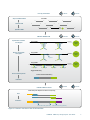
Library production is initiated by the random hybridization of starter/stopper heterodimers to
the poly(A) RNA still bound to the magnetic beads. These starter/stopper heterodimers contain
Illumina-compatible linker sequences. A single-tube reverse transcription and ligation reaction
extends the starter to the next hybridized heterodimer, where the newly-synthesized cDNA insert is ligated to the stopper. As the insert size is determined by the distance between starter/
stopper binding sites RNA fragmentation is not required. Therefore spurious second strand
synthesis from the 5’ ends of fragments is absent providing the basis for the excellent strandspecificity of the SENSE protocol.
Second strand synthesis is performed to release the library from the beads, and the library is
then amplified, introducing the sequences required for cluster generation (see Appendix E, p.28,
for a schematic representation of the finished library). Library quantification can be performed
with standard protocols and is further discussed in Appendix C (p.22). Libraries are compatible with single-end or paired-end sequencing. Barcodes can be introduced either as in-line
barcodes at the beginning of each read or as standard external barcodes (Appendix D, p.24).
External barcodes require a separate sequencing reaction whereas in-line barcodes do not. Data
can be analyzed with a number of standard bioinformatic pipelines. Special considerations for
the analysis of SENSE data, such as read orientation, are presented in Appendix F (p.31).
4
LEXOGEN · mRNA-Seq Library Prep Kit · User Guide