1
6. Isolate the cold water feed to the tank, or tie up the ball valve. Install a temporary compression fitting gate
valve to the end of the open safety vent pipe where it discharges over the f & e tank. Proprietary sealing
caps may be used, but MUST be secured tightly with a worm drive clip.
7. Install a temporary gate valve into the cold feed pipe close to the f & e tank. The tank fitting securing the
pipe to the f & e tank sometimes has a male ¾. BSP thread protruding on the inside of the tank, and an
alternative is to screw a cap on this. These are temporary measures only, and must be removed after the
flushing process is completed. (If the system flushing pump connection method detailed in point 8d
is utilised, cold feed and expansion pipes are automatically isolated).
As an alternative to points 6 & 7, the cold feed and expansion pipe may be securely coupled together. The
cold feed and expansion pipes are then included in the flushing process, which is beneficial if there is a
deposit problem at the junction of the cold feed with the heating system. We recommend Prochem Scale
Remover to remove these deposits.
Location / Connection
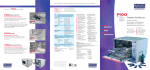
The optimum location for the ProFlush unit will vary depending on the system to be cleaned, and availability
of suitable connection points. Generally the unit should be located in a room with a suitable drain or waste,
and near to a convenient mains water supply, such as a bathroom or kitchen. The cold water supply for a
washing machine or dishwasher is a convenient source when a mixer tap makes connection of a supply
hose difficult. The normal precautions during work on any heating system should be taken, and it is prudent
to place a drip tray or waterproof ground sheet underneath the ProFlush and surrounding area.
8. Ensure that the isolating valves either side of the ProFlush flow reverser on the flow and return pipes are
in the closed position. Connect flow and return hoses of the ProFlush pump to the system at the selected
point. This may be either:
8.1 Across the .tails. to a radiator (having drained and disconnected the radiator) using appropriate 15mm or
¾” BSP female adapters to connect to the valve bodies. The radiator valves are available to isolate the
flushing pump from the system if necessary.
8.2 Across the 1 ½” BSP female couplings left once the circulating pump has been removed. The circulating
pump isolating valves are available for system isolation if required. An adapter set enabling the ProFlush to
connect to the system can be supplied as an optional extra.
8.3 Across the flow and return connections at the boiler, isolating the boiler itself. This is the preferred
method when flushing a heating system prior to installing a new boiler.
8.4 By breaking into and connecting across the cold feed and expansion pipes (after isolation of the water
supply to the f & e tank) if these are easily accessible, (perhaps in an airing cupboard), and not adjacent to
each other in the same pipe run. This method can clear deposit accumulations at the lower end of the cold
feed pipe. The powerful action of Prochem Scale Remover will be required to achieve this.
9. If the ProFlush is not standing in a secondary containment tank, then a suitable length of ½” PVC pipe as
required should be attached to the overflow and be connected to the dump hose via a suitable T piece.
10. Connect a suitable length of ½” PVC hose to the dump line and lead to a suitable foul drain.
11. Connect mains water supply hose ½” PVC to the inlet connection marked .fill. and run the other end to
suitable mains water connection point, open the fill line ball valve and fill the ProFlush up to half way
between the min and max fill lines, and then close the fill line ball valve. (If the F & E tank has drained down
into the ProFlush tank, only topping up if required is necessary).
Method
Note: In the following procedure, the ProFlush is used to forcibly expel existing system water before
establishing full chemically treated circulation through the unit itself. In order to expel as much loose debris
and sludge as possible at an early stage, and prevent an excessive amount of debris collecting in the
ProFlush tank. By removing loose material before the addition of any chemical, the full effect of the
chemical is available to disturb, loosen, and dissolve more stubborn accumulations of debris.