1
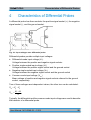
R&S®RT-ZD40 Measurement Principles Probing Philosophy 5.2.2 Signal Loading for Non-Differential Input Signals As described in chapter 4, "Characteristics of Differential Probes", on page 26, various types of input signals can be measured with a differential probe. Every type of input signal has an associated input impedance. ● For differential input signals, the input impedance of the probe is the impedance between its positive and negative signal sockets. ● For single-ended input signals, the input impedance is the impedance between the positive or negative signal socket and the ground socket. ● For common mode input signals, the input impedance is the impedance between the parallel connection of the positive and negative signal sockets and the ground socket. The equivalent circuit diagram in figure 5-1 can be used to determine the associated input impedance. The table 5-3 provides as an example the DC input resistance for several input signals. Table 5-3: DC Input Resistance for Various Input Signals Type of input signal Differential Single-ended Common mode Input Resistance 1 MΩ 500 kΩ 250 kΩ This table shows that common mode signals suffer the highest loading. This characteristic of all differential probes is particularly bothersome because common mode signals frequently have a very high source resistance (e.g. 10 kΩ for conventional fail-safe circuits). While the input resistance achieved for common mode voltages with the R&S RT-ZD40 differential probe remains sufficiently high, probes with lower input resistances can lead to unfavorable loading effects. 5.3 Probing Philosophy The previous sections made clear that probes exert a load on the signal to be measured and change its characteristic. The signal at the test point where the probe makes contact (Vin) is therefore different from the signal that was present before the probe was connected (VS). This effect cannot be avoided and occurs with all real probes – independent of type and manufacturer. User Manual 1410.5240.02 ─ 0102 39