1
LEAP User Guide
in three different ways corresponding to the three types of Java environments that can be
found on the considered devices:
• j2se: to execute JADE-LEAP on PC and servers in the fixed network running
JDK1.2 or later.
• pjava: to execute JADE-LEAP on handheld devices supporting PersonalJava such as
most of today PDAs.
• midp: to execute JADE-LEAP on handheld devices supporting MIDP1.0 only such
as the great majority of Java enabled cell phones.
Though different internally, the three versions of JADE-LEAP provide the same set of
API to developers thus offering a homogeneous layer over a diversity of devices and
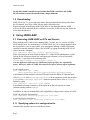
types of network as depicted in Figure 1.
Only a few features that are available in JADE-LEAP for j2se and pjava are not
supported in JADE-LEAP for midp as they are intrinsically related to Java classes that are
not supported in MIDP (see 5 for a summary of MIDP unsupported features).
Distributed agent application
Homogeneous layer
JadeLeapJ2se
Container
JadeLeapJ2se
Main Container
JadeLeapPjava
Container
JadeLeapMidp
Container
JADE “powered by LEAP”
J2SE
J2SE
Internet
PersonalJava
CLDC MIDP
Wireless environment
Figure 1. The JADE-LEAP runtime environment
1.4 JADE and JADE-LEAP
From the point of view of application developers and users JADE-LEAP for j2se is
almost identical to JADE both in terms of APIs and runtime administration (see 4 for a
summary of the differences). Therefore in general developers can deploy their JADE
agents on JADE-LEAP and vice versa without changing a single line of code. Moreover
there is no need for a JADE-LEAP programmers guide or API documentation as those
provided with JADE apply to JADE-LEAP too.
Pag 4