1
21
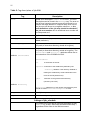
Clustering
CLUSTER_GEODIS
geometry clustering using the “geodis” algorithm
CLUSTER_EVNN
clustering using the energy and the nuclear-nuclear repulsion
energy
CLUSTER_SMS
clustering using the sigma match similarity (COSMO results
only)
CLUSTER_MU
clustering using COSMO-RS chem. potentials (COSMO results only)
Data sorting, reduction & adding
SORT_BY_E
sort by energy
ADD_MOLECULE_SET
adds a molecule set XML (defined by the file tag, see tab 1a)
to the current molecule set. The file must be defined. Name
conflict have to be avoided by the user. The routine checks
name conflicts and quits with an error if two molecules
share the same name.
REDUCE_BY_E_MAX
reduce data set. Use maximal number (see definition) of
molecules with a relative (to the min. conformer) energy
within a defined energy window. The number of surviving
molecules is defined by the tighter criterion (max number of
molecules or energy window). A sort by energy will be done
before the reduce algorithm starts. Therefore, the results
can be expected to be sorted.
REDUCE_TO_UNIQUECODE The unique-codes of the structures of the set are checked
against the reference structure. Conformers with different
uniquename than the reference structure will be neglected.
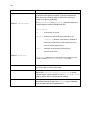
Writing
PRINT_CONF_INFO
prints listing of molecule names and relative energies on
screen (not important for calls from GUI)
WRITE_ENERGY_FILE
writes an energy file for each molecule of the current set.
The structures and energies will be taken from the molecule
set directly. The relative (to execution directory) path used
is: path/name.energy with:
path: path defined by subtag see table 1.a
name: molecule name as defined in <molecule name =…>
The level description printed to the energy files can be given
in a subtag (see table 1.a). The Molecule Set coordi-