1
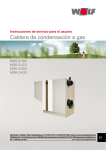
Operating instructions
Gas condensing boilers
MGK-130
MGK-170
MGK-210
MGK-250
MGK-300
Wolf GmbH · Postfach 1380 · D-84048 Mainburg · Tel. +49 8751/74-0 · Fax +49 8751/741600 · Internet: www.wolf-heiztechnik.de
Document no. 3062881_0910
Subject to technical modifications
GB
Contents
Contents...............................................................................................................................................Page
Warranty / General information................................................................................................................... 2
Safety instructions....................................................................................................................................... 3
Installation information / Maintenance information...................................................................................... 4
Water connections and gas supply connection........................................................................................... 5
Control unit operation.................................................................................................................................. 6
Information for energy efficient operation / Faults.................................................................................... 7-8
Warranty
Our warranty is subject to the installation being carried out by a
recognised heating contractor and adherence to all operating and
installation instructions.
Warranty period
Gas condensing boilers are guaranteed for 2 years.
General information
Gas is an environmentally friendly fuel that does not represent any danger
unless handled with gross negligence. Your gas condensing boiler is a
high grade product that incorporates the latest safety technology.
These safety instructions should protect you from
potential risks.
Risk to life!
Non-observance of these references can lead to risks to
individuals and the risk of material losses.
In case of risk of fire
• Immediately switch OFF the emergency stop switch of the heating
system (if outside the installation room).
• Close the gas shut-off valve.
• In case of fire, use a suitable fire extinguisher.
2
3062881_0910
Safety instructions
SAFETY INSTRUCTIONS
If you smell gas
- Do not operate any light switch.
- Do not operate any electrical switches.
- Keep naked flames away.
- Close the gas shut-off valve.
- Open windows and doors.
- Notify your gas supply utility; use a telephone outside of the danger
area.
If you smell flue gas
Caution - risk of poisoning, suffocation and explosion!
- Shut down the system.
- Open windows and doors.
- Notify your local contractor.
Caution - risk of poisoning!
When changing a fuse
- Isolate the appliance from the power supply prior to changing a fuse.
The mains terminals of the boiler are 'live' even when the ON/OFF
switch has been switched OFF.
Caution - risk of electrocution!
Frost protection
The use of antifreeze is not permissible.
The control unit protects the gas condensing boiler against frost. The risk
of frost cannot be totally prevented, e.g. during longer power failures.
Therefore only install the gas condensing boiler in rooms that are free
from the risk of frost. Should there be a risk of frost during longer idle
periods, e.g. when the heating system is switched off, ask your local
heating contractor to drain the boiler and the heating system to prevent
pipes from bursting.
Caution - risk of water damage and malfunction through
freezing.
Balanced flue routing
With low outside temperatures, the water vapour contained in the flue gas
may condense and freeze on the balanced flue. This ice may fall from
the roof causing injury or material losses. Prevent ice from falling by
taking on-site measures, e.g. the installation of a snow guard.
Caution - risk of injury!
3062881_0910
3
Installation information /
Maintenance information
Positioning / modifications
- Your gas condensing boiler should only be installed and modified
by an approved heating contractor, as only they have the essential
knowledge to carry out such work.
- Never modify flue gas components.
- Never close or restrict the ventilation apertures in doors or walls
when operating the boiler in open flue mode; only start the boiler
when the flue has been fully installed.
- For operation in balanced flue mode, only take the appliance into
use if the balanced flue system has been fully installed and the
wind protector is not covered up.
- The gas condensing boiler may only be installed in rooms that are
protected from frost.
- Never isolate the appliance from the power supply when outside
temperatures fall below zero, otherwise there is a risk of the system
freezing up.
- Never modify the drain or the safety valve.
Caution - failure to observe this rule may lead to a risk of fire
as well as a risk of destruction, poisoning or explosion!
Do not use or store explosive and/or flammable materials, e.g.
petrol, thinners, paints, paper etc. inside the boiler room!
Corrosion protection
Never use or store sprays, solvents, chlorinated cleaning agents,
paints, adhesives, etc. in the vicinity of the gas condensing boiler.
Under unfavourable conditions, these materials may lead to corrosion
in the gas condensing boiler and the flue system. Ducted vents routed
through a roof may also contain corrosive vapours. For that reason,
maintain a sufficiently large distance to the air/flue gas terminal (minimum
recommendation: 5 m).
Care
Clean the casing with a damp cloth and mild detergent.
The components inside the gas condensing boiler may only be cleaned
by a heating contractor.
Service
NB - only the heating contractor offers the required
knowledge and expertise!
- The user is responsible for arranging a regular service of the system,
in order to ensure the reliable and safe function of the gas condensing
boiler.
- Your gas condensing boiler should be serviced annually.
- Maintenance is explicitly detailed in the installation instructions.
- Isolate the appliance from the power supply before any maintenance
work.
- After a service and before the gas condensing boiler is returned into
use, check that all components that were removed for maintenance
have been refitted correctly.
- We recommend you arrange a maintenance contract with an approved
heating contractor.
4
3062881_0910
Water connections and gas
supply connection
Please observe before
commissioning
Depending on your specific heating system, the safety equipment
must be tested by a heating contractor.
The heating system must be completely filled with water. Subject to the
boiler output and operating temperature of the heating system, the water
quality for heating systems is regulated by local regulations governing "Water quality in heating systems with hot water boilers".
Observe the system pressure. If necessary top up with water.
Never use boiler water for domestic use.
Check whether the ventilation of the boiler room is ensured in accordance
with local regulations.
The air supply to the boiler must not be obstructed, otherwise
there is a risk of suffocation.
Never position objects directly on the boiler - maintain a minimum
clearance of 40 cm. Otherwise there is a high risk of fire.
If necessary top up with water. When filling the heating system, the
shut-off valves must be open.
Filling the system
Connect a water hose to the boiler drain & fill (BDF) valve and open the
mains water tap. Open the BDF valve to provide a moderate flow rate and
fill the heating system to approx. 1.5 bar. Check the water pressure at the
pressure gauge. Vent the system. The boiler must be topped up, since
heating water will only fully deaerate after several hours’ heating operation.
Generally leave the system full - except where there is a risk of frost.
The connection required for filling between the tap water and heating
water must be removed after the fill has been completed. Otherwise
there is a risk that your tap water will be contaminated by heating water.
The appliance may overheat if it is operated without water.
Filling the siphon
The siphon must be fitted and filled.
Checking the water level
Regularly check the water level. The pressure gauge must indicate
between 2.0 and 2.5 bar. Your heating contractor will explain how to top
up your system. Do not supplement your heating water with additives,
otherwise components may be damaged.
3062881_0910
5
Control unit operation
ON/OFF
Heating water
switch
Reset button temperature selector
Illuminated
DHW
ring
temperature
selector
Thermometer
Pressure gauge
Illuminated status indicator ring
Illuminated ring
Explanation
Flashing green
Standby (power supply ON, burner OFF, e.g. summer mode)
Constant green light
Winter mode: Pump running, burner OFF
Flashing yellow
Emissions test mode
Constant yellow light
Burner operating flame ON
Flashing red
Fault
Note:
6
Summer mode
(central heating OFF)
Winter mode
Setting 2 to 8
Emissions test mode
(indicator ring flashes yellow)
DHW temperature selector
1 (15 °C) ... 9 (65 °C)
Heating water temperature selector
2 (20 °C) ... 8 (75 °C)
7 (55 °C) recommendation
The BM programming module can also be integrated into the control unit.
That means that all settings are made at the MGK. For installation and
operation, see the BM programming module operating instructions.
3062881_0910
Information for energy efficient operation
Heating mode
Saving energy with modern heating technology: gas condensing
technology saves your cash
In conventional heating systems energy is expelled unused to the
atmosphere along with the flue gas. Modern condensing technology
utilises that energy for heating.
Use as little electrical energy as possible
Operate your system with multi stage heating pumps at the lowest
required level.
Regular heating system maintenance pays for itself
A contaminated burner or poorly adjusted appliance can reduce the
heating system efficiency. Regular heating system maintenance through
your local contractor quickly pays for itself.
Heating at the lowest energy level
Operate your heating system, where possible, with a flow temperature
of less than 60 °C or a flat heating curve.
A heating system control unit also regulates your heating costs
A heating system in standby mode saves energy. With automatic night
setback and thermostatic valves, a modern weather-compensated or
room temperature-dependent heating system control unit ensures that
the system only operates when heat is required, saving you money the
rest of the time.
- Equip your heating system with a weather-compensated heating
controller from the Wolf range of accessories. Your heating contractor
will be happy to advise you how to achieve optimum settings.
- In conjunction with the Wolf control unit accessory, use the night
setback function to match the energy level to the actual demand
period.
- Use the optional summer mode setting.
Never overheat your system
Adjust the room temperature as accurately as possible. This leaves
occupants comfortable and energy is not wasted on providing
heating output that nobody needs. You can differentiate between the
optimum temperatures for individual rooms, such as living rooms and
bedrooms.
A room temperature that is one degree higher than necessary represents
an additional energy consumption of approx. 6%.
- Use room thermostats to match the room temperature to the actual
use of the room.
- In any room where you have installed a room temperature sensor,
open the thermostatic valve fully. This enables you to achieve optimum
control characteristics for your heating system.
Ensure adequate air circulation
Air must be able to circulate freely near the radiators and the room
temperature sensors, otherwise the heating system will lose work less
effectively. Badly positioned long curtains or furniture "swallow" up to
20% of your heat.
3062881_0910
7
Information for energy efficient operation /
Faults
Keep the heat inside the room - at night too
At night, closing shutters and drawing curtains noticeably reduces heat
losses via the window areas. Insulating the radiator recesses and having
light coloured paintwork can save up to 4% off your heating bills. Airtight
joints at windows and doors also help to keep energy inside the room.
Minimise energy consumption through sensible ventilation
Ventilating for hours loses heat stored in walls and objects. As a result, the
room climate will only become comfortable again after prolonged heating.
Short and thorough ventilation is more effective and pleasant.
Bleeding the radiators
Bleed the radiators regularly in every room. This safeguards the perfect
function of radiators and thermostats, particularly in the upper apartments
of apartment blocks. The radiator responds quickly to changing heat
demands.
Intelligent use of DHW circulation pumps
Always control DHW circulation pumps via time switches. Program these
in accordance with your DHW demand patterns.
DHW mode
The optimum DHW temperature
Only ever set the DHW temperature or that of the cylinder to the
temperature you really require. Any additional heating uses additional
energy.
Sensible handling of DHW
Showering consumes only approx. 1/3 of the water volume required for
a bath. Repair any dripping taps immediately.
Faults / Fault codes
If the status indicator ring flashes red, where possible read the fault
code on the connected control unit accessory and note the code. The
appliance can be returned into use by pressing the reset button. In case
of repeated faults, shut down the appliance and notify your heating
contractor.
Gas condensing boilers are equipped with an electronic flue gas
temperature limiter. The appliance automatically shuts down when the
flue gas temperature exceeds 110 °C. The boiler restarts when the reset
button is pressed. If this recurs, ask your heating contractor to check
the flue system.
NB - risk of damage, poisoning and suffocation work less
effectively.
Keep your operating instructions safe in an easily accessible place near your gas condensing boiler.
8
3062881_0910